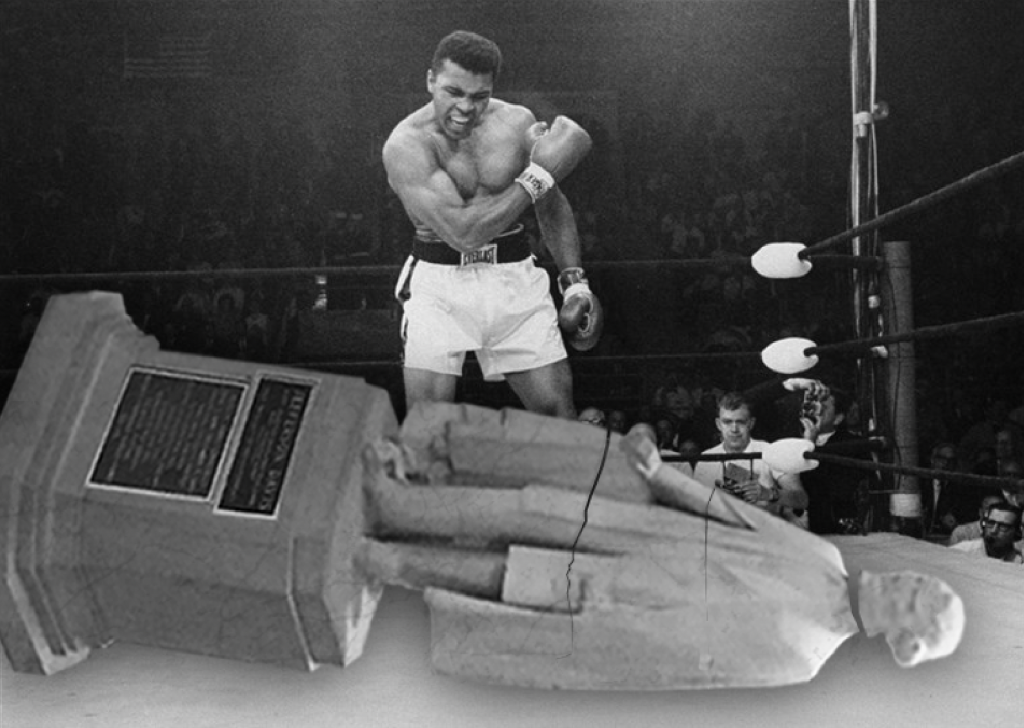
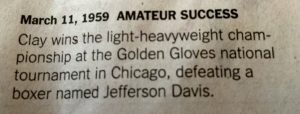
Please sign the petition below to remove the statue of Jefferson Davis currently in Kentucky’s Capitol Rotunda, and replace it with a tribute to Muhammad Ali, “the Louisville Lip” and “the Greatest of All Time.”
I just heard from the Ali family: It is the Champ’s belief that Islam prohibits three-dimensional representations of living Muslims. Accordingly, I have adjusted the petition to call for a two-dimensional representation of Ali (a portrait, picture or mural) in lieu of a statue.
UPDATE (Tuesday, December 2, 2014)
In this interview with WHAS-TV’s Joe Arnold, Governor Steve Beshear endorses the idea of honoring Muhammad Ali in the State Capitol (although he disagrees with removing Davis). Arnold explores the idea further on his weekly show, “The Powers that Be.”
Click here to check out WDRB-TV’s Lawrence Smith’s coverage of the story.
And here’s my op-ed in Ali’s hometown paper, the Louisville Courier-Journal.
UPDATE (Saturday, June 4, 2016)
In the wake of the 2015 Charlestown tragedy, in which a Confederate flag-waving murderer united the nation against racism, all of the most powerful Kentucky policymakers — U.S. Senator Mitch McConnell, Governor Matt Bevin, Senate President Robert Stivers and House Speaker Greg Stumbo — called for the removal of the Davis statue from the Rotunda. Today, as we commemorate last night’s passing of Muhammad Ali, there is no better moment to replace the symbol of Kentucky’s worst era with a tribute to The Greatest of All Time.
UPDATE (Wednesday, June 8, 2016):
Great piece by Lawrence Smith of WDRB-TV in Louisville on the petition drive to replace Jefferson Davis’ statue in the Capitol Rotunda with a tribute to Muhammad Ali.
UPDATE (Thursday, June 9, 2016):
Excellent piece on the petition drive by Jack Brammer that was featured on the front page of the Lexington Herald-Leader.
Highlight of the article:
Miller said he has received a few “angry comments” on his call to honor Ali.
“One of them encouraged me to kill myself,” he said. “You can quote me that I have decided not to take their advice.”
UPDATE (Friday, June 10, 2016)
The petition drives continues to show the Big Mo(hammed): check out these stories from WKYU-FM public radio in Bowling Green and WKYT-TV, Channel 27 in Lexington:
UPDATE (Saturday, June 11, 2016):
Still not convinced? Check out this excerpt from today’s New York Times:
By Artur Davis, on Tue May 14, 2013 at 10:00 AM ET
It is not news that affluent families extend their advantage of wealth and connections to the next generation in ways more tangible than trust funds: their kids invariably compile better grades and test scores, accomplish more in extracurricular and leadership activities, and win admission to better ranked colleges with the best rates of placing their alumni in well paying jobs.
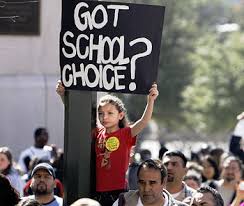
A recent essay in the New York Times by a Stanford academic, Sean Reardon, (“No Rich Child Left Behind”) has won a lot of praise for its dissection of those trends and its collection of data showing that the gap between children born in affluent homes and their middle and lower income peers is growing. But Reardon’s analysis is also worth examining for a blind spot it reveals in the left’s critique of educational inequality: despite a laundry list of mostly proposals to grow government services, Reardon never mentions two words, vouchers and parental choice. Not even in passing, not even for the purpose of debunking them. It’s as if Reardon is wholly oblivious to the idea that what plagues many parents is not so much an absence of more social welfare, but a lack of capital to buy mobility into better educational options for their children.
And while Reardon captures the extent to which affluent parents are gaining an edge for their kids by pouring cash into extracurricular programs and by devoting more of their own time and knowledge to their child’s life after school hours, he oddly gives no consideration to the most vital thumb these parents place on the scale: they cut the check necessary to enroll their child in the most elite private school they can find, or they buy a home in a neighborhood with a track record of sustaining top flight schools.
Reardon is perceptive in his suggestion that fixating on school quality can shortchange other decisive factors like parental involvement. But that insight does not challenge the obvious: parental support can still be undermined by weak or poorly run schools, and what the most engaged parents bring to the table can be augmented by schools that are exemplary. For those reasons, liberals and conservatives have spent a lot of energy attacking the problem of failing schools, with the right tending to focus on more accountability from teachers and principals, and the left embracing challenges to state funding formulas that disadvantage low income districts in various ways, typically by leaving them too dependent on inadequate local property tax bases.
To be sure, conservatives have sometimes been guilty of seeming more enthusiastic about reining in teachers unions than they are about the plight of under-served minority and low income youngsters. But most left-leaning critics are guilty of a blatant contradiction: they spend enormous energy worrying about the deficit between richer and poorer school districts while seeming unengaged in the even more prevalent reality that richer parents have a considerable edge in maneuvering the menu of school options.
Read the rest of… Artur Davis: Education and the Power of Choice
By Nancy Slotnick, on Tue May 14, 2013 at 8:30 AM ET
A lot of girls swear by the “thank you” text after a first date. (We’re assuming the guy pays- because he should. :-)) And most guys say that they like to get the thank you text. Or email. But whenever something’s done out of obligation it loses its power. I’m not denying the importance of thanking the guy. But look at the text above, and now imagine saying (or hearing it) it in your most sexy sultry voice while looking a guy straight in the eye, leaning in and showing a hint of cleavage at the same time? Now that’s a powerful move.
Timing is everything. My husband and I missed the first season of 24. We got introduced to it when Fox ran a marathon on Labor Day of 24 hours consecutively, just as they really happened when Jack Bauer was really there. It was so realistic. Well, not really. But the draw of watching it in real time was so powerful that we became instant addicts of the show for life. We couldn’t even bear to go to the gym that Labor Day (well, we did but they had TV’s there) or go to sleep because of what we were missing. It was never the same in future seasons of course but we were happy loyal fans most of the time. It was the timing that got us.
So too is dating. The momentum, the pace, the immediacy as well as the suspense (you can’t give it all up in the first episode) are all what make things exciting. That’s why you have to “leave it all on the field” on the first date. Don’t get complacent and think- I’ll just send the thank you email tomorrow and then I can show how I feel on the 2nd date. You might not get a 2nd date!
Speaking of 2nd date, a lot of the clients that I coach ask me what to do after the first date to make the second date happen. My answer to the girls is this: Nothing.
As I alluded to above, what you do to get the 2nd date always happens on the 1st date. You can’t try to strongarm it afterwards. It just doesn’t work. On the 1st date, be flirty, interesting and interested. Be on time; thank him if he pays. If he doesn’t pay, be very skeptical. (Unless you asked him out.) Always kiss on the 1st date if you like the guy. Don’t maul him; it should come from him but help him create an opportunity for it to happen. Then say good night sweetly and turn and walk away with a spring in your step. That’s what I mean by “leave it all on the field.”
Read the rest of… Nancy Slotnick: “thx 4 the drinks. I had a great time.”
By Jonathan Miller, on Tue May 14, 2013 at 8:00 AM ET
This morning’s Newsweek/The Daily Beast features a cover story by The RP on the growing national movement to legalize hemp. Here’s an excerpt:
Poor, poor pitiful hemp.
Its cooler cannabis cousin, marijuana, gets all the buzz — generational bards from Bob Dylan to Snoop Dogg sing Mary Jane’s praise; cancer and AIDS patients declare her glory.
And even though smoking hemp won’t make you feel high — just really stupid for trying (as well as a sharp burning sensation in the lungs) — the Feds still crack down on it because they think it kinda…sorta…looks like the wacky weed that threatens to send our nation back into reefer madness. Just another innocent casualty in the War on Drugs.
In recent weeks, however, it appears that hemp might have the last (sober) laugh. That’s because a bi-partisan, blue-grassroots effort to secure federal legalization of industrial hemp production might not only prove successful; it could also provide a model for solving far more pressing issues within our hyper-partisan, dysfunctional democracy.
===
To understand why the hemp movement is going mainstream, consider one of its strongest advocates: first-term Kentucky Agriculture Commissioner James Comer. The GOP official shocks the hemp stereotype: He’s neither the liberal hipster nor the bow-tied libertarian, each hoping the movement will bring us a step closer to legalized marijuana. Instead, the 40-year-old, rosy-cheeked beef cattle farmer is part and parcel of his rural, small town, socially conservative upbringing, a culture that’s traditionally been most hostile to hemp legalization…mostly because, well, they fear it will bring us a step closer to legalized marijuana.
And Comer, a political comer who’s popular with both the Mitch McConnell GOP establishment and the Rand Paul Tea Party, is passionate about agriculture. Seeing his vocation under siege, particularly upon the decline of tobacco, Comer risked ridicule by campaigning on an issue that many lampooned, and few of his constituents understood. But he stubbornly embarked on a statewide educational campaign with a simple, irrefutable message: Hemp is not marijuana.
Skip to the 12:43 mark to watch the legendary Bill Bryant interview The RP and KY Agriculture Commissioner James Comer about their bi-partisan trip to Washington, DC, to lobby capital lawmakers about industrial hemp legalization:
By Jonathan Miller, on Mon May 13, 2013 at 3:00 PM ET
From Tom Eblen of the Lexington Herald-Leader:
Each time I have visited West Liberty since the devastating tornado, people have expressed determination to rebuild. But they didn’t just want to put things back the way they were; they wanted to use the disaster to reposition their community for the future.
The Morgan County seat had been hurting for years before the twister, which killed six people on March 2, 2012. West Liberty was like so many other small towns that have struggled to adapt to the loss of cash crops and factories.
Last week, after more than a year of study and work, West Liberty leaders unveiled a new strategic plan for their community. It is a creative, forward-looking plan designed to attract national attention and support. If successful, it could serve as a model for struggling small towns throughout Kentucky and across America.
“I’m very excited about it,” said Hank Allen, CEO of Commercial Bank in West Liberty and president of the Morgan County Chamber of Commerce. “There is such a will to rebuild, to not only get back to where we were but to be better than we were.”
One key aspect of the plan follows the lead of Greensburg, Kansas, which was wiped out by a 2007 tornado and attracted national attention by rebuilding using the latest energy-efficient technology.
West Liberty’s energy-efficient reconstruction plans include replacement houses with “passive” design and construction, which can cut energy costs as much as 70 percent over conventional construction. Habitat for Humanity has already built several such homes in the area.
The downtown business district also would be rebuilt using energy-efficient construction, including a geothermal loop that many buildings could share to lower their heating and cooling costs.
Allen says he thinks that will be one of the biggest factors in recreating a viable downtown. Rent was cheap in the old buildings the tornado blew away. But reconstruction will be expensive, pushing rents beyond what many mom-and-pop businesses can afford.
Commercial Bank is kicking off the geothermal loop as part of its headquarters reconstruction. Allen said designs are almost complete for a new bank building that should be certified LEED Gold. The pre-tornado bank building cost about $4,000 to $5,000 a month to heat and cool, but Allen estimates the new one will cost about $1,500 a month.
The bank building will include about 1,800 square feet of incubator space on its first floor to help small local businesses get back on their feet, Allen said.
The strategic plan also calls for encouraging downtown to be rebuilt with mixed-use structures housing businesses, offices, restaurants and apartments. That would create a more lively downtown with lower rents because of more efficient use of space.
Plans also call for installing free wireless service downtown to attract businesses and people in a region where wi-fi availability is now limited.
The strategic plan’s economic development initiatives have a big focus on eco-tourism, built around Morgan County’s natural beauty and local assets such as the Licking River, Cave Run and Paintsville lakes, and nearby destinations such as the Red River Gorge.
There would be encouragement for entrepreneurs to start businesses focusing on kayaking, rock climbing, hiking, canoeing, fishing and hunting. Plans also call for developing walking and biking trails along the Licking River through West Liberty.
Other economic development ideas in the plan also focus on existing strengths, such as trying to use the local ambulance service and hospital to develop new methods for rural health-care delivery.
The strategic plan grew out of a partnership among the city, Morgan County, local businesses, Morehead State University’s Innovation and Commercialization Center and the nonprofit Regional Technology and Innovation Center.
Midwest Clean Energy Enterprise LLC of Lexington was a consultant on the process. Jonathan Miller, a clean-energy advocate and former state treasurer, has been retained to help raise money nationally for the effort by promoting it as a model for small-town revitalization.
The Morgan County Community Fund, an affiliate of the Blue Grass Community Foundation, has been set up to help collect and distribute donations for the rebuilding effort.
These efforts got a big jump-start in February, when Gov. Steve Beshear and U.S. Rep. Hal Rogers announced a package of about $30 million in federal, state and private money for various rebuilding projects.
“That really opened people’s eyes to what is possible,” Allen said of the financial package. “As a community, we must think really, really large. But we have a long way to go.”
By John Y. Brown III, on Mon May 13, 2013 at 2:00 PM ET
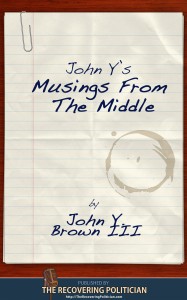
Click here to BUY MY BOOK!
A shameless and unconventional promo of my eBook.
Look…my eBook is ranked, ahem, 391,200 on Amazon.com.
Is that bad? It is only if you focus on the link underneath it offering to take you to the top 100 ranked books on Amazon.com. In other words, there are 391,101 that separate me from being in that group.
To some people who read a lot of books, that may not sound like a lot. But to me, well, even though I read a good deal….391,101 books …..is a lot. Quite a bit. A whole lot, in fact!
So I’m pitching this eBook one last time. And if I don’t break into the top, say, 281,200 on Amazaon.com, guess what? I’ll write another book! That’s right. If enough people don’t buy this one because they don’t want it…. there will be a sequel! Mark my word.
That’s right.
Next time I’ll try hawking two books in a Facebook post that other people don’t want to read, not just one!
Game on!! I’m serious. I’ll write it. I will. I’ll write a second eBook. I already have a title for it.
Title: “More….a lot more….Musings from the Middle: The sequel. II. And these aren’t very good at all –and seem to just go on forever. Just awful.”
Do you really want me to go there? Do you really want me to hawk a second and much worse eBook in a Facebook post? I don’t want to…and you don’t want me to either…but I just may. You’ve been warned.
By John Y. Brown III, on Mon May 13, 2013 at 12:00 PM ET
My “Unfilled” Bucket List of things to do before turning 50 (in 3 weeks)
1) See the Grand Canyon
2) Be an author (I kind of did that but with an eBook, which is only partial credit)
3) See some other national historic site in the West but can’t recall which one.
4) Get down to “HSW +15” (high school weight plus 15 lbs).
5) Learn to paint
6) Learn to dance
7) Learn to play an instrument
8) Become a millionaire (or at least stop asking my mom for loans)
9) Make a second contribution to IRA. (After I start one and contribute once.)
10) Run the mile in under 4 minutes. (Oops! I meant, run for 4 minutes nonstop)
11) Watch the entire Godfather trilogy in sequence
12) Clean out my closet
13) Change the light bulb in the basement storage closet
14) Read a Gentleman’s Guide to Etiquette to my son. (Or have my daughter read it to me. This was an either/or bucket list item)
15) Fix something in the house without using duct tape or super glue
16) Learn to sing
17) Take a foreign language (Ok. This was on and I took it off and then put back on and took off again for good.)
18) Don’t qualify for any new 12 step programs
19) Don’t shrink in height because you are close to not being able to round up to 5 ‘9 as it is.
20) Turn 49 ( I did that! Yay me!!)
I still have 17 to go after dropping foreign language and only partial credit for eBook and stopping asking my mother for loans.
It’s going to be a very busy next 3 weeks trying to complete my “Bucket List before 50” right?
Nah!
My new Bucket List for the second half of life is going to include not having a Bucket List and just live each day relatively well and not worry about stuff I won’t get to do before I die. I’ve done a few. Like turning 49. And it was overrated anyway.
By Erica and Matt Chua, on Mon May 13, 2013 at 10:00 AM ET
I like vegetarians, they taste good. Nowhere else is this better understood than in South America, where meat isn’t just part of a meal…it’s the meal. Balanced diet? That’s when your plate has an equal amount of meat on all sides, right? Vegetables? We feed those to the animals, so it’s pretty much in the meat, right? Seemingly ridiculous to say at home, a proper South American parrilla (or asado) ignores the Surgeon General’s warnings about eating healthy for meat, meat, and more meat.
.
.
Where’s the beef? Such a question doesn’t even make sense to South Americans who love their beef with sides of chicken, sausage, fish and anything else that once moved under it’s own volition.
Read the rest of… Erica & Matt Chua: South America’s Must-East Meal
By Jonathan Miller, on Mon May 13, 2013 at 9:15 AM ET
I’ve lived a blessed life, and my 11 years in public office in Kentucky were pretty extraordinary.
There was one thing, however, I was never able to add to my bucket list — a positive editorial from any Kentucky newspaper. Not that I received a lot of negative editorials; I was just mostly ignored.
So I’d be lying to say that I wasn’t grateful for the following editorial that appeared over the weekend in Danville’s Advocate-Messenger. I didn’t embark on the hemp legalization initiative to get a bunch of atta-boys, but it is always a great feeling when your hard work is recognized:
EDITORIAL: Bipartisan effort something worth Kentucky pride
11:22 a.m. EDT, May 10, 2013
A tip of the cap to our Republican Agriculture Commissioner James Comer and former Democratic State Treasurer Jonathan Miller for their inter-party field trip to Washington, D.C., this week. The duo, joined by Republican State Senator Paul Hornback of Shelbyville, visited Washington to drum up support among lawmakers for lifting federal barriers to legal hemp in Kentucky.
While it is too soon to tell whether the trip will pay dividends, the follow-through from Comer, and the bipartisan joining of forces with Miller, should make the state proud.
Legal hemp doesn’t approach the gravity or complexity of many controversial issues that divide Democrats andRepublicans, but it is refreshing to see leaders in both parties willing to stand together for something. The broad coalition Comer and Miller are helping to build, along with their federal counterparts, has been evident from their dueling, sometimes playful Twitter updates — one includes a photo of Comer flanked by Miller and Democrat U.S. Rep. John Yarmuth in front of Barack Obama’s portrait.
For his part, Miller has continued to put his time and money where his mouth is since swearing off electoral politics several years ago. After his unsuccessful Democratic primary run in the 2007 governor’s race and a stint heading the state Democratic Party, Miller started Recovering Politcian, an online forum devoted to a less shrill conversation about important issues.
As the Recovering Politician website states, Miller remains “a proud progressive Kentucky Democrat, but he’s learned that we must put aside our labels on occasion to work for the common good.” Miller, who spent time in Washington during the Clinton administration, has offered his full complement of Beltway contacts to his Republican partner.
Even without a positive legislative outcome, the gambit looks like another net win for Comer, who was swept into office with a decisive margin two years ago.
Comer’s ability to leverage public opinion and bipartisan support for the hemp bill, which was opposed from the outset by a Democratic governor and leader of the House, was truly impressive. Although Richie Farmer may be one of the easiest acts to follow in recent memory, Comer has done his level best to decontaminate his department and clean up the embarrassing, possibly criminal mess Farmer left behind.
It would be hard to blame Comer for also seizing the chance to rub shoulders with D.C. powerbrokers, or to bask in the reflected importance of our nation’s capital. If his star stays on the same trajectory, he may someday be able to choose between Frankfort and Washington.


 Blog this!