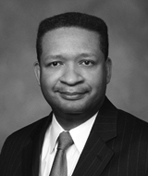
By Artur Davis, on Fri Jul 29, 2011 at 12:30 PM ET
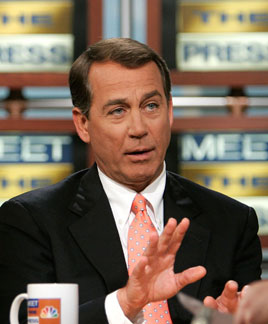
Until this week, Democrats were as split as Republicans over the debt ceiling endgame. But John Boehner has a far tougher task in keeping his party unified, and it is rooted in the very different political character of the rank and file membership within the House.
A substantial part of the Democratic caucus consists of professional politicians who have climbed the ladder in a manner that makes them responsive to their party’s demands – they often won their first primaries by maneuvering to gain institutional support, and their ambitions invariably turn on the good graces of their party leadership. In turn, they are partisans first, ideologues second.
After the demise of the Blue Dogs in 2010, the remaining Democrats also represent disproportionately liberal districts where their pressure emanates from a base that scolds them for not doing enough to help President Obama.
In sharp contrast, a major part of the Republican caucus, particularly its massive freshman class, consists of relative newcomers who did not form ties by climbing the traditional ranks, and in many cases, won their primaries by overcoming their party establishment and their local versions of John Boehner. More of them owe their organizational strength to the Tea Party than to the local chamber of commerce.
As a result, their ideological fervor shapes them much more than their party loyalty. Their hopes for advancement rest as much on carving out a profile with their party’s “movement conservatives” as it does currying favor on the Hill. Their external pressure arises from a base that loathes Barack Obama and grades them based on the intensity of their opposition to his agenda.
Rallying the Democrats I describe to swallow a deal that is imperfect but “supports the President” is one thing; rallying the Republicans I describe to make an accommodation that cuts spending but salvages Obama is an infinitely harder mission. That is the reality that constrains John Boehner and it has the potential to wreck a deal even after one is reached.
By Jason Atkinson, on Fri Jul 29, 2011 at 8:30 AM ET
I took part in the Aspen Institute’s Global Leader Network bi-annual gathering, and once again I felt like the bellhop to these accomplished people.
Just over 200 fellows from 27 counties all with the same ‘virus’ to change the world. For the seminar “why I stepped up,” I was asked to be a presenter, and like everyone there, my phony meter had long ago broke. I look at the self-help genre through the same Vaurnets as the guy with the Madonna microphone selling the slap-jack.
The seminar was all honesty, and the answer to why people step up and put themselves forward for public service is not linear. It’s very hard to put into words. Some people are hard-wired to mix their personal confidence with their convictions, look past the personal sacrifices and pitfalls, and try to do their best knowing they might never be recognized for it.
As I wrote that sentence, it dawns the need for recognition could be the difference between states-people and politicians.
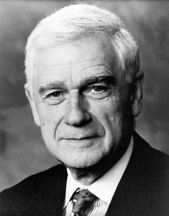
Mark Hatfield
A few concerns on modern service were articulated I think need to be discussed at the intellectual temple of the The Recovering Politician: First, is service today accepting the values of the party over the values of the person? I know firsthand the stinging backlash from ones own party for being too independent. Caucus politics can be small, petty and very effective. In my state, I’ve never seen a pro-life Democrat go anywhere and neither do pro-conservation Republicans. In my experience, the behind the door caucus politics and the perceived party policies are entirely different. I wonder if Mark Hatfield could get elected today?
The second concern about modern service is process. We have created a system of governance in which process (committees, task-forces, blue ribbon panels) are hallowed. Every state in America has plenty of process; because the process is suppose to provide a voice to everyone, right?
Not so fast. I think process protects the status quo in modern service and makes the role of the elected harder. In my state, task-force members are all bureaucrats and paid lobbyists-both with kingdoms to protect. Why are elected servants not part of process? Simple- they can’t afford it. Most states do not even pay public servants minimum wage. So does everyone have a seat at the process table?
Channing
Before I leave you with the impression that I am a Debbie Downer, let me leave you with a quote from one of her contemporaries–William Ellery Channing who wrote “The office of government is not to confer happiness, but to give men opportunity to work out happiness for themselves.” Yep, that’s my kind of stepping up. It’s a complicated calling.
For as long as I can remember, complaints about “dysfunctional” government have permeated the public dialogue about Washington.
I was swept into congress in 2006 on a tide of “change” and swept out in 2011 as the pendulum swung the other way. During my time as a candidate and as a member I was enmeshed in a system that prized raising money above all as the key to credibility, power and effectiveness.
I was good at raising money. I set fundraising records in my small home state both as a candidate for the House and during my Senate run. I loved my work and my colleagues. I worked with high-minded people who wanted to do the best they could for the American people.
I also saw that or campaign financing system had developed into a system which was often at odds with the best interests of the people who we served. “Money talks, nobody walks” was an advertisement from my youth. In our system, money talks and those with it ride comfortably while those without walk behind. The power of money gives disproportionate power to those who have it and threatens the fabric of our democracy.
I felt first hand the deleterious effects of the abhorrent Supreme Court decision in the Citizens United case as unnamed corporate interests barraged my state’s airwaves with millions of dollars in ads tearing me down. The money and the pursuit of it subtly corrode even the most principaled representative. The first time a member thinks to him or herself “If I vote this way, I’ll lose X”, that subtle corrosion is at work.
I was privileged the other day to sit on a panel with former Republican Senator Larry Pressler at the screening of a film titled “Priceless”. Go see the film. Think about how much easier it would be to get things done with a change in our campaign finance system.
Visit the website of Americans for Campaign Reform. I believe changing the way we finance elections is at the core of ensuring the future of our representative democracy.
In a surprise and even stunning move, President Obama vetoed legislation that reached his desk today that would raise the debt ceiling in exchange for $2.4 trillion in spending cuts and the formation of a new commission to identify $1.6 trillion in additional cuts over the next 10 years.
House Speaker John Boehner earned the support of Tea Party members of his caucus and House passage of the legislation because it met their demands for $4 trillion in cuts without new revenue. The Democrats had originally hoped to close some corporate tax loopholes and end Bush-era income tax cuts on the wealthiest 2% of Americans. The compromise legislation was worked out between Boehner, Senate majority leader Harry Reid, and Senate minority leader Mitch McConnell.
The bill reaching the president’s desk was seen as the last possible compromise needed to prevent American default on its loans. But was it? Apparently heeding the advice of former President Bill Clinton, Obama invoked the 14th Amendment of the constitution in insisting the country would continue to pay its bills, and practically dared the GOP to challenge his authority to do so in federal courts. “If the Republicans want to sue me into forcing America to default on its loans, that is their prerogative. But I intend to carry out my constitutional authority to authorize the Treasury to pay our bills on time. What I won’t do is be cornered into supporting legislation that devastates America’s seniors and middle-class.” One House insider who was part of negotiations commented that by challenging the constitutionality of the debt ceiling deadline by ignoring it, “the President basically took away any and all GOP leverage.”
President Obama, with one stroke of his veto pen, declared that “I will not allow fringe elements of Congress to continue to subsidize corporate loopholes on the backs of our middle class and senior citizens. I will not see Medicare and Social Security and middle class tax breaks compromised so that a billionaire CEO can pay less in taxes than his secretary, or a profitable big corporation can pay less in taxes than a small business. This legislation revealed Republican true colors, and I had to kill it. We need to tip the scales back towards a government that serves everyday people.”
In a hastily assembled press conference, an obviously stunned House majority leader Eric Cantor (R-Virginia) declared “President Obama is willing to send America into default and possibly a constitutional crisis in the name of raising taxes on job creators.” The political airwaves are abuzz in debate over whether the President’s move was bold or careless. Emboldened Democratic congressional leadership has indicated they will stand behind the President.
In the coming week, Obama plans to take his case to the American people for a balanced approach to deficit reduction. According to USA Tomorrow’s latest polls, 56% of Americans support a balanced approach that uses cuts and new revenue to address the deficit; 64% oppose cuts in Medicare and Social Security; 78% oppose ending the home mortgage loan deduction.”
By Artur Davis, on Wed Jul 27, 2011 at 12:30 PM ET
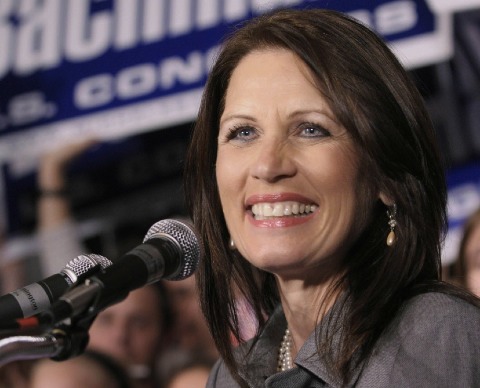
Based on my own observations in the House, I would have been stunned if you had told me Michele Bachmann would ever seriously contend for the presidency. Nothing about her abilities as a politician or legislator ever marked her as that kind of talent.
But it does not require sympathy for her candidacy to be repelled by the ugliness and the venom of the whispering campaign that is underway against her. It proves first, that the liberal blogosphere is as crudely toxic as the right-wing blogosphere has always been.
Second, the coverage in mainstream media of unattributed allegations from individuals with an axe to grind is a dangerous lowering of the bar. Standards still have a role to play in the coverage of a presidential race, and some of those standards are being shredded in the zeal to “unmask” Bachmann.
I think Michele Bachmann is on the verge of opening up a sizable lead in Iowa and that she is about to become an explosive online, grassroots fund-raising force in the next several months. If she wins Iowa, there is enough of a conservative base for her to compete effectively in New Hampshire, South Carolina, and Florida.
But I am unconvinced that she can sweep those states and avoid a protracted three-month fight in the northern battleground states that she is not well-positioned to win. If Romney is still standing, he will be the choice of an establishment and a traditional donor base that doubts Bachmann’s elecability and suspects that she jeopardizes the Republican hold on the House, and the drumbeat against her general election vulnerability will take a toll.
The defining question: if Bachmann is surging early next year, is she running competitively in the polls with Barack Obama or not? If she is the nomination will be within her reach; if not it simply won’t happen.
By Loranne Ausley, on Wed Jul 27, 2011 at 8:30 AM ET
I have just re-read my inaugural post from April 27, 2010 and it is hard to believe that only 3 months have passed. Way back in April I was trying to figure out what to do with all of the extra time on my hands, struggling with being on the “other side of the fence” and in a general state of malaise as I watched the Florida legislature dismantle everything that I care about.
In the past 3 months, I have joined my husband’s law firm, and started a new statewide progressive research and messaging effort. Our son has graduated from 2nd grade, I have completed 6 triathlons, and we have driven across the country.
There really is nothing like a cross country road trip. I set off with a dear friend from law school and our two sons (ages 8 and 9) from Atlanta in late June. Our final destination was Driggs, ID, but we took THE LONG WAY. I mean what fun is a cross country trip without crashing on a friend’s couch (at age 47 with my 8 year old) and doing a half ironman (in Lubbock, TX during a heat wave/drought)? Nine days and over 3,000 miles later we made it to our final destination with a van load full of laughs and memories.
While my last post was written from a remote barrier island in Florida, today I am writing from the western side of the Grand Teton range – looking at what I believe is the most beautiful view of The Grand Teton — from the back side. I could stare at that mountain all day long – and sometimes I do. Something about the wide open plains that reveal themselves to the dramatic, majestic Tetons has always been magical to this flatlander. It doesn’t hurt that the average high temperature out here is about 85 while the rest of the country is suffering through a major heat wave.
One of the highlights of this trip has been the opportunity for our 8 year old to attend a Rock & Roll Music Camp out here. While the camp is for entering 6th graders and up, they made an exception and let Will participate (thanks to pushy mom who insisted he could handle it…before I told them he was legally blind).
By Jonathan Miller, on Tue Jul 26, 2011 at 12:00 PM ET
If you’ve read former Missouri House Speaker Rod Jetton’s stunningly candid pieces on his rise, scandal and renewal, you probably have a lot of questions that his post raised.
So did the RP. Here, he interviews Rod Jetton for the RPTV feature, “Fifteen Minutes of Fame.” Rod elaborates on many of the themes in his column, and talks from the heart about the nature of public services in today’s era. Enjoy:
By Kathleen Kennedy Townsend, on Tue Jul 26, 2011 at 8:30 AM ET
In an earlier piece, I talked about the breakdown of our infrastructure based on my experience with the Washington DC Metro: the broken escalators, the slow Orange line, the unscheduled stops in the middle of tunnels.
Today I’d like to add my complaints about the Maryland Area Regional Commuter line, MARC, where delays are not uncommon, and Amtrak’s Acela, which sustained a speed of 0 mph for two straight hours in New York’s Penn Station during one of my recent trips.
I choose the quiet car, because I don’t want to hear the curses that greet one delay after another. But then I think, Is passivity really the American way? Aren’t we supposed to take action, do something, get the job done? Americans solve problems. What’s going on when I read that China is launching a new line of fast trains and we aren’t even able to get our slow trains going?
Congressman John Mica
So I took it personally when Congressman John Mica, a Florida Republican and head of the House Transportation and Infrastructure Committee — rather than embracing the idea of an infrastructure bank that had the backing of John Kerry (Democrat) and Kay Bailey Hutchinson (Republican), the Chamber of Commerce, and the AFL-CIO — proposed to decrease infrastructure funding even beyond what Paul Ryan had proposed. Mica wants a 40 percent cut, to outdo the Tea Party’s cut of 30 percent.
The Republicans say they want to create jobs. But making it difficult to get to work is not the right path. And it’s tough get a job when you can’t get to an interview on time. On the delayed Acela, one of my fellow passengers complained (despite being in the quiet car) that he was going to miss his meeting with a potential client. As we sat in the station, unmoving, he became increasingly agitated and depressed. “In this bad economy, I really can’t afford not to meet him,” he said.
Read the rest of… Kathleen Kennedy Townsend: Why Are Our Bridges Made in China?
This concluding post will complete the story of how I finally got my life back on track.
I don’t know if you believe in God or not, but I DO! In December of 2009, God finally had enough of my wayward ways and allowed my choices to get me into a situation that only he could help me through.
After spending the night with a lady I had reconnected with on Facebook, I was charged with felony assault. The press, along with my enemies, had a heyday, and I immediately shut my consulting business down.
Soon after that, I was notified that I was a target of a federal grand jury investigation surrounding my handling of a bill in the 2005 legislative session.
Needless to say I started 2010 broke, with no job, very few friends and lots of time on my hands. As bad as my troubles were at the time, looking back now, I’m thankful for them. Life passes by so quickly, and very few of us get the chance to sit down and contemplate what is important. My troubles gave me a chance to analyze my bad choices and personal weaknesses.
With my pride stripped away, I was able to honestly evaluate my past actions. I saw how foolish I had been to put my family on the back burner. I learned how bitterness toward my enemies had made me a bitter person to everyone around me. The hardest thing for me to admit was that I wasn’t the same friendly and caring guy who had gone to Jefferson City in 2000.
Read the rest of… Rod Jetton: Success, Scandal & Change, Part 3-Downfall and Renewal
In my last post, I talked about some of my successes, and success can be a wonderful thing, but if you’re not careful, success can be your downfall.
It sure took a toll on me. I tried to hide my vanity and pride, but deep down in my mind, I started to believe all the things lobbyists, other members, donors and conservative activists were saying about me. When you are a public official with power over funding and other member’s bills — along with all the laws people live by — folks tend to tell you what you want to hear.
Everyone tells you what a good job you’re doing, how smart you are, how thankful they are that you are in charge, or that nobody else has ever done or could ever do as good as you.
Of course in politics not everyone is singing your praises. In Missouri the Kansas City Star and St. Louis Post Dispatch were not very friendly to a conservative Republican like myself. I received plenty of bad press. Liberals, labor unions, and trail attorneys opposed to my agenda sent me thousands of emails and letters, which were not always flattering.
Another item that made enemies and allowed the press to attack me was my campaign consulting company. By 2004, I was spending more and more time helping friends with their campaigns, so I decided to start my own campaign consulting business. I didn’t work for any House campaigns or HRCC, but I helped some of my friends who wanted to move up to the state Senate or Congress. I also was able to work on Mitt Romney’s presidential race in 2008.
Between my political activities, legislative duties and straightforward ‘tell it-like-it-is attitude’ I started picking up quite a few new enemies, and they never hesitated to start a nasty rumor or provide a negative quote about me when they could. Oddly enough, most of my attacks came from the Republicans.
You are probably asking why I didn’t listen to my critics or at least think about their charges. The simple answer is most politicians develop thick skins, because critics say such terrible things about them, and constantly mis-characterize their motives. For me it was easy to chalk up all the negative comments and criticism to enemy hacks that hated me, because I had either beat them in the legislative chess game or defeated them in a campaign. I told myself that no matter what I did they would complain.
My experience has shown me how easy it is for powerful leaders to listen to the flattery and discount their critics when they are under fire.
Another negative consequence to the flattery and criticism a leader hears is they start putting everyone into two camps. You’re either for them or you’re against them, and if you’re critiquing them or even questioning them, you fall in the latter category. They become a bit paranoid when friends or innocent bystanders try to be honest and tell them the truth. Unfortunately, I feel this sometimes happened to me and it damaged a few of my relationships.
But let’s get back to the flattery. It slowly started affecting me. Not in the beginning; I knew what they were doing and I told myself not to pay attention to them, but flattery has a way of slowly creeping up and changing your attitude. (Or at least it did me)
Have you ever heard the story about the frog that was placed in the pot of boiling water and immediately jumped out and survived?
If you have, then you know that same frog didn’t fare so well when he was placed in a pot of cold water while the heat was slowly turned up until he was boiled to death and never even knew it. It’s very embarrassing to admit that this happened to me. Looking back on my time in the legislature I feel a bit like the frog that was slowly cooked to death and just didn’t feel the heat rising. In fact the warm water feels kind of good after awhile.
But be careful, because the warm water will kill you.
What I needed was balance. Take a moment and think about the word: BALANCE.
It’s a simple word that makes the whole world go round. Balance is required for the sun, moon, and stars to work like they do. It takes balance for us to walk, drive and function as human beings. Most importantly it takes balance in your life to have healthy relationships with your wife, kids, family, friends, co-workers and fellow citizens.
The biggest mistake I made was not having balance in my life. I worked too hard at politics and forgot about my family, friends, community and sometimes, the whole reason I went to Jefferson City in the first place. I remember telling my ex-wife that when the first campaign was over I would be home more. Then session started and I said after session I will be home more. Then I was gone working on redistricting and when that was done the next session had started, and after that I was working night and day to win the majority, and I told her once we won I would be home.
Read the rest of… Rod Jetton: Success, Scandal & Change, Part 2-Flattery, Criticism and Bitterness


 Until this week, Democrats were as split as Republicans over the debt ceiling endgame. But John Boehner has a far tougher task in keeping his party unified, and it is rooted in the very different political character of the rank and file membership within the House.
 As a result, their ideological fervor shapes them much more than their party loyalty. Their hopes for advancement rest as much on carving out a profile with their party’s “movement conservatives” as it does currying favor on the Hill. Their external pressure arises from a base that loathes Barack Obama and grades them based on the intensity of their opposition to his agenda.






 In my last post