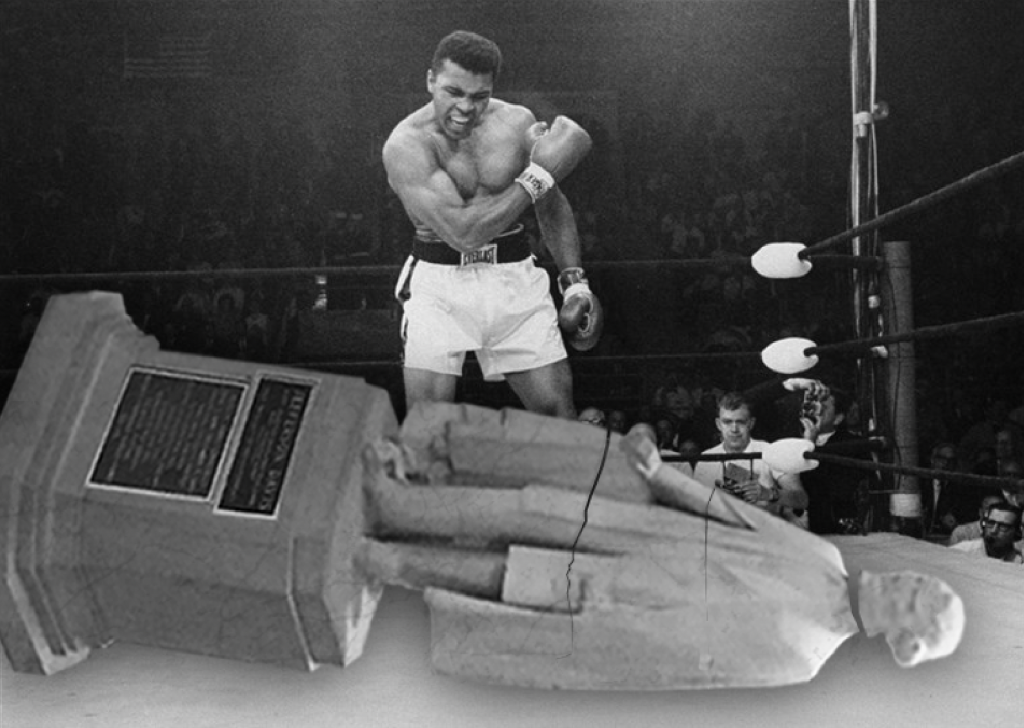
Please sign the petition below to remove the statue of Jefferson Davis currently in Kentucky’s Capitol Rotunda, and replace it with a tribute to Muhammad Ali, “the Louisville Lip” and “the Greatest of All Time.”
I just heard from the Ali family: It is the Champ’s belief that Islam prohibits three-dimensional representations of living Muslims. Accordingly, I have adjusted the petition to call for a two-dimensional representation of Ali (a portrait, picture or mural) in lieu of a statue.
UPDATE (Tuesday, December 2, 2014)
In this interview with WHAS-TV’s Joe Arnold, Governor Steve Beshear endorses the idea of honoring Muhammad Ali in the State Capitol (although he disagrees with removing Davis). Arnold explores the idea further on his weekly show, “The Powers that Be.”
Click here to check out WDRB-TV’s Lawrence Smith’s coverage of the story.
And here’s my op-ed in Ali’s hometown paper, the Louisville Courier-Journal.
UPDATE (Saturday, June 4, 2016)
In the wake of the 2015 Charlestown tragedy, in which a Confederate flag-waving murderer united the nation against racism, all of the most powerful Kentucky policymakers — U.S. Senator Mitch McConnell, Governor Matt Bevin, Senate President Robert Stivers and House Speaker Greg Stumbo — called for the removal of the Davis statue from the Rotunda. Today, as we commemorate last night’s passing of Muhammad Ali, there is no better moment to replace the symbol of Kentucky’s worst era with a tribute to The Greatest of All Time.
UPDATE (Wednesday, June 8, 2016):
Great piece by Lawrence Smith of WDRB-TV in Louisville on the petition drive to replace Jefferson Davis’ statue in the Capitol Rotunda with a tribute to Muhammad Ali.
UPDATE (Thursday, June 9, 2016):
Excellent piece on the petition drive by Jack Brammer that was featured on the front page of the Lexington Herald-Leader.
Highlight of the article:
Miller said he has received a few “angry comments” on his call to honor Ali.
“One of them encouraged me to kill myself,” he said. “You can quote me that I have decided not to take their advice.”
UPDATE (Friday, June 10, 2016)
The petition drives continues to show the Big Mo(hammed): check out these stories from WKYU-FM public radio in Bowling Green and WKYT-TV, Channel 27 in Lexington:
UPDATE (Saturday, June 11, 2016):
Still not convinced? Check out this excerpt from today’s New York Times:
Q. I work for a New York state assemblyman who has consistent turnover of attractive female staffers in the office. I recently heard that one reason behind the turnover is that he has slept with more than one of them. At least he’s not married, I guess. Even though it’s not exactly ideal, do you think it is problematic enough that I should leave, or does it sort of come with the territory in politics? —No name or initials, obviously, New York City
Is this kind of thing more pervasive in politics than elsewhere? Perhaps; as Kissinger said, “Power is the ultimate aphrodisiac.” But that doesn’t make it right. If he’s slept with multiple members of his staff who have then quit or been fired, then yes, this is problematic enough for you to leave.
Do people in supervisory positions occasionally fall in love with subordinates? Sure, and yes, it can be complicated. But if it’s happened multiple times and caused “consistent” turnover (your words), then it’s not a fairy tale connection between principal and aide. It’s a pattern, and one with which you should avoid any association, because politicians (or bosses in any field) whose offices have patterns remotely like this don’t typically have bright futures (see: Filner, Bob).
Q. I work in a charter school in New York City and believe in the mutually beneficial relationship between a public school and its community, though in the charter world that’s hard: We are often treated as outsiders and insurgents. Relatedly, I am very concerned with what happened in the mayoral campaign around charter schools. Eva Moskowitz of Success Academy, with a few other schools, held a rally and march across the Brooklyn Bridge. It was obvious from the media coverage and the way it was discussed internally that the intent was to warn one of the mayoral candidates that opposition to charter schools would be dangerous. My concern, shared by many of my colleagues, is whether such a protest is unethical—or even worse. The organizers seem to have made a point to keep the rally from [using] obvious campaign rhetoric, but it seems that a rally about an issue that has been a source of debate in the campaign, held during a general election period, is inescapably political in the way that bars public schools from participating. The twist, perhaps, is that charter employees are not government employees, unlike district schools’ staff. Our schools’ budgets rely on public funds, yet the workforce is made up of private individuals. The call to action was done during work time; thus, while we were being paid with public dollars, flyers sent home to parents were printed on a copier paid for with tax dollars. I’m curious what you think about both the legality and the ethics of such an action. —Concerned, New York CityThe narrow legal question is whether the protest organizers acted inappropriately. By using taxpayer resources to engage in political activity during work hours, the answer appears to be yes. (I am not a lawyer, and—for the uninitiated—I violated election law myself a decade ago.)
The broader question relates to this assertion: “[A] rally about an issue that has been a source of debate in the campaign, held during a general election period, is inescapably political in the way that bars public schools from participating.”
I completely disagree. Even if charter school employees were government employees, lots of public employees have interests that are “inescapably political” around which they organize during election season. Have you ever heard of AFGE (a union of federal government workers) or AFSCME (state and local government employees)? Their members don’t take vacations from political organizing because it’s election season. Quite to the contrary, election season finds them at their most active; elections focus the attention of voters, journalists and candidates, so timely activism is savvy. No one—unless their job specifically requires them to refrain from partisan political activity—should be precluded from participating in political activity during election time or any other time. And charter schools in particular—whose very existence hinges upon state law and local regulation—may find employee (and family) mobilization critical to their survival.
By Lauren Mayer, on Wed Nov 27, 2013 at 8:30 AM ET
Politics and show business make interesting but strange bedfellows – and one could say that’s both a metaphor and a literal statement (Jerry Brown & Linda Ronstadt, anyone?) For starters, there is substantial cross-over betwee the two fields – elections often seem more about show-biz glitz than issues, while actors complain about the ‘politics’ of casting. Plus celebrities frequently endorse candidates, who in turn may solicit those endorsements, or quote from plays and songs (or in the case of Herman Cain, lyrics from a Pokemon movie).
My career has been a hybrid of both, starting when I was a child trying to decide if my goal was to be a concert classical pianist or the first female president. (Yeah, I was an unambitious kid.) I wavered between going to law school or becoming a starving artist, and while I settled on the latter, I never lost my interest in politics. So it’s been great fun to combine both issues in these weekly videos, which has let me weigh in on current issues without having to mount a campaign. (I opted out of politics because of my thin skin and propensity to burst into tears at everything from Kodak commercials to being put on hold, not because of any skeletons in my closet – I have an embarrassingly unembarrasing past!)
But every now and then, a politician comes along whose entire career seems too theatrical to take seriously – sort of like the presidential campaigns of either Pat Paulsen (if you’re old enough to remember him) or Stephen Colbert (for everyone else). And we’ve had some doozies in this country – I’ve particularly enjoyed the hypocrites like Larry Craig, with his ‘I wasn’t playing footsie in an airport bathroom, I just have a really wide stance,’ or anti-gay activist George Rekers with his ‘rent-a-boy’ travel companion. However, nothing compares to Toronto’s Rob Ford – from denying he smoked crack to claiming he didn’t lie because reporters didn’t ask the right questions, to insisting that if bike riders get killed by cars, it’s their fault. In fact, more than a few people have wondered if his antics are just a giant performance art piece. – and I’m sure Anthony Weiner is wishing he’d run for mayor in Toronto, where his measly texted crotch shots would be child’s play. Meanwhile, Ford is defiantly staying in the public eye, despite being stripped of most of his authority and despite the additional allegations that come forward daily (from arrests for domestic violence to the checkered records of his driver and gym trainer). (And yes, “Rob Ford’s Gym Trainer” does seem like an incredible oxymoron.)
Rob Ford is larger than life, both literally and figuratively, and someone really should write a song about him. So I did.
By John Y. Brown III, on Tue Nov 26, 2013 at 12:00 PM ET
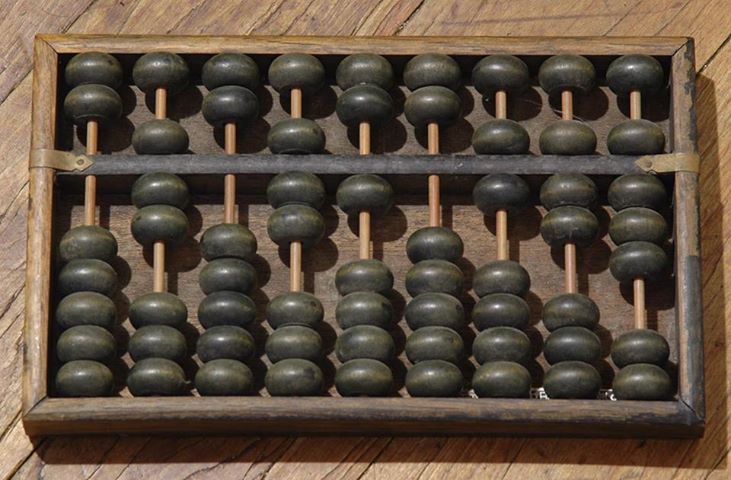
Is the stop light becoming the abacus of transportation technology?
Maybe I am just restless and hate waiting.
Maybe I am a complete fool when it comes to technology and logistics.
Maybe I have no right or qualifications to comment on topics, like traffic control, that I know nothing about.
Well, there’s the thing. Even if all those things are true they haven’t stopped me before.
So here goes. I was sitting at several stop lights today for very long periods of time. Several minutes which is a long time in stop light time. And there was no other traffic because it was very early. This happens to me most days and got me thinking that I probably spend about an hour a week sitting at stop lights when there is no reason to —if we had the proper smart technology. For some people sitting at stop lights unnecessarily for 50 hours a years is a huge loss in production and an inefficient use of their time. (In my case, it is probably a good protective measure and prevents me from screwing things up, but that isn’t true for everyone).
Which got me thinking about the abacus as I stared (leered, really, at the stop light). For centuries, even millennia, the abacus was considered an advanced and ingenious discovery for making mathematical calculations. And is still used today in many countries that haven’t moved over to hand calculators. (Which are actually much superior in terms of speed and efficiency).
At the time the abacus was invented, it was a breakthrough technology right up there with fire and the wheel…..but that doesn’t mean we should never try to improve on the abacus.
Hence hand calculators. So, is there a “hand calculator” like advancement on the horizon for smarter stop lights? Or is this truly the best we can do? I don’t know.
I would just hate to find out that every time I was sitting for several minutes unnecessarily at a stop light with no cars in sight it was because someone somewhere was operating the stop light from an abacus-like system. That when it was invented was an utterly brilliant breakthrough but over time could have been improved on.
“It seemed I was a mite of sediment / That waited for the bottle to ferment / So I could catch a bubble in ascent.”
As Thanksgiving trots its way closer, many of us identify with the cheerful sentiment that Robert Frost describes in his poem, “In a Glass of Cider.”
Especially if you are lucky enough to be sipping one of the many high-quality hard ciders that are available now. From Virginia to New York to Washington state, producers across the U.S. offer many exceptional varieties.
This time of year, food columnists and wine experts argue like family over which of this or that wine may pair best with the myriad (and sometimes mystifying) dishes of Thanksgiving. Zinfandel? Pinot Noir? Dry Riesling? This year, I’m recommending a hard cider. It’s crisp, it’s refreshing, and it’s a traditional American beverage. The Pilgrims are said to have drank it, and it may pair surprisingly well with your Aunt Lulu’s green bean casserole and Cousin Alvin’s cornbread stuffing. As a bonus for your allergy-challenged relatives, it is gluten-free.
Thanksgiving pairings are all about accenting the feast of plenty while not distracting from it. Today’s ciders use an assortment of apples, including Pippins and Kingston Black, among many others. Most cider producers make several renditions, from dry to sweet. For meal pairing purposes, a drier version would work best. But if you’re looking for an aperitif or dessert drink to pair with the pumpkin bread pudding and pecan pie, go for a sweet or sparkling apple cider. You may just create a new ritual.
While you indulge, be sure to toast and treasure those nearest and dearest to you, whether friends, relatives, or tablemates for a day. As Frost concluded his poem, “The thing was to get now and then elated.” There’s no better time to celebrate than while surrounded by loved ones and before a heaving table of fixings and fine draughts.
Although excellent cider options abound, here are a few suggestions
Potter’s Craft Cider (Charlottesville, VA) This young label produces two lively types of cider: the Farmhouse Dry and the Oak Barrel Reserve, which is aged in apple brandy oak casks.
Foggy Ridge Cider (Dugspur, Virginia) Try renowned cidermaker Diane Flynt’s First Fruit and Serious Cider to go with the main course, or the harder-to-find Foggy Ridge Handmade for dessert.
Original SinHard Cider (New York) In addition to the traditional apple hard cider, there are flavors such as Pear, Elderberry, and Heirloom Cherry Tree, which is made from heirloom apples and tart cherries.
Alpenfire Cider(Port Townsend, WA) Of the many wonderful choices from this organic producer, you may want to sample Smoke, which is triple fermented in whiskey and mead barrels, and benefits victims of the 2013 wildfires.
By Erica and Matt Chua, on Tue Nov 26, 2013 at 8:30 AM ET
Wine regions rarely disappoint. The combination of the visual, well-tended vines climbing towards the sky, and the experiential, flavors of the wine and food, will excite the most dull among us. Almost universally wine regions are worth the trip, but being situated literally halfway around the world from most people, Argentina’s Mendoza region needed to offer something more than tours and tasting rooms. Mendoza has succeeded in creating a food and wine experience worth the trip.
Mendoza is one the world’s most improbable and unique wine regions. Naturally it is a barren, as precipitation is kept on the Chilean side by the highest part of the Andes range. It should be a productive agriculture region as little as it should be a wine destination. Therein lies why it is successful though, generations had to work to make it happen, never taking for granted natural gifts. The culture of hard work that led to the irrigation and cultivation of the land has since been put into creating an international tourist destination.
Fulfilling it’s duty as Argentina’s largest wine producer by volume, Trapiche offers the gold standard of large-winery tours similar to Mondavi in California. Informative and thorough, the tours walk visitors through the entire process, albeit closer to the process than you can get in many other places.
Read the rest of… Erica & Matt Chua: Why Wine Taste in Mendoza
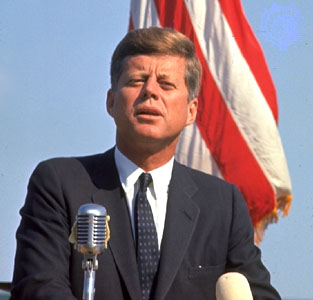
If you are an American over sixty, you remember when you learned that John F. Kennedy had died. If you are one of my contemporaries—too young to have experienced Kennedy, too old to be a cynic about his aura—you may recall a different snapshot, of the moment you thought Jack Kennedy had been reborn in the form of some youthful contender who could turn an inspirational phrase and stab a finger in the air.
Your moment might seem absurd now: Gary Hart in the glow of winning New Hampshire in 1984. Or bittersweet—the November night in 1992 when Bill Clinton retired the WWII generation. Yours might be agonizingly recent – Barack Obama on a dream-lit stage in Grant Park in 2008. It’s been the longest quest in modern politics, the effort to recreate an ideal of power that was extinguished exactly 50 years ago, and it has never ended well.
Pretenders like Hart imitated the style without Kennedy’s strength of purpose. Clinton, Kennedy’s equal as a tactician, never matched his capacity to lift the country’s moral tone. As for Obama, he has gone steadily backward in terms of his hold on the public’s imagination. Kennedy did the opposite, expanding a one vote per precinct squeaker into the last presidency that never dropped below fifty percent approval.
The consistent take on Kennedy, which Chris Matthews argues in his 2011 book “Elusive Hero” and Thurston Clarke reprises in his recent effort, “JFK’s Last Hundred Days”, is that the late president’s genius was his disdain for conventional wisdom, whether it was about the grip of the decaying boss structure in his party, the permanence of the Cold War, or the rigidity of social barriers like racism. True, as is their assessment that JFK never stopped growing and adjusting to circumstances: he reversed his worst blunder, the Bay of Pigs, with his mastery during the Cuban Missile Crisis, and one doesn’t have to share Clarke’s cherry picked rendition of Kennedy’s last few months to appreciate that the leader who died in Dallas was wiser and more substantial than the image-meister who barely left a footprint in the Senate.
But Kennedy’s strategic deftness in avoiding war with a country that no longer exists surely is not what resonates with this post-nuclear generation: nor is the hedging on civil rights and Vietnam that kept his popularity intact the quality that frames him as an exemplar of presidential vision. To account for why he still outranks all of his presidential peers in public esteem, to find why a presidency whose early days exist only in black and white newsreel still resonates, requires understanding two other elements of Camelot.
First, Kennedy is the last president who consistently challenged rather than promised. JFK’s successors have outdone themselves in bidding to give us more of what we want – the liberal ones offering more entitlement, the conservatives offering to return more tax dollars to us, or to restrain your tax dollars from being squandered on “them”. Kennedy read the country’s mood as less self-absorbed than that, and America rewarded him.
And then there is the fact that Kennedy managed to invigorate his supporters without ever really pitting Americans against each other. The rhetoric of politics has been set on a different course ever since: modern liberals describe a country weighted down by privileged interests that have stacked the deck; modern conservatives paint a picture of a society under siege from permissive forces who are burdening success and undermining our values. You can search Kennedy’s speeches in fine detail, and the trait that is missing is a demonization of his domestic antagonists.
He must have been tempted: dogs were being marshaled against children in Birmingham, southern governors were re-litigating the Civil War, and can anyone dispute that the Republicans of his day genuinely were Neanderthals on poverty and health care? That Kennedy resisted the urge to define American politics as a clash of light versus darkness yielded a practical dividend for him – no president since has enjoyed consistently high approval ratings from his rival party – but it was also borne out of the skepticism the old war hero had for blood-feud ideology.
The ironic side of Kennedy no doubt admired Shakespeare’s passage about the Welshman who brags that he can “call spirits from the vasty deep,” and the rejoinder that “So can I, so can any man. But will they come when you do call them?” More than a few charismatic politicians have issued their share of high-flown calls. The last one we have answered, and kept answering, is John Kennedy.
A version of this essay was published in Politico in November, 2011.
By John Y. Brown III, on Mon Nov 25, 2013 at 12:00 PM ET
Please!! Seriously! Would someone just contact this poor guy from Malaysia and take the $10M he has been trying to give away for the last decade —so he’ll quit filling up my (and others) email inbox and Facebook message box?
Here’s the latest from him. (see below) He’s been pursuing me under various identities for years. Sure, I’d love the money but it seems like such a hassle and then there are the tax consequences and having a new lifelong friend (named Godfrey Lau??). What would that entail? I am not ready to make that kind of commitment but am sure someone younger and more adventurous would. So, please, have at it. And help this poor Mr Lau out so he’ll leave the rest of us alone.
“My name is Mr. Godfrey Lau, an external auditor working with MayBank Malaysia. I have taken pains to find your contact through personal endeavors because a late investor who bears the same last name with you has left funds totaling a little over ( $10 Million ) with Our Bank for the past Eight years and no next of kin has come forward all these years. To affirm your willingness and cooperation to my proposal, I will like you to get back to me as soon as possible and treat with absolute confidentiality and sincerity.”
===
Ok. I don’t know what to think about this!!
In my post above I asked for someone to please, please help the poor guy from Malaysia who has been working feverishly for years to give someone in the US $10M for a little help on a minor matter.
I finally got someone to offer to do the job.
But her response seems suspicious to me:
“Hi,you got a nice looking profile picture that interest me to write… you for a mutual benefit,I must confess you look very attractive.I hope we can be friends?my email is(tfr19799@gmail.com)Regards,Tracey Fujikawa”
Heck, I can’t even be for sure she is responding to my request to help out this Malaysian feller. They both seem crazy as loons, though, if you ask me— and like they deserve each other.
===
Bad habits are like spam emails.
We sign up for them (both spam emails and bad habits) motivated by a belief we are getting some reward without paying the usual price.
You can unsubscribe and think that the bad habit won’t return. But somehow the level of spam (bad habits) stays fairly consistent. And we don’t really know if the bad habits are the same old ones or some new and recently devel.ped bad habits.
Same with spam email. We aren’t sure if the unsubscribe didn’t work or if we signed up for a new bad habit. I mean spam email. What I suspect is really going on with spam emails is that it is much harder to shake them off….to end them for good…with just a simple unsubscribe click after we have finally had enough.
Unsubscribing from spam emails —or ending a bad habit–is never that easy. And there always seems to be a disappointing number of them in my inbox at the end of each day. Spam emails, that is. And the filter to eliminate them works about as well as just trying to stop a bad habit. We may need to just embrace the fact that spam email will always be with us and focus instead on just eliminating our bad habits Or vice versa.
How many capabilities are locked away, underleveraged in organizational or industry silos? Who hasn’t suffered a severe case of innovator’s envy, coveting access to information and capabilities that seem so tantalizingly close?
Most innovation doesn’t require inventing anything new. It is often just a matter of combining and recombining capabilities across disciplines, organizations, and sectors. The problem is that those capabilities are often impossible to access. The biggest opportunities in health care, education, security, and energy lie in the gray areas between silos. We need to think and act more horizontally.
In doing so, we’ll connect unusual suspects in purposeful ways. Take spies and environmentalists. Recent news of the CIA reviving its MEDEA (Measurements of Earth Data for Environmental Analysis) program and providing access to data from national intelligence assets for environmental research really got my attention. What a great example of the power and politics of collaborative innovation.
More Data Sharing
With no security risk, disruption of agency activities, or incremental cost, the CIA has opened up a treasure trove of valuable data to scientists from academia, government, and industry for environmental research. To replicate the capture of this information would be silly and cost-prohibitive, and I was encouraged that the data were being shared to make progress on an important social issue. But then naysayers and politics entered the conversation. Instead of garnering praise for the program, as I would have expected, the CIA was criticized for mission creep.
Admittedly, news of the collaborative program came right on the heels of the U.S. terror threat on Dec. 25. Talking heads across cable news accused the CIA of negligence, arguing that sharing data with environmental scientists was a distraction from its core mission of minding the American public. But the pundits have it wrong. The CIA and all Homeland Security organizations should be doing more, not less, cross-agency collaboration and data sharing. The protection of data, capabilities, and turf has gotten us into the current mess. Perhaps if the focus had been on networking capabilities and sharing data across silos, America would be a safer country today.
In 1986, the Federal Technology Transfer Act created the CRADA (Cooperative Research & Development Agreement) process to enable public-private partnerships around promising government technologies. CRADA may just as well stand for “Can’t Really Access Developed Assets.” Government rhetoric claims to support technology transfer, but the painful bureaucratic process in place makes it nearly impossible to leverage existing government capabilities. I get a headache just thinking about how hard it is to access all the valuable information and data that have been created by government agencies and paid for by taxpayer dollars. Many of these assets could be leveraged to unleash new value and to help make progress on our big social challenges.
Combining Capabilities
Private-sector organizations are similar. We are so busy pedaling the bicycle of today’s business models that there is no capacity to explore new ones. The secret sauce of business model innovation is the ability to explore new ways to deliver customer value by combining and recombining capabilities, in and out of the organization, across silos.
One story that sticks with me is from my friend Alexander Tsiaris, founder ofAnatomical Travelogue, who has built a successful company creating human anatomy visualization tools to help us better understand health care. When Alexander was starting his digital media business he needed access to hospital MRI equipment. He was willing to pay for access to the equipment during down times to capture the scanned images he transforms into a beautiful art form and health-care education tool. The initial hospitals he asked all said the same thing: We are not in this business and can’t provide access. Alexander is persistent and ultimately found willing partners in New York City, but it wasn’t easy.
This pattern repeats itself over and over. It is not the technology that gets in the way of innovation. It is humans and the organizations we live in that are both stubbornly resistant to experimentation and change. If we want to make progress on the big issues of our time, we have to look up from our silos and become more comfortable recombining capabilities in new ways in order to connect with the unusual suspects.
Yes, that’s an intentionally provocative framing of the question, but given recent events, the idea warrants a deeper examination.
In stumping for the health care reform bill that bears his name, President Obama promised dozens of audiences (37 in all in the past four years) that “if you like your plan, you can keep it.” But he knew that over half of those who had purchased insurance on the individual market would lose their plans during implementation of his health care reform bill, and his administration assumed that, given the typical churn in the individual market, people would not notice the difference.
House Speaker John Boehner told two undocumented teenage girls that he’s “trying to find some way” to pass a comprehensive immigration bill. Yet, with a sufficient number of Republicans having publicly declared their support for such a bill, everyone in the Capitol knows that the votes are there to pass it if Boehner would simply agree to bring it to the floor despite it lacking the support of a majority of Republican legislators.
And Toronto Mayor Rob Ford recently claimed that he was prepared to admit smoking crack cocaine well before his ultimate admission; it’s just that reporters were asking him the wrong question.
Surely two of our nation’s most powerful leaders would be aghast at their inclusion in a category with the buffoonish Rob Ford. But there is a common thread: a lack of public candor by leaders who feared that transparency would damage them politically. Faced with similar challenges 50 years ago, our nation’s young president could not have responded more differently.
President Kennedy’s stunning candor following the 1961 Bay of Pigs fiasco seems quaint now that spinning, exaggerating, parsing words, and shading truths have become accepted parts of our nation’s political dialogue. But when leaders make mistakes, be they in the public or private sector, anything less than complete candor can empower rivals, the press, or, worst of all, law enforcement, to seize on a false statement, turning a speed bump into a full-blown scandal. As President Nixon taught us, the cover-up is almost always worse than the crime; it is a lesson I learned all too well.
There are many memorable photographs of former President Bill Clinton, but perhaps the most memorable is the one of a 16 year-old Clinton representing Arkansas at Boys Nation, beaming while shaking President Kennedy’s hand. Kennedy, of course, was Clinton’s role model. But there was one area in which, at a critical moment, Clinton departed from Kennedy’s playbook: crisis management.
The Bay of Pigs debacle was an unsuccessful 1961 invasion of Cuba by a CIA-trained paramilitary group who hoped to overthrow Castro’s government, which routed them in three days. The media clamored for Kennedy to address the events, which he did with clarity and candor. First, he acknowledged the United States’ role in the coup, and admitted the coup’s failure: “The news has grown worse instead of better.” Kennedy confessed surprise and disappointment in the outcome, showing a vulnerability rare among leaders as he described “useful lessons” from the “sobering episode.” He pledged to “re-examine and reorient our forces of all kinds.” Last, he fully he accepted responsibility.
There’s an old saying that victory has a hundred fathers and defeat is an orphan . . . further statements, detailed discussions, are not to conceal responsibility because I’m the responsible officer of the Government.
He did not blame the CIA for insufficient planning, or blame his national security team for offering poor information or guidance, or blame anyone for anything at all.
Read the rest of… Jeff Smith: What John F. Kennedy’s Legacy Teaches Us About The Value Of Candor


 Blog this!