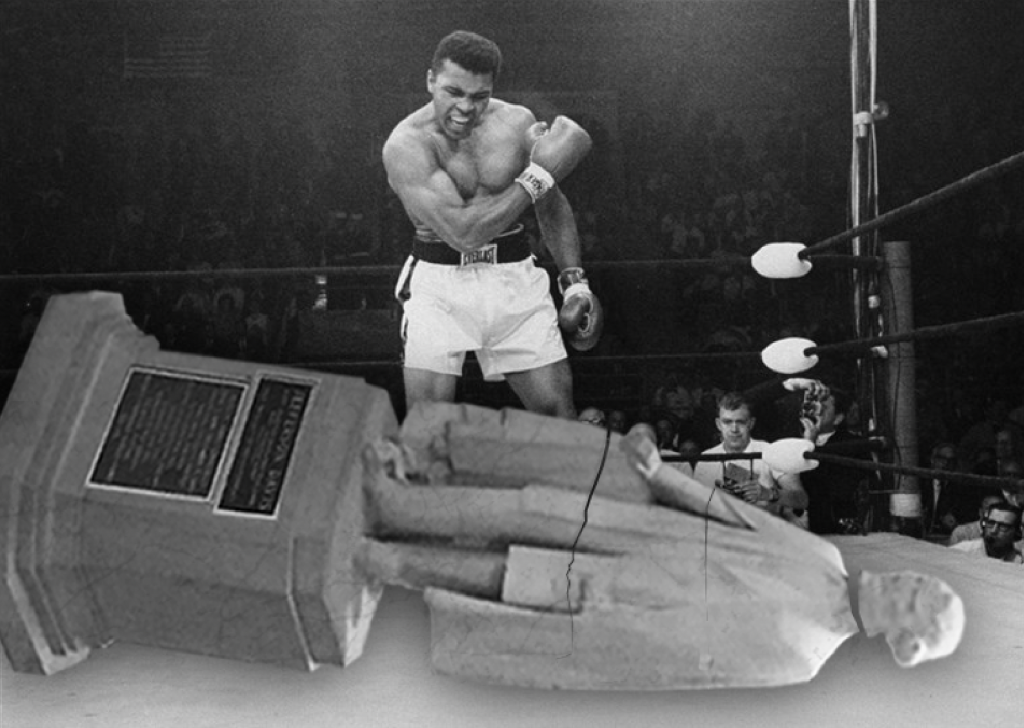
Please sign the petition below to remove the statue of Jefferson Davis currently in Kentucky’s Capitol Rotunda, and replace it with a tribute to Muhammad Ali, “the Louisville Lip” and “the Greatest of All Time.”
I just heard from the Ali family: It is the Champ’s belief that Islam prohibits three-dimensional representations of living Muslims. Accordingly, I have adjusted the petition to call for a two-dimensional representation of Ali (a portrait, picture or mural) in lieu of a statue.
UPDATE (Tuesday, December 2, 2014)
In this interview with WHAS-TV’s Joe Arnold, Governor Steve Beshear endorses the idea of honoring Muhammad Ali in the State Capitol (although he disagrees with removing Davis). Arnold explores the idea further on his weekly show, “The Powers that Be.”
Click here to check out WDRB-TV’s Lawrence Smith’s coverage of the story.
And here’s my op-ed in Ali’s hometown paper, the Louisville Courier-Journal.
UPDATE (Saturday, June 4, 2016)
In the wake of the 2015 Charlestown tragedy, in which a Confederate flag-waving murderer united the nation against racism, all of the most powerful Kentucky policymakers — U.S. Senator Mitch McConnell, Governor Matt Bevin, Senate President Robert Stivers and House Speaker Greg Stumbo — called for the removal of the Davis statue from the Rotunda. Today, as we commemorate last night’s passing of Muhammad Ali, there is no better moment to replace the symbol of Kentucky’s worst era with a tribute to The Greatest of All Time.
UPDATE (Wednesday, June 8, 2016):
Great piece by Lawrence Smith of WDRB-TV in Louisville on the petition drive to replace Jefferson Davis’ statue in the Capitol Rotunda with a tribute to Muhammad Ali.
UPDATE (Thursday, June 9, 2016):
Excellent piece on the petition drive by Jack Brammer that was featured on the front page of the Lexington Herald-Leader.
Highlight of the article:
Miller said he has received a few “angry comments” on his call to honor Ali.
“One of them encouraged me to kill myself,” he said. “You can quote me that I have decided not to take their advice.”
UPDATE (Friday, June 10, 2016)
The petition drives continues to show the Big Mo(hammed): check out these stories from WKYU-FM public radio in Bowling Green and WKYT-TV, Channel 27 in Lexington:
UPDATE (Saturday, June 11, 2016):
Still not convinced? Check out this excerpt from today’s New York Times:
By Jonathan Miller, on Mon Dec 2, 2013 at 10:00 AM ET
The Recovering Politician is proud to present the latest project by Friend of RP Mark Nickolas, recovering political blogger and now award-winning documentary filmmaker:
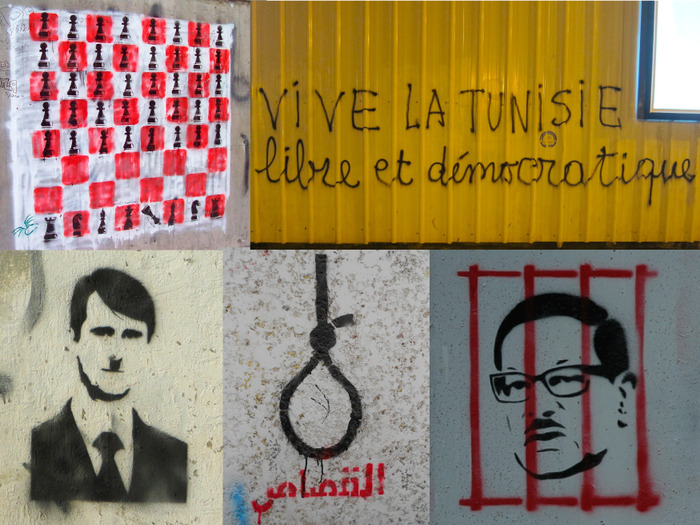
THIS IS NOT GRAFFITI: A Film on Revolutionary Graffiti & Art — a short film exploring use of political graffiti and street art as a catalyst for popular revolutions and uprisings around the world.
This Is Not Graffiti is a 20-minute short documentary film on the critical role that politically-charged graffiti and street art has played in uprisings and revolutions around the world, particularly the recent popular revolts in the Arab world that began in Tunisia in 2011.
Despite the preferred media narrative that the Arab uprisings were the ‘Facebook Revolution,’ what is often overlooked is the enormous impact that anonymous graffiti and street art played in galvanizing the public (particularly youth) and served as a revolutionary call-to-arms, where the walls became a canvas to speak truth-to-power and proved to be a powerful weapon of resistance.
In fact, the current conflict in Syria began simply with a group of teenage boys who, while watching the events in Libya and Egypt unfold on TV, spray-painted on their school wall the simple phrase “Your Turn Has Come, Doctor” — referring to President Assad, a Western-trained ophthalmologist.
Throughout the Middle East and North Africa, graffiti and street art became the prime communications vehicle for people to vent their anger, express their hopes and dreams, and demand action.
But this phenomenon is hardly new.
Graffiti dates back to walls of prehistoric caves. But its modern use as a political weapon came into plain view in revolutionary pre-war Europe of the mid-1900s, eventually coming into its own during the 1968 French riots where all across Paris, a groundswell of creative street expression came from striking workers and students, who spray-painted walls with poetic and philosophical slogans, speaking to its readers on a much more emotional level.
Since then, revolutionary graffiti and street art can be found all over the world and has played a vital role during times of political transformation and social instability, creating a shared public visual space which symbolically and physically challenges the establishment and the dominant ideologies, and has tremendously influenced the great social and political upheavals of the past century.
THE FILM
This Is Not Graffiti will examine this history and evolution while telling this global story by way of a local one, mixing interviews on the subject here in the New York City area with a week in Cairo talking with those who have made, studied, and been directly impacted by these words and images.
The film will also explore how this effort to demand change from governments has led to other calls, most prominently from women in Egypt — a country that recently ranked last in the Middle East for women’s rights — who have taken to street art to demand change from their own society.
We are seeking the funds in this Kickstarter campaign to fully produce, finish, and submit the film to festivals around the world by the end of Spring 2014. You join us on the ground floor for this endeavor.
We have been in touch with several of the people who we hope to visit with and interview on-camera, and are ready to begin production as soon as this campaign is successfully funded.
We will interview people in the New York City area in early January 2014, and then fly to Cairo in February during the third anniversary of the Egyptian revolution where we will spend a week shooting.
Editing, scoring, and finishing the film will be completed by April when we will begin an aggressive film festival campaign—domestically and internationally—where we fully expect the film will find a home for the next year or two.
THE FUNDS
Filmmaking is not an inexpensive endeavor and funds for independent documentaries are in short supply. Your donations will allow us to fully fund this film (***there will be no second Kickstarter project to finish this film, we promise!***), permitting us to:
• rent film gear: while we own much of the equipment needed, we will need to rent some lighting accessories, camera gear, and some additional audio components.
• transportation: a week in Cairo, Egypt for our very small crew will account for the vast majority of our travel costs, though there will be several days of production travel locally, as well.
• music: allow us to hire a composer for an original score for the film.
• crew: our very small crew of three will require very modest funds to pay for a cinematographer and sound recordist, and a small fee to direct and produce this project.
• post-production work: while we will handle a large majority of the work for this film ourselves, we will need to outsource some graphic design, audio work, color correction, and film transfers to specialty houses.
• film festival submissions: film festival submissions, even for shorts, run between $35 and $50 a piece, and an aggressive festival campaign will require 75-100 submissions, and the cost for us to attend our theatrical premiere.
• miscellaneous production expenses: production always requires small purchases that add up — from food for the crew and volunteers, to periodic runs to Office Deport or Radio Shack or Home Depot, to unexpected fees for traveling and driving, etc.
• Kickstarter rewards: though we were careful to create great rewards for our donors, we were also cost-conscious in making sure that they accounted for a reasonable portion of the overall budget to create, acquire and ship.
One of my biggest pet peeves is setting strategy one tactic at a time. It drives me crazy to be surrounded by people and organizations that think if they just work hard enough and do more things that a strategic direction and destination will emerge. It seems that most of the world works this way. It is terribly inefficient. How many people and organizations do you know that pedal the bicycle like crazy but never seem to arrive anywhere. They just keep pedaling harder hoping that something will eventually stick. It is exhausting watching them. Why not determine a destination and work hard on those things that help you get there. It seems so simple. Setting a strategic direction provides a way to know which tactics are aligned and contribute to reaching the destination. The destination may change along the way requiring different tactics, and that is OK, but not having a destination at all is a ticket to nowhere.
When John F. Kennedy said, “We choose to go to the moon” in 1961, Americans rallied around the destination. We believed it was possible and the goal of setting foot on the moon rallied a country to advance its global science and technology leadership. It was cool to study math and science and clear that innovation was the economic engine that would drive American prosperity. When Neil Armstrong set foot on the moon eight years later and said, “That’s one small step for [a] man, one giant leap for mankind”, we celebrated his achievement as if it was our own and knew at that moment that anything was possible. We have been trying to get that feeling back ever since. Today, we have no clear destination, in space or on earth.
I am still trying to process President Obama’s plan to cancel NASA’s Constellation program for manned space flight back to the moon. OK, I thought, maybe he has a bolder more imaginative space destination in mind or a better way to get back to the moon. It turns out that the announced strategy identifies no new destination at all and has been called a “flexible path” focusing on enabling technologies. The destination will be determined later. Please say it isn’t so. It is impossible to be inspired with out a destination and it is terribly inefficient to develop enabling technologies with out an end in mind.
My second thought upon hearing the new NASA strategy was that maybe President Obama wants to turn our attention and resources toward earth and create an inspiring space mission like focus on fixing health care, education, or climate change. We have no clear destination for any of these huge system challenges. We continue to play around the margins hoping that incremental changes will launch us toward systemic solutions. It isn’t working. We need to transform each of these systems and it will take “moon landing” like clarity and commitment to make it happen. So maybe the president plans to shift attention and resources away from space exploration toward transformation here on earth. No such luck.
It isn’t as if the NASA budget was cut freeing up resources for other priorities. The proposed budget actually increases NASA’s budget by 2% allocating $6B over 5 years to create a commercial taxi to the space station. The budget comes nowhere close to the $3B a year that the recent expert advisory panel suggested was needed to create a robust manned space program. So we appear to be lost in space and on earth. We will continue to invest in space technologies without a clear destination and we will continue to work around the margins of the important system challenges we face here on earth.
It is enough to make you scream. All I can think of is Ralph Kramden in the Honeymooners getting angry and red in the face, proclaiming, “To the moon, Alice”!
By John Y. Brown III, on Fri Nov 29, 2013 at 12:00 PM ET
I’m not talking about deliberate and demented cruelty. Like torturing little animals. I’m talking about accidental and unintended actions that lead to an unplanned cruel outcome.
Today I decided to drive into a car dealership to look at some cars….mostly to kill time. I pulled in and as I pulled toward the door I saw three sales reps waiting to greet me. So I turned left and was going to park but saw two more sales reps standing near the parking space. So I turned left again and pulled into what looked like a “sales rep free zone” but as I looked out my side window there were two other sales reps standing casually nearby waiting for me to get out and look at a car.
I was psyching myself up to get out of the car and thinking of nice ways of saying, “I’m just looking” but before I could my wife texted me. And I texted back.
There was palpable tension anyone watching could sense and each of the seven sales reps were curiously waiting to see which direction I’d walk when I got out of my car.
So, to buy time, I texted my wife something totally irrelevant and we texted back and forth about it for about two minutes. By this time several of the sales reps were getting concerned and wondering what I was up to. A few looked like they were ready to write me off as crazy. One looked like he may have to call the cops if I didn’t get out of my car soon and start negotiating pricing on a new car.
I then felt stuck. I wasn’t texting any more but pretended like I was. One sales rep walked close enough to see that I wasn’t crazy but looked really fed up with my seeming to toy with him …if not torture him.
Once I realized I had crossed over into an inadvertent kind of torture of people I had no reason to dislike or harm in any way, I got nervous, restarted my car, backed up and drove off.
And swore I’d never do anything that cruel to car sales reps ever again.
If you’re still rocking that North Face parka over your suit jacket, it’s time for an upgrade.
Nothing ruins a great look faster than a not-so-great coat. For some reason outerwear often seems to be at the end of peoples’ priority lists, but I can’t stress enough how important it is for your coat or jacket to be up to par with the rest of your outfit. Think about it: you walk into a restaurant to meet a date. Before you take your coat off, she’s already formed an impression of you. The same goes for your office elevator. People tell me all the time that they sneak in to their office building in junk clothes/shoes and change once they’re there, but if you’re riding up in the elevator with people in your office, the damage is done. So, have I convinced you of the merits of a good overcoat yet? Good! Here are my suggestions on how to choose one.
Fit: I see too many people around in oversized, too long overcoats – such a disappointing look! It makes me think of a little kid playing dress-up. Ideally, your overcoat should fit comfortably over a suit but still be slim enough to look stylish with just a shirt and pants. The best, most versatile length for a modern but still classic look is around your knee. It should hit anywhere from mid/low-knee to just above it, depending on how modern you want the look to be (the shorter you go, the younger the look). A good-fitting overcoat should make you look taller, leaner and broader across the shoulders.
Sizing: An overcoat is meant to fit on top of your suit, so when buying off-the-rack, start by going up one size from your suit. Try it on with a suit jacket or blazer and be sure it can close. The sleeves should cover your suit and shirt sleeves.
Buttons – Make sure it buttons to a location on your body that you’re comfortable with. I like this houndstooth check coat above from Balenciaga, but notice how low it buttons on the model’s body. If it’s too low, and you get cold easily, you might want to choose a coat that buttons a little higher. Remember that you’ll likely be wearing a scarf with it on very cold days which will give you additional coverage. What about the number of buttons? Most people will need 3 buttons for a classic single-breasted style, but if you’re very tall (over 6’ 3”), you should get 4.
Style: A single-breasted notch lapel creates a more conservative/traditional look, whereas a double-breasted peak lapel is more dressy, and also warmer due to the fuller coverage and double layer of fabric over your chest. Overcoats also come with a wide choice of different pocket options for you to consider: straight/horizontal, flap/slit, ticket/no ticket, breast pocket/no breast pocket. And make sure to consider whether you want a center vent in back or no vent at all. Don’t get locked in to the first coat you see just because it’s convenient. Look around to find the one that resonates best with you. Perhaps you wouldn’t have considered one with a leather collar like the above from Burberry Prorsum until you saw it in person. There’s a world of options!
Color/Patterns – The most classic colors are navy, camel and grey (in that order), but you might also consider getting a pattern if you’re into that sort of thing. If you do go for a pattern, make sure to keep the rest of your outfit subtle. I’m anxiously awaiting this brown herrringbone which I ordered custom as a chesterfield (with a velvet collar) for a client.
Fabrics: There’s a huge range, from camel hair, to wool, to cashmere to blends. Do some research on the different weights that you’re choosing from and figure out how warm you need your overcoat to be before taking the plunge. I’ve seen people buy very heavy overcoats that they never wear because they’re just too warm. Know yourself and the climate you’re in (or that you travel to) and factor that in.
Investment: Remember when you purchase a high quality overcoat that it’s a classic piece which should last you at least 10-15 years. This is one place in your wardrobe where it makes sense to invest.
Where to buy: You can either go off-the-rack or custom. For the former, try department stores like Saks, Barney’s and Bloomingdale’s, along with specific brand boutiques like Hugo Boss or Prada. If you live somewhere without access to a lot of stores, you can look online. Websites like Mr. Porter and Suit Supply are good go-to’s. If you decide to go custom, check Yelp and local listings (like nymag.com here in NYC) for highly-rated clothiers or ask well-dressed friends/acquaintances where they go.
By John Y. Brown III, on Thu Nov 28, 2013 at 12:00 PM ET
I am writing this entreaty from the back seat of my wife’s mini van. My daughter is sitting in the font seat and controlling the music and music volume (keeping it turned up just slightly higher than she knows I want it to be) and my wife is driving and the two of them are chatting away (somehow) over the music and seem to be laughing and enjoying each others company.
I, as always, am alone in the back seat. I feel like a refugee from another country who can’t speak the language and who doesn’t understand the cultural customs.
I sometimes feel the loud music is to keep me muted. I can’t engage in the conversation anyway because 1) I can’t hear well enough to understand it (even without music blaring); 2) I don’t understand it even when I can hear it, 3) I make really “stupid” comments even when I can hear and understand what is being said.
I am worried it won’t be long until I am asked to move to the trunk part of the minivan when we go out to eat—the part behind the final row of seats and the rear hatch. It is really cold back there in the winter and even lonelier than where I am sitting now. But only by a little. (Although I suspect, on the positive side, the music won’t seem as loud)
I am writing because I, frankly, don’t know how this situation happened. It wasn’t long ago that I confidently strode to the front passenger seat every time my wife drove the family out to eat. And I didn’t even have to run to get to the front seat first. At first it was an inconvenience but it was still clear (to me, at least) who the head of the household was. But it wasn’t long –maybe two weeks or less–before that sinking confidence that I was still head of the household turned into spiraling self-doubt about my status in the family— to the current state of near obsolescence. If it wasn’t for the annoying contributions I made to family outings, my wife and daughter may not even think to acknowledge me at all.
I’ve tried to turn things around by playing to my current strengths and being even more annoying than usual but that didn’t work as well as I’d hoped. I thought about offering to drive but I have a smallish compact car that the family never wants to drive in anywhere –even to circle the driveway. I’m now out of plans to reassert myself to a position in my family, not of dominance, but simply relevance. I am much more realistic now. I don’t have to actually matter…just as long as family members would be willing to pretend like I “could matter.”
Is that asking for too much? Or should I start dressing more warmly and placing pillows around the flooring and sides between the hatch and back seats, where I seemed destined to find myself any night we next go out for dinner?
By Jonathan Miller, on Thu Nov 28, 2013 at 9:15 AM ET
Over the past few weeks, politicians, comedians, and the lamestream media have joined in what can only be referred to as The Shandah of the 21st Century: the trenchant desecration of the sacred holy day of Thansgivukkah.
In case you missed the Stephen Colbert satire, the Bostonian turkey-shaped menorah, or even the Presidential shout-out; millions of Americans have been exposed to the rare and historic confluence of Thanksgiving and Chanukkah with snide laughter and tweeted snarkery, treating Thanksgivukkah as just some ironic day of mock-celebration — akin to The O.C.‘s lame interfaith mashup, “Christmukkah,” or the brilliant, yet secular Frank Costanza inspiration of “Festivus.”
Indeed, while Thanksgivukkah has been only celebrated formally twice before in our nation’s history — in those extraordinarily rare cases in which a late November fourth Thursday coincided with an early winter Hebrew lunar calendar — the holiday once served as an integral thread that wove together the Jewish and American fabrics.
And yet, there is a dark, forgotten undercurrent to this Festival of Turkey Light.
I’m here to set the record straight and remind my fellow Jews and my fellow Americans of the secret, sordid history of the holiday of Thanksgivukkah:
NOVEMBER 1621
Shecky Howard
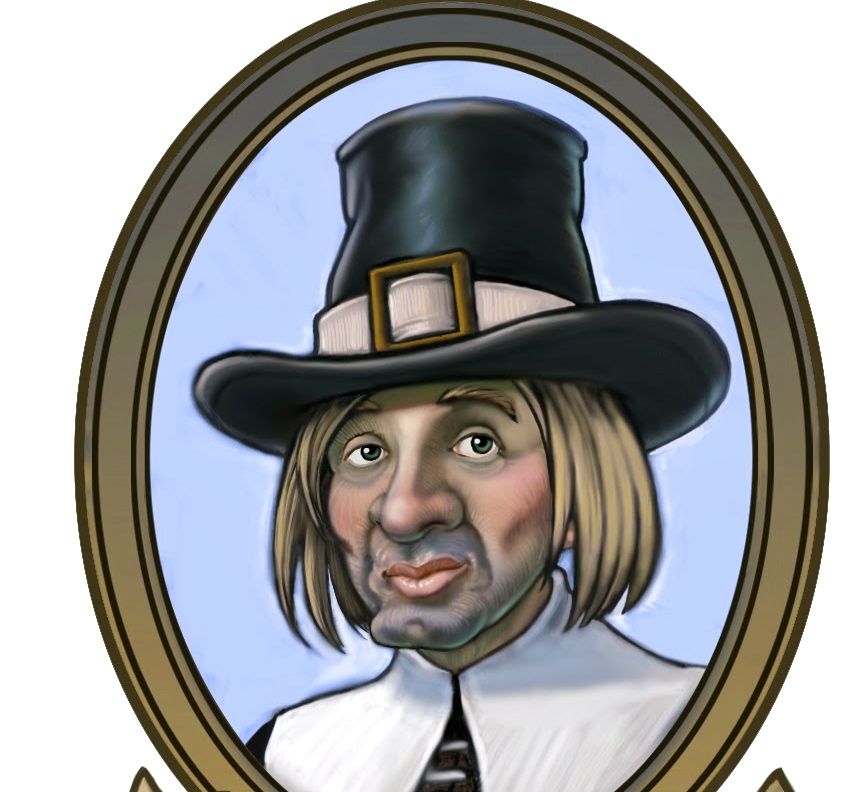
In a global conspiracy rivaled only by the fake Moon landing, the coverup of Paul McCartney’s death and the transparently fabricated long-form birth certificate of our Kenyan-born President, the anti-Semitic textbook industry has scrubbed all records of America’s first Jewish citizen, Shecky Howard.
Escaping religious persecution as a Jew in late 16th century Europe, Shecky pretended to convert to Christianity, and chose the faith with which he seemed most comfortable — the big black hats, mother-inspired guilt-trips, and victimization of Separatist Puritanism.
OK, not a great choice for a guy fleeing religious persecution…
But Shecky made the best of a bad situation. And after serving as the mohel, pediatrist and the stand-up entertainer on the Mayflower (Sample joke: “Take my wife’s apron…please!), Shecky was primarily responsible for the early peaceful entente reached among the Pilgrims and Native Americans in Plymouth, after he quietly confided to the Indian leadership that he too was a Member of the Tribe. Perhaps most poignantly, the Puri-Jew Shecky convinced both sides that turkey was the appropriate protein of choice (and carved the first bird with his circumcision tools), by arguing that pork chops would be inappropriate…because…uh…well…applesauce hadn’t been invented yet.
NOVEMBER 1863
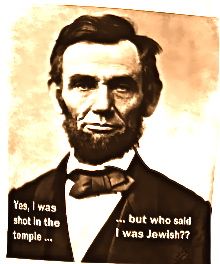
The official American holiday of Thanksgiving was first declared in 1862 by our first Jew-ish President, Abraham Lincoln.
(OK, I said Jew-ish, not Jewish. Read the difference here and consider his black hat and beard, his über-protective wife, his passion for minority civil rights, his Kentucky birthplace (we’re all Jewish here), and most of all, HIS NAME WAS ABRAHAM, FOR MOSES’ SAKE!)
It’s no wonder, then, when the second official Thanksgiving coincided with Chanukkah, Lincoln invited Shecky Howard’s great-great-great grandson Mordechai to officiate the very first Thanksgivukkah ceremony at the White House.
And it was then that the Thanksgiving dinner as we now know it took formal shape — a family event loaded with Jewish influence — mothers insisting that their children eat every last morsel of food (THINK OF THE STARVING CHILDREN IN AFRICA!); participants guilted to travel long distances to spend agonizing hours in cramped quarters with their neurotic extended families; even the dreaded cardboard folding Kids’ Tables, a remnant of overcrowded Passover seders.
The Black Friday shopping tradition arose from the rush to purchase Chanukkah gifts before the Jewish Sabbath began that evening. And most significantly, the modern mythical ethic of Thanksgiving — the Pilgrims’ supposed quest for religious freedom — was lifted by one of Rand Paul’s ancestors directly from the story of Chanukkah’s brave Maccabees: Archeological evidence recently revealed that the Mayflower was actually a Gilligan-esque three hour boat tour gone horribly, horribly wrong.
NOVEMBER 1899
The most recent Thanksgivukkah occurred on the eve of the 20th century, when an elderly Mordechai Howard took the invitation of President William McKinley to introduce merged holiday themes at their White House celebration: turkeys stuffed with sweet potato latkes, jelly doughnuts filled with pumpkin sauce, hora dances circling piles of green bean casserole.
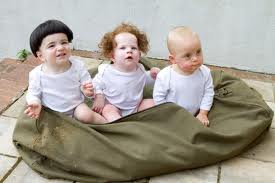
But alas, the ceremony went totally, awfully awry. Mordechai’s three toddler grandsons were playing a robust — some say vicious — game of Spin the Pilgrim Dreidel. After losing all of his cranberry sauce-flavored gelt, the oldest son poked the youngest in the eyes, then banged him on the head with a Star of David engraved musket, accidentally knocking over the brown gravy-fueled menorah, setting fire to the White House curtains, and ultimately killing Vice President Garret Hobart.
The Howard children
With the pogroms furiously raging in Eastern Europe, and the wave of Jewish immigrants desperately finding refuge at Ellis Island, an anti-Semitic backlash was rearing its ugly head, and the notorious Thanksgivukkah fire added (brown gravy) fuel to the hatred. A multifaceted coverup ensued; even the history books were altered to claim that Vice President Hobart died of “ill-health.” (Look it up here.) No one knows what happened to the three Howard children, although one colorized picture of them remains and is posted here.
===
So alas, we come to today, as we celebrate Thanksgivukkah for the last time apparently until the year 79,811. I urge my fellow Americans — particularly my fellow Jews — to refrain from the easy jokes, and instead honor the great Howard family…Shecky, Mordechai, even the three clownish grandsons..and remember what this holiday is truly about: religious freedom, family togetherness, delicious food, and most soi-tenly, the miracle of laughter.
Holidays present a nutritional nightmare for everyone, including yours truly. Cakes, egg nog, cookies, alcohol, etc. are served at every dinner party, work gathering and family get-together. You can’t ignore it, it’s the holidays and regardless of religious beliefs high sugar foods will be there. So to combat your holiday cravings, I compiled a list of strategies to help you throughout this holiday season. Here are my top 12 strategies to surviving the holidays and keeping your body in tact.
1. Know what types of foods will be where you are going and what you are going to choose to eat.
2. Don’t go to the table saying “you are going to eat healthy,” Don’t draw attention to it. The host will be mad if you are not sampling the food.
Fill the plate with veggies, fruits and lower fat fare. Start eating these foods first so you are not so hungry. Satiety.
3. Don’t say yes to every basket or cookie someone puts in front of you. Say no to Egg Nog!
4. Do not nibble throughout the day. All those bites add up.
5. If you are not cooking offer to bring a healthy alternative with you. Eat something healthy to fill you up sooner.
6. Have a healthy snack before the meal, that way you are not as hungry when you eat for real
7. Control stress. Stress makes everything worse.
8. Focus on weight maintenance vs. weight loss during the holidays. If you are currently overweight and want to lose weight, this is not the time to do it. Maintenance of your present weight is a big enough challenge during the holiday season. Don’t set yourself up for failure by making unrealistic goals for yourself.
9. Plan on NOT dieting after the New Year. Anticipation of food restriction sets you up for binge-type eating over the holidays (“after all, if I’m never going let myself eat this again after Jan. 1st, I might as well eat as much as possible now!”) Besides, restrictive diets don’t work in the long run. They increase your loss of lean body mass vs. fat, slow down your metabolism, increase anxiety, depression, food preoccupation, and binge eating, and make weight re-gain more likely.
10. Be physically active every day. Often, students’ busy holiday schedules (or lack of structured schedules) bump them off their exercise routines. Physical activity, especially aerobic activities (like brisk walking, jogging, bicycling, roller blading, and swimming) can help relieve stress, regulate appetite, and burn up extra calories from holiday eating.
11. Choose your beverages wisely. Alcohol is high in calories. Liquors, sweet wines and sweet mixed drinks contain 150-450 calories per glass. By contrast, water and diet sodas are calorie-free. If you choose to drink, select light wines and beers, and use non-alcoholic mixers such as water and diet soda. Limit your intake to 1 or 2 alcoholic drinks per occasion. And, watch out for calories in soda, fruit punch, and egg nog as well.
12. Enjoy good friends and family. Although food can be a big part of the season, it doesn’t have to be the focus. Holidays are a time to reunite with good friends and family, to share laughter and cheer, to celebrate and to give thanks. Focus more on these other holiday pleasures, in addition to the tastes of holiday foods. The important thing to remember is balance and moderation. It’s OK to eat too much once in a while. Just relax, enjoy the holidays, and remember what the season is all about.
Maintain perspective: Overeating one day won’t make or break your eating plan. And it certainly won’t make you gain weight! It takes days and days of overeating to gain weight. If you over-indulge at a holiday meal, put it behind you. Return to your usual eating plan the next day without guilt or despair.
By Jason Atkinson, on Wed Nov 27, 2013 at 1:30 PM ET
All right, I’ll admit it: I’ve always wondered what’s the deal with Wall Drug. Green stickers with old-fashioned white lettering stuck on muddy Subaru wagons and rusty Suburbans in ski area parking lots all across the Rocky Mountains and the Northwest.
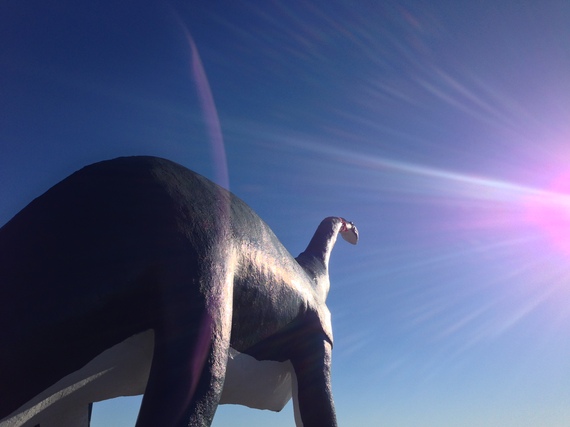
Driving from Pierce, S.D., west a few days ago, having been forewarned by hundreds of billboards lining the last hundred miles, just off the freeway, I was greeted by Wall’s 80-foot-long, concrete two-tone giant dinosaur, staring at me with its white light bulb eyes, entering the Wall Drug store vortex. Nickel coffee, touristy stuffed jackalopes and enough key chains and tee shirts to satisfy the most thirsty tchotchke devotee, alas, Wall Drug. The town of Wall, S.D., is the gateway to the Badlands National Park, which I’ve always wanted to see at sunset, and here I was, en route, driving my rent-a-wreck to Mt. Rushmore at the perfect time of day.
Neither disappointed, sunset or the next morning coffee with the presidents. In fact, in person, Mt. Rushmore is so much more touching, emotionally, than that picture in Encyclopedia Britannica I grew up looking at. Patriotism wrapped in the natural environment of a perfectly run National Park. The four grand leaders of our country (George, Tom, Abe and “T.R.,” among friends) are much bigger in person than I expected. Maybe that picture and my childhood View-Master limited my expectations. Even the size of the rubble pile was captivating. That rubble being its own monument to the years of invested lives, determination and dynamite liberating these figures from the mountainside. They loom large in the pages of history and literally tower at Mr. Rushmore.
All 50 states and territories are represented there, with their flags and dates admitted to the U.S. etched in stone. I grinned a little wider finding Oregon’s name in marble, telling myself how much better my state’s placement was than the other 49. Donning my Teddy Roosevelt hat with the pride of a child wearing mouse ears to Disneyland, I had my picture taken and posted it to Facebook, where my little grandmother in Sacramento gushed about me as if I were still a young boy and shared her pleasure in seeing Mt. Rushmore, even though she’s never been there herself. And isn’t that what protected lands provide Americans: the security that public parks and monuments are open, that our forests and rangelands are well-managed, even if you never get a chance to visit?
Driving around Custer State Park looking for buffalo, which is downright exotic to a Northwesterner, I was trying to decipher how this year’s dwindling pheasant population is hurting South Dakota’s economy. I’ve chased wild pheasants all over Oregon, fulfilling the employment act to the retrievers who live with me, and on this trip, I was privileged to hunt with the Governor Daugaard and a smiling, deaf English Springer, aptly named “Hunter.” Sadly, this year in the Great Plains, the Governor had to call state leaders together to grapple with the effects of an unusually low wild bird population, and, therefore, unusually low out-of-state-hunter-tourist population. Well, at least they have one of the crown jewels in the National Park system.
I understand politics. The Legislative shortens a budget; the Executive finds something to scare and make the public feel the pain. For Newt, it was school lunches; for Boehner, it was National Parks a few weeks ago. Closing National Parks was a partisan blunder that instilled even greater fear into western states as to whether or not the federal government can manage federal lands — no small concern, considering that the U.S. government is the largest landowner in the west. In today’s budget environment it’s an easy step to think national parks should be turned over to the states, removing the threat of Congressional politics. In South Dakota, the state runs at a budget surplus, but could you imagine California’s legislators considering selling off parts of Yosemite to balance their budget? National parks, monuments, and the like belong to all of us. T.R. had it right: federal policy can protect places from short-term pressures, whether it is hunting species to near collapse or today’s partisan budget battles, be that state or Congressional.
A recent report, “Protected Lands: A Government-lite Approach,” is trying to reframe the issue and its economics. The policy’s premise is that keeping American’s public lands and National Parks open must be consistent with the long-term health of the parks and public land and be founded on a strong working relationship with local communities, as well. No more winners vs. losers, left vs. right, environmental vs. the communities near that environment. The theory is to create federal policy with sustainable economic benefits in both “gateway” communities and the nation as a whole, while preserving America’s natural heritage.
I’m not too sure Wall Drug is the sort of gateway argued for, but Rapid City certainly is. As an Oregonian playing tourist, I was impressed how vibrant Rapid City is — hotels, restaurants, and full-scale Cabalas stores filled with out-of-state license plates. National parks are wonderful, and for many visitors, the only time they ever experience the natural United States. The concept of “government-lite” extends beyond just parks. I like to apply the concept to areas of our country where the public lands debate is still couched in terms of who has a job and who votes against local police levies.
In Oregon, Forest Service and BLM ground was teased back and forth to the logging industry during the spotted owl wars of the 1980s. As a result, several counties are on the brink of bankruptcy today because their budgets were built on a federal payment for not harvesting trees. Oregonians in those counties know the short shrift of trusting their federal government and the all too familiar pain of living in hurting communities. There is a balance that has not been struck.
Read the rest of… Jason Atkinson: Where the Buffalo, Jackalopes and Presidents Roam
By John Y. Brown III, on Wed Nov 27, 2013 at 12:00 PM ET
Winston is a several month old Ocherese weighing all of 2 1/2 pounds but with lots of confidence and spunk–and an annoying habit of making a 6:30am donation in my home office beside my work chair.
Me: (Le…aving for work.) “Hey Sweetie. Good morning.”
Winston (tail wagging and prancing outside my home office): “Check it out. I did it again.” (With evil puppy grin)
Me: “Come on, man. That’s not cool.”
Winston: “What?”;Laughing in mischievous way to self “Oh, yeah. That. Sorry. You gonna pet me?”
Me: “What if I did this to you every morning in your little pin? It would get old and you’d eventually stop licking me so much, right?”
Winston: “John, C’mon…I am a puppy. What do you expect?” Adding, “Pet me. Or I’ll do it again when you’re gone.” (Laughs mischeviously to self again and barks)
Me: “Whatever” as I reach down to pet Winston goodbye.


 Blog this!