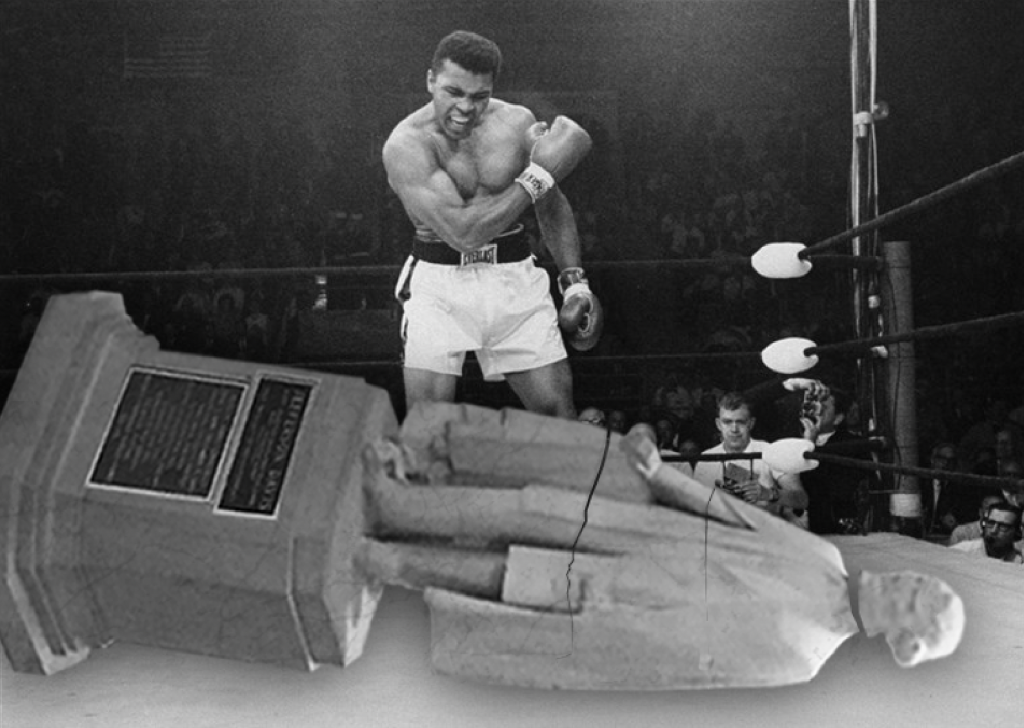
Please sign the petition below to remove the statue of Jefferson Davis currently in Kentucky’s Capitol Rotunda, and replace it with a tribute to Muhammad Ali, “the Louisville Lip” and “the Greatest of All Time.”
I just heard from the Ali family: It is the Champ’s belief that Islam prohibits three-dimensional representations of living Muslims. Accordingly, I have adjusted the petition to call for a two-dimensional representation of Ali (a portrait, picture or mural) in lieu of a statue.
UPDATE (Tuesday, December 2, 2014)
In this interview with WHAS-TV’s Joe Arnold, Governor Steve Beshear endorses the idea of honoring Muhammad Ali in the State Capitol (although he disagrees with removing Davis). Arnold explores the idea further on his weekly show, “The Powers that Be.”
Click here to check out WDRB-TV’s Lawrence Smith’s coverage of the story.
And here’s my op-ed in Ali’s hometown paper, the Louisville Courier-Journal.
UPDATE (Saturday, June 4, 2016)
In the wake of the 2015 Charlestown tragedy, in which a Confederate flag-waving murderer united the nation against racism, all of the most powerful Kentucky policymakers — U.S. Senator Mitch McConnell, Governor Matt Bevin, Senate President Robert Stivers and House Speaker Greg Stumbo — called for the removal of the Davis statue from the Rotunda. Today, as we commemorate last night’s passing of Muhammad Ali, there is no better moment to replace the symbol of Kentucky’s worst era with a tribute to The Greatest of All Time.
UPDATE (Wednesday, June 8, 2016):
Great piece by Lawrence Smith of WDRB-TV in Louisville on the petition drive to replace Jefferson Davis’ statue in the Capitol Rotunda with a tribute to Muhammad Ali.
UPDATE (Thursday, June 9, 2016):
Excellent piece on the petition drive by Jack Brammer that was featured on the front page of the Lexington Herald-Leader.
Highlight of the article:
Miller said he has received a few “angry comments” on his call to honor Ali.
“One of them encouraged me to kill myself,” he said. “You can quote me that I have decided not to take their advice.”
UPDATE (Friday, June 10, 2016)
The petition drives continues to show the Big Mo(hammed): check out these stories from WKYU-FM public radio in Bowling Green and WKYT-TV, Channel 27 in Lexington:
UPDATE (Saturday, June 11, 2016):
Still not convinced? Check out this excerpt from today’s New York Times:
I follow up my observations about the challenges conservative reformers face with some thoughts about how those issues are playing out in the debate over Common Core educational standards. Stanley Kurtz’s observations on the subject in National Review Online are a pretty fair articulation of the right’s grassroots based activism against the Core. To be sure, he gets lost in his share of rabbit holes—raising the Fifth Amendment-taking IRS bureaucrat Lois Lerner as a bogeyman is about as irrelevant as Arnie Duncan’s comparing opposition to the Core to worrying about black helicopters; and Kurtz’s specter of liberals imposing “fuzzy math” sounds loopy because it is—but he highlights the dilemma rank and file Republican politicians are running into. And his claims raise an important question right of center Republicans ought to be stressing over: is education reform about to become the next subject that Republicans are about to cede to the left?
To be sure, the Core is not the most inspiring kind of fight. Liberals who spent the last decade waging trench war against national accountability standards are playing a hypocritical game by suggesting that resistance to Washington driven reform is now the province of Luddites and primitives. There is no question that curriculum content is being artificially elevated to the point that it is drowning out elements that are far more decisive to student achievement, like the deteriorating quality of entry level teachers, the impediments against parents transferring their kids out of under-performing schools, and the institutional protections that make replacing inept teachers all but impossible in many districts. It is also far from clear that state by state variations in the Core’s focus of math and science teaching are as substantial as some advocates suggest.
But Kurtz and some of the Core’s sharpest critics go too far in their suggestion that education should not even be on the table as a national agenda item, and it’s worth remembering that they hardly represent the only conservative vision on educational policy. In fact, for most of the last decade, the right’s critique of No Child Left Behind was not that it overstepped some constitutional line but that the law wasn’t aggressive enough about incentivizing ideas like vouchers or charter schools. True, a number of conservatives questioned the heavy handedness of the Race to the Top fund; but for much of the first Obama term, the case was made with equal force that it imposed too weak rather than too strong a set of rewards for tenure reform or merit based pay for teachers.
As sanguine as Kurtz is about the decision-making processes of local school boards and state legislatures, the local and state level have been venues where teacher unions have typically been far more effective than reformers in driving their cause. It’s an illusion that a locally driven debate is necessarily one that favors the interests of parents or accountability, and conservatives who think so should be discomfited by the ease with which the teacher unions mimic arguments about local control in their efforts to thwart the most rigorous goals within Race to the Top.
Until recently, the political right also seemed to enjoy a rough consensus that the values that underlay the effort to prod states and districts toward more demanding standards on education were conservative in nature. As much as today’s conservative libertarians denigrate George W. Bush’s forays into rewriting education law at the national level, those efforts deserve to be appreciated as a campaign to inject market driven notions of performance and results into education rather than some weak kneed effort to pander or out-promise Democrats.
To be sure, there are very few conservatives who don’t have a palpable suspicion of the federal government using the leverage of funding to compel states to do much of anything. And it’s not a revolutionary insight that reforms are most politically palatable on the right if they are linked to language and values that ordinary Republicans will embrace. Given those realities, Republican governors who are shortchanging populist initiatives like overhauling tenure and parental choice will probably find that they haven’t stored up enough capital with their base to take on fights like the Core.
Read the rest of… Artur Davis: Conservatives and the Fight Over the Common Core
By Lauren Mayer, on Tue Jun 11, 2013 at 3:00 PM ET
Anyone familiar with 12-step programs or various philosophical guides to serene living will tell you that the key to happiness is to surrender to the moment, to change what you can, to accept what you cannot change, and to know the difference. And anyone familiar with air travel in recent years will tell you that even the Dalai Lama would struggle with staying serene when you’re confronted with cancelled flights, long lines, inedible overpriced food, and cramped uncomfortable seats.
But we do our best to cope – for me, that means loading my Kindle with a wide assortment of reading material and bringing socks along so I don’t have to think about what I might be getting on my feet in the security line. For others, it may mean scoping out the best chair massages amd cheapest bars. And for everyone, it means trying our hardest to surrender, to remind ourselves ‘this too shall pass’ and we will, despite all appearances, eventually get to our destination.
Occasionally I try to go one step further and look for the silver lining – can anything good come out of this experience? I know of one couple who met in line to get re-routed after their flight was cancelled, and I have one friend who travels frequently for work and wrote a book while she was waiting at airports. Up until recently, the only unexpected benefit of air travel hassles I’d ever experienced was on the third leg of a rescheduled flight that was originally nonstop – I was so sick of sitting, I had walked back to the galley, started chatting with the flight attendant, and found out we had a friend in common. When she heard I’d been on the canceled flight, she poured me a double scotch and didn’t charge me. I immediately felt better – sure, the scotch helped, but it was more the unexpected generosity.
And lest you think that my only silver linings involve alcohol, this past weekend provided another. I had yet another delayed flight and long wait at a small airport, and I was also panicking since I’d been away, hadn’t kept up with the news and thus hadn’t figured out what this week’s song would be about. As I was combing through the newspaper looking for an idea, I heard the announcement about my delayed flight and a lightbulb went off – I could write a song about air travel, instead of just complaining about it! Suddenly, what was once a huge annoyance became a source of inspiration, or as my ‘woo-woo’ friends say, I reframed the experience. (Of course, it’ll only work this way once, but I’ll take what I can get!)
So have faith – next time you have a cancelled or delayed flight, look for something fun and unexpected to happen (or at least look for the nearest good chair massage place), and if you aren’t lucky enough to travel much, you can hum this song to get the general idea.
By Nancy Slotnick, on Tue Jun 11, 2013 at 8:30 AM ET
I read recently that 35% of Americans suffer from chronic loneliness. Ok, I did read it on the American Bible Study building’s electronic billboard. But that doesn’t mean it ‘s not true. When I was single in my 20s, after a really hard break-up, I was so lonely that I could physically feel an ache in my stomach. Maybe that had some direct correlation to the emotional eating frenzy that was definitively not a sign of wallowing. No, that was not it.
With my coaching clients, I dole out a lot of strategy and advice. But the most valuable service I provide is a lifeline to a world where a healthy relationship can be a comfort. Unfortunately for the state of affairs on marriage in this country, loneliness is not confined to singles. But it is much harder to dig yourself out of the loneliness hole when you are single. I think of Uma Thurman in Kill Bill, banging and clawing her way out of the coffin that she was nailed into and buried 6 feet under. Almost impossible but she did it. Such is the work here. But it’s so worth it.
So how do you go from the isolation of living alone in a Facebook-induced haze of faux connection? Not that I am knocking Facebook. Geez, my wholeMatchmaker Café business is based on Facebook. But there’s a reason that all of this social networking makes us feel more lonely. We use it as an end in itself instead of a means to an end.
If you want to use Facebook for dating (which everybody does), take specific action. Connect with 10 old friends, message someone to ask them to set you up, or message me to stalk someone for you! (Yes, I do this and it’s very discreet – I’ll explain if you write me).
Don’t resort to emotional eating and watching the Real Housewives – that only makes it worse. Eat and drink from the cup of life – it’s scary but it’s the only way.
Click here to purchase e-book for ONLY 99 CENTS this week only
There was nobody happier than I was when term limits ended my official position in 2008. I was tired of feeling responsible for all the problems that needed to be fixed in our state. I was also tired of getting beaten up in the press and having my enemies constantly trying to take me out. As a private citizen, I thought I would be able to be behind the scenes, work on my friends’ campaigns and not be in the crosshairs each and every day.
Unfortunately, my marriage was in bad shape by that time; and even though I was out of office, things continued to get worse. In early 2009, we separated; and by October, we were divorced. I tried to tell everyone it was a good thing for me; but inside, it really messed me up. After all, we had been married almost 20 years and had raised three wonderful kids.
I was a 42-year-old successful divorced man, whose personal life was not turning out like he planned it. My dad was a Baptist preacher, and the best parents in the world had given me a perfect childhood. I was a family values conservative Republican who was not supposed to have these types of problems. I won’t go into details, but my life was not reflecting the teaching my parents had taught me, nor was I being the example I wanted my kids to see.
I don’t know if you believe in God or not, but I do! In December of 2009, God finally had enough of my hypocritical ways and got my attention. After spending the night with a lady I had reconnected with on Facebook, I was charged with felony assault. The press, along with my enemies, had a heyday. I immediately shut down my consulting business. Soon after that, I was notified that I was a target of a federal grand jury investigation surrounding my handling of a bill in the 2005 legislative session.
Needless to say, I started 2010 with no job, very few friends and lots of time on my hands. As bad as my troubles were at the time, looking back now, I’m thankful for them. Life passes by so quickly, and very few of us get the chance to sit down and contemplate what is important. My troubles gave me a chance to analyze my weaknesses. With my pride stripped away, I was able to honestly evaluate my past actions. I saw how foolish I had been to put my family on the back burner. I learned how bitterness towards my enemies made me a bitter person toward everyone around me. The hardest thing for me to admit was that I wasn’t the same friendly and caring guy who had gone to Jefferson City in 2000.
Most of my friends say, “Rod you were not that bad, you handled it well. You were polite and treated everyone with respect. We liked you then, and we like you now.” I’m very thankful for those friends and their friendship, but I know the prideful thoughts I was thinking, and I know I should have handled things better.
As I mentioned earlier, I’m thankful for all the successes I was a part of. I’m also grateful for all the kind people I met along the way who helped and encouraged me. But I wish I would have worked less and stayed home more; been more forgiving and not gotten bitter at my opponents; been less prideful, less judgmental and more understanding. Plus, I wished I had lived the personal life I believed, instead of being such a hypocrite. Of course, I can’t change the past. I can only look to the future and focus on learning from my mistakes.
Life is wonderful for me now. Each morning, I wake up and thank God for the day. I spend more time with my family and stay connected with my friends. I have a lovely new wife, a great job and a contentment I never knew in my first 42 years of life. I was never convicted in the assault case, and the grand jury suspended their investigation into the ethics allegation and never charged me with a crime. I have slowly begun gaining back the respect I lost from my bad choices, and I am even back in politics.
Let’s face it. Sooner or later we are all going to make a mistake; we are all going to do something stupid that we regret.
Sometimes these mistakes go unnoticed and don’t cause us much trouble publicly. But for those in the limelight, their mistakes are written about, analyzed and discussed in the public square.
It happens to celebrities, business leaders and athletes; but it also happens to parents, kids and everyday people. Anyone who has made a mistake that becomes public has a problem; and how you deal with it will either make it a bigger problem or put it in the rear view mirror.
Just in case you’re thinking, “It can’t happen to me!” think about this: Powerful politicians, corporate leaders, pro athletes and Hollywood stars all have opponents, enemies and even subordinates who believe it is in their best interest to help promote problems for them. The more powerful or well known you are, the more likely it is that others are looking harder to find the mistakes you make. Additionally, the press desperately needs scandals to generate readers/viewers, and most reporters dream each day about breaking the story that takes someone down.
===
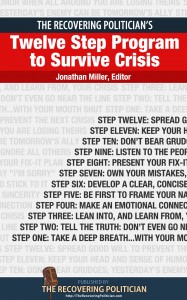
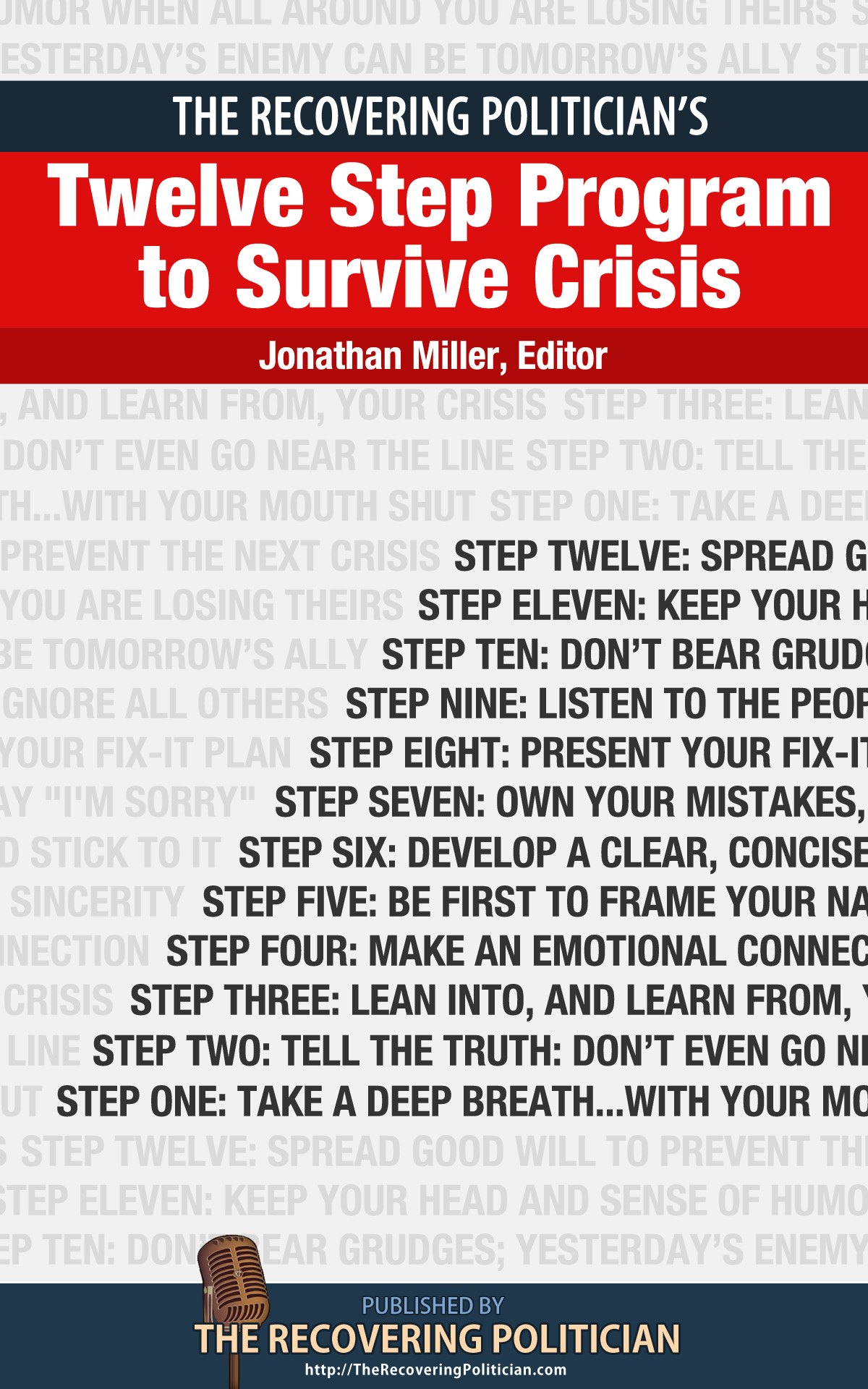
Click here to read the rest of Michael Steele’s extraordinary chapter by purchasing The Recovering Politician’s Twelve Step Program to Survive Crisis for only 99 cents this week only.
By John Y. Brown III, on Mon Jun 10, 2013 at 12:00 PM ET
What’s in a name? In the business world, more than we usually think….
Award for worst named new technology in the past decade?
“The Cloud” A remote point for storing massive amounts of sensitive data
Nothing says security like “I’m moving my data from the server in IT to a place where it will be more secure and accessible. Something called “a cloud”
It’s like calling a sturdy new product for storing dangerous liquids “The Sieve.”
I know that were naming the new technology based on its physical (or rather non-physical) characteristics.
But it’s important to remember when naming a new product or service–especially one that is supposed to change the world— to think not only of the “appearance” but also of the benefit it produces for future users.
And surely the name “The Cloud” has given pause to IT directors who might otherwise be eager to take the leap (worth billions for a truly superior product)but resist because they have to explain to their boss how “The Cloud” isn’t anything like a cloud but just the opposite.
Of course in naming some things, like boys and girls, neither appearance nor functionality are helpful. But even painful names like Helga and Norbert would have been better for remote data storage than “The Cloud.”
I would feel secure with all my sensitive data stored in “The Norbert” or “Helga”
Then again maybe the person who came up with the name “The Cloud” was named Norbert or Helga —and was just trying to get even. That might explain it.
By Erica and Matt Chua, on Mon Jun 10, 2013 at 10:00 AM ET
WHAT WAS YOUR SCARIEST TRAVEL MOMENT?
HE SAID…
For reasons yet unknown I found myself quite intoxicated. Maybe it was the beer with lunch, or the beers between lunch and dinner, certainly the beer at dinner didn’t help, but no matter when and how, I needed to go home. Home was our friend’s Hong Kong apartment which we had arrived to the day before. He lived, conveniently for those of us of Chinese descent, above a 24-hour Dim Sum restaurant and a 7-11. While great neighbors, both of these establishments are as frequent as skyscrapers in Hong Kong, which means it could be anywhere on Hong Kong Island. If you didn’t know exactly where his street is and where to find his discrete door, you’d never find his place. Luckily for me, with built-in GPS, even in the state of inebriation I was in, I could found his place after leaving LOCAVORista and Michael to drink the night away.
Hours later I woke to the sound of the door opening I saw Michael enter…alone. He turned on the light, looked me straight in the eye and said, “I lost Erica.” This was an “oh-shit” moment. I asked what happened, to which he responded, “last I saw her she jumped over a median and was running. You wouldn’t believe how fast she is! I tried to catch her but she was gone…” She had little money on her, didn’t have a credit card, or any way to contact us. We had no idea where she could be, how to find her, or if she’d be able to find a safe place for the night. We thought about going to the police, but realized that was best done in the morning, hoping we would find her before we would need to explain ourselves.
We had lost Erica. This wasn’t the first time, but definitely the most serious. Losing Erica on the Macalester College campus at home was one thing, Hong Kong, a city we’d been in for two days, was another matter. Knowing this was a situation with no resolution we cracked open another beer and watched “Swamp People”, because, you just lost your wife…what else are you going to do?
Read the rest of… Erica & Matt Chua: He Said/She Said FAQ — Scariest Travel Moment
We can learn a lot about innovation by observing the social behavior of honeybees. Who hasn’t been riveted by devastating stories of colony collapse? This is serious stuff. From a honeybee’s perspective watching 35% of your fellow Apis mellifera get wiped out is no joke. From a human perspective, think of it this way, one out of every three mouthfuls of food we eat is dependent on honeybee pollination. Bees are responsible for about $15 billion in U.S. agricultural crop value. Colony collapse really matters. It’s worth paying attention to bees.
The term colony collapse disorder was first applied to a drastic rise in the number of honeybee disappearances in 2006. It’s an eerie phenomenon where one day worker bees swarm together in great numbers and the next they are gone, poof they just disappear, leaving behind an empty hive. It’s not as if they leave to join another colony. They leave to die alone and dispersed which is strange given the social nature of honeybees. Scientists have been working feverishly to determine the etiology of colony collapse disorder.
I read with great interest the recent announcement that researchers collaborating from academia and the military had found the answer. I am a sucker for a good collaborative innovation story where unusual suspects tag team across silos to solve a problem that neither of them could solve on their own. This one is a classic. Army scientists in Maryland working with academic entomologists in Montana solved the mystery. They applied proteomics-based pathogen screening tools to identify a co-infection comprised of both a virus and a fungus. They found the combination of pathogens in all of the collapsed colonies they tested. Hopefully their findings will quickly lead to pathogen mitigation strategies dramatically reducing the incidence of colony collapse disorder.
While I am glad the mystery is solved I can’t help asking, what is it about organizing in colonies that prevents bees from innovating themselves. And closer to home, aren’t bee colonies like hierarchical corporate structures? Maybe understanding the social behavior of bees in their colonies will help us understand why corporate structures are also vulnerable to colony collapse.
Read the rest of… Saul Kaplan: Innovation Lessons From Bees
By Carte Goodwin, on Mon Jun 10, 2013 at 8:15 AM ET
Click here to purchase e-book for ONLY 99 CENTS this week only
Some times crisis can be borne of tremendous good news – a chance of a lifetime; or put another way, when the dog finally catches the car. As one of my political heroes, President John F. Kennedy, once noted, “The Chinese use two brush strokes to write the word ‘crisis.’ One brush stroke stands for danger; the other for opportunity.”
I’m living testament to that principle. A childhood dream almost literally was dumped in my lap. It was an extraordinary opportunity. But it came with considerable responsibilities and posed some serious challenges.
And I learned a powerful lesson for all forms of crisis management: Keep your head and sense of humor when all around you are losing theirs.
* * *
In July 2010, I was a 36-year-old attorney, recently returned to private practice after an incredible four-year stint as General Counsel to West Virginia Governor Joe Manchin. Then, West Virginians were saddened to learn of the passing of Senator Robert C. Byrd – one of the true lions of the Senate and West Virginia’s most beloved public servant.
Governor Manchin had a strong interest in serving in the Senate (and ultimately, he would run for and win the seat); but as a man who believed in the sacred rites of our democracy, he did not want to appoint himself to the vacancy: He’d let the voters decide if they wanted to give him the honor of federal office.
But he also recognized that the people of West Virginia needed representation during the four months before a special election could be held. And much to my incredible honor, Governor Manchin appointed me to serve as West Virginia’s junior U.S. Senator.
Senator Byrd cast quite a long shadow, and it was daunting to contemplate being appointed to fill the seat previously occupied by the longest serving legislative member in the history of the United States. I could not begin to replace Senator Byrd or ever hope to fill his enormous shoes, but what I could do was emulate his work ethic and commitment to West Virginia – which is precisely what I strove to do during my four months in Washington, a town ruled by Congress, Blackberries and Members-only elevators; and a place where fame (and infamy) can come and go in a matter of hours.
(Side note: Years before, former Oklahoma standout and Chicago Bulls forward Stacey King saw limited action in an NBA game, hitting a single free throw. That same night, his teammate Michael Jordan poured in 69 points. Afterwards, King joked that he would always remember that game as the night that he and Jordan “combined for 70 points.” Similarly, rather that describing my term as “four months,” I usually characterize it by saying that Senator Byrd and I combined to serve over 52 years in the United States Senate.)
Within days of my arrival, men and women I had studied in law school were introducing themselves to me, welcoming me as one of their own, then asking for my vote in the same sentence. And I wasn’t alone; I was immediately put at the helm of a full Senate staff – many of whom had served for decades under Senator Byrd. I was given a personal secretary and press secretary – no longer would I be the one answering the phone in my own office. However, I declined the offer of a personal driver and walked myself to work.
In fact, as the august body’s youngest member – and one who had never stood before the voters – I found it especially important to strongly resist all temptation to allow any of the unusual attention get to my head. Maintaining humility was critical, but also approaching the extraordinary opportunity with a healthy sense of humor would be a necessary prerequisite.
===
Click here to read the rest of Carte Goodwin’s extraordinary chapter by purchasing The Recovering Politician’s Twelve Step Program to Survive Crisis for only 99 cents this week only.
By Jonathan Miller, on Sat Jun 8, 2013 at 12:36 PM ET
I was greeted this morning by a letter to the editor in my hometown paper, the Lexington Herald-Leader that repeated a variety of bizarre conspiracy theories (including the one where Bush and Cheney ordered the 9/11 attacks) and ended with this highly offensive line:
A continuation of 5,700-plus years of Jews buying their host country’s leadership in the name of a non-existing God of Abraham.
There’s no one who feels more strongly about the sacred nature of our First Amendment rights. I support anyone’s freedom to spew hateful, bigoted trash like this.
But there is no obligation on the part of the Lexington Herald-Leader to publish such offensiveness. Indeed, with all of the letters I imagine that fill their in boxes every day, I would imagine that they wouldn’t have room for such an blatant anti-Semitic rant.
I’m hopeful that we will hear an explanation or an apology soon from the paper’s leadership.


 Blog this!