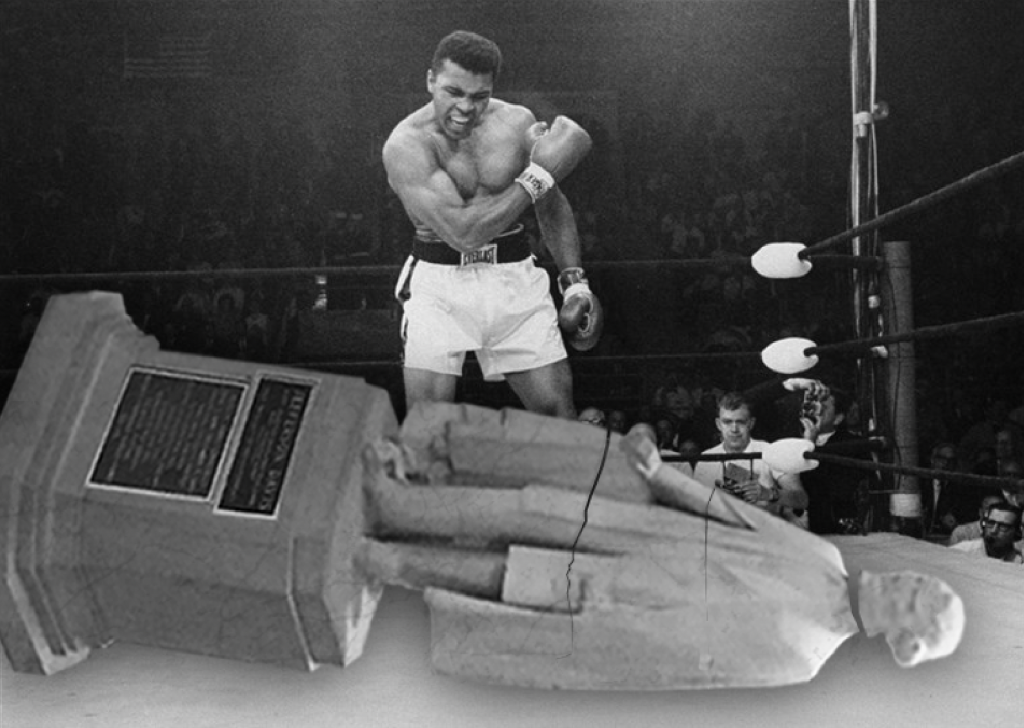
Please sign the petition below to remove the statue of Jefferson Davis currently in Kentucky’s Capitol Rotunda, and replace it with a tribute to Muhammad Ali, “the Louisville Lip” and “the Greatest of All Time.”
I just heard from the Ali family: It is the Champ’s belief that Islam prohibits three-dimensional representations of living Muslims. Accordingly, I have adjusted the petition to call for a two-dimensional representation of Ali (a portrait, picture or mural) in lieu of a statue.
UPDATE (Tuesday, December 2, 2014)
In this interview with WHAS-TV’s Joe Arnold, Governor Steve Beshear endorses the idea of honoring Muhammad Ali in the State Capitol (although he disagrees with removing Davis). Arnold explores the idea further on his weekly show, “The Powers that Be.”
Click here to check out WDRB-TV’s Lawrence Smith’s coverage of the story.
And here’s my op-ed in Ali’s hometown paper, the Louisville Courier-Journal.
UPDATE (Saturday, June 4, 2016)
In the wake of the 2015 Charlestown tragedy, in which a Confederate flag-waving murderer united the nation against racism, all of the most powerful Kentucky policymakers — U.S. Senator Mitch McConnell, Governor Matt Bevin, Senate President Robert Stivers and House Speaker Greg Stumbo — called for the removal of the Davis statue from the Rotunda. Today, as we commemorate last night’s passing of Muhammad Ali, there is no better moment to replace the symbol of Kentucky’s worst era with a tribute to The Greatest of All Time.
UPDATE (Wednesday, June 8, 2016):
Great piece by Lawrence Smith of WDRB-TV in Louisville on the petition drive to replace Jefferson Davis’ statue in the Capitol Rotunda with a tribute to Muhammad Ali.
UPDATE (Thursday, June 9, 2016):
Excellent piece on the petition drive by Jack Brammer that was featured on the front page of the Lexington Herald-Leader.
Highlight of the article:
Miller said he has received a few “angry comments” on his call to honor Ali.
“One of them encouraged me to kill myself,” he said. “You can quote me that I have decided not to take their advice.”
UPDATE (Friday, June 10, 2016)
The petition drives continues to show the Big Mo(hammed): check out these stories from WKYU-FM public radio in Bowling Green and WKYT-TV, Channel 27 in Lexington:
UPDATE (Saturday, June 11, 2016):
Still not convinced? Check out this excerpt from today’s New York Times:
By John Y. Brown III, on Fri Jun 7, 2013 at 12:00 PM ET
If I could give high school freshmen one piece of advice to motivate them to work hard the next 4 years, it would be this.
“The primary importance of working hard and achieving a lot in high school is that high school, fairly or unfairly, is where we develop our core opinion of ourselves. If we do well, we have high self-esteem. If we do poorly, we worry we will have to spend the rest of our lives fooling our bosses.”
It’s a self-image thing primarily.
But there is also a very measurable financial component that can be measured.
Over the course of a lifetime your success over the next four years in high school will be worth about $300,000. In avoided therapy bills.
But at the end of all that therapy you’ll learn that the people who did well in high school that you envy, think they are faking it too and fooling their bosses. They just believe they are better at fooling others than you are. That’s the chief advantage in life. None of us feel we’re up to the task. Except that one family member we all have who is a certifiable narcissist. (Or four or more family members in certain families.)
And, if you don’t have a have a successful run in high school and become a therapist yourself, you’ll eventually get to treat those students from high school who achieved the most. They will want to meet discreetly and late at night and you can charge them a lot more than your other clients. And they can pay. So charge them. It will make you feel better and finally realize they really had nothing on you all these years and are a bigger mess than you are.
It’s awesome when that happens.
Which leads to the second thing I would tell 9th graders if I could.
The universe has a way of balancing out in the end. So don’t sweat it if you aren’t able to take advantage of my first piece of advice. Just be patient and keep a sense of humor. And have an office space you can meet wealthy but screwed up salutatorians after hours.
One pundit I admire, Ross Douthat, and another I admire and count as a friend, Reihan Salam, have waded into the debate over whether reform conservatism amounts to a coherent ideological vanguard, or is only a loose blanket for a set of sensibilities about what the political right should start to sound like. I lean more toward the latter, which is Salam’s take, for a variety of reasons: the splintering of conservative reformers over immigration; their imprecision on the bullet points of the healthcare fight (are they bothered by the “cadillac tax” for high quality insurance plans, or is it the one thing they like about Obamacare); the lack of a defense in conservative intellectual circles for Senator Pat Toomey’s bravery on guns; the fact that the class of reformers is made of columnists and bloggers and not congressmen and presidential aspirants all undercut the idea of even a sort of unified front. But what Salam calls a “tendency” still reminds me of what Democratic reformers were doing 20 years ago. And if history repeated itself, it wouldn’t be a bad thing.
First, the history: for all of the varnished memories of exactly how Bill Clinton and the Democratic Leadership Council reframed their party, it was no masterpiece of cohesion around policies or specific goals. To be sure, Clintonian reformers were virtually all free traders and advocates of tougher teacher standards and charter schools. To a person, they thought that welfare was too easy to obtain and even easier to depend upon, which distinguished them from 20 years of liberal rhetoric.
But these were relatively small sized pieces of the conversation at the time. On a much larger array of issues, Democratic reformers were all over the map. Some were ardent social liberals, who even then touted gay rights, others were notably sympathetic to the pro life movement and uncomfortable that liberalism verged on being libertarian. Some were anti-affirmative action, just as many thought anti-quota talk made them sound like mini Pat Moynihans (a Democrat, but a liberal scourge for years for his advice that the subject of racial injustice could use a dose of “benign neglect”). Some thought it a priority to readjust Reagan era tax rates to take a bigger chunk from the wealthy, others were self-consciously pro-business (the DLC’s bills were always heavily footed by industry lobbyists) and promoters of corporate rate cuts. One camp embraced comprehensive healthcare reform, another feared it was too costly and smacked of sixtyish redistribution.
There was, in other words, a consensus on a few second tier agenda items, disarray on the hottest subjects in politics, mixed with a strategic instinct about making Democratic political language more middle class friendly, deemphasizing identity based appeals, and there was a fondness for the word “community” without a lot of common ground on what that meant.
Yet, for all of the ambiguity, Democratic reformers in the gap years between Reagan and Clinton mattered a great deal. They introduced thematic arguments that were foreign to the liberal activists who had controlled the Democratic nominating process since 1972: notions like personal obligation, mutual responsibility and the concept that a downsized government could more efficiently promote progressive values, and that all of these principles were not code words for survival of the fittest. And by driving these arguments, DLC style Democrats showed a side of their party that was more attractive to blue collars and suburbanites than the interest group beholden, socially permissive brand of their intra-party rivals.
It strikes me that today’s right of center reformers are doing something similarly abstract, but potentially just as vital. The reform crowd is injecting into the conservative value stream the ideas that (1) middle class insecurity and stagnant wages are a genuine threat to the national wellbeing, a concept that explicitly rejects the assessment that over-regulation is the only source of trouble; that (2) public policy can and should promote economic upward mobility, although through market oriented means, which diverges from the Tea Party wing’s constitutionalism, and its single-minded desire to whittle government down to no domestic agenda other than protecting economic liberty; and that (3) there is such a thing as entrenched inequality, especially in areas like education and access to healthcare, and that the interest in social cohesion gives conservatives stakes in carving out opportunity based solutions.
If I had my druthers, I would push that reform mindset further than some of my cohorts on the center right would. I line up with the majority of Republicans who believe expanded background checks for buying firearms don’t shatter the rights of any law abiding citizen. I think the “Cadillac plan” tax in Obamacare is as lousy a policy as the individual mandate and is far more likely to break the backs of middle income workers. I am much more dubious than many conservatives that a First Amendment that was designed in a century where campaign contributions barely existed is a spigot for unfettered campaign dollars by businesses or individuals. I would rather see an immigration approach that got tougher in tangible ways, like making illegal entry a felony and making an illegal immigrant’s failure to declare and register a deportable offense, but still provided some form of legal gateway for the undocumented, to either the overly complex bill working its way through the Senate or to an enforcement only approach. And I would trust states to resolve the debate over defining marriage, which separates me from some reform conservatives who would embrace a right of same sex marriage as another extension of limited government.
But even the more slimmed down principles I describe earlier are a way of taking on the political and rhetorical landscape that has dominated the Republican Party of late and articulating a different path. That’s not much of a policy synthesis, per se; as Reihan Salam puts it, it is well short of a movement. But it is, I suspect, as essential as what the center left’s reformers did a generation ago. If only this right-leaning reform impulse is set to have as good a run as its Democratic predecessor.
If you’ve ever wondered what colors will bring out the handsome devil in you, you might want to consider having a color analysis done. This is a process by which someone trained in color drapes you in various fabrics to determine your optimal color palette. The idea is that the “right” colors will brighten skin tone, even out complexion, smooth skin texture, balance the shapes of your features and make you appear rested and younger. The “wrong” colors will dull skin and drain your coloring, making you appear tired and sallow…not cool at all!
Check out this video of me with the ever-dynamic Mary Schook on a Chinese news hour that aired this past weekend. In it, we discuss how colors relate to the Asian population, namely women:
Yes, color analysis may sound super girly, but it’s of particular relevance to guys, and here’s why: women can get away with wearing the “wrong” colors because they use makeup to help negate any ill effects those colors may have on how their skin looks. Most men, however, don’t wear makeup, so it’s crucial if they want to make flattering clothing choices that they know what colors will look fantastic on them.
If you’re in the New York Tri-State Area or metro-Boston and are interested in getting your colors done officially (and in English), contact me.
By Jennifer Mann, on Fri Jun 7, 2013 at 8:15 AM ET
Click here to purchase e-book for ONLY 99 CENTS this week only
In the midst of my tenure in office as a Pennsylvania state representative, a statewide scandal uprooted the political landscape like a tornado of Wizard of Oz proportions. For those of us unscathed and continuing work in Pennsylvania’s Capitol, we were still left with a “we’re-not-in-Kansas-anymore” reality that proved tense, to say the least.
“Bonusgate” was the pithy pet name for a massive investigation into political corruption in which millions of taxpayer dollars were misappropriated as bonuses to legislative staffers who were campaigning while on the clock.
The investigation wound together deceit, cover-ups and political finger pointing into a whirlwind that swept up some of the state’s longest serving lawmakers. Some of my colleagues caught up in the storm of rapid-fire reporter questions and constituent scorn landed not in Oz, but in jail. Many more were thrown out of office, as voters took their anger to the polls and elected one of the largest freshmen classes in the state’s history. It was a scary time to be a state representative.
Just as a point of reference, I should note that Pennsylvania is one of the few states to employ a full-time legislature and no term limits. For those who choose to run for office and succeed, there is a scary realization that your career and income is suddenly in the hands of voters. And while I will defend the importance of maintaining a full-time legislature, I’ll admit that the overlying threat of getting the potential “pink slip” at the polls leads to a protective instinct that’s palpable around the Capitol. The desire to survive creates a sub-culture of risk-taking, and even forces a select few to cross the line between right and wrong. This is my assessment of what creates corruption, at least in this case.
When the Attorney General released the first of many findings in the Bonusgate investigation, careers and reputations were ruined almost instantly, and the career carnage kept coming. Fortunately, I was a Bonusgate bystander, a safe distance from the action.
Until one morning, I wasn’t.
When the reporter contacted me to get my side of the story on the juicy tidbit of information he had, supposedly tying my top aide to Bonusgate, I responded openly and with the same nothing-to-hide style that was the core of my political reputation.
Still, by the time I hung up the phone, my stomach was in my throat. The mere thought of the article hitting newsstands consumed my thoughts and nerves. I tried to hope for the best, like a sidebar blurb buried somewhere in the back of the paper.
The resulting banner headline that greeted me soon after was the antithesis of any style or reputation I had cultivated, and it was far from hidden. Instead, it alluded to a direct link between my senior staffer and some of those who had fallen the farthest in our state’s scandal.
In reality, the full-color, front-page exposé was all style, no substance. The emails cited were taken out of context. The source faced criminal conviction and had already established a jailhouse-snitch notoriety for trying to invite company into his misery. And the fact was that my staffer had not pocketed any tax dollars for his time spent on the campaign trail.
Still, the timing of the story and the wording in the headline alone suggested a cover up that could only serve to outrage vexed voters even more.
I processed the article like a boxing match transpiring in slow motion. I saw the heavyweight square up, cock his arm and start to pivot slowly as his fist came straight for my face. The best I could hope for was a permanent black eye, but I’d seen this fight before, and it typically ended in a total knockout.
My phone rang before impact. It was my staffer and subject of aforementioned article. We had a conversation that I vaguely recall as, “Oh crap! Oh crap! Oh crap!”
===
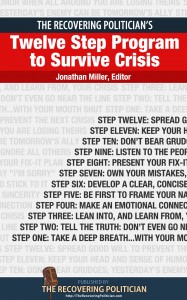
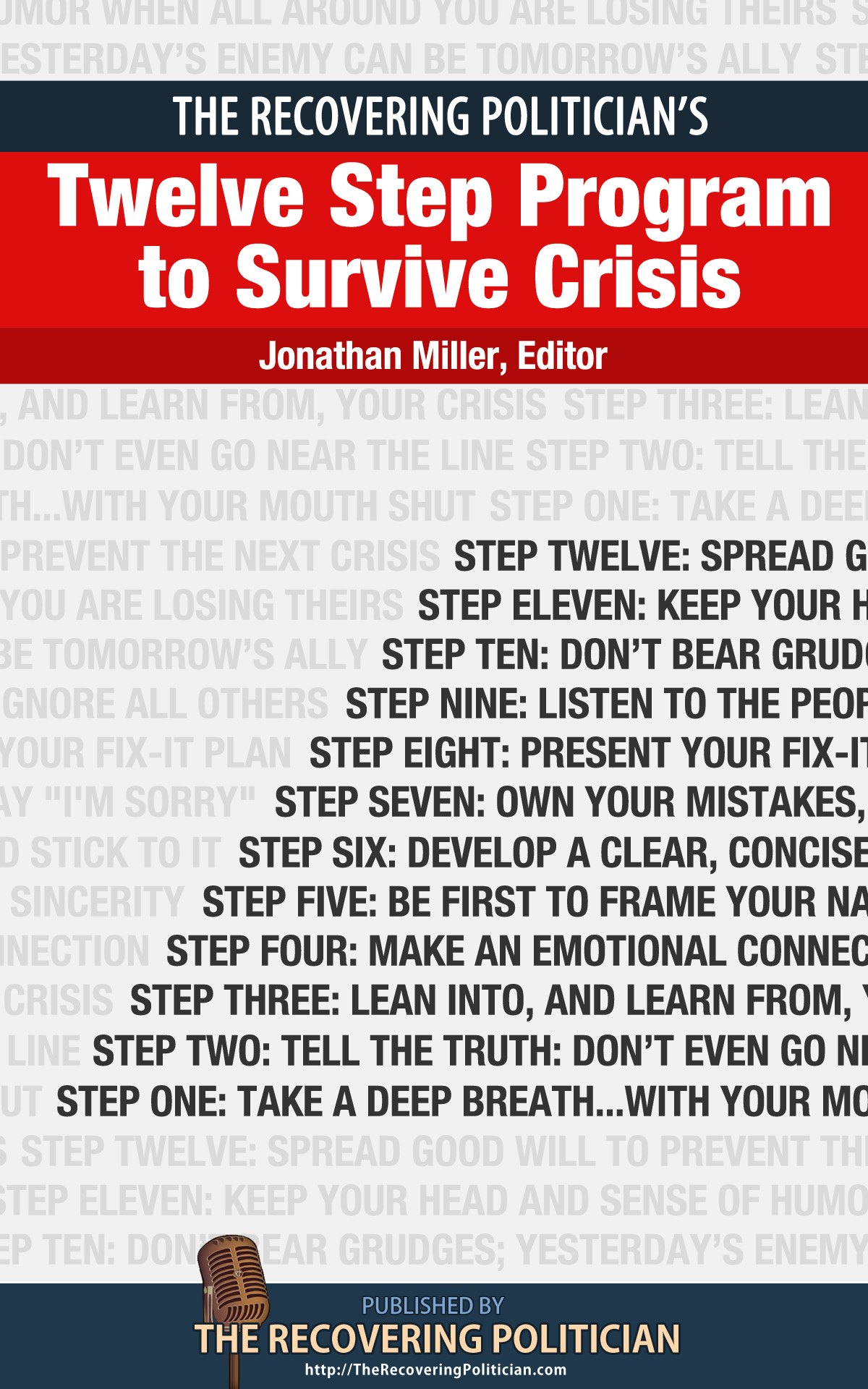
Click here to read the rest of Jennifer Mann’s chapter by purchasing The Recovering Politician’s Twelve Step Program to Survive Crisis for only 99 cents this week only.
By Jonathan Miller, on Thu Jun 6, 2013 at 10:00 PM ET
Click here to purchase this week only for 99 cents
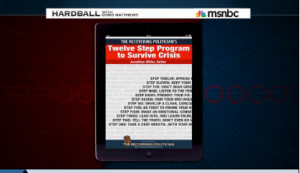
On tonight’s MSNBC “Hardball,” host Chris Matthews plugged The Recovering Politician’s Twelve Step Program to Survive Crisis after a discussion with former RNC Chair Michael Steele, a co-author of the book.
By Jonathan Miller, on Thu Jun 6, 2013 at 3:00 PM ET
Welcome to Episode One of The Recovering Politician’s CRISIS TV, a weekly roundtable discussion of the highest profile national scandals, with expert analysis from those who’ve served in the arena and suffered through crises themselves.
SPOILER ALERT: Be prepared to laugh — these former pols tend not to take themselves too seriously.
CRISIS TV is hosted by The RP, former Kentucky State Treasurer Jonathan Miller.
This week’s guests include:
Michael Steele, former Chairman of the Republican National Committee and former Lt. Governor of Maryland
Courtney Spritzer, co-founder, SOCIALFLYNY.com, a social media consulting firm.
Click here to order, this week only, for 99 cents
This week’s topic — the Obama Administration’s IRS scandal.
The panelists discuss where all of the President’s men (and women) have gone wrong, how they could have handled the crisis more effectively, and what advice they would share with the White House.
The panelists discuss the lessons they learned from their own crises, detailed in the book they co-authored, The Recovering Politician’s Twelve Step Program to Survive Crisis. Click here to order, this week only, for only 99 cents.
By John Y. Brown III, on Thu Jun 6, 2013 at 12:00 PM ET
Some people who claim to always go the “extra mile” –actually often only go a few extra yards. Or feet .
And just hope nobody notices and measures.
I have done that myself a few times. I find it helps to look like I am out of breath, so it will look like I really did go a full extra mile in working on a project
In the future, I think we ought to consider the practical advantages of changing the phrase “going the extra mile” to “going the extra kilometer”
Sure, chalk one up for the metic system but its also much more efficient and realistic . A kilometer is about 6/10th of a mile but is about as much extra a person can go on something without looking like a fool, or martyr.
Once you go a full mile over what is required, you are just trying to show off. But a kilometer is more believable and sends the message you really do try harder.
November 5th, 1994. The MGM Grand in Las Vegas, Nevada. A boxing match featuring potentially the future of the sport against an older, heavier, washed-up ex-champion. If you were gambler the smartest money would be on the young lion. However, this is real life and nothing is more dramatic than real life. On that a 45 year old ex-heavyweight champion of the world got lucky or did he? With one punch, George Foreman, knocked out Michael Moorer to capture the world’s heavyweight boxing a title, a title he hadn’t held for 20 years.
So was Foreman lucky or did something else happen? Was a lucky punch that any of us could of landed or was there something else to blame? Fitness and real life are one in the same. What you do for fitness affects every other aspect of your being. We are all given 24 hours in a day and we are all given one life to live as we choose. Ask George Foreman if he was lucky? He will tell you that the thousands of hours, all the blood, sweat and tears and the practice of going against the greatest (Muhammad Ali) prepared him for that moment. He caught lightening in a bottle, one more time. So can you.
A wise person once told me that if you are not doing something to make the world a better place AND making people around better, you are wasting your time. That you have to have an insatiable desire for achievement. Nothing should ever stand in your ways of what you want. I apply this principles to fitness; if you want something go get it. Don’t sit back and let it come to you because it won’t. “Big” George didn’t wait for it to come to him, he took it and made history. History is yours for the taking.
By Michael Steele, on Thu Jun 6, 2013 at 8:15 AM ET
Click here to purchase e-book for ONLY 99 CENTS this week only
The one thing you don’t want in politics or business is to be unpleasantly surprised.
We pride ourselves on seeing every angle and knowing every pitfall; and when we don’t or we can’t, we hire consultants who supposedly do because there’s nothing that will throw you off your game faster than the unknown.
So it was with particular attention to detail that my staff at the Republican National Committee (RNC) planned for me and over thirty members of the RNC’s Site Selection Committee to visit the three cities in the final running to host the 2012 national convention.
It’s no secret that my tenure as RNC Chairman had more than its share of unpleasant surprises. So my instruction to the staff regarding the site visits was simple: “lean, clean and no surprises!”
As the visits got underway, by any measure, they were going exceedingly well. These trips used to be about goodie bags and cocktail parties, but we had resolved to take a decidedly more business-oriented approach – with an emphasis on contracts, bus schedules, fundraising and hotel rooms; and as it turned out, the members preferred that (although they still wanted their cocktail parties).
But as they say, “the best laid plans…”
* * *
The day had already been long with meetings and tours with the Mayor of Salt Lake City, our respective legal teams and members of the Site Selection Committee. As this was the second of our three cities to visit, we had begun to establish a rhythm for the day; and by this point, it was definitely time for one of those cocktails. For most of that afternoon, I observed the courtesy of keeping my cell phone turned off. After all, if my chief of staff – or anyone else for that matter – needed to reach me, there were enough other cell phones nearby.
So when the executive director of the site selection committee, Belinda Cook, handed me the phone with a look of anger: “The office has been trying to reach you for the past hour; your cell is off” – I thought to myself: “Don’t be mad at me; you told me to turn it off!”
But I would soon realize that she wasn’t angry about the phone. Rather, a major conservative web site, the Daily Caller, wanted a “comment” on a story it was about to run that a member of the RNC finance staff had spent $2000 at a Los Angeles strip club that featured a sexual-bondage theme. And to make matters worse, the reporter was inferring that I was there.
I’ll spare you the first words I uttered at that moment.
Read the rest of… Former RNC Chair Michael Steele: Sexual Bondage Strip Clubs? Oh, my! — AN EXCLUSIVE EXCERPT from The Recovering Politician’s Twelve Step Program to Survive Crisis
By Loranne Ausley, on Wed Jun 5, 2013 at 3:51 PM ET
Click here to read a recent article from The American Prospect about the “Not So Solid” Republican South. This is the first in a 4 part series, which really lays out the case for our collective work in the south.
Stay tuned for some exciting news from The Southern Project in the next few weeks!


 Blog this!