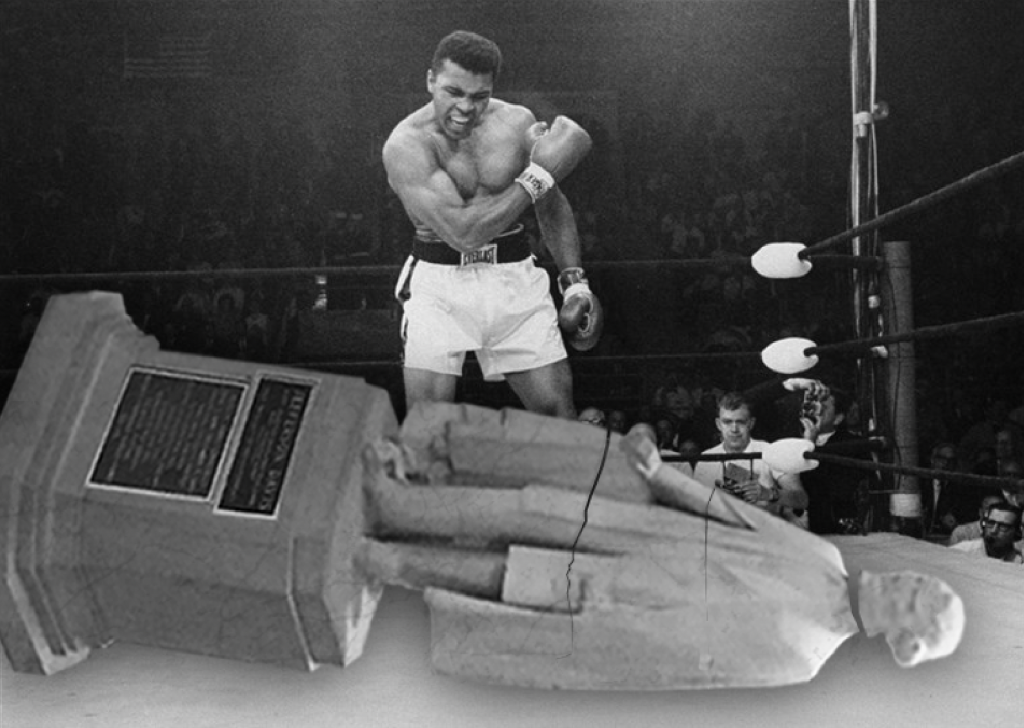
Please sign the petition below to remove the statue of Jefferson Davis currently in Kentucky’s Capitol Rotunda, and replace it with a tribute to Muhammad Ali, “the Louisville Lip” and “the Greatest of All Time.”
I just heard from the Ali family: It is the Champ’s belief that Islam prohibits three-dimensional representations of living Muslims. Accordingly, I have adjusted the petition to call for a two-dimensional representation of Ali (a portrait, picture or mural) in lieu of a statue.
UPDATE (Tuesday, December 2, 2014)
In this interview with WHAS-TV’s Joe Arnold, Governor Steve Beshear endorses the idea of honoring Muhammad Ali in the State Capitol (although he disagrees with removing Davis). Arnold explores the idea further on his weekly show, “The Powers that Be.”
Click here to check out WDRB-TV’s Lawrence Smith’s coverage of the story.
And here’s my op-ed in Ali’s hometown paper, the Louisville Courier-Journal.
UPDATE (Saturday, June 4, 2016)
In the wake of the 2015 Charlestown tragedy, in which a Confederate flag-waving murderer united the nation against racism, all of the most powerful Kentucky policymakers — U.S. Senator Mitch McConnell, Governor Matt Bevin, Senate President Robert Stivers and House Speaker Greg Stumbo — called for the removal of the Davis statue from the Rotunda. Today, as we commemorate last night’s passing of Muhammad Ali, there is no better moment to replace the symbol of Kentucky’s worst era with a tribute to The Greatest of All Time.
UPDATE (Wednesday, June 8, 2016):
Great piece by Lawrence Smith of WDRB-TV in Louisville on the petition drive to replace Jefferson Davis’ statue in the Capitol Rotunda with a tribute to Muhammad Ali.
UPDATE (Thursday, June 9, 2016):
Excellent piece on the petition drive by Jack Brammer that was featured on the front page of the Lexington Herald-Leader.
Highlight of the article:
Miller said he has received a few “angry comments” on his call to honor Ali.
“One of them encouraged me to kill myself,” he said. “You can quote me that I have decided not to take their advice.”
UPDATE (Friday, June 10, 2016)
The petition drives continues to show the Big Mo(hammed): check out these stories from WKYU-FM public radio in Bowling Green and WKYT-TV, Channel 27 in Lexington:
UPDATE (Saturday, June 11, 2016):
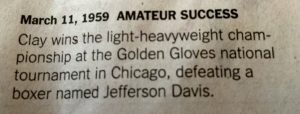
Still not convinced? Check out this excerpt from today’s New York Times:
By John Y. Brown III, on Wed Jun 5, 2013 at 12:00 PM ET
Keep an open mind….don’t jump to conclusions.
If the first thing you think of when letting your mind wander on a Saturday morning while having your coffee is, “Jack Rabbit Slims,” it’s probably worth asking yourself “What did I have for dinner last night?” and making sure you don’t eat that again since it must have caused indigestion that led to disturbing images the next morning.
At least that’s what was my first thought in reaction to the first thing I thought of this morning, which was “Jack Rabbit Slims.”
But it turns out it isn’t such a bad thing after all. I wasn’t thinking of the famous Travolta-Thurman dance scene or the great dialogue scene. I thought of the tracking shot of Travolta-Thurman entering the restaurant and walking to there table.
And I found the video of clip and watched it twice. It turns out that watching (and thinking) about Jack Rabbit Slim the first thing on a Saturday morning while having coffee is a pretty cool way to start the day off after all.
Click here to purchase e-book for ONLY 99 CENTS this week only
The first Correctional Officer (CO) I met was straight out of Deliverance. I came in with a young black guy who mumbled and a middle-aged Chinese man who spoke broken English, but at least I could decipher their words. The CO was harder to understand. Manchester, Kentucky is tucked in an Appalachian mountain hollow, and he had apparently never left. When he sauntered into the austere, concrete holding room and asked the Chinese man his name, the man replied, “Shoi-ming Chung.”
“Sesame Chicken?” replied the CO; laughing uproariously and then repeating it twice as if it were the funniest thing he’d ever heard.
He sent me to a heavyset nurse for a battery of questions.
“Height and weight?” she asked.
“5’6”, 120 pounds.”
She examined my slight frame and frowned. “Education level?”
“Ph.D.”
She shot me a skeptical look. “Last profession?”
“State Senator.”
She rolled her eyes. “Well, I’ll put it down if ya want. If ya wanna play games, play games. You’ll fit right in – we got ones who think they’re Jesus Christ, too.”
Another guard escorted me to a bathroom without a door. He was morbidly obese and spoke gruffly in a thick Kentucky drawl. “Stree-ip,” he commanded. I did. “Tern’round,” he barked. I did.
“Open up yer prison wallet,” he ordered.
I looked at him quizzically.
“Tern’round and open up yer butt cheeks.”
I did.
“Alright, you’se good to go.”
Read the rest of… Former State Sen. Jeff Smith: From Politics to Prison — AN EXCLUSIVE EXCERPT from The Recovering Politician’s Twelve Step Program to Survive Crisis
Michele Bachmann recently told us she was not going to run for re-election in 2014. While some people greeted her announcement with either relief (no more being confused by Minnesota having both legal gay marriage and Bachmann as a representative) or snickers (instead of a press conference, she posted a gauzy, underscored video that bore an eerie resemblance to those short films airplanes use to show you how to buckle a seatbelt.) But there were also many people who were distraught that she would be leaving public life, especially since Fox News is denying rumors that she would simply be moving there.
Of course her loyal followers are upset, but probably not nearly as much as comedians. One basic tenet of good comedy is to say outrageous things as though they were perfectly normal. (A great example of this is George Carlin’s segment in “The Aristocrats,” the cult movie about the world’s dirtiest joke. Carlin’s advice was to deliver off-color content as though one was describing how a carburetor works – the movie is worth watching just for that part!) Ms. Bachmann was a textbook illustration of this principle, maintaining her composure while expounding vehemently, and seriously, about everything from the IRS’s conspiracy to deny Tea Party members any health care, to “The Lion King” serving as a homosexual recruiting tool (convincing kids that they should be gay because a gay composer wrote the music). And facts be damned – when she was criticized for stating that Lexington & Concord were in New Hampshire, she simply explained that New Hampshire had as much right to be proud of “the shot heard round the world” as the actual location. My personal favorite was her claim that there was a suspicious coincidence in flu surges occuring during Democratic presidencies, like an outbreak under Obama and then the big swine flu epidemic in 1976 (which was under Gerald Ford’s watch, not Jimmy Carter’s, but whatever?). Frankly, at times I wondered if she were some sort of giant humor project, like Stephen Colbert’s brief run for president, and the whole thing would be revealed like Joaquin Phoenix’s odd ‘performance art’ on The David Letterman show.
But now she’s leaving – and while there will still be plenty of loony conspiracy theorists around, none of them will make writing comedy as easy as Ms. Bachmann has, because what she actually said needs no embroidering to be funny. (I discovered the truth of the axiom that real life is funnier than anything I can write when my kids started asking me about the facts of life . . . when I explained the whole thing to my younger son and asked if he had any questions, he said with great concern, “What if it gets stuck?” I told him that wouldn’t happen, not as long as he was 18 and she was Jewish . . . . Sadly, now that they’re older teenagers with cars, they’re not home enough to provide me with material. But I digress . . . )
I’d actually planned on doing a song for Ms. Bachmann during the 2012 election, but she dropped out before I got to her, so I’m grabbing this opportunity just in case she vanishes from public life and devotes her life to combating the scourge of gay liberal Disney-movie propaganda . . .
It’s a good time to revisit a point that I made a year or so ago on George Stephanopolous’ “This Week” program. The new health-care law, for all of its moral claims about making medical coverage universal, will end up falling about six million people short of that goal, and the individuals left out of the equation will be the very low income uninsured who are touted as the primary beneficiaries of Obamacare. The New York Times has just summarized the reasons. While the law substantially expands Medicaid eligibility beyond its current focus on children and low wage families, the Supreme Court’s rewrite of the statute last summer has permitted states to opt out of the expansion with no penalty, and to date, 25 states have done just that. Under the new law, there are no provisions to capture the sizable pool of people whose states decline to raise their eligibility standards and who don’t qualify for traditional Medicaid: that is, low income but able bodied adults with no children, and adults with children but whose income is between 32% and 100% of the federal poverty level (which translates to between $6,250 and $19,530 for a family of three). And Obamacare’s insurance subsidies for lower middle income families were allotted exclusively for individuals or families earning above the poverty line.
The political blame has rested primarily with the Republican governors who have not been moved to accept the strings and, post 2018, new financial obligations that come with growing their Medicaid program, despite the large numbers of working, uninsured poor who live in many of their states. But there is nothing unpredictable about cash starved states with a low tax base, or states whose voters are overwhelmingly hostile to the new healthcare law, refusing to assume responsibilities that will be unpopular in the short term and costly in the long term. Nor is there any huge surprise that the component of Obamacare which was supposed to avoid this dilemma, a draconian demand that states accept the expansion or risk their whole federal Medicaid match, would face a severe legal fight. In fact, the same Supreme Court that sharply split over the constitutionality of the insurance mandates in the Affordable Care Act agreed 6-2 that the “take it or risk your whole program” threat was illegal.
Given those realities, one of the centrist criticisms of Obamacare—the argument that it is needlessly ambitious and overshoots the aim of extending insurance to Americans who couldn’t afford healthcare—seems to have been borne out. There were any number of viable ways the White House and congressional architects could have avoided this trap, ranging from taking then Chief of Staff Rahm Emanuel’s advice to shelve broad-based reform for a more targeted version that would have shored up Medicaid and picked up 100% of the tab, to establishing a pool for catastrophic coverage for low wage earners facing medical emergencies. Or, in other words, abandoning the expensive and complex array of reforms in service delivery and doctor reimbursement that have muddled the law without building its popularity, in favor of a straightforward low-income assistance program.
Read the rest of… Artur Davis: Another Thing Obamacare Got Wrong
By John Y. Brown III, on Tue Jun 4, 2013 at 12:00 PM ET
My first and last Beiber rant.
I just watched a video clip of two people reacting to the reaction of several commentators who offered their opinions on the reactions of two other people to an event that I personally didn’t find important enough for anyone to form an opinion on in the first place.
And now I feel the need to add my two cents to the two people reacting to the several commentators… reaction to the two people who originally reacted to an event that doesn’t seem very important in the first place.
My commentary is this:
If an event isn’t that important–or involves the name Justin Bieber– it’s probably not worth the time to form a full opinion about it. And certainly not worth the time to form an opinion and publicly express it.
And if someone does do those two things, it’s not really worth the time for a commentator (or group of commentators) to comment about further because that will only lead to more people, or at least two, who will feel compelled to comment publicly about their disagreement with the commentators commentary about the original two people’s reaction to the unimportant event.
And then, dammit, I’ll feel compelled to get involved and suggest that maybe, at the end of the day, when it’s all said and done, whatever I think about Justin Bieber, I should just keep to myself. And maybe other people should do the same.
Let’s all just agree that Justin Beiber seems like a nice enough fella and sings well and has the same hair like of a lot of young people we know. And leave it at that.
It just saves everybody time and energy to talk about more important things.
JEFFERSON CITY, Mo. — Co-Founder and President of The Missouri Times, Rod Jetton, has co-authored a book on how to survive a crisis.
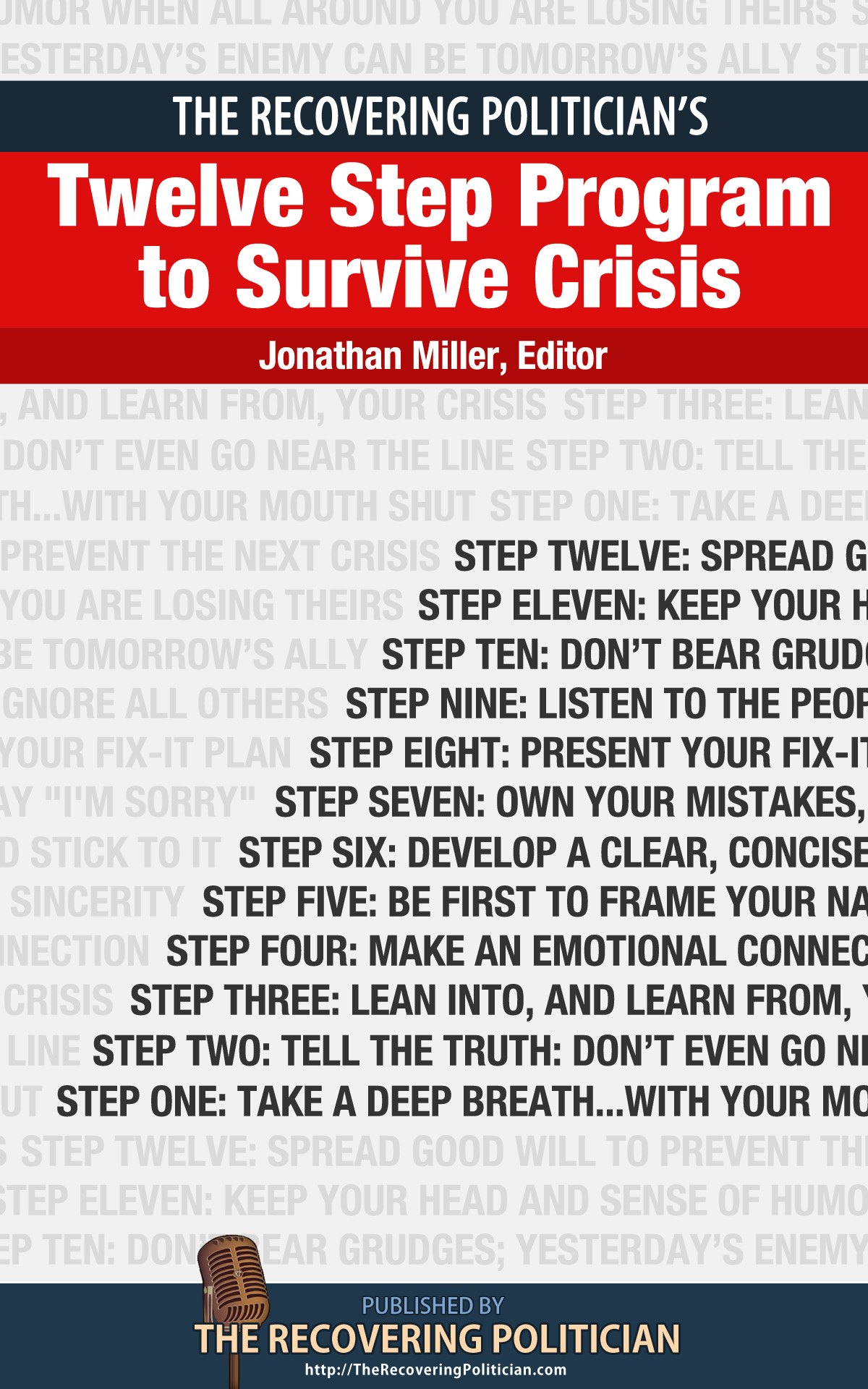
Jetton told The Missouri Times that his book, “The Recovering Politician’s Twelve Step Program to Survive Crisis,” is about the steps necessary to handle, overcome and survive mistakes or crises in life.
The book download will be available for 99 cents for one week.
Rod Jetton, President of The Missouri Times
In the book, more than a dozen “recovering politicians” share lessons learned from some of their most difficult personal trials, from highly publicized and politicized scandals, to smaller, more intimate struggles.
In The Recovering Politician’s Twelve Step Program to Survive Crisis, a bi-partisan collection of former politicians, readers can draw lessons from more than a dozen “recovering politicians” who use their scandals to share guidance on how everyday readers can transcend crisis, recover, and launch their own second acts.
The book outlines deliberate, focused and vigorous courses of action and reaction that are meant to be applicable to helping readers resolve and transcend their own crises in the worlds of business, finance, non-profit, religion and in their own personal lives.
“Each of the writers did an excellent job of addressing how they dealt with their individual scandals,” Jetton said. “Politics is a blood sport and the lessons learned from these political stories are more needed today than ever before. With the explosion of social media and new technology celebrities, athletes, corporate leaders and even average individuals have less privacy than ever before and even a small mistake can turn into a major crisis if not handled properly.”
Some of the stories in the book include:
Republican National Committee Chair Michael Steele plunging into a nationally televised scandal when a subordinate uses the party’s credit card at a strip club with a sexual bondage theme
Former Missouri State Senator Jeff Smith facing a year in federal prison when he lies to federal investigators about a minor campaign finance violation.
Former Missouri House Speaker Rod Jetton enduring trial and tribulation when he is accused simultaneously of sexual and ethical improprieties.
Former Pennsylvania State Representative Jennifer Mann humbled by banner headlines alleging that her top aide is implicated in the state capital’s “Bonusgate” scandal.
“This book was a bi-partisan, collaborative labor of love,” Editor and co-author, Jonathan Miller added. “It has been an extraordinary honor to bring together former elected officials from both parties, each of whom has struggled through crisis or scandal, all of whom are eager to share their lessons with everyday readers. And best of all — it is a highly engaging, entertaining and informative book.”
“Mary Pickford once said that failure is not falling down but staying down,” former state Senator and co-author Jeff Smith said. “That’s the spirit in which we approached this book and we hope it helps others face adversity with courage, humility, grit, and even — when appropriate – humor.”
“I had made mistakes and let friends and family members down,” Jetton said of his own chapter of the book. “Too many times when we make mistakes we don’t sincerely apologize and take responsibility. I hope my story will help others learn you can move on and enjoy life even after making serious mistakes.”
The book can be downloaded in digital format for the Kindle, iPad, iPhone and more until June 11th for only 99 cents. The price will go to $4.99 for the digital version after the first week. A paperback version will be available soon for $8.99, and Miller, Jetton and the other authors will launch a national book-signing tour later this year.
“We are excited to offer over200 pages of wisdom and advice, gleaned not from the self-declared ‘experts,’ but from people who actually have weathered crisis and scandal as the principal, the man or woman at the center of the fire,” Miller said.
By Nancy Slotnick, on Tue Jun 4, 2013 at 8:30 AM ET
The hierarchy of communication:
Text
Chat
Email
Phone
Text is largely considered the lowest common denominator in the food chain of communication. Although arguably Facebook chat is lower. I mean you have to have someone’s cell # in order to text, right?
Yet I love texting. It’s quick and efficient and concise. And I am rarely concise- ask my husband. I once told a friend who was editing an interview of mine that I am better when edited, and he wisely said “Everyone’s better when edited.” (Thank you, Dave Adox) And here I babble.
Anyway, text forces me to edit myself, and I appreciate that. Apparently Harvard Magazine reported that young people say phone conversations slow them down. I agree! Yet a lot women (and some men too) feel that it’s rude to text in dating rather than calling. Who has time for all this calling? Who knows how to win at the game of phone tag these days? I sure don’t. These phone-o-philes think that they are standing up for healthy communication and true connection. They often have quite a moral high ground about it. I find their superiority complex on this topic to be unwarranted. The era of the phone call (ala “we talk on the phone every night”) has ended. This battle has been already lost.
I see texting as men’s revenge. The phone call era gave rise to a lot of annoyed guys and the phrase “chewing my ear off.” Many of these guys were pretty keen on technology and thus the text was born. Or maybe Al Gore invented it; I’m not sure.
Read the rest of… Nancy Slotnick: Text in the CIty
By John Y. Brown III, on Tue Jun 4, 2013 at 8:15 AM ET
Click here to purchase e-book for ONLY 99 CENTS — this week only
My own dark night of the soul. Without a crisis manager to guide me.
At the age of 22, most of my friends had graduated college and were beginning to wear suits and ties and dress shoes and carry a sleek umbrella when it rained, as they went to work at enviable places like accounting and law firms and growing businesses and established organizations.
I was doing none of those things and felt ostracized and dismissed by my peers and friends and loved ones who had run out of patience with me. I was out of all of my “second chances.”
Hope from others had been displaced with sadness, concern and eventually disgust. Friends were calling my parents telling them I needed help and that they were worried for my safety. One of my old friends had just visited me while he was back in town and saw me in shambles, in a deliberately dark and dank apartment wearing only my dingy robe (ironically decorated with Roman Empire images), as I sat disheveled, unshaven and un-bathed amid a sea of empty vodka, bourbon and beer bottles.
I had squandered my last few jobs and dropped out of college for three consecutive semesters from three different colleges. When my friend asked me what I was going to do next, I joked in my own macabre way that “I was torn between starting my own business and committing suicide.” I laughed through my pain, but he had only a look of concern and sad confusion.
A few days after that, my father came to my apartment late on a rainy Sunday afternoon and knocked furiously on my door. He knew something was very wrong, but I kept the shades drawn, lights out and refused to answer.
Finally, the knocks became kicks at the base of the door. Followed by more knocks that eventually trailed off with a sense of defeat I had come to recognize from others trying to help me. It was my father, a man whose time was precious and I’d always wanted more of; and I finally opened the door and walked outside. The bottom of the door had scuffmarks from his shoes; and my father was in his car, and I got in the passenger side.
I said, “I’ve screwed up, Dad. I’ve really screwed up, and my life is a mess.” My voice cracked, and I looked down dejectedly as I began crying tears of desperation. My father was a man of action who had built Kentucky Fried Chicken, owned the Boston Celtics, and just finished serving a term as Kentucky’s Governor. He wasn’t accustomed to not having a quick answer to solve any problem that faced him. But he was bewildered, too. I remember him saying “we’ll get through it,” and that he would help find a way. He had heard of treatment centers for problems like mine, and maybe that’s what I needed to do. He said, “You are my flesh and blood, and the blood that runs through your veins runs through mine, too. We’ll figure this out. I love you and want to help however I can.”
But, again, there were no quick fixes for how to deal with my problem.
A few weeks after that, I moved back home with my mother, since I was not functional at either work or school and unable to care for myself with the kind of minimal self-care expected of some my age. I was a listless, beleaguered and bewildered soul. Mostly, ironically, confused. I had no idea what was really wrong with me or what next to do. I just knew something was terribly wrong, and I was out of solutions and out of any help from friends or family.
One of the last nights I was in my apartment (an apartment, by the way, that the exterminator who visited routinely once told me was the worst kept apartment of the 4,400 he serviced monthly), I was standing alone in my bedroom trying to come up with a new plan. I looked at the world map hanging above my bed and decided what I needed to do was move.
Again.
Read the rest of… John Y. Brown, III’s “Dark Night of the Soul”: AN EXCLUSIVE EXCERPT from The Recovering Politician’s Twelve Step Program to Survive Crisis
By Jonathan Miller, on Mon Jun 3, 2013 at 4:06 PM ET
Great piece about our exciting Rebuilding West Liberty initiative (Read more about it here) from WYMT’s Michelle Heron:
To city leaders, the honor is huge compared to the devastation an EF3 tornado left in its wake more than one year ago.
“We’re hoping that the visibility will bring a whole lot of new investment into West Liberty to help us realize our ambitious goal,” Former Kentucky State Treasurer Jonathan Miller said.
The town of West Liberty will be recognized next week in Chicago by former President Bill Clinton’s Clinton Global Initiative for a project called Rebuilding West Liberty.
“But several months ago, the community got together and decided we want to rebuild the community in a strategic way, to rebuild it better than they found it,” Miller added.
Judge Executive Time Conley says the project focuses on a number of strategies to make the town stronger, not just in a physical way, but also in energy efficiency.
“We want to make sure the homes and buildings we’re building are very high energy efficient buildings that can help us not only conserve energy but show how Appalachian towns can be built to a phase that is business friendly and economically friendly,” Conley said.
The three year project also includes a fiber optic system and downtown Wi-Fi hub paid for by a variety of grants.
“Hopefully not only would the town thrive and jobs be created, it can serve as a model for other disaster ravaged towns or for the rest of rural America,” Miller said.
President Clinton is not a stranger to the mountains; he made a stop in Hazard back in 1999 during a four day tour to encourage businesses to invest in rural communities.
“This tragedy is an opportunity to rebuild ourselves in a new way,” Miller said.
A way that puts West Liberty back on the map.
The Clinton Global Initiative meeting takes place June 13-14th.
By Michael Steele, on Mon Jun 3, 2013 at 2:09 PM ET
From The Huffington Post:
Former Republican National Committee Chairman Michael Steele is weighing a run for Maryland governor, a move that could put him back into the realm of electoral politics, he said Monday.
“We’re looking at it,” Steele, now an MSNBC contributor, told the network’s Chuck Todd. “You’re gonna take a look at the numbers. Maryland’s a tough state, there are a lot of challenges there.”
Steele went on to say that new taxes in Maryland over the past eight years could give a Republican another shot at winning a statewide election in the the reliably blue state. He served as lieutenant governor under Republican Robert Ehrlich during his single term. Democrat Martin O’Malley defeated Ehrlich in 2006 and again in 2010, but is term-limited from running again in 2014.
Speaking last week on WMAL, Steele similarly admitted interest in a gubernatorial run.
“I love my state,” Steele said, according to the Daily Caller. “I think the potential in Maryland is huge. I look at the last 8 years. I look at the tax increases. I look at some of the things they’ve done to drive jobs away and opportunity out the door. And you just kinda say, ‘Can you contribute something?’ So we’ll weigh it.”
Steele’s previous attempt at politics in Maryland was unsuccessful, when he lost a Senate race to Democrat Ben Cardin in 2006. While Steele didn’t win, his campaign did produce this memorable ad about puppies and political attacks.


 Blog this!