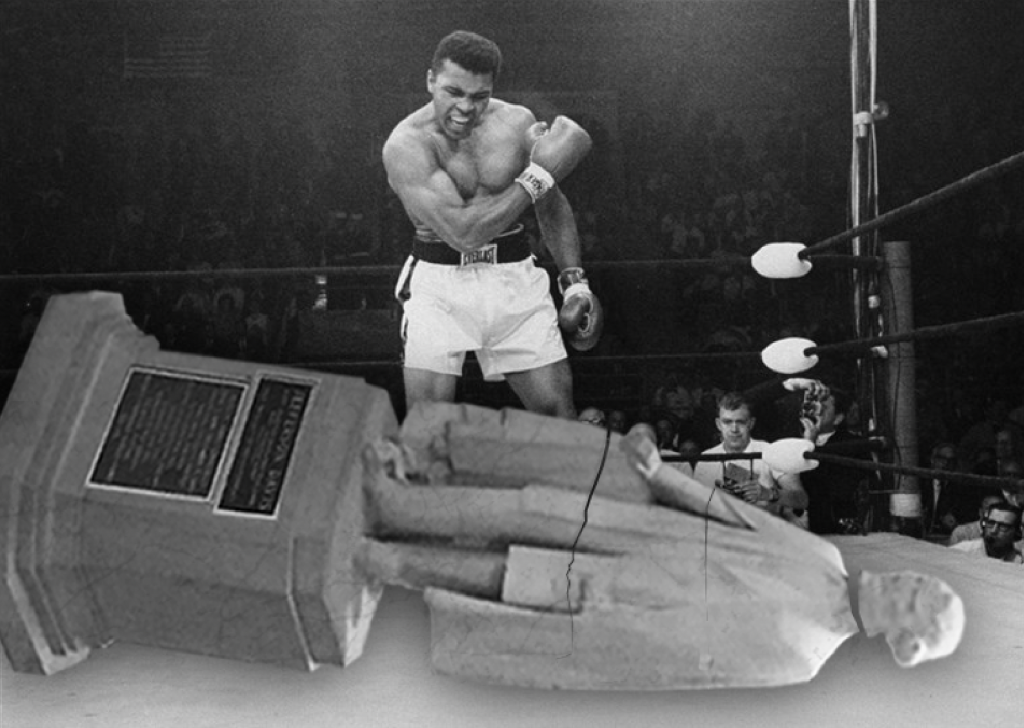
Please sign the petition below to remove the statue of Jefferson Davis currently in Kentucky’s Capitol Rotunda, and replace it with a tribute to Muhammad Ali, “the Louisville Lip” and “the Greatest of All Time.”
I just heard from the Ali family: It is the Champ’s belief that Islam prohibits three-dimensional representations of living Muslims. Accordingly, I have adjusted the petition to call for a two-dimensional representation of Ali (a portrait, picture or mural) in lieu of a statue.
UPDATE (Tuesday, December 2, 2014)
In this interview with WHAS-TV’s Joe Arnold, Governor Steve Beshear endorses the idea of honoring Muhammad Ali in the State Capitol (although he disagrees with removing Davis). Arnold explores the idea further on his weekly show, “The Powers that Be.”
Click here to check out WDRB-TV’s Lawrence Smith’s coverage of the story.
And here’s my op-ed in Ali’s hometown paper, the Louisville Courier-Journal.
UPDATE (Saturday, June 4, 2016)
In the wake of the 2015 Charlestown tragedy, in which a Confederate flag-waving murderer united the nation against racism, all of the most powerful Kentucky policymakers — U.S. Senator Mitch McConnell, Governor Matt Bevin, Senate President Robert Stivers and House Speaker Greg Stumbo — called for the removal of the Davis statue from the Rotunda. Today, as we commemorate last night’s passing of Muhammad Ali, there is no better moment to replace the symbol of Kentucky’s worst era with a tribute to The Greatest of All Time.
UPDATE (Wednesday, June 8, 2016):
Great piece by Lawrence Smith of WDRB-TV in Louisville on the petition drive to replace Jefferson Davis’ statue in the Capitol Rotunda with a tribute to Muhammad Ali.
UPDATE (Thursday, June 9, 2016):
Excellent piece on the petition drive by Jack Brammer that was featured on the front page of the Lexington Herald-Leader.
Highlight of the article:
Miller said he has received a few “angry comments” on his call to honor Ali.
“One of them encouraged me to kill myself,” he said. “You can quote me that I have decided not to take their advice.”
UPDATE (Friday, June 10, 2016)
The petition drives continues to show the Big Mo(hammed): check out these stories from WKYU-FM public radio in Bowling Green and WKYT-TV, Channel 27 in Lexington:
UPDATE (Saturday, June 11, 2016):
Still not convinced? Check out this excerpt from today’s New York Times:
By John Y. Brown III, on Mon Jun 3, 2013 at 12:00 PM ET
It’s never too early—or too late—for vindication: The ABA.
The old American Basketball Association (ABA), with all its quirkiness. eccentric characters and hilarious stories, was also home to the greatest basketball players and basketball prowess on the planet during the league’s hey day in the mid 1970s.
The NBA nervously sneered at the league that played with a “beach ball.” But as the stuffy NBA tried to marginalize it’s competitor league struggling with ticket sales and fiscal viability, the inevitable was happening. A merger. The nimble, dynamic but financially strapped ABA would merge 4 of its teams into the vaunted NBA in 1976.
Many in the NBA privately believed none of the 4 teams would be around 4 years hence.
What was the result? The first year after the merger almost half the NBA’s leading scorers were former ABA players from the merger. As well as the player who led the league in assists and steals. Nearly half the All-Stars were from the much ridiculed ABA. Even in that year’s championship series between two traditional NBA teams, 5 of the 10 starters were former ABAers.
Most notably, however, was as the old NBA league adopted the playing style of the former upstart ABA league —shorter shot clocks, run-and-gun scorning, high-flying slam dunks a la Dr J, pressing defense, and the ABA signature 3 point shot—something remarkable happened. The NBA which seemed always to be playing in black and white, began playing basketball in technicolor. The league that looked like it learned the game of basketball from an Army training video, integrated the spirit and heart of the game of basketball that was so flamboyantly nurtured in the ABA. Thanks to what the NBA borrowed and learned from the ABA. TV revenue soared and professional basketball in the US became as beloved as pro baseball and football, perhaps ever more so. And pro basketball emulating this playing style exploded on to the international scene.
And how about those 4 teams that merged with the NBA 37 years ago but weren’t expected to make it into the 1980s? All four of them are now staple NBA franchises. And two of them, the San Antonio Spurs and Indiana Pacers, could be battling it out for the NBA championship this year!
And our hometown team in Kentucky, the Kentucky Colonels, was the ABA’s all-time winningest team.
Many of us, of course, wish the Colonels had stayed put. I certainly did and wish a better business case could have been made for the Colonels to merge with the NBA. We have debated for years and can continue to debate the merits of that decision, but one thing that is beyond debate anymore is that the American Basketball Association was truly as great as many of us secretly imagined.
And each passing year further vindicates that belief. Even 37 years later!
I’m pulling for the Spurs and the Pacers to have a brilliant NBA championship series, ABA -style!! The way great basketball was played back in the 70’s in our little bush league—the bush league that transformed how the rest of the world plays basketball.
37 years later I believe that vindication for the ABA can’t come too early or last too long. And the world of sports is better for it.
By Erica and Matt Chua, on Mon Jun 3, 2013 at 10:00 AM ET
The Middle Eastern version of the free market is the modern day souq. A visit to Dubai wouldn’t be complete without a stroll through the covered alleyways in search of exotic treasures and fine jewelry and silks. While these markets don’t offer the luxurious shopping experience of the Mall of the Emirates or the Dubai Mall they give visitors a glimpse into the origins of Dubai’s trade.
The Dubai Creek where many of the historic and still active souq’s are located is the foundation of modern Dubai. It originally served as a port for trading vessels plying to and from India, Africa and the Middle East. You can still see some of the old custom houses, but the creek is frequented more by local shoppers and tourists than by shipping vessels these days. Take a step back in time with me and take a peek into Dubai’s souq’s:
Gold Souq
The dazzling gold souk, located at the mouth of the Dubai Creek is a must vist for any visitor to the gold-obsessed UAE. The small shops are packed with large quantities of gold and shop-owners ready to bargain. Most of the gold is 22 carat and sold by weight with an additional charge for craftsmanship. The window shopping is excellent, but prices are high for prospective buyers.
Textile Souq
The textile souq’s alleyways are adorned with luxurious silks, yards of beaded fabrics, pashmina scarves and everything you need to outfit yourselif in traditional Emirati dress. If you want something special made any of the vendors will be happy to help you, just remember to bargain.
Read the rest of… Erica and Matt Chua: Dubai Souqs
Ever want to throw a shot put into the middle of an intransigent organization or system? I know I have. With a shot put weighing in at 16 pounds most of us had better either be very close to the target or consider a better way to catalyze change.
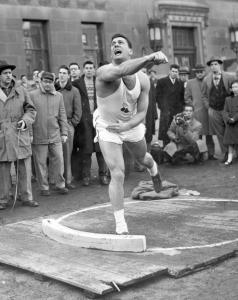
You probably haven’t heard of James Fuchs, who passed away on October 8, but he was a classic innovator. Fuchs was the best shot-putter in the world from 1949-1950. He won 88 consecutive meets, set four world records, and changed the sport forever. Fuchs teaches us about the difference between best practices and next practices.
Fuchs was a fullback on the Yale football team but injuries kept him from playing. He was also on the track team and while recovering from surgery for a leg injury he was limited to competing in discus and shot put. Fuchs became best known for shot put. Fuchs’ leg injury prevented him from using the standard and universally accepted shot put technique. State of art at the time was for a shot-putter to come to a complete stop before releasing the shot. Before Fuchs, shot put was all about brute arm strength. Athletes focused their training on weight lifting. All shot putters competed on a model of arm strength equals distance. That is until James Fuchs came along. Fuchs didn’t lift weights at all and weighed only 215 pounds, small for a shot putter.
Because Fuchs’ leg injury prevented him from using accepted best practice he invented a new practice that worked for him. Innovation is more about next practices than best practices. Fuchs came up with a fluid catapult motion that didn’t require him to stop short aggravating his injury. His innovative technique involved rocking back on one leg, swinging the other in front for balance, hopping forward and propelling the 16-pound iron ball forward. He had learned from a physiology teacher that legs are three times more powerful than arms. Fuchs, like all innovators do, took advantage of both existing constraints and insights missed by current competitors. His innovation became known as the ‘sideways glide’ working around his injury and taking much better advantage of the power of his legs. In 1949 Fuchs set a new world shot put record of 58 feet 4 ½ inches. In 1950 he beat his own world record three times with a personal best of 58 feet 10 ¾ inches. He had changed the sport forever. Fuchs’ sideways glide became the new best practice for all shot-putters. That is until innovation struck again and it wasn’t.
Read the rest of… Saul Kaplan: 16 Lbs. of Solid Iron Innovation
By John Y. Brown III, on Sun Jun 2, 2013 at 9:00 AM ET
What’s it like to turn 50?
It’s like watching a play and you seem to lost track of the story line but are enjoying watching the current scene because it reminds you of something fun about your life that you like thinking about and then the audience suddenly starts clapping and the lights go up. And you think for a moment the play must be over—but it’s not.
It’s just the second intermission of a very long play and you are going to have to go outside in the lobby and talk to the other members of the audience about how interesting you think the play is even though you have no idea what is going on and are still a little rattled at what exactly is happened before the audience started applauding but tell yourself there was probably an applause sign directly over your head that only you couldn’t see— and you stand around and look like you are dignified and in control because others there are standing around in their dress up clothes talking eloquently like they know exactly what is going on but all you really want to do is find out if the concession stand has lemonade and maybe some peanut M&Ms.
And if they don’t you are thinking of asking your wife if you can slip out and watch the rest of that DVD series that you started last night because now you remember that you don’t think you’ve seen it before. And would she mind driving.
===
The coolest thing about turning 50 years old is that 50 is the age that many of the statisticians working in the insurance industry start to consider us “actuarially interesting.”
===
John Y. Brown, III in best fashion mode
I’m starting an Xtreme Shuffleboard league for people over 50 who still feel physically like they are only 48.
===
I got a notice on my phone at 11:45 that I was having a birthday today.
Weird.
In a college psychology course I learned that skydivers feel the height of their fear not seconds before they jump …but about 15 minutes earlier when the plane is taking off and there is no turning back.
When it’s time to jump, the skydiver is ready and not afraid.
Turning 50 is a lot like that
===
Tonight and tomorrow night are my last Friday and Saturday nights ….before turning 50.
Am I ready?
I think so.
How do I know?
I have no plans for either Friday or Saturday night except dinner with my wife and then possibly watching a TV series on DVD.
Why do I say “possibly watching?”
We are two episodes into the series and can’t recall if we’ve seen it already or not.
But we should be able to figure that out by Sunday.
===
Perhaps the most disconcerting thing about turning 50 is realizing that going forward everything starting with a “5” gets rounded up.
====
One of the great gifts of being middle-age is realizing that others know about falling into rabbit holes.
That you really have seen flying monkeys and survived
And your best friend really is a scarecrow who has protected you.
And as irritating as they can be, Tweedledum and Tweedledee are family and you miss them.
And the person you admire most in your life right now is a Chesire cat
Sounds good, right? With some foresight and planning, you can save valuable time in the morning so you can have that extra 10 minutes in bed. Read on for 13 tips on getting out the door quickly, efficiently, and of course stylishly.
1) Lay your clothes out the night before. We learned this back in grade school, but at some point along the way we stopped doing it. If you have the space, get a wardrobe valet to keep things neat and visible as you make your selections. It also helps to check the weather so you can decide on what shoes and outerwear you’ll need.
2) Maintain an organized closet so that you can find everything you need the moment you need it. For my tips on how purge your closet, click here.
3) Once you’ve cleared out the things you don’t need, keep your clothing organized by type (suits with suits, blazers with blazers, shirts with shirts, etc.), then by color within each type. Again, it’s all about easy access.
4) If you don’t have heavy beard growth, shave the night before. This also reduces irritation.
5) Put your keys on top of anything you need to bring with you, like the Netflix envelope you’ve been meaning to mail for the past few days.
6) Keep all the things you know you’ll need right before you walk out the door in one handy place, for example in a basket in your closet, or in a hallway drawer. This might include a lint-brush, hair product, glasses, sunglasses, change for coffee/the paper, mobile device, wallet, office security badge, transit pass.
Read the rest of… Julie Rath: Do You Wish You Got More Sleep?
By John Y. Brown III, on Thu May 30, 2013 at 12:00 PM ET
It’s polite to let dads down easy.
The transition from the role of a strong, dominant , all-knowing, father-knows-best, man-of-the house to the diminished role of amusing obsolescence is hard on the male ego.
We are on our way to dinner in the care —my wife, daughter and me. My wife and daughter were talking about me and agreed I had been “good” this weekend. My daughter joked that maybe I …should get a gold star. My wife suggested we have a special board on our refrigerator to track my success.
They were laughing good natuturedly and I was even begrudgingly agreeing I deserved some sort of recognition for my “good behavior” this weekend.” But my daughter sensed I was slightly wounded by the receding role in the in the family and tried to reassure me. And that meant a lot and didn’t take a lot of effort.
She simply turned to me where I was sitting in the back seat and patted me on the leg and told me she was proud of me and would make sure it was a big gold star.
By Jonathan Miller, on Thu May 30, 2013 at 10:00 AM ET
Rebuilding West Liberty, an Eastern Kentucky community initiative aimed at reconstructing a small rural town nearly destroyed last year by horrific tornadoes to be a 21st Century model for sustainability and entrepreneurship, today announced that Tim Conley, the Morgan County Judge/Executive helping to lead this effort, will attend the Clinton Global Initiative America (CGI America) meeting June 13th and 14th in Chicago. Judge Conley will participate as a member of the Residential Energy Efficiency Working Group (one of twelve working groups convening at CGI America) to share Rebuild West Liberty’s Residential Energy Efficiency Project.
On March 2, 2012, the town of West Liberty, Kentucky suffered a massive tragedy. An EF3 tornado ripped through this community of about 3,400 residents, killing seven, devastating nearly 400 homes, businesses and government structures, and destroying much of the downtown area. While the disaster was an unprecedented crisis for the tiny community, it also represented an extraordinary opportunity: to rebuild itself with a 21st century, lower-cost, sustainable infrastructure, and develop a path to create job‐producing business opportunities, increasing the tax base and attract new residents to West Liberty.
The community’s residents and leaders chose this bolder path. After a year of extensive discussions among key stakeholders and outside experts, the community completed a thorough visioning process to rebuild West Liberty in a thoughtful and sustainable manner, giving careful consideration to the need to preserve the region’s Appalachian heritage and resources.
In January 2013, the town issued a strategic report: Rebuilding West Liberty, Kentucky, outlining thirteen locally-inspired strategies that would make West Liberty not only a model for disaster-ravaged communities, but also for all of rural America. (Click here for a PDF-version of the full report.)
Judge Conley will provide insight on one of Rebuilding West Liberty’s most urgent stakeholder-inspired strategies and most critical needs: rebuilding roughly half of the 300 residential homes that were lost to the storm. To meet this dire need, Rebuilding West Liberty has committed to the construction and development of 150 affordable, highly energy-efficient factory-built and site-built homes. The three year project includes a $27 million investment of equity, grants, debt and operating grants to complete the project in West Liberty and scale innovations piloted for other disaster response efforts and affordable housing projects for factory-built homes across the nation.
===
Please join us in this critical initiative.
Sign the petition below, to take part in the grassroots coalition supporting the project:
About CGI America
The Clinton Global Initiative (CGI), an initiative of the Clinton Foundation, convenes global leaders to create and implement innovative solutions to the world’s most pressing challenges. Established in June 2011 by President Bill Clinton, the Clinton Global Initiative America (CGI America) addresses economic recovery in the United States. CGI America brings together leaders in business, government, and civil society to generate and implement commitments to create jobs, stimulate economic growth, foster innovation, and support workforce development in the United States. Since its first meeting, CGI America participants have made more than 211 commitments valued at $13.6 billion when fully funded and implemented. To learn more, visit cgiamerica.org.
CGI also convenes an Annual Meeting, which brings together global leaders to take action and create positive social change, CGI University (CGI U), which brings together undergraduate and graduate students to address pressing challenges in their community or around the world, and, this year, CGI Latin America, which will bring together Latin American leaders to identify, harness, and strengthen ways to improve the livelihoods of people in Latin America and around the world. For more information, visit clintonglobalinitiative.org and follow us on Twitter @ClintonGlobal and Facebook at facebook.com/clintonglobalinitiative.
“The quality of a person’s life is in direct proportion to their commitment to excellence, regardless of their chosen field of endeavor.”
– Vince Lombardi
What is the difference between dedication and commitment? As one of my best clients I ever had told me years ago; the difference between commitment and dedication is like the difference between the bacon and eggs. The chicken is dedicated, dedicated to hatching eggs for all of us that love eggs. However, the pig is committed. committed to the cause and willing to sacrifice their life so all of us can enjoy the great taste of bacon.
So here is what I have done:
1. Given you a visual of the difference between being dedicated to something and being committed
2. Completely over-dramatized the difference between both dedication and commitment and bacon and eggs
3. Introduced my next piece on how to become committed
Extra Credit: Hopefully I made you chuckle…just once.
Let’s bring it back down to planet earth now. Commitment is a huge part of success in anything, not just fitness. However, without commitment to the cause, the results will become hindered and adherence to exercise maybe damaged. So lets first look at some common reasons that challenge people’s commitment to fitness.
1. Time- We live in a world that goes from 0-60 the moment your feet hit the ground. It is easy to use the excuse of “I don’t have time.” Here is the hard truth, we are all given the same amount of time everyday, how we use that time is on us. An hour of exercise a day is 4% of your day. Honestly, in some cases you could get by with 10-20 minutes of exercise. So now you are telling me you don’t have time? Dedication versus commitment.
2. Cost- Money is always an issue in things that are perceived to cost money. Gym memberships, personal trainers, fitness clothes, organic food etc. can sometimes interfere with people starting and/or continuing a fitness program. Truth is fitness can be free. With the wealth of information out there (ie my blog) that is free one can start and continue a program without really having to shell out any cash. However, if buying a gym membership and maybe a personal trainer (come see me!) is what you want to do but are scared of the cost remember value versus cost. If you see value in something you can always budget for it but if you look at it as a cost it will always be just that, something else you have to pay.
Read the rest of… Josh Bowen: Bacon or Eggs – Part One
By John Y. Brown III, on Wed May 29, 2013 at 12:00 PM ET
It’s important not only to be grateful to be born the way we are but also to be grateful we were born when we were.
If I had been born early in human civilization —for example, during the Hunter-Gatherer era—I would have struggled to fit in.
When asked which group I was in, hunter or gatherer, I would have been faced with the harsh reality that I wasn’t good at either. And I would have aske…d if there was a third option available. Maybe for consultants?
But the Hunter-Gatherer-Consultant era just doesn’t have an authentic ring to it.
I guess I should be grateful to have been born when I was. When there are more than just those two job options. It would have been painful for me each day to have been the last one in my group picked for either the hunter or gatherer team. Like playing in a 4-on-4 pick-up basketball and you are the 8th guy and only one under six feet tall who didn’t play basketball in high school or college. That awful exasperated final pick (forced on the team stuck with you)….and hearing the captain mutter “Oh, man. Not him” as he realized after the seventh player was selected that only left you.
I would have had to deal with that kind of humiliation daily during the Hunter-Gatherer era. And this was the period in human civilization after fire had been discovered but before the discovery of affective mood disorder medications, talk therapy, or support groups. And satire. And obviously before outsourcing.
Life really would have lousy for me and probably included a lot of passive-aggressiveness toward my group coupled with a lot of difficult to explain acting out. And no one knowing at that time about intervention processes– and just writing off my bad behavior and attitude to not being good at hunting and gathering.
And no Facebook or other social media outlets to vent about my sense of alienation and being misunderstood.
What a bizarre culture to try to survive in.
I may come up short in many areas of my life, but when it comes to the period in human civilization (era-wise) for me to be born, I nailed it.


 Blog this!