By John Y. Brown III, on Thu Jul 11, 2013 at 12:00 PM ET How to stay relevant even when you’re not.
Oh come on. You’ve wondered this too. It’s like trying to avoid excessive amounts of cellulite on our personality or wrinkles on our reputation. And, yes, it matters.
I saw this news release on my feed this morning:
Forbes listing of the “Most Powerful Celebrities” in the world.
I had no interest to read the article. We all have a pretty good idea of who the “most powerful celebrities” are.
Obviously, Oprah tops the list. And it’s fair to assume Lady Gaga, Madonna and Justin Bieber are all in the mix near the top.
OK. Yawn.
But what about a list of “The Least Powerful Celebrities” in the world?
That would pique my interest. Maybe it’s age; maybe practicality or maybe fear. But increasingly I’m more interested with the secrets of maintaining my status as my skills and energy levels decline.
I would be interested to know how some celebrities have found ways to succeed at remaining celebrities while being on the brink of irrelevancy and without any apparent influence.
I know that doesn’t sound like the most exciting late night infomercial pitch.
Or does it?

Think about it….
“Have you spent your career trying to establish yourself in some area and finally broken through? But now see age and agism start you on the downhill course toward obscurity and professional oblivion? What can you learn from Cuba Gooding, Vanilla Ice, Kato Kalin and Nik Wallenda? The surprising answer is “More than you might think.” What are their secrets to staying in the public mind despite nearly half the public believing they “may have died” several years ago? What is it that they do to differentiate themselves from those who have already transitioned to merely “former celebrities” with no power? How do they successfully get invited to appear on QVC and Donald Trump’s Celebrity Apprentice show while their less savvy borderline celebrity peers phase out of the public mind?
Now that is a pitch that I’d be interested in hearing more about. And be willing to buy the book, CDs and DVD set.
Operators are standing by.
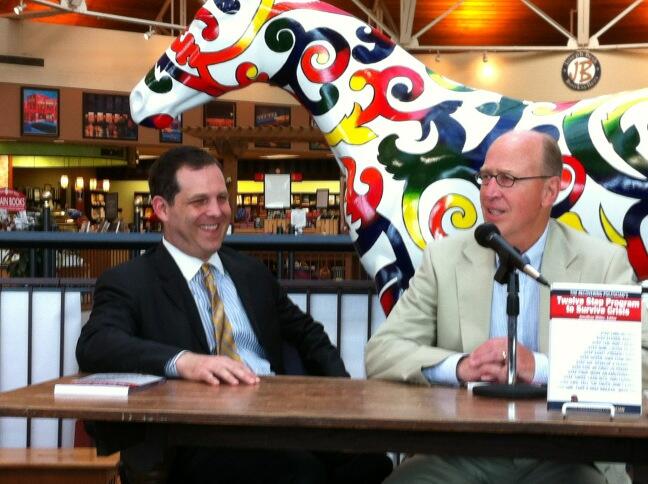
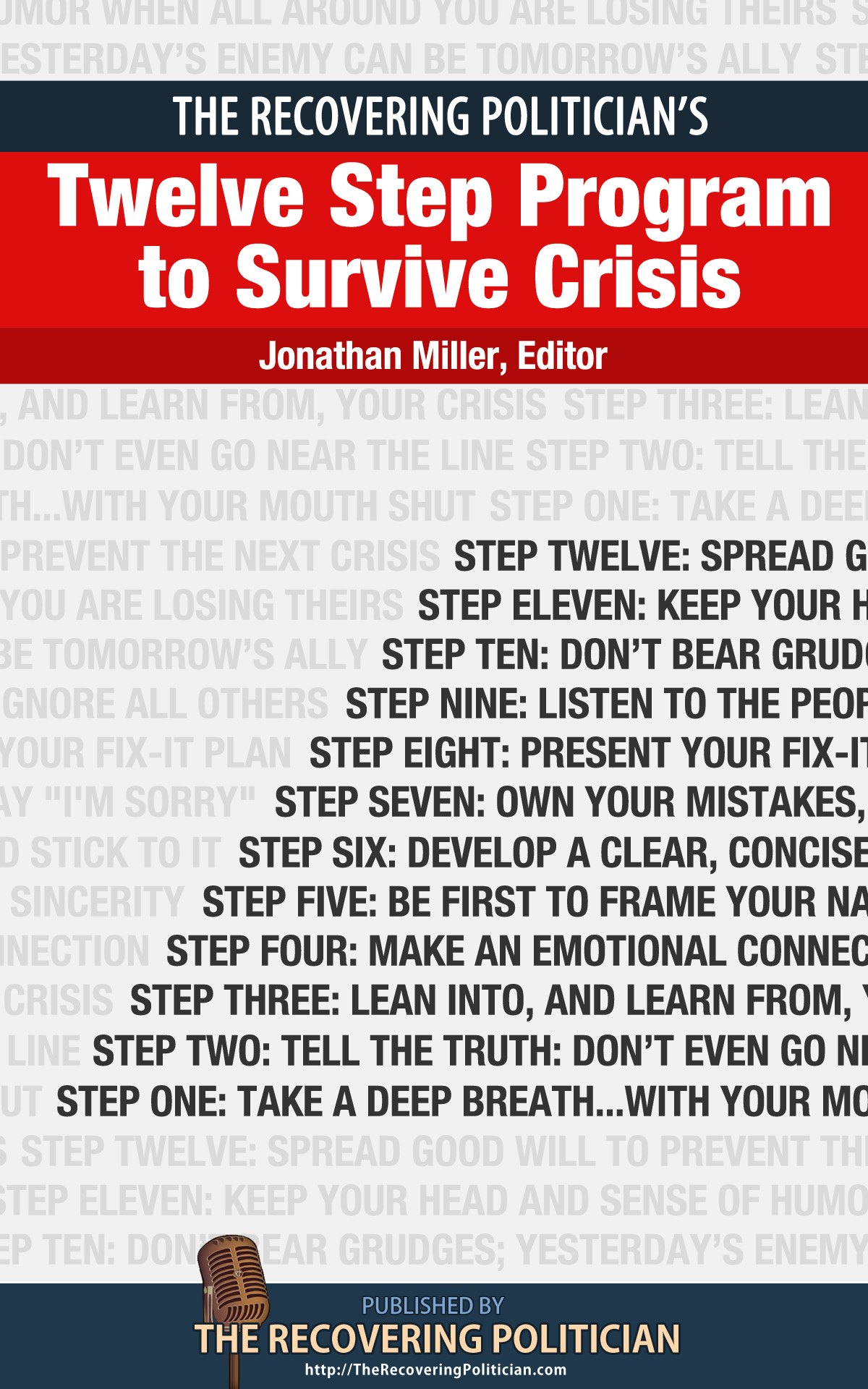
By Jonathan Miller, on Thu Jul 11, 2013 at 10:00 AM ET 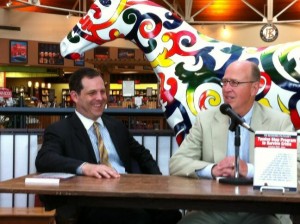 The Recovering Politician’s Twelve-Step Program to Survive Crisis was launched with an exciting book signing event at Joseph-Beth Booksellers in Lexington, KY. Editor and co-author Jonathan Miller was interviewed by Kentucky Hall of Fame journalist Bill Goodman. The Recovering Politician’s Twelve-Step Program to Survive Crisis was launched with an exciting book signing event at Joseph-Beth Booksellers in Lexington, KY. Editor and co-author Jonathan Miller was interviewed by Kentucky Hall of Fame journalist Bill Goodman.
If you were one of the handful of Americans who missed the event, click here to learn more about the book.
By Josh Bowen, on Thu Jul 11, 2013 at 8:30 AM ET “Our deepest fear is not that we are inadequate. Our deepest fear is that we are powerful beyond measure. It is our light, not our darkness that most frightens us. We ask ourselves, Who am I to be brilliant, gorgeous, talented, fabulous? Actually, who are you not to be? Your playing small does not serve the world. There is nothing enlightened about shrinking so that other people won’t feel insecure around you. We are all meant to shine, as children do. It’s not just in some of us; it’s in everyone. And as we let our own light shine, we unconsciously give other people permission to do the same. As we are liberated from our own fear, our presence automatically liberates others.”
Let’s think about the quote above. What is separating all of us from achievement? Is it us? Could it be that we are actually afraid of accomplishing what we set out to do?
Bingo!
The previous section talked about the Power of the Why The Power of the Why and how to find it. Now lets discuss the importance if that why. As described previously, the why gives reason behind decisions and clarity behind things that are not yet understood. The importance of this is to initiate movement and action. Because in order to achieve any goal, you must have action. Your why will keep you motivated through the hard times, because there will always be hard times. Life is not perfect and neither are you. However, each and every one of us is powerful enough to accomplish anything we set out to do.
I have a lot of experience in training and motivating others, not just in fitness but in life. I have always had a sense that deep down people are not afraid of failure but rather afraid of achieving. When you achieve something people will expect you to do the same every time. This adds responsibility and adds the component of hard work. Now, don’t get me wrong I am not calling out people, talking about how lazy they are. Quite the contrary, I am saying that in our subconscious we have a deep fear that we CAN accomplish any and every thing that we set out to do.
 So how do I perform reverse psychology on myself? So how do I perform reverse psychology on myself?
Here is the deal the first step to accomplishing anything is you have to believe it is possible. Here is an example; people once thought that running a mile in under 4 minutes was impossible. It wasn’t until 1954 that Roger Bannister broke the 4 minutes barrier, running a mile in 3 minutes and 59 seconds. 42 days later another man ran a mile in 3 minutes and 58 seconds. Fast forward to present day and the world record for the mile has lowered 17 seconds and now running a mile in under 4 minutes is the STANDARD by which all middle distance runners are judged.
Do you see what happened there? Once one person did it, everyone else knew it was possible. You think that you are the only person in the world sitting there at your computer, reading this article with 50, 60, 70, 100 pounds to lose. The reality of it is people are doing it every day and so can you! All you have to do is believe.
The last step (yes I only have 2 steps here, this is not a 12 step process!) you have to have an undying commitment to your goal. Whatever the goal is, it does not matter you have to love it, marry it and live it. It is you and it is a part of you. Do what ever it takes, throw caution to the wind and do it! I believe in you, you must believe in you. Do not be afraid of climbing your personal Mount Everest! GO DO IT!!!!
Read the rest of…
Josh Bowen: The Importance of Why
By Jason Grill, on Wed Jul 10, 2013 at 1:30 PM ET
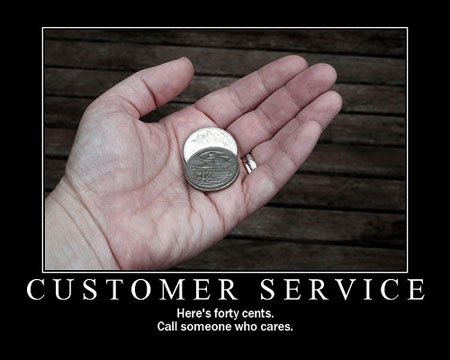
By John Y. Brown III, on Wed Jul 10, 2013 at 12:00 PM ET The calculus of bad customer relations.
Company A estimates if they make it maddeningly difficult to get through to a customer service representative and have a nearly incomprehensible policy for refunds when a failure occurs … it will take approximately 3 hours of waiting and wading through annoying delays, hold times, and numerous representatives saying, “I understand your situation, John, and if it were up to me I would refund your money, but it is out of my hands and the rules require me to…..” —-Company A estimates that after 3 hours a rational customer will give up. And they are correct.
Giving up is a “rational decision” because 3 hours of anyone’s time is worth a lot to them. Probably more than the money in question, even if it is a several hundred dollars. Just do the math. Would you let someone have 3 hours of your life if it required you getting increasingly frustrated in return for the “chance” of getting $200? Probably not.
Plus, to persist for longer than 3 hours with multiple different customer service representatives trained to say “no” 258 ways in the same language as they wear you down to demoralizing defeat requires one to be, well, a certifiable ass. A jerk. And that’s very hard –in fact, almost impossible– for some people.
But we never get too old that we can’t occasionally surprise ourselves.
And sometimes that can include surprising ourselves in unusual ways. Like the fact that despite repeated past failures at successfully being an ass, finding out that deep-down inside us there is an “inner ass” just waiting to come out.
And further surprising ourselves that sometimes, in a few select and rare situations, making an irrational decision about our time and money is actually the right thing to do. And feels better than the “rational decision” of giving up.
And no, it’s not the “principle of the matter.”
It’s the value of reminding ourselves–and others on remote calls with customer service operators from parts unknown–that we can if we really, really, really want to— still stand up for ourselves. And sometimes that we will, despite logic to the contrary, do just that.
===
Business 101 lessons aren’t typically fun to be reminded of or interesting to re-learn and rarely ever are profound. They do, however, tend to be essential to business success.
Like this fairly uncomplicated rule of thumb.
Nothing in business relationships is more upsetting and disappointing than poor customer service.
Nothing in business relationships is more appreciated and valuable than good customer service.
No product or service is easier or cheaper to provide than good customer service. (The only requirement is the organization treat customer satisfaction as the top priority)
No product or service is more costly to skimp on or more difficult to remedy than poor customer service. (The only requirement is the organization not value customer satisfaction)
I suspect that no business miscalculation has caused more organizations to fail than skimping on giving time and priority to customer satisfaction.
The “soft stuff” truly is “the hard stuff.” And at the core of every business relationship isn’t an inanimate piece of technology or clever algorithm or new system or decision tool. But rather a human being who is free to take his or her business elsewhere at anytime for any reason. And will.
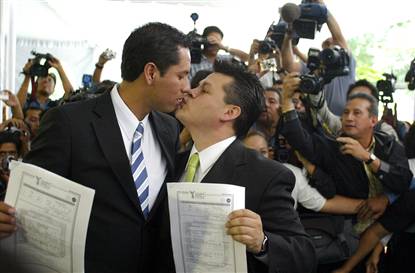
By Artur Davis, on Wed Jul 10, 2013 at 10:00 AM ET Continuing to pick over the remains of the Supreme Court’s news-making week, there is one other piece that should be examined. As my last posting argued, the Court’s decision to avoid the merits of Prop 8, Hollingsworth v. Perry, is hard to defend as a work of judicial analysis, given the anti-democratic veto power it puts in the hands of a Governor and Attorney General who disagree with laws their own constituents voted into existence. But I would argue that there is a real chance that taking Prop 8 on the merits might have ended disastrously for social conservatives, and that we have just gotten a good look at what the next super-showdown on the subject will look like.
The basis for all of that: a not well remembered Supreme Court decision from the mid nineties, Romer v. Evans. The case involved a Colorado constitutional amendment that sought to preempt a series of grassroots campaigns around the state geared toward winning more local protections for homosexuals. Under the amendment, which voters approved statewide, local jurisdictions were precluded from passing any form of initiatives that had the effect of making sexual orientation a “protected class”, analogous to race or gender. In a majority opinion by Anthony Kennedy, the Colorado amendment was struck down on the ground that it blocked one class of the state’s citizens, its gay community, from exercising the ability to win favorable results in the political process, and that even under the lowest level of equal protection review, rational basis, there was no valid justification for such a limitation. One of the informal legal advisors for the litigants challenging the amendment: a rising Republican appellate whiz who had just missed being confirmed for a federal judgeship a few earlier, named John Roberts.
 Romer did turn heads in 1996 because it was the first instance of the Supreme Court invalidating a law that was aimed at gays. But the reasoning, that a law couldn’t survive constitutionally if it simply reflected disapproval of homosexuality, seemed light years beyond the political culture at the time, which included a near unanimous passage of the Defense of Marriage Act, signed into law by a Democratic president. And for all practical purposes, Romer seemed to have almost nothing to do with DOMA, didn’t discourage it or generate any real challenge to it, and is not lauded in liberal legal circles in the same manner as Lawrence v. Texas’ 2003 overturning of local sodomy laws. Romer did turn heads in 1996 because it was the first instance of the Supreme Court invalidating a law that was aimed at gays. But the reasoning, that a law couldn’t survive constitutionally if it simply reflected disapproval of homosexuality, seemed light years beyond the political culture at the time, which included a near unanimous passage of the Defense of Marriage Act, signed into law by a Democratic president. And for all practical purposes, Romer seemed to have almost nothing to do with DOMA, didn’t discourage it or generate any real challenge to it, and is not lauded in liberal legal circles in the same manner as Lawrence v. Texas’ 2003 overturning of local sodomy laws.
That was then. This week, Romer is cited heavily in and was one of the linchpins of the ruling ending DOMA, and had the Court chosen to decide whether Prop 8 violates the equal protection clause, it could not have avoided Romer’s potentially broad reach. Does a state referenda limiting marriage to its traditional definition somehow preclude gays from petitioning California’s legislature or judges to change that definition? Would the five justices who discarded DOMA have bought any rationale that there was a reason for Prop 8 other than moral apprehensions about homosexuality?
Read the rest of…
Artur Davis: The Gay Marriage Case That Will Really Matter
By Jason Atkinson, on Wed Jul 10, 2013 at 8:30 AM ET Save The Great South Bay, a non-profit organization founded in August 2012, is a local grassroots organization dedicated to the revitalization of the bay.
We want future generations to fish, clam and swim in these waters as we had. We want to restore marine and shoreline habitats so that the South Shore and beach communities that ring the bay can become sustainable for this century.
At present, we are at a moment of crisis. The water quality on Long Island is such that due to septic tank seepage, pesticides, storm runoff, and lawn and agricultural fertilizer, we may not have water to drink, bathe in and cook with before long. As our polluted ground water seeps into our aquifer, it also seeps into our rivers, bays and ponds, and it is killing our bodies of water at an accelerating pace, and the costs of over-development and poor infrastructure mount.
Science has both the diagnosis here and the cure. Save the Great South Bay relies greatly on the collective expertise of researchers from a variety of institutions, many of them in The Long Island Clean Water Coalition, a group formed to address this urgent problem of ground water pollution before it is literally too late.
By Lauren Mayer, on Tue Jul 9, 2013 at 3:00 PM ET Like most people from my generation (late-baby-boomers or early whatever-is-in-between-that-and-Gen-X?), I was taught to respect my elders, my teachers, or anyone in a position of authority, even if I disagreed with them. This apparently outdated training gave us very good manners and some real difficulty in calling our parents’ friends by their first names even when we were parents ourselves. It also meant that we behaved respectfully toward bosses or elected officials even if we couldn’t stand them or their politics, so that up until recently, political discourse always at least had the veneer of politeness.
These days, of course, it’s easy to point to the collapse of civility everywhere from Congress to preschool. (And yes, there’s a joke in there somewhere about how I just insulted preschoolers.) Some of this informality is welcome – for example, since between my husband, my kids and myself we have three different last names at my house, it’s just easier to go by my first name; and I certainly don’t long for those days when my mother put on a girdle, stockings, a dress, heels, and even gloves to go to the grocery store. But as many writers on this site have pointed out, not holding back our opinions is part of why there’s such partisan gridlock in government. Can’t we manage to be polite and courteous even to people with whom we disagree? (And how many of you had the equivalently old-fashioned education to notice that correct grammar?)
I like to pride myself on that ability to rise above petty differences. It’s worked with my ex-husband, to the point where we can sit together at our kids’ events, and only my closest friends know all the mean-spirited little digs I was tempted to throw out there but didn’t. It’s worked with my friends who have different political views – yes, some of my best friends are Republicans. (Of course I live in the San Francisco area, so Republicans here tend to have liberal social views along with being more fiscally conservative; on the other hand, one of my favorite New Yorker cartoons showed one woman describing her latest date to a friend, “He says he’s a social liberal and a fiscal conservative – which just means he sleeps around and he’s cheap.” But I digress . . . )
However, sometimes it’s just too hard to stay polite and respectful, particularly when someone says or does something too egregious to ignore. (Or in kids’ parlance, “He started it!”) And this can be true even for Supreme Court justices. I had my first taste of head-scratching behavior by one of these lofty figures when I spent a semester in college as a DC intern. (This was back when being an intern had nothing to do with jokes about Presidential infidelity.) Our group got to meet with Potter Stewart, who had just made headlines with his statement that while he couldn’t define pornography, he knew it when he saw it. Not only did he reiterate that view to us, he elaborated by explaining he’d had to view quite a bit of the material in question to come up with his conclusion. Somehow, the idea of a fairly elderly man in a black robe rationalizing his porn consumption knocked the Supreme Court off the pedestal in my mind – I realized they were just people like anyone else, extremely influential, and presumably more intelligent than most of us, but not necessarily. (Not to mention the fact that a Supreme Court justice discussing pornography with sophomoric college juniors was already pretty surreal, as well as giving us all bad cases of supressed snickers.)
So speaking of ludicrous statements by Supreme Court justices, I had planned to resist the temptation to write about Antonin Scalia’s ranting opinions, dissents, and other tirades in recent months, but the combination of his “argle-bargle” comment and his son now claiming that homosexuality simply doesn’t exist was just impossible to ignore – and impossible for me to remain civil and completely respectful. (Although I will give the man credit – he makes the nation’s highest court both colorful and great material for comedians!)
“The Scalia Song”:
By Artur Davis, on Tue Jul 9, 2013 at 10:00 AM ET At the risk of upsetting a popular narrative, that the Supreme Court just dealt a crippling blow to the interests of black voters while handing a decisive win to gays on the future of marriage, I offer a few contrarian points. In random order,
(1) It’s a cheap misread to construe the Court’s rulings on Section 5 and the Defense of Marriage Act as some subversive proof that the Court, or more accurately Anthony Kennedy, the deciding vote in both cases, is more sensitive toward the aspirations of gays than blacks. Whatever you think of Kennedy’s analysis, it is at its core a judgment about the scope of federal v. state authority: put simply, Justice Kennedy’s view is that states should have more leeway to regulate their election practices, as opposed to Washington, and that states ought to determine what is or isn’t a marriage, as opposed to Congress doing so. Those are serious, entirely consistent positions that shouldn’t be dismissed by fixating on the politics or matching the gloom on the face of blacks outside the Court yesterday with the zeal of gays today.
(2) The Court’s complex holding on Prop 8 has a clean result-an explosion of gay weddings in California in the next month-but its winding procedural course had little to do with sweeping claims of autonomy or dignity. To the contrary, a rare coalition of conservative and liberal justices clung to some fairly basic rules of legal standing: You don’t get to file a lawsuit simply because you are rooting for one outcome or another. You have to be an injured party who is contending that either enforcing or violating said law injures you in some way. I am in the camp that thinks that the Court got it wrong here: by denying standing to the plaintiffs, the Supremes effectively let the Governor and Attorney General of California over-turn a majority of their voters by refusing to enforce or even defend Prop 8, their constitutional oaths of fidelity to California’s laws notwithstanding. But resolving Prop 8 with an ordinary technical legal point hardly suggests that the Court is poised to take on North Carolina’s referendum against same sex marriage last year, or any statute in any of the other 37 states that don’t recognize gay marriages.
(3) Combined with the decision to decide another day on affirmative action, this was a week of a cautious court (or again, two cautious jurists in Kennedy and John Roberts) that took pains to minimize the upset to the social and political landscape. Politicians who have linked the Voting Rights Act to the Obama presidency can certainly do so in a thematic, inspirational way, but they should remember that with the exception of Virginia, not one VRA covered state was part of President Obama’s winning coalition in 2012. In not one of these states will a black congressman’s job be imperiled, given that the Republicans who control the legislatures in these states are perfectly happy with heavily racially gerrymandered districts and the free ride they give Republicans in the rest of the state. (It is telling that every single southern redistricting plan in 2011, all but one drawn by a Republican legislature, was pre-cleared by the Holder Justice Department). To be sure, voter ID laws in the VRA states will pass more frequently and with less scrutiny, but in states that are already red and that haven’t been contested at the presidential level since Bill Clinton seemed momentarily capable of winning everything in October 1996. (I will allow for the possibility that Texas is the one state where a rollback of Section 5 confers an edge to Republicans, given the vagaries of drawing districts there and the tension between a heavily Republican legislative majority and a rising minority base that is not as geographically concentrated as in the South).
Read the rest of…
Artur Davis: Of Voting Rights and Gay Rights
By Erica and Matt Chua, on Mon Jul 8, 2013 at 1:30 PM ET What did I most want to eat after almost eight months in India, Nepal and Sri Lanka? Some old-fashioned American fast food. OK, it’s not that I wanted fast food, it’s that the UAE offers such a wide selection of the stuff that got me. In the rush to “modernize” the UAE seems to have lost all sense of itself in a wash of North American craptacular foods. While we in the West try to limit our consumption with public health campaigns, taxes and regulations, the Middle East rejects such beliefs with each trans-fat filling station they build in the desert. Sadly, after so long on the “sub-continent” of Asia I too fell victim of, “taste over common sense”. Let’s take a food tour of the UAE…

It started with Tim Horton’s. Not really American, it’s a staple of our Northern Territories (AKA Canada), offering the cliche police staples of donuts and coffee. For me it was a welcome change from dosas for breakfast.
Read the rest of…
Erica & Matt Chua: Eat Like An American
|
The Recovering Politician Bookstore
|