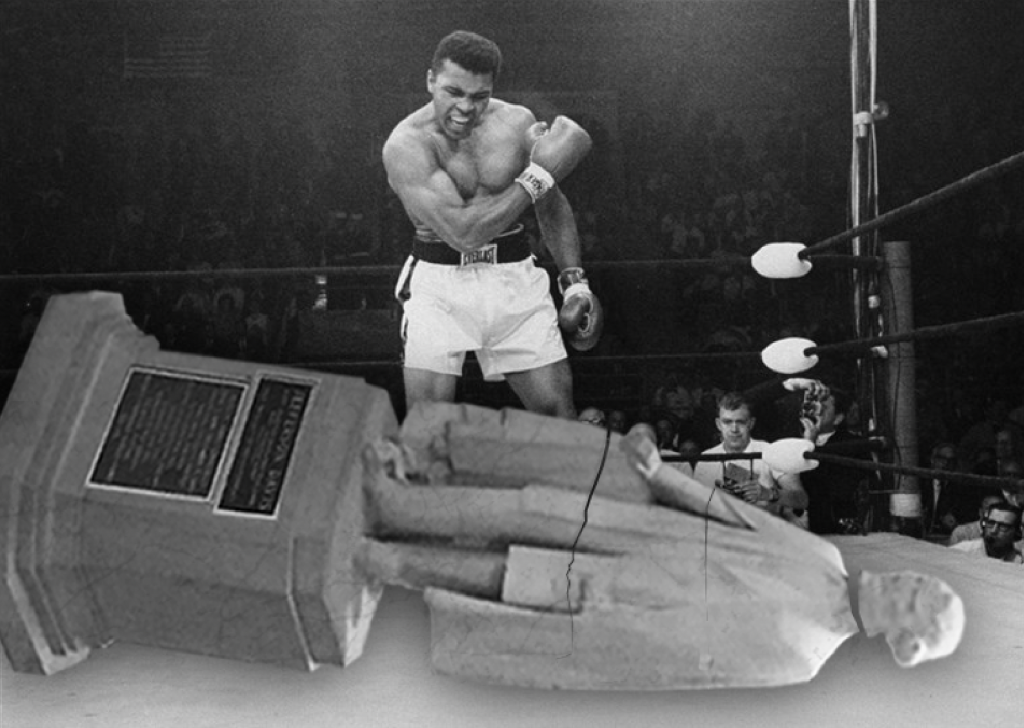
Please sign the petition below to remove the statue of Jefferson Davis currently in Kentucky’s Capitol Rotunda, and replace it with a tribute to Muhammad Ali, “the Louisville Lip” and “the Greatest of All Time.”
I just heard from the Ali family: It is the Champ’s belief that Islam prohibits three-dimensional representations of living Muslims. Accordingly, I have adjusted the petition to call for a two-dimensional representation of Ali (a portrait, picture or mural) in lieu of a statue.
UPDATE (Tuesday, December 2, 2014)
In this interview with WHAS-TV’s Joe Arnold, Governor Steve Beshear endorses the idea of honoring Muhammad Ali in the State Capitol (although he disagrees with removing Davis). Arnold explores the idea further on his weekly show, “The Powers that Be.”
Click here to check out WDRB-TV’s Lawrence Smith’s coverage of the story.
And here’s my op-ed in Ali’s hometown paper, the Louisville Courier-Journal.
UPDATE (Saturday, June 4, 2016)
In the wake of the 2015 Charlestown tragedy, in which a Confederate flag-waving murderer united the nation against racism, all of the most powerful Kentucky policymakers — U.S. Senator Mitch McConnell, Governor Matt Bevin, Senate President Robert Stivers and House Speaker Greg Stumbo — called for the removal of the Davis statue from the Rotunda. Today, as we commemorate last night’s passing of Muhammad Ali, there is no better moment to replace the symbol of Kentucky’s worst era with a tribute to The Greatest of All Time.
UPDATE (Wednesday, June 8, 2016):
Great piece by Lawrence Smith of WDRB-TV in Louisville on the petition drive to replace Jefferson Davis’ statue in the Capitol Rotunda with a tribute to Muhammad Ali.
UPDATE (Thursday, June 9, 2016):
Excellent piece on the petition drive by Jack Brammer that was featured on the front page of the Lexington Herald-Leader.
Highlight of the article:
Miller said he has received a few “angry comments” on his call to honor Ali.
“One of them encouraged me to kill myself,” he said. “You can quote me that I have decided not to take their advice.”
UPDATE (Friday, June 10, 2016)
The petition drives continues to show the Big Mo(hammed): check out these stories from WKYU-FM public radio in Bowling Green and WKYT-TV, Channel 27 in Lexington:
UPDATE (Saturday, June 11, 2016):
Still not convinced? Check out this excerpt from today’s New York Times:
By John Y. Brown III, on Tue Apr 8, 2014 at 12:00 PM ET
If you are an adult and think you are a victim in life, you are sadly correct.
You are a victim of your own need to be a victim.
I am not saying we are not sometimes victimized. We most certainly are. People get raped, maimed, murdered, and harmed physically and emtionally in inmumerable and unthinkable ways. But those instances of being victimized are situational and do not permanently define us.
Unless, of course, we decide it is preferable to be defined as a victim than to get on with our life.
There are many enticing advantages to being a victim. When we are in that role we get pity, attention, compassion, concern, are the center of attention, less is expected of us and we expect less of ourseleves.
Not a bad deal.
If you don’t mind spending your life “on the sidelines,” so to speak. We are like an injured athlete that sits with the team during the games but never gets to play and we are always pointing to our injury to explain why.
We nurture and promote how we have been harmed until it really does define us.
It is as though we place a sign around our neck for all to see that says, “Wounded. Don’t expect much of me.”
But on our back is another sign that only others can see that says, “Because I choose to be a victim. And don’t expect much of myself.”
And the sign on our back doesn’t come off until we take off the sign that proclaims we are a victim –that we put on ourselves.
Editors’ Note: The author, a Duke alum, is one of my very best friends, and also one of my biggest enemies on game day. I have excerpted a letter he wrote me this morning.
I didn’t text or call last night because I knew how crushing that loss must have been, and even this may be too soon. But you know I hope you will forgive me for intruding on your, “It was a great season moment.”
You had the most talented team in the nation, they were favored, they could taste it and they deserved it having beaten Wichita State, Michigan and Louisville, and they were playing UConn who lost to Louisville 3 times this year, once by 30 points, who the Cats killed twice this year. I know you thought even if UConn was able to lead in the first half it would only a matter of time before UK’s immense talent would take over and dominate in the second half. It looked that way, UConn was on the ropes, everybody knew it was only a matter of time, UConn’s bigs were in four trouble, Randle was, as he was all year, a man among boys, one of the Harrison twins could be counted on to hit a 3 if it was needed, the Cats were destined to win.
UK had a dozen possessions in the second half 0with UConn clinging to a 1-pt lead, and they just couldn’t take the lead. Instead they will always be remembered as one of the most talented basketball teams in NCAA history not to win the National Championship. Right up there with Calipari’s 2008 Memphis team ranked #1 with Derrick Rose with a 106-9 record over the last 3 years coming into the finals with Kansas. Rose had an unbelievable second half leading Memphis to a 9 point lead with 2 minutes left. But then like last night, Calipari’s stars as talented as they were, couldn’t hit their free throws missing 4 of 5 over the last minute. The other less talented team last night like Kanas hit theirs, all 10 of them. The team with less talent, with less freshmen starters, who worked at free throws intently in every practice where misses result in wind sprints, won.
Comparisons to the ’83 Houston Cougars with Olajuwon and Drexler, or Michigan’s ’93 Fab Five or the most dominant team ever the ’91 UNLV Running Rebels led by the Calipari like Tark the Shark. The Running Rebels demolished every team they played in 1990, including the largest blow-out ever in the finals beating Duke by 30 points. In ’91 they were undefeated trouncing teams by an average margin of victory of almost 30 points and they faced Duke in the quarter finals who they had humiliated in the finals the year before. And they, like UK last night, lost. And like last night, there was a feeling that the more talented team lost, but somehow there was justice in Calipari like Tarkanian being denied a Championship that by all rights they should have won. Sometimes preparation, hard work and experience beats talent. Sometimes there is justice in the world. Last night felt to a non-Kentucky fan like one of those times.
College basketball is a cruel, crushing sport, and none more cruel to BBN and one of the most talented teams in the history of College basketball, than last night’s loss. I feel your pain.
By the time that you read this, #MarchMadness2014 will probably be over and a winner will be crowned. College basketball fans: How did you like it? Do you hear Pharrell Williams singing his ubiquitous song “Happy” playing in the background? If you are a UConn fan or a Kentucky fan, you probably do.
Unfortunately, your joy may be quite short lived. One team will cut down the nets in a state of utter euphoria after the game. The other team will bury their heads in towels to absorb a downpour of tears and to mask the looks of sheer frustration on their faces. Let’s consider a little history and the culture of the March Madness.
The 1992 Michigan Wolverines — affectionately dubbed the “Fab 5” — and the 2013 Kentucky Wildcats: Do you see the similarity between the teams? They are the only teams ever to start five freshmen in an NCAA Championship Game. That’s large…XXL!
In 1992, the notion of five freshmen starting in an NCAA Championship Game was unheard of…almost preposterous! Five freshmen (Webber/Rose/Jackson/King/Howard) outranked all the seasoned sophomores, juniors, and seniors already on the team who held their egos in check and who gave new meaning to the phrase “Team First.”
The Wildcat Five (Johnson/Randle/Young/Aaron/Andrew Harrison) faced no competition among their upper-class teammates, of which only two were seniors. Such is the state of Kentucky basketball these days. Coach John Calipari guarantees starting spots to blue-chip recruits…a highly questionable recruiting strategy. One and done—NBA here I come! The best high-school players want instant gratification and adoration and Coach Cal loves to bring athletes like that into his system.
In the 90s, the players wanted to be part of a team. Not now. Incoming freshmen come the team packed with attitude. Basketball did not change. You still need to run the pick and roll the way it’s been done for decades. [Side note: Thankfully the tight uniforms got jettisoned!]
For the record, John Calipari stated, “There is always next year when I have the top recruits once again coming for one year.” A lot of Calipari’s counterparts deem him to be a sleazy coach with no moral compass…especially when it comes to recruiting.
For those with short — or selective — memories, consider the time that Temple Owls Coach John Chaney and then U Mass coach Cal almost came to blows at a press conference after Chaney uttered the words, “I’m going to tell my kid, to kick yours kid’s butt,” as a result of the tactics used on the court by U Mass—a classic moment in intercollegiate athletics.
How many Kentucky Wildcats ever played in the NBA? More important: How many earned degrees from that storied institution.
Why don’t today’s players stay for four and graduate? The radical new culture in NCAA basketball comes down to “cream”—Cash Rules Everything Around Me. How soon can I get paid?
If the Kentucky Wildcats emerge victorious John Calipari will deposit a whopping $700,000 check in his bank account. If the Huskies cut down the nets Connecticut Head Coach Kevin Ollie receives a “measly” $166,000—but he’s only in his second year on the job so…The colleges themselves will receive over millions of dollars. The players get beautiful rings from the good folks at Jostens, but no “paper.”
The Fab Five never won an NCAA Championship, although they reached the finals twice in 1992 and 1993. They made a pact to stay another year to see if they could win it all and they stayed true to their words.
The Wild Five stand on the threshold of history: They can win with a starting five consisting of only freshmen. If they lose will the Wild Five put fame and fortune on hold for just one more year—like the Fab Five? Or — as seems more likely to be the case — will they pursue the pot of gold at the end of the NBA rainbow? Talk amongst yourselves!
By Jonathan Miller, on Tue Apr 8, 2014 at 9:00 AM ET
For a few laughs on this official day of mourning in Big Blue Nation, be sure to check out my tweet recaps from the tourney games: Connecticut, Wisconsin, Michigan, Louisville.
An unwelcome and unfamiliar deep blue fog envelops the Bluegrass State this morning. In grocery stores and city parks and shopping malls, neighbors who months before felt nothing in common are now greeting each other with sad, knowing nods, exhausted shrugs, and wane, funereal “just wait ’til next year” salutations.
For after one of the most thrilling three weeks of cardiac-inducing, last-second-thrilling, and yes, community-building hardcourt theatre, the University of Kentucky Wildcats’ unexpected NCAA basketball tournament run came to a sudden and heartbreaking end at the hands of the newly-crowned national champion UConn Huskies.
And yet, while the Big Blue Nation mourns, much of the nation’s chattering class is leaping in giddy celebration. Kentucky basketball embodies to them everything that is wrong with the game, indeed with college sport as a whole. The focus of special ire is head coach John Calipari, for his diabolical exploitation of the NBA’s controversial “one and done” rule that permits pro teams to draft 19 year olds who are at least a year out of high school. As the Cats’ NBA-focused, all-freshman starting squad marches through March Madness — squashing upperclassmen-dominated rivals like Wisconsin, Michigan, and previously-undefeated underdog Wichita State — the righteous guardians of the Athenian ideal of amateur student athletics loudly decry the vulgar capitalist reality…in the form of a collection of mostly African-American teenagers representing one of the nation’s poorest states.
No doubt, many gripes with college hoops are quite legitimate. From its economic exploitation of teenage athletes, to the shady shoe contracts secured by its plutocratic coaches, to the blatantly unfair and hypocritical NCAA governance regime — big-time, big-money college roundball leaves many the casual fan with a guilty hangover after the last shimmy of the Big Dance in April. There also lies another, more intimate truth: Since middle school, much of my kind — the jump shot-challenged intelligentsia, that is — have scoffed at the popularity, coddling, and public financing of the jock culture. College is our sacred realm — for academics, scholarship and research, not professional sports-grooming.
But in rooting against the team that has mastered the flawed system, the critics are missing a greater truth: The keys to fixing the sport’s soul can be found precisely in the qualities that make Kentucky basketball so special. For while cerebral baseball and primal football continue to be heralded as our national pastimes; college basketball, particularly here in the heartland, really does matter.
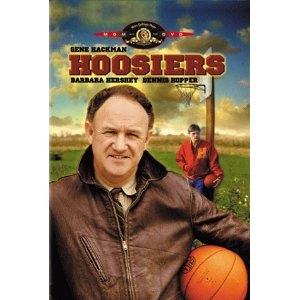
At its core, basketball is the most populist and egalitarian of major sports. Its character derives in part from its tiny barriers to entry—all you need is a ball and a hoop to practice alone, and a bona fide game can be played with just a pal or a small group of friends. While its complex choreography and mosaic interpersonal psychodynamics are often underestimated, basketball is the simplest game to understand and appreciate. Ball goes into basket; your team scores. A contest’s time is precise and limited; its court dimensions, clear and uniform: As Gene Hackman famously proved in Hoosiers, the rim is always exactly ten feet from the ground whether at an urban playground or in a professional arena.
Basketball is also the ultimate spectator sport. Unlike radio-friendly baseball or HDTV-enhanced football, hoops are best enjoyed in person. With much, much less downtime than the Big Two, basketball games are filled with relentless exhibitions of artistry in action—colorful feats of intensely-rehearsed talent and gravity-defying acrobatics, while the participants remain in near constant motion. Because the vertical plane is regularly pierced, only basketball can provide those rare, sublime moments of transcendental grace. The courtside crowd isn’t distracted by the weather, organ player, food, bands, or tailgating: Until the final buzzer sounds, the game itself is the only thing that matters.
Whether in a high school gym or a professional arena, the game is played indoors, the fans on top of the action, literally involved in the hum and flow of the game, the most intimate among the major sports. In a game in which improvised and instinctual play is the norm, where fatigue and self-confidence are critical to performance, an enlivened and vocal crowd can provide enormous emotional and psychological comfort to the home squad, or can harass and dispirit the visitors. A home crowd—particularly at the college or high school level—becomes, for a few hours at least, a cohesive, interdependent community: Fans who might disagree sharply on matters of politics, religion, lifestyle, or just about any topic, join voices in passionate advocacy of their squad, or, almost as often, in intense criticism of the referees. It’s no coincidence that in many rural communities, most community-building events—graduation ceremonies, formal dances, citizen forums—take place in the high school gym.
Indeed, a potent communitarian strand of populism—in contrast with the “me first” Tea Party variety—is modeled in the game itself. Bill Simmons’ bestseller, The Book of Basketball, reads in places like a Michael Sandel philosophy lecture or a 1968 Bobby Kennedy campaign speech: “The secret of basketball is that it’s not about basketball…Teams only win titles when their best players forget about statistics, sublimate their own games for the greater good and put their egos on hold.” And the greatest of the greats — Jordan, Magic, Bird — only earned their iconic status after they learned to surrender their own self-interest (high scoring averages) for the common good (winning championships), a noteworthy lesson in unselfishness and the Golden Rule for the boys, girls, and grownups who consider these hardwood heroes role models.
There’s been no better example of this phenomenon than this year’s Kentucky Wildcat squad. Heralded last year as the best recruiting class in the history of college basketball, the freshmen-dominated Wildcat team suffered through a disappointing regular season — falling from number one in the preseason polls to out of the top 25 by season’s end. Undeniably, these teenage phenoms were extraordinarily talented individual ballers, but they simply weren’t gelling as a cohesive unit. It wasn’t until postseason that they learned to overcome their stereotypically-Millenneal narcissism and played selfless ball. And as a result, they emerged as one of the most beloved teams in the long, long lore of the blue and white tradition.
It’s no wonder then why college hoops have made such a remarkable and substantive impact on education at the University of Kentucky. The administration understands that many Kentucky families — especially those in the most remote, economically-depressed areas of the state — dream of sending their kids to UK, and it has leveraged roundball prowess to help market and fund all of its major academic initiatives and capital campaigns, including its ambitious long-term effort to transform the school into a Top 20 public research university. And while it’s an unusual, although not a unique, collegiate example, UK basketball not only sustains itself financially; but along with football, its profits help enable the athletic department — with 20 other sports teams–to pay for itself, plus provide millions of dollars to the school for non-athletic scholarships
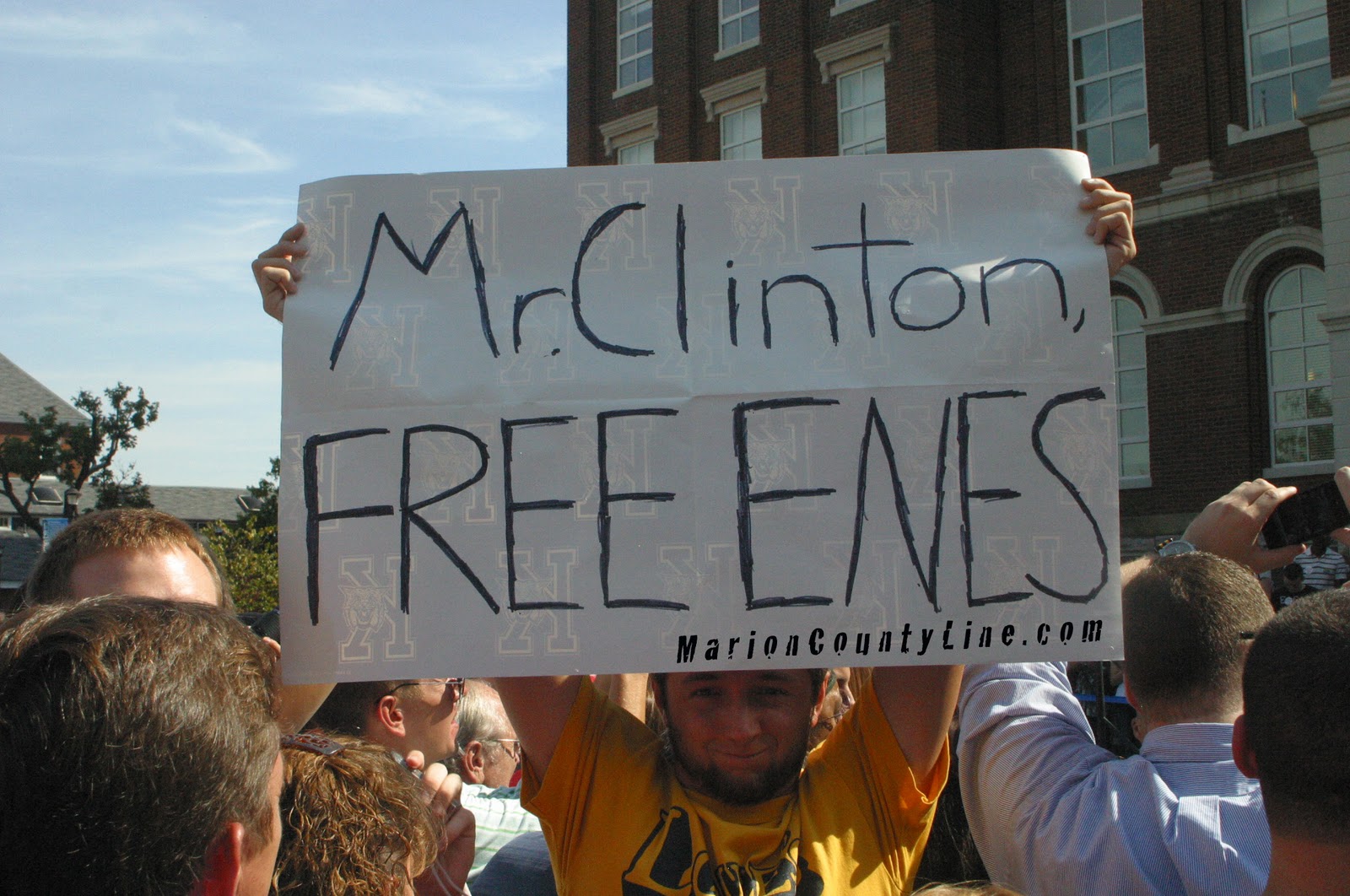
There’s also been perhaps no force more powerful for religious and racial fence-mending, at least here in the South. A few years ago, the hoops-mad University of Kentucky’s cause celebre was Enes Kanter, a recruit who was blocked permanently from college ball by the NCAA, citing his acceptance of payment in a professional league in his home country of Turkey. A “Free Enes” campaign grew organically from the grassroots, uniting the overwhelmingly Christian state behind a Muslim — not mind you, a more familiar American convert such as Louisville’s Cassius Clay/Muhammad Ali, but an honest-to-goodness, olive-skinned, Middle-Eastern Muslim. Imagine the impact Kanter could have made on religious tolerance had he been allowed to play and lead the Wildcats to another national title.
Perhaps more poignantly, just a half century since UK’s all-white “Rupp’s Runts” lost the national championship to Texas Western’s history-making all-black starting lineup — the whitest of all southern states has fallen in love with a series of mostly “one and done” teams composed almost entirely of African-American teenagers, and reveled in their soul swagger and hip-hop sentimentality.
From this egalitarian spirit comes the reform necessary to rebuild the sport’s integrity. Most legitimate complaints about the sport revolve around the same principle that animates our current national debate about income inequality: The 1% (NCAA, elite coaches, broadcast networks, and advertisers) are acquiring obscene wealth at the expense of the 99% (the student athletes) who don’t earn a dime. Even under the NCAA’s rosiest recent projections, more than a third of college basketball players, the vast majority of whom will never gasp a whiff of professional riches, don’t graduate, and many that do fail to develop any meaningful job skills, or even middle school level reading skills.
If we can simply apply a dash of the same communitarian principles found in the sport itself to the policy deliberations of the sport’s governing bodies, we can enhance the people’s sport by ensuring that we provide sufficient economic opportunity to the young men who bring the rest of us such enjoyment.
One core flaw is the ludicrous and pernicious assumption that every “scholar-athlete” has the preparation, the aptitude — or even the need — to earn a four-year, liberal arts bachelor’s degree. For decades, outside of sport, policymakers have been encouraging youth from lower income environments and underachieving high schools (a common background for many a collegiate hoopster) to enroll in two-year vocational and technical colleges, where they can be empowered with the skills they need for the 21st century job market. That’s why it is incumbent on the NCAA and its member schools to direct athletes, when appropriate, to focus their academic attention on job skill and technical programs that interest them, prepare them for postgraduate life, and enable them to earn associates degrees at the university, or through an affiliated community college or vo-tech program. Similarly, while the vociferous criticism of “one and done” is overblown (It worked well for Bill Gates after all), the NBA and its players’ union should effectuate a new “two and done” system, which will enable each player to earn sufficient credit to graduate with at least an associates’ degree.
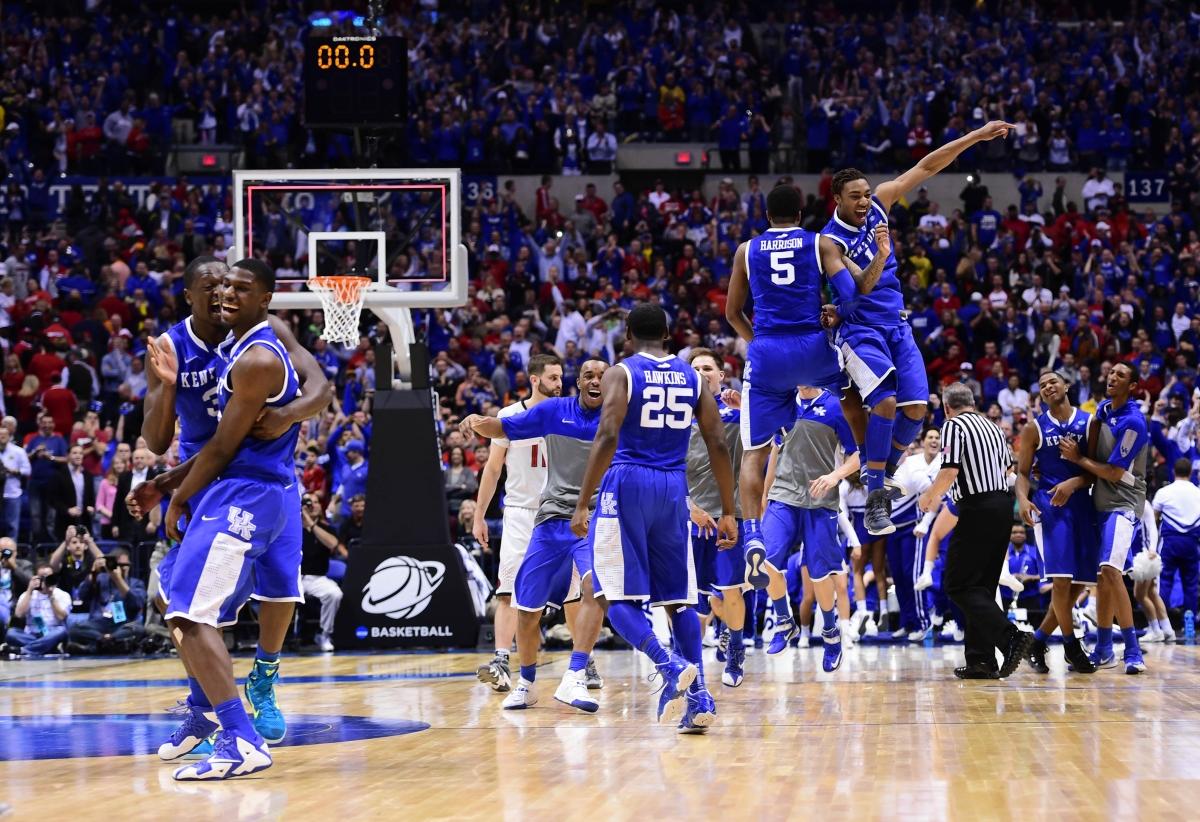
(Photo by Jeff Gross/Getty Images)
Further, while full compensation of athletes is both unmanageable and fiscally infeasible among already-financially strapped institutions, I suggest that athletes be paid an hourly living wage—the same for each player on scholarship; adjusted slightly among universities by local standards of living—that would provide athletes with some (but not too much) walking around money for the occasional restaurant jaunt or shopping spree (maybe they could finally afford their own replica jersey at the campus book store), as well as the exceptional luxury of flying their parents in for special games. Let some of the funding come from the schools’ much-criticized shoe contracts so that players don’t continue to serve as unpaid jumping billboards for their product.
March Madness is an opportunity for college basketball to hold a mirror to itself, and apply what is so right about the sport to fix what is so wrong about the institution. By working towards a system that reflects the same principles that are taught on the court and imitated by the fan base — equality, selflessness, and community — college basketball can truly take its rightful position as an American pasttime that truly reflects American values. And the talented band of teenagers that led Kentucky to the precipice of its ninth national championship can be held up as role models for the nation.
By Erica and Matt Chua, on Tue Apr 8, 2014 at 8:30 AM ET
The United Arab Emirates is a stage for the world’s super-rich to strut their stuff in pricey hotels, clubs and malls. For example, mall’s include ski slopes, ice arenas, massive aquariums and more high-end shopping than could ever afford. If the glitz and glam are too much, neighboring Abu Dhabi provides a taste of culture in the world’s most expensive mosque which puts the Taj Mahal to shame. For speed addicts, Abu Dhabi’s Ferrari World boasts the world’s fastest roller coaster, while the traditional camel market in Al Ain provides a welcome counterpoint. Even if you don’t have the money to roll with the Emerati, you can still enjoy their playground.
……………………………………
DON’T MISS: Sheikh Zayed Grand Mosque in Abu Dhabi, it has to be seen to be believed. MUST SEE: The Burj al-Khalifa (Dubai), the world’s tallest building, Al Ain camel market, Dubai Marina, Dubai gold souk and Sheikh Zayed Grand Mosque. MUST TASTE: Possibly there are better choices, but after two years of traveling we indulged on New York’s famous Shake Shack burgers and other American delicacies.
……………………………………
TRIP PLANNING: See the highlights of Abu Dhabi and Dubai in a weekend, but plan for a week to include Oman. GETTING AROUND: Make use of the excellent buses. Utilize airline’s free shuttles between Abu Dhabi and Dubai. Getting around is substantially easier if you rent a car.
……………………………………
OUR COST PER DAY (2 ppl): $64.71 COST OF A BEER: $5-$12 USD, alcohol is available exclusively at international hotels and pubs. KEY MONEY-SAVING TIP: Use Priceline for the best hotel rates, you can score a luxurious hotel for a great price due to the over-supply of hotels in both Abu Dhabi and Dubai.
……………………………………
YOU NEED TO KNOW: Conservative clothing is required and shows respect for Emirati culture, revealing clothing worn by men or women can be quite offensive. IF WE KNEW WHAT WE KNOW NOW: We would have spent more time in neighboring Oman. HELPFUL LINKS TO LEARN MORE:The New York Times recommendations for spending a weekend in Abu Dhabi.
By John Y. Brown III, on Mon Apr 7, 2014 at 12:00 PM ET
We either need more ways to say “no” or more ways for people to understand what we mean when we say “no.”
By itself “no” –a little two letter word– seems to be the most misunderstood and confusing word in the English language. When someone asks you if you would like such and such and you say “no” or “no thank you,” it’s as if you really are saying, “Gee, I can’t decide. Can you please help me with more options?” Because inevitability the other person will reapond “Oh, I understand. How about this other such and such or the original such and such in a larger size?”
Maybe we say the word “no” too fast and people can’t really hear or underatand us.
Or maybe it is a literacy issue where only about 10 or 15% of the population knows what the word “no” really means.
Or maybe “no” is just a word that has underperformed for so long it needs to be replaced by a longer, stronger and more daunting word. No?
See what I mean?! You were ready for a brand new tougher word for “no” until you saw that little wimpy wishy-washy word “no” that you’ve grown so used and attached to. And decided that even though it is weak, it is good enough.
So maybe it’s not the word “no” but our own indifference and lackadaisical disposition toward saying “no” –and meaning it– that is the real culprit behind the lack of meaning behind the perplexing little word.
There is something to that, isn’t there?
Nah.
Well….at least we have “nah” when we really mean “no” but “no” alone isn’t strong enough to do the trick. And the heck of it is that when “nah” was invented it was supposed to be weaker than “no!” The word “no” has clearly fallen on hard times.
So, for now, I guess, whenever we mean “no” we should say “nah” instead –and say it emphatically. Like this, “Nah!!”
Geez. That is pathetic sounding. And a little creepy. I think I’ll just keep saying “no” insted, for now, and letting people think I don’t really mean it –until we come up with some better options.
Here’s the thing about toothpaste tubes. You can squeeze all you want on one part of the tube and the toothpaste will only pop up in another part of the tube. Many of today’s important systems operate much the same way.
The big challenges we face today including health care and education are systems issues that require systems solutions. These systems have evolved over a long time and are well intentioned. Players in the system work hard year after year to deliver value, improve their position, and create sustained incremental improvements. It is not enough. We need new toothpaste tubes. We can’t fix these system issues by squeezing harder on different parts of the tube. We need to design and experiment with new system level solutions.
Everyone loves to point fingers at the other players in the system as the cause of the problem. Health care is a classic example. Observing our health care system today is like watching an intense rugby scrum that is moving in slow motion hoping the ball will pop out. Finger pointing and incessant public policy debates galore. We love to admire the problems: It is the cost of drugs that is killing us. It is the high cost hospitals that are the problem. It is the insurance companies that are in the way of change. Doctors are the ones who are resisting change. If only the government would get its act together. If only patients would take more responsibility for their care. It goes on and on.
In education, the same movie is playing with different actors. It’s the unions that are getting in the way. Teachers are resisting change in the classroom. Administrators don’t understand what is going on in the classroom. Parents are not engaged. Public policy makers can’t make up their minds. If only private sector companies were more engaged. Students are unruly, undisciplined, and disrespectful. Everyone is blamed and nothing changes.
I’m not a cynic. I’ve seen and participated in many innovative initiatives that are trying to create systems-level changes within healthcare and education. And some of them have indeed succeeded in creating incremental value. But where are the disrupters? Where are the systems-level game changers? The problem is that great ideas coming from one silo are tried but quickly bump into the other silos and constraints of the system. Promising new solutions squeeze on one part of the toothpaste tube only to learn that when you squeeze on one part of the tube it just pops up in another. We need safe environments to design and experiment with new toothpaste tubes or systems.
The student and the patient should be at the center of our redesign efforts in education and health care. We need to experiment at the systems level, trying new approaches to see what works. For instance, we’ve proven that innovation works at the school level with hundreds of successful charter schools across the country. Now we need to experiment at the district level to test new student centered system approaches that are not constrained by the way the current system operates. That is the only way we are going to learn what solutions can deliver value to the student at scale. The same thing is true in health care. We need to design and test patient centered system approaches that are more about well care than about sick care. We can’t get there by playing at the margins of today’s system. Squeezing today’s toothpaste tubes harder will not work.
By Jonathan Miller, on Sat Apr 5, 2014 at 11:00 AM ET
Yesterday, on the 46th anniversary of the assassination of Martin Luther King, Jr., I wrote this piece at The Daily Beast declaring Robert Kennedy’s eulogy to King as the greatest speech of the 20th century.
A loyal reader, the obscenely youthful looking media personality/stand-up comic/right-wing-nut-job Lee Cruse disagreed:
Cruse makes a point: John “Bluto” Blutarsky’s most famous line:
What? Over? Did you say ‘over’? Nothing is over until we decide it is! Was it over when the Germans bombed Pearl Harbor? Hell no!…
is certainly more quotable than RFK’s exegesis on Greek poet Aeschylus:
And let’s dedicate ourselves to what the Greeks wrote so many years ago: to tame the savageness of man and make gentle the life of this world.
But it is only fair to compare the speeches as a whole. So, in the spirit of a fair competition, I post the videos of both orations and ask the RP Nation to decide. Is either the greatest speech of the 20th Century? Or does another surpass it? King’s “I Have a Dream”? Reagan’s “Tear Down that Wall”? Carl Spackler’s “It’s in the hole!”?


 Blog this!