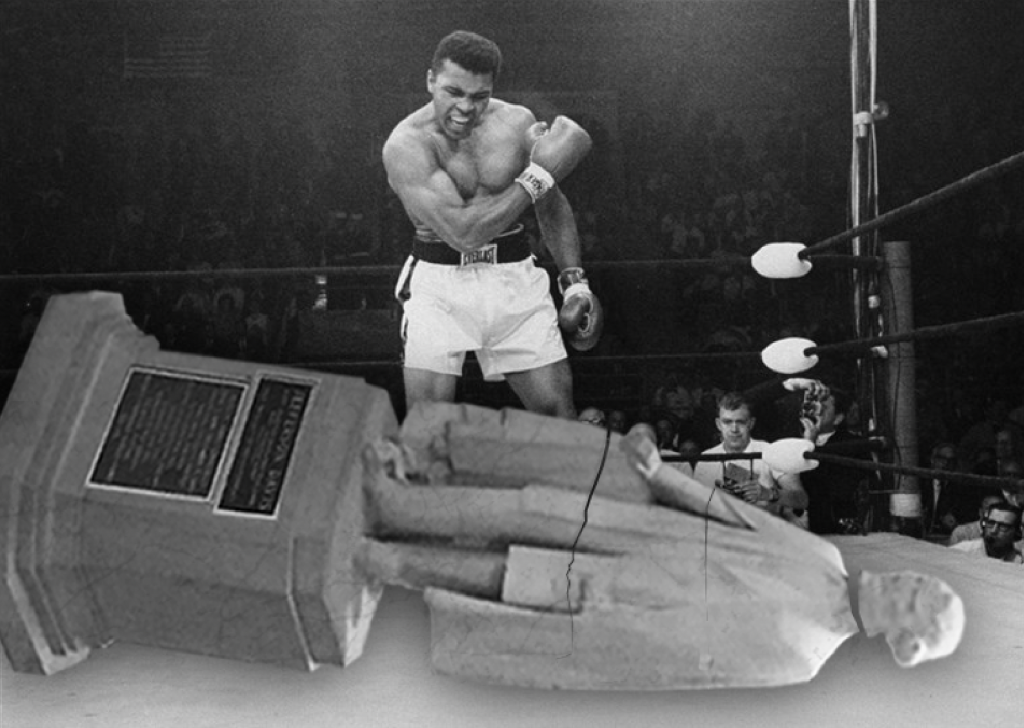
Please sign the petition below to remove the statue of Jefferson Davis currently in Kentucky’s Capitol Rotunda, and replace it with a tribute to Muhammad Ali, “the Louisville Lip” and “the Greatest of All Time.”
I just heard from the Ali family: It is the Champ’s belief that Islam prohibits three-dimensional representations of living Muslims. Accordingly, I have adjusted the petition to call for a two-dimensional representation of Ali (a portrait, picture or mural) in lieu of a statue.
UPDATE (Tuesday, December 2, 2014)
In this interview with WHAS-TV’s Joe Arnold, Governor Steve Beshear endorses the idea of honoring Muhammad Ali in the State Capitol (although he disagrees with removing Davis). Arnold explores the idea further on his weekly show, “The Powers that Be.”
Click here to check out WDRB-TV’s Lawrence Smith’s coverage of the story.
And here’s my op-ed in Ali’s hometown paper, the Louisville Courier-Journal.
UPDATE (Saturday, June 4, 2016)
In the wake of the 2015 Charlestown tragedy, in which a Confederate flag-waving murderer united the nation against racism, all of the most powerful Kentucky policymakers — U.S. Senator Mitch McConnell, Governor Matt Bevin, Senate President Robert Stivers and House Speaker Greg Stumbo — called for the removal of the Davis statue from the Rotunda. Today, as we commemorate last night’s passing of Muhammad Ali, there is no better moment to replace the symbol of Kentucky’s worst era with a tribute to The Greatest of All Time.
UPDATE (Wednesday, June 8, 2016):
Great piece by Lawrence Smith of WDRB-TV in Louisville on the petition drive to replace Jefferson Davis’ statue in the Capitol Rotunda with a tribute to Muhammad Ali.
UPDATE (Thursday, June 9, 2016):
Excellent piece on the petition drive by Jack Brammer that was featured on the front page of the Lexington Herald-Leader.
Highlight of the article:
Miller said he has received a few “angry comments” on his call to honor Ali.
“One of them encouraged me to kill myself,” he said. “You can quote me that I have decided not to take their advice.”
UPDATE (Friday, June 10, 2016)
The petition drives continues to show the Big Mo(hammed): check out these stories from WKYU-FM public radio in Bowling Green and WKYT-TV, Channel 27 in Lexington:
UPDATE (Saturday, June 11, 2016):
Still not convinced? Check out this excerpt from today’s New York Times:
By John Y. Brown III, on Sat Apr 5, 2014 at 10:30 AM ET
Note from John Y. Brown, III: Thanks to Randy Ratliff and Eric Crawford for drawing attention to about the best piece of journalism I’ve stumbled across in a long while. The piece, by Cory Collins, is a heartfelt and wrenchingly honest and humble personal piece asking probably the most unpopular question in central Kentucky this week on the eve of the NCAA Final Four; namely, Are we making too much of UK college basketball? Collins’ piece succeeds where so many pieces like it before have failed because it is not a disconnected and predictable scolding for misguided priorities but a sentimental and bittersweet journey of one thoughtful man who has been personally intertwined in the debate for many years and from many different vantage points. And who has reached a very thoughtful conclusion and desire to express it at precisely the moment when no one else in Kentucky really cares to hear it, including me. Which makes it all the more important that we do. And why I am glad I took the time to read it and respond to it just now.
(Photo by Jeff Gross/Getty Images)
Allow me to bestow remembrance, lest you forget the Battle on Broadway, circa 2013.
I was sports editor of a publication you’ve undoubtedly encountered on newsstands, somewhere between USA Today and The New York Times on the rack. For the uneducated, unwashed masses, lest you forget my work, it was The Rambler, Transylvania University’s student newspaper, circulation: 1,000.
And there was a basketball game. A preseason exhibition. A storied crosstown Lexington rivalry that none of your kids will talk about: the Kentucky Wildcats hosting the Transylvania Pioneers, my Division III institution that stands just a short Conestoga ride down Broadway from the sacred walls of Rupp Arena.
As you might imagine, hype was high, even if trash talk proved difficult. Something about “Hey, UK! In the 1800s, you were our AG SCHOOL! And we reap what we sow!” didn’t exactly elicit fear in the hearts of seven-foot Wildcats.
We lost. I’ll spare you the bloody details. But Pioneers could take pride in a 30-second spot on ESPN’s SportsNation, where our own Brandon Rash (sort of) posterized Willie Cauley-Stein. The reaction was predictable, only lacking the low-hanging fruit that is a joke about Dracula.
The host, Colin Cowherd, mocked the name on the chest, as if to ask, where the hell is Transylvania?
It’s hard to blame him. For in the world of sports, we were Atlantis, lost in the Lexington, Ky., sea of blue.
Perhaps we wore crimson because we often acted as a vein pumping blood into the heart of Big Blue Nation. We had our fair share of duel-fandom, students who wanted Transy diplomas but UK basketball T-shirts. We had Matt Jones, who became the host of Kentucky Sports Radio. We have current senior Ben Lyvers, who helps lead a Pioneer cheering section but wore blue to the Battle on Broadway.
And we had me. Stubborn, hipster me. Adamant that I had picked sides. Adamant that I had put my heart into Transylvania and a critical eye on Kentucky.
What I saw: it wasn’t that simple.
***
I don’t know when I became an outsider.
Before Cory Collins waxed poetic about the problems with big-money college athletics and referred to himself in the third person, Cory Collins played basketball on a plot of packed mud, a basketball hoop nailed to a tree. For hours, he played. And when the names taking the shots weren’t imaginary, they were often Wildcats.
I was just a rural Kentucky boy with a dream, and like many children, I loved things unconditionally and disproportionally. I loved shooting the basketball. And of all Wildcats, I loved Wayne Turner, and the way he shot free throws like he was mean enough to throw a baby backwards but kind enough to put a hand behind its head. I’d mimic the motion, because a swish is just as sweet when its origin makes no sense. And it made me smile. Why isn’t motivation always so simple?
I can’t pinpoint the exact moment that boyhood admiration for Big Blue disappeared. I turned into that typical creative, heady kid who seeks to assert himself. I dreamed beyond the boundaries of Kentucky, and thus, I cheated on my childhood and fell in love with new groups of young men playing ball games. I loved Texas’s baseball squad, UCLA’s color palette.
But these were fleeting fancies. In the end, I went to Transylvania, years after I discovered that a late-bloomer who has a way with words does not a scholarship athlete make. I thought my choice was made, my allegiance assigned. I’d left behind that Kentucky boy.
Instead, I found myself in an epicenter.
***
To live in Lexington with objective eyes is to see it: the big money program, the John Calipari car commercials, the burning couches, the fandom that does not border on obsession but defines it. I’ll admit that I was disenfranchised by its surround-sound persistence.
In 2012, when Big Blue raised its eighth banner, I was there as chaos hit State Street and Limestone. The success of selfless superstars like Anthony Davis and Michael Kidd-Gilchrist begat something much different — a mass self-indulgence. The destruction, the binge drinking, that’s what you’d see if you look no further than the six o’clock news.
So on the surface, it looked like everything that is wrong with the Kentucky fan base, what some may call the Alabama football following of the hardwood. A group that stands on a self-built pedestal, downgrades the outsider, and takes criticism as personal affront. But if that’s all you see, you miss a bit of beauty in Big Blue Nation:
You miss the fans that have nothing else to hold on to, not just in the streets of Lexington, but in the mountains, on the farms, inside the trailer parks where, without Big Blue, hope is a penny stock and they can’t afford it.
You miss the bond Big Blue perpetuates. As the aforementioned Mr. Lyvers explains it, “It just gives you chills. I’ve high-fived so many strangers in the past two weeks I had to ice my hand. It’s unifying.”
You miss the rare moment in the 21st century when something has the power to send people from their digital screens and screened-in porches to celebrate as a community.
But it should be said: if you only skim the surface of Kentucky basketball, you miss the dangers in the undertow.
***
When this culture surrounds you, so too does its flaws.
There are the obvious problems that you can find on the Twitter accounts of Jay Bilas of ESPN (@JayBilas) and Steve Berkowitz of USA Today (@ByBerkowitz) — Calipari’s unbelievable salary, the marketing of young men, an infrastructure so out of touch with its fan base that it sometimes feels like basketball’s McDonald’s, letting its poor indulge on unhealthy expectations until they are full.
But there are other things you see up close. There’s the way Kentucky basketball defines a city, despite a burgeoning culture of art, of inclusion, of creativity that fights to compete with its significance.
There is a dangerous dependence where identities, days, and moods are determined by wins and losses. It isn’t fandom, it’s a civil war, the difference between Kentucky being a national champion and a national punch line.
There appears to be a value system of athletics over academics, despite Calipari’s insistence to the contrary. UK is a team, in some eyes, before it’s a school. The school’s own official Twitter account, after 2012, led off its description promoting itself as the home of basketball’s best team. There was, surprisingly, no mention of its music program.
There is the onslaught of one-and-done, which has created a distance between fans and players. A veteran like Patrick Patterson is now the rarity. And while these fans understand better than many that dreams are fleeting, and that winning has a way of healing the hurt, they engage a coping mechanism. They decide the latest bunch will soon be gone, lament the loss of the old days and discard the new ones.
As an observer, as a liberal arts student and millennial hippie with cultural sensitivity and ingrained skepticism, this troubles me. But then I dare to look beneath the extremes. Beyond the ugly sides of fandom and into the beautiful in-between.
***
It was only two years ago when Kentucky represented the model for how youthful superstars could coalesce into something spectacular. It was only two months ago when Kentucky seemed to offer proof that no number of high school All-Americans could overcome the intangible necessities of experience and chemistry to succeed.
Now, the Wildcats are only two games away from potentially reclaiming the crown.
And on one hand, I dread it. I dread the fed beast that is the Big Blue Nation. I dread the calls to sports radio that will cement stereotypes of a Kentucky mindlessness that sees basketball, but misses the point.
But on the other hand, I can see it. I can already envision the sights of the state I called home. And some of it is beautiful.
I can see my Aunt Becky, as she battles cancer, for a moment able to stand strong, a tear in her eyes, a blue shirt over her heart, the words “our boys” on her lips as they dance across her television screen, victorious.
I can see the streets of Lexington, swarmed in jubilation. And beneath the binge-drinking, the danger, some student just happy to be there will hug a stranger, or take a selfie on Limestone Street with no intent to destroy, just to remember.
I can see a boy, somewhere, in the woods on a mud-packed court, running outside like I did in 1998, counting down imaginary seconds, perfecting Andrew Harrison’s follow through. Just a boy in the middle of nowhere that can dream of being somebody.
And yes, I can see the sight of freshman boys beneath confetti, a farewell party where their parting gift is the title, “National Champion,” smiling while we damn the system. The system that, God forbid, lets these boys of basketball leave to do what they love.
That’s when I’ll realize: who am I to damn the dreamers? Why should I, an outsider who can see the inside, fault the Big Blue Nation for its happiness?
I am critical. Of the money, of the culture, of the insensitivity and ignorance that can sometimes flow from a fan base so devoted to winning basketball games that it forgets that there are human beings beneath the jerseys, both the opposition’s and the one’s that spell “Kentucky” across the chest.
And there will be a time to revisit the one-and-done. To reconsider the explicability of recruiting players to use their university as a stepping stone to greatness, of sacrificing a sense of continuity for a sense of contention. To rediscover a game that used to be a Kentucky pastime before it became a Kentucky corporation.
But it is not just a cliché, in Kentucky, to miss the forest for the trees. So many problems dot the landscape that it’s easy to lose the scenery, to overlook the beauty.
I couldn’t truly see it until I left. I had intended to write about living within the city limits of Kentucky’s evil empire for four years, of lamenting how Kentucky ball courts became cult cathedrals.
But then I remembered that, beneath the burning couches, the hateful words on talk radio and the complicated racial relationship between player and fan (all of which still boils my Kentucky blood), there was happiness. There were smiles.
Because yes, we do have teeth in Kentucky. There’s just not always much reason to show them.
There’s a reason that a recent study from Gallup Healthways ranked two areas in the Commonwealth among the nation’s ten most miserable. For many, times are tough.
And if it takes millions of dollars, a basketball and a miracle run to bring those smiles back to Big Blue Nation — if it takes two Harrison twins and one coach with a car salesman’s smile — on some level, just maybe, it’s worth it.
Or maybe I’m still Wayne Turner in the wooded back yard, and I’ll never have a proper grip.
By John Y. Brown III, on Fri Apr 4, 2014 at 12:00 PM ET
We can’t know the future but we can try to guess as accurately as possible what the future will likely look like for us. But at best we can only approximate small parts of it. And it is imposible to know which parts will be correct.
When I was a boy I watched the Jetson’s cartoon every Saturday morning. Not so much because I enjoyed the storyline but rather because I wanted to get glimpses into what my high-tech futuristic life would be like.
As it turns out—over 40 years later–very little in my world resembles what was promised to me in the Jetson’s cartoon. No spaceships, no spacesuits, no hopping from planet to planet. Not even a robot dog that comes fully house trained.
The only similarities, if I really press myself, is that I am as goofy and ineffectual as George Jetson and my wife is as hot as Judy.
By Jonathan Miller, on Fri Apr 4, 2014 at 10:00 AM ET
In my latest column for The Daily Beast, I discuss what I believe was the greatest speech of the 20th Century. Here’s an excerpt:
America is the story of improvisation.
From the ad hoc debates that framed our founding documents, to the native jazz syncopations that power our cultural soundtrack, to the deeply American notion that we all deserve second chances — our national fabric is woven together by motley patches of spontaneous innovation, creativity and reinvention.
It’s no wonder that we cherish the myth that our history’s greatest oration was scribbled furiously on the back of an envelope during a train ride to a Pennsylvania battlefield.
But while Lincoln’s words were more planned and deliberate, the most significant speech of the 20th century was indeed improvised, a spontaneous burst of prose and poetry in the immediate wake of national tragedy. And much as the Gettysburg Address forever redefined the Founders’ promise that “all men are created equal,” Bobby Kennedy’s extemporaneous eulogy to Martin Luther King, Jr. — delivered 46 years ago today — can offer a path toward a more just, compassionate second act for our country.
===
It was the evening of April 4, 1968, and a bitter, black nightfall had descended on one of our nation’s grayest days.
Rejecting the impassioned urging of local officials who feared imminent violence, Senator Robert F. Kennedy ascended the back of a flatbed truck in a vacant lot, surrounded by dilapidated public housing units, in the heart of the Indianapolis ghetto. Hair tussled, wearing the old overcoat of his fallen brother, Bobby stepped up to a single microphone before a growingly angry African-American audience that had waited hours in the freezing cold to confirm what many had already heard: that Martin Luther King, Jr. — their Voice — had been permanently silenced. And without notes, speaking directly from his heart, a heart that ached from an unimaginable half-decade of grief — grief for a brother, for a comrade-in-peace, for a nation in turmoil — Robert Kennedy improvised the speech of his life.
Zzzzzzzzzzzzzzzzzzzz. Oh, excuse me, someone was talking to me about navy blazers, and I fell asleep.
The idea of navy blazers typically conjures memories of a first trip to Brooks Brothers for a rite of passage Sunday jacket, gold buttons and all. But not all navy blazers have to be a snoozefest. In fact, there are ways to take this conservative stalwart and give it a good shake-up. Read on for 5 tips on how to make a navy blazer your own:
1) Get it tailored so that it FITS you. I’ve you’re a current Rath & Co. client, or if you’ve been following me for some time, you know I’m a stickler for clothes that fit perfectly. So if you have a navy blazer that’s been hanging around your closet for a while, and the fit is within striking distance (the first thing to check is if it’s right across the shoulders), take it to a tailor you trust, and have him or her check the rest, including waist, arms and length, and make adjustments as needed. You’d be amazed at the 180 a jacket can take with a few nips and tucks.
2) Swap out those trad gold buttons for ones made of horn or gunmetal, like in the image above of a blazer I designed for a client. You’ll go from preppy to polished in no time.
3) Rather than standard navy, consider a blue with some kick to it, like midnight, cobalt or royal. Check out the same shot above of my client in his spanking new bright blue blazer. (His fiancée wasn’t complaining.)
4) Instead of a solid, try a subtly patterned fabric, like this tone-on-tone windowpane (above left — you have to expand the image to see the pattern) I just picked out for a different client. A blue hounds-tooth or pin-dot (above center and right) would also work, as would blue tweed in cold weather. From 4 + feet away, these fabrics read as solid, but up close you can see the extra oomph.
Read the rest of… Julie Rath: Wake Up that Navy Blazer
By John Y. Brown III, on Thu Apr 3, 2014 at 12:00 PM ET
If a roulette ball had “free will” which number and color would it try to land on?
Makes you think, doesn’t it?
At least it does if you have an hour drive into work every morning and can dictate random thoughts into Facebook posts on your smartphone.
===
Typical Monday morning blues…
Feeling Michael Mcdonald but looking Lyle Lovett.
==
I know our month calendar is based on the Roman Justinian calendar but I sometimes wonder if our week calendar is based on Greek mythology and the story of Sisyphus.
Sisyphus is a mythological figure who was condemned for eternity to repeatedly roll a boulder uphill — experiencing a momentary sense of relief (the weekend)– and then watching it roll back down and having to start pushing uphill all over again (Monday).
===
What is up with this fickle weather?
When did weekend weather reports routinely become “sunny with a couple inches of snow on Monday?”
I can’t tell if Spring is really just around the corner or if we are just experiencing intermittent hot flashes.
==
If a 3 year old needs to plead his or her case for a cupcake and isn’t having success, there is a 3 year old in San Jose, CA I recommend you hire to represent you.
And I am guessing he’s willing to work on a cupcake contingent fee basis.
“You either prepare to succeed or prepare to fail…there is no in-between.”
You have great intentions. You want to eat better. You want fitness results. But you didn’t bring any food to work today. So you go out with the rest of the crew and eat Mexican.
Is this you?
Professor JB here! I am prepared to take you through a course of food preparation. But first lets digress on why you would prepare your food:
1. Selection- I find that clients that prepared their meals ahead of time select better foods. Clients that do not prepare meals, tend to select whatever is available. Selecting whatever is available is a great way of messing with your fitness results.
2. Cost Effective- Today I fixed 3lbs of chicken and a half pound of rice. This will last for 10-12 meals. The total cost $60 or $5-6 per meal. To eat out and get the same meal would cost $10-15. That is a savings of $5-10 per meal. In other words, prepare your meals.
3. Results- Everyone wants results but few are willing to do what it takes to get them. If you want results, prepare your meals. It is that simple.
Now let us get down to the “nitty gritty” on how to prepare your food.
1. Prepare ahead of time- Take a day or two and prepare your meals for the week. Plan what you are going to have (in accordance of your goals) each day and only cook what you need.
2. Keep it simple- Try your best to keep it simple. A great protein source, a steamed vegetable and a small amount of carbohydrates (depending on goal) is a great way to prepare your meals.
3. Variety- If you want variety for taste purposes, use different seasoning and sauces to switch it up. Keep the additives to a minimum but also it is important to have fun with your meals. Getting a cookbook and trying different recipes is a great idea as well.
4. Fun- Try you best to look at this as fun, rather than a chore. This process is to help you see fitness results and keep you on track and more efficient.
For you enjoyment, here are some of my lovely clients food prep pictures:
By John Y. Brown III, on Wed Apr 2, 2014 at 12:00 PM ET
I will never personally explore outer space or the mysteries of the ocean depths.
But after becoming a “morning person” in middle age I have discovered an exciting new world that I never knew existed between about 530am- 8am each morning. It doesn’t involve identifying new stars or planets or observing a new underwater species or rare coral growth. Bu…t there are some real characters, fascinating behaviors, impressive routines and surprising activities that I never knew about that exist in this mysterious “early morning” world.
And you don’t need a spaceship or bathyscape to travel there. Just a functional alarm clock that doesn’t have a snooze button.
And astonaut helmets and swimming goggles are optional.
By Michael Steele, on Wed Apr 2, 2014 at 10:00 AM ET
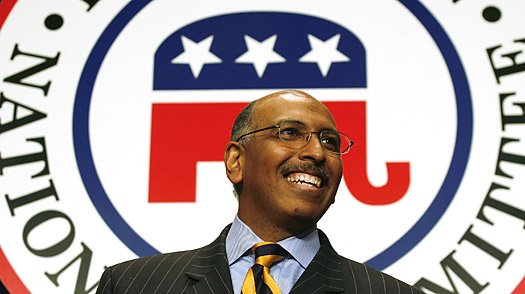
Awesome piece by Roger Simon in today’s Politico on recovering politician Michael Steele:
Steele, who is a resident fellow at the university’s Institute of Politics, manages to traverse the entire breadth of the Midway before the inevitable happens: A passing car comes to halt, and the driver lowers her passenger window and hails Steele as an old friend, even though they have never met.
While Steele was once the (first black) lieutenant governor of Maryland and the (first black) chairman of the Republican National Committee, today he is far better known than he was then. This is largely due to the airtime he gets as an MSNBC analyst and his appearances on “Real Time with Bill Maher” and “The Colbert Report.”
He is outgoing, bright, magnetic, recognized on streets and in airports and is the one thing he was not while he ran the Republican Party: popular.
“I am the most misunderstood man in politics,” Steele tells me.
Steele was elected to a two-year term as Republican Party chairman on Jan. 30, 2009. It seemed like a good idea at the time. Barack Obama had moved into the White House, and a lot of people were talking about a “post-racial” America. Nancy Pelosi was running the House, Harry Reid was running the Senate and it didn’t seem as if the Republican message was selling all that well.
So maybe it was time for a change.
Except Steele’s election took six ballots and, though Steele had conservative Republican credentials, the reaction of some of the party kingpins ranged from displeasure to dismay. And then there was the race thing. Maybe the country was not so post-racial after all.
“After I was elected chairman, there were some people who refused to shake my hand,” Steele says of some Republican bigwigs.
He was a different kind of chairman. He got involved in controversies that earned him the wrath of Sen. John McCain (not that hard a thing to do, actually) and made a series of statements that some found baffling.
He said the war in Afghanistan was a war “of Obama’s choosing” and that he was going to tell local Republican chairmen, “Don’t think this is a country club atmosphere where we sit around drinking wine and eating cheese and talking amongst ourselves. If you don’t want to drill down and build coalitions to minority communities, then you have to give that seat to someone who does.”
Some of his ideas were actually pretty good. He said he wanted an “off the hook” public relations offensive to reach out to “the young, Hispanic, black, a cross section” and apply party principles “to urban-suburban hip-hop settings.”
This earned him the wrath of Rush Limbaugh, which could be considered a badge of honor, but Steele was the chairman of the Republican Party, a party that didn’t actually think of itself as being that “off the hook.”
like to joke that I have 3 boys, ages 17, 20 and 47. (One is my husband – cue rim shot.) Husband 2.0 came along when I was a single mother with really young kids, and he proceeded to endear himself to them by doing silly impressions (his Yoda and Scoobie-Doo sort of mesh together) and inventing a game he called ‘Dodgeball In The Dark,’ in which they raced around the backyard throwing whatever wasn’t nailed down. But he really bonded with the boys via male humor – first Simpsons, then Family Guy as they got (almost) old enough, with a healthy dose of “that’s what she said” jokes thrown in.
Many writers have weighed in on why women are less amused by this type of humor – in fact, Google “Why men love The Three Stooges and women don’t” and you’ll get over 2 million entries, with a wide range of explanations. I’m constantly trying to give my boys a bit of refinement and elegance, and moms are traditionally the ones who discourage rough-housing and bad language, but there is also something to be said in favor of letting our hair down a bit – especially since at my house it’s a losing fight anyhow.
I’ve learned to enjoy Family Guy (okay, it can be horribly offensive, but also really funny, and the song parodies are a riot), and I’ve been known to crack an off-color ‘that’s what she said’ on occasion. Plus this week, when I was at my wits’ end trying to figure out a topic for my song, Husband 2.0 suggested I do something juvenile with the rhyming name of Hobby Lobby – and this is the result. (Maybe we’re the reverse of the old saying about Fred Astaire and Ginger Rogers, that he gave her class and she gave him sex appeal. . . I give him class and he gives me bawdy humor suggestions?)
By John Y. Brown III, on Tue Apr 1, 2014 at 12:00 PM ET
Finally!
My long-time trusty alarm clock broke several months ago–and I have relied on my wife, Rebecca, to wake me up every morning using her alarm clock.
Why?
Because for 4 months I have been unable to find an alarm clock for myself that is “idiot proof.”
In other words, that I can figure out how to use–like my old one dimensional alarm clock. It is a Sony from Walgreens and costs $14.99 and I am elated.
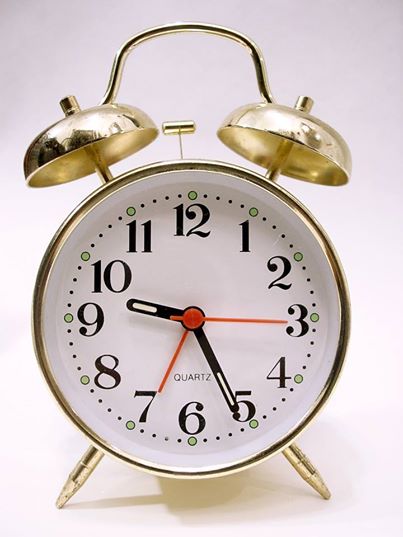
Every other alarm clock I have looked at seems to require an advanced degree in engineering to operate. (It’s not the one pictured but is as scaled down and limited to its original uses) When did clocks become easier to make than to use?
I am so relieved. Imagine…having a clock that I can set all by myself.
Most alarm clocks I am passing on, I am sure, have many wonderful new fangled features. Some project the time on the ceiling; some probably connect to NASA and can track satellites. But I just need an alarm to go off around 6am every morning and am willing to give up all the other cool clock “value adds.”
I just need a loud alarm buzzer and something that tells time–and I’m good.


 Blog this!