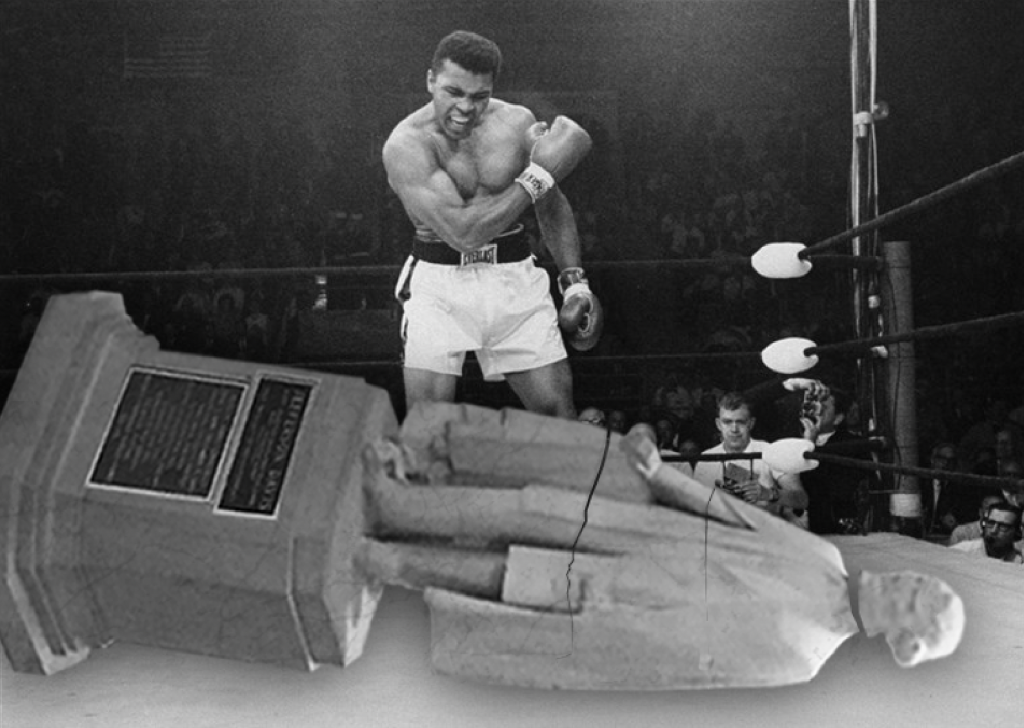
Please sign the petition below to remove the statue of Jefferson Davis currently in Kentucky’s Capitol Rotunda, and replace it with a tribute to Muhammad Ali, “the Louisville Lip” and “the Greatest of All Time.”
I just heard from the Ali family: It is the Champ’s belief that Islam prohibits three-dimensional representations of living Muslims. Accordingly, I have adjusted the petition to call for a two-dimensional representation of Ali (a portrait, picture or mural) in lieu of a statue.
UPDATE (Tuesday, December 2, 2014)
In this interview with WHAS-TV’s Joe Arnold, Governor Steve Beshear endorses the idea of honoring Muhammad Ali in the State Capitol (although he disagrees with removing Davis). Arnold explores the idea further on his weekly show, “The Powers that Be.”
Click here to check out WDRB-TV’s Lawrence Smith’s coverage of the story.
And here’s my op-ed in Ali’s hometown paper, the Louisville Courier-Journal.
UPDATE (Saturday, June 4, 2016)
In the wake of the 2015 Charlestown tragedy, in which a Confederate flag-waving murderer united the nation against racism, all of the most powerful Kentucky policymakers — U.S. Senator Mitch McConnell, Governor Matt Bevin, Senate President Robert Stivers and House Speaker Greg Stumbo — called for the removal of the Davis statue from the Rotunda. Today, as we commemorate last night’s passing of Muhammad Ali, there is no better moment to replace the symbol of Kentucky’s worst era with a tribute to The Greatest of All Time.
UPDATE (Wednesday, June 8, 2016):
Great piece by Lawrence Smith of WDRB-TV in Louisville on the petition drive to replace Jefferson Davis’ statue in the Capitol Rotunda with a tribute to Muhammad Ali.
UPDATE (Thursday, June 9, 2016):
Excellent piece on the petition drive by Jack Brammer that was featured on the front page of the Lexington Herald-Leader.
Highlight of the article:
Miller said he has received a few “angry comments” on his call to honor Ali.
“One of them encouraged me to kill myself,” he said. “You can quote me that I have decided not to take their advice.”
UPDATE (Friday, June 10, 2016)
The petition drives continues to show the Big Mo(hammed): check out these stories from WKYU-FM public radio in Bowling Green and WKYT-TV, Channel 27 in Lexington:
UPDATE (Saturday, June 11, 2016):
Still not convinced? Check out this excerpt from today’s New York Times:
BuzzFeed Politics asked contributing RPs Jeff Smith and Rod Jetton –both who served with Todd Akin in the Missouri legislature whether GOP donors will ever follow their political leadership and support Akin’s bid for the U.S. Senate. Here were their responses:
Rod Jetton, a former Republican speaker of the House in Missouri who works now as a political analyst, said major donors have about a week left to reevaluate and contribute money to Akin if they want to make a difference in the race.
But, Jetton told BuzzFeed, donors will remain wary of investing in Akin who, as a candidate, has been inconsistent at best.
“I don’t know that they have the confidence that the last four weeks of the campaign will be any different from what the past six weeks have been, from a messaging standpoint,” Jetton said.
“Let’s be honest,” he added. “Whether they like Todd Akin or not — and they don’t — if it can put them to 50, it doesn’t matter: They’re going to have to spend the money. But these misstatements make them wonder if they should be spending money in one of the other contested races.”
“Your standard Romney bundler is not going to start bundling for Todd Akin,” said Jeff Smith, a professor at the New School and a former Democratic Missouri state senator. “That person would be embarrassed to bring Todd Akin to Manhattan.”
Because major Missouri donors have also stayed away, Smith told BuzzFeed, outside groups will be the ones who keep Akin afloat—or not, as the case may be.
“Obviously this is the seat of last resort, the one they don’t want to have to give to, but it keeps coming back,” Smith said. “If they can figure out any way to get the Senate back without spending money in Missouri, they’ll do it.”
By Zack Adams, RP Staff, on Mon Oct 8, 2012 at 3:00 PM ET
The Politics of Pigskin
According to Pro Football Reference the 49ers became the first team to accumulate over 300 yards in both passing and rushing. How’s that for a balanced offence? [Pro-Football-Reference]
Cheifs OT Eric Winston had strong words following their game on Sunday regarding fans who cheered when Matt Cassel went down with an injury (which later turned out to be a concussion). [Arrowhead Pride]
Another starting QB was knocked out of his game on Sunday when Robert Griffin III also sustained a concussion while scrambling for a first down. The hit was deemed legal because RG III had not slid. [ESPN]
The Colts did right by absent head coach Chuck Pagano on Sunday – upsetting the Packers and sending a game ball to Pagano in the hospital. [SI]
For Sunday’s night game fans were treated to the Saints claiming their first win of the season and Drew Brees breaking Johnny Unitas’ record for consecutive games with a passing TD. [ESPN]
In the Recovering Politician Bowl we lost our last unbeaten team as the Powerful Lobbyists took their first loss.
By John Y. Brown III, on Mon Oct 8, 2012 at 12:00 PM ET
Do you know your strongest demographic?
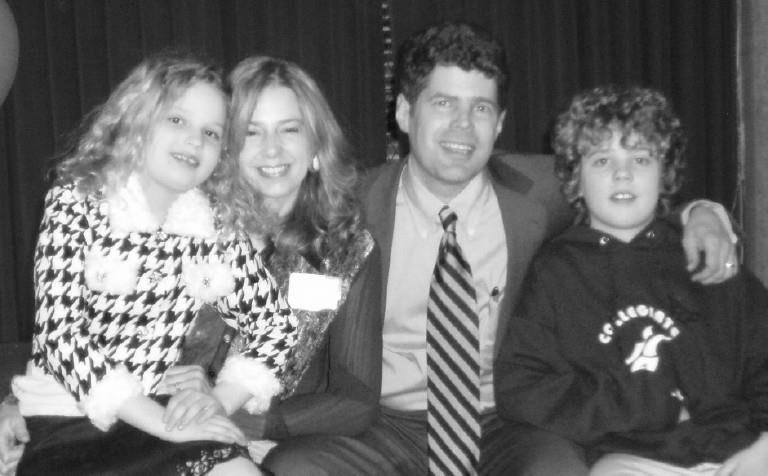
A favorite campaign story I was reminded of recently happened in 2007 when my family at our first major fundraising event in Frankfort. I was the Lt. Governor running- mate candidate with House Speaker Jody Richards. We were huddled in our van before the event with my 11 year old son, Johnny, listening intently as we went over fresh poll numbers.
I tried to include Johnny so it would make sense to him and explained that the poll was broken up into different demographic groups based on age, sex and so on.
I explained to Johnny that we did OK with 18-24 year olds; better with 30-45 year olds and even better with those 55 and over. And went though other demographic breakdowns with him as well.
We arrived at the event and over a 100 people were present. Johnny did what any 11 year old would do first and went for the food table. We stayed until almost everyone had left and Johnny walked up to me exhausted–with the arms pulled up from his over-sized sweat jacket— but eager to report something to me. He seemed excited and told me, “Dad, I shook a lot of hands tonight.”
I said, “Well, wonderful honey, but you didn’t have to do that. But I sure appreciate it!”
“I enjoyed it and everyone was really nice.” Johnny responded before pausing and then adding. “I think my best demographic is women over 55.”
I almost embarrassed myself I laughed so loudly….but was quick to remind Johnny, who didn’t understand what was so funny, That’s an awfully good demographic to do the best with. And that he should consider himself lucky.
By Jonathan Miller, on Mon Oct 8, 2012 at 10:00 AM ET
A lot of virtual ink has been spilled about Friday’s controversial infield fly rule call in the Major League Baseball playoff game between the Atlanta Braves and the St. Louis Cardinals.
Rob Neyer, one of my favorite sports journalists, offers this dispassionate, very persuasive, and counter conventional-wisdom analysis as to why the umps got the call right. Here’s an excerpt:
Now, before we get to the heart of the thing, let me clear up a couple of things.
Friday night, a great number of observers — and I use the word “observers” quite literally — complained that left-field umpire Sam Holbrook didn’t make the call immediately, as (supposedly) stipulated by the rule. But that isn’t what the rule says. What the rule says is that he should make the call immediately after it comes apparent that it’s an Infield Fly.
Usually, that happens a split-second after the ball is hit; most of the time, it’s quickly apparent that an infielder might easily make the play. This just wasn’t one of those times. Because of where the ball was hit — short left field — it wasn’t apparent until a) the baseball began its descent, and b) there was an infielder in the vicinity.
But what’s truly odd about the complaint is that making the call “late” actually helped the Braves. If an umpire had screamed “Infield Fly” immediately, the runners might well have held their bases. Instead they went halfway down their respective baselines, and actually advanced one base apiece. Even if you think they would have gotten there anyway, the delayed call certainly didn’t hurt the Braves.
So let’s forget about that complaint, and focus instead on the only valid point of dispute, a simple question:
Could that fair fly ball have been caught by an infielder with ordinary effort?
By Jonathan Miller, on Mon Oct 8, 2012 at 8:30 AM ET
We’re in trouble. And the people we sent to Congress to solve America’s biggest problems are completely stuck.
On January 1, unless our leaders stop the partisan brawling and focus on solutions, we’ll face massive budget cuts and tax increases that could send the U.S. economy back into a tailspin.
We all remember what economic meltdown is like. None of us — in any party — want to go through it again. We can head this crisis off at the pass, but not unless we fix the Senate filibuster. If we don’t, then we can assume that any policy solution will be sabotaged through the filibuster process.
The filibuster is used in the Senate now more than ever before — in part, because it’s easier to do than it used to be. A senator doesn’t even have to hold the floor to force a filibuster anymore. Often, all a senator has to do is signal that he or she intends to filibuster a bill to bring the whole process to a dead stop.
Just one senator can take the whole body hostage — and he or she can do it in secret without ever having to make his or her case.
It’s outrageous. And because elected officials are using it to block legislation introduced by their opposing parties, it’s preventing potential solutions from receiving due consideration in Washington.
Our Senate leaders can help stop the gridlock by putting limits on how and when the filibuster can be used when legislators return to Washington in January. But they won’t — not unless they feel the heat from all of us.
By John Y. Brown III, on Fri Oct 5, 2012 at 12:00 PM ET
The little recognized “divider”
In the early stages of life we find qualities serve us that seem at the time “most important” to success. The more obvious ones are intelligence, hard work, education, looks, personality, persistence, loyalty, faith, honor, savvy and the like.
All those seem to come and go after being indispensable at some point during our early life stages. But what about the key trait that distinguishes those who thrive in the middle years and those who find this period befuddling and daunting?
I think the key distinguishing trait is self-awareness—or more bluntly, self-honesty. How well are we able to candidly and painfully assess who we are and how we see the world and our place in it. Maybe this is what Socrates meant with his maxim, “Know thyself.”
I was having lunch with very bright friend 4 years ago who as a few years younger than I. He has a law degree from Harvard and was wondering how to figure out succeeding in the murky middle years. I remember saying something like, “I think it is less taxing on our minds than our souls. And open to all who are ready for the journey within where we get to meet and make peace with ourselves.” Adding, “it’s the easiest on the surface but the hardest in practice.”
And I don’t think I’ve wavered from that belief in the 4 years since then.
If Showtime’s exemplary “Homeland” is the new pace-setter for politically themed drama, and CBS’s “Good Wife” is a successful, if less psychologically rich, portrait of a scandal surviving heroine, what to make of Starz’s largely obscure “Boss”, an ensemble drama about a fictional Chicago Mayor who is fighting off mental illness and all manner of intrigue? It is a well-acted, intricately conceived narrative that has utterly failed to break through the popular consciousness, much less the Emmy circle, and it is worth pondering why its ambitions have gone unrealized at a time when political morality plays are newly resurgent on network and cable.
The rap on “Boss” may well be that the conceit at the heart of the show—that gaining and holding power is one sordid, muddy blend of egos and ruthlessness—is so shopworn that it manages to bore. The protagonist, the 20 years plus mayor of the Windy City, Tom Kane (Kelsey Grammer) is a brute: by the middle of the second season, we know that his power is built on a web of corrupt bargains with city developers, a sham of a marriage to the glamorous daughter of his predecessor, and a staff of devotees who protect his lies out of some alchemy of ambition and loyalty. We know he ruins and takes lives. Nothing new here: it is more or less an amped up version of every recycled stereotype about the unseemly nature of power. Nor is there any justifiable thread for Kane’s abuses beyond the old stand-by—at least the city works for its elite, and the trains run on time, and the poor and the marginal are subsidized by a mixture of patronage and spoils. It is no accident that Chicago looks in this rendition less like a modern metropolis than a hulk of decaying deals and faded urban monuments.
Read the rest of… Artur Davis: The Unbearable Emptiness of “Boss”
By Zack Adams, RP Staff, on Thu Oct 4, 2012 at 1:30 PM ET
The Politics of Tech
The Philippines have passed a law that is many times worse that SOPA. It criminalizes cybersex, torrenting, and criticizing someone online. [CBS News]
On the topic of torrents, the founder of Pirate Bay, Gottfrid Svartholm, continues to be imprisoned without official charges being filed. [TorrentFreak]
After the criticism of the new Apple Maps app following the release of the the iPhone 5 last week Apple CEO Tim Cook has apologized via press release. [engadget]
MIT grads advancing molten salt reactor which can use thorium as a nuclear fuel. [Forbes]
Why It’s Bad That Smartphones Have Banished Boredom: When we reach for a smartphone at every pause in our day, we forget how to reflect naturally [Slashdot]
By John Y. Brown III, on Thu Oct 4, 2012 at 12:00 PM ET
We’ve all heard the saying, “It’s impossible to ask a stupid question.”
As someone who has the habit of asking lots of questions, I always took comfort in this maxim. But learned about 12 years ago during a marriage counseling session, it’s not always true.
I have since become a huge fan of marriage counseling for all couples. It teaches relationship skills we all need and is no different, in my opinion, to time and money we spend keeping our bodies and minds fit. But this was during the first few weeks of counseling and my lovely wife, Rebecca, and I still assumed it we were basically having a contest to see who could “win” and that the counselor was basically our umpire and score keeper.
Rebecca had won the first few sessions on points. I’d always known that if I’d been a boxer life, I’d be better served trying to always win on points rather than going for the knockout punch—even though the impulse to go for the knockout was always hard for me to resist. This morning I was off to an excellent start—doing all the right things. Using I statements and parrying well by mirroring empathetically Rebecca’s statements. I seemed to have our counselor on my side with momentum rolling my way.
And then I decided to go for the close and seal the deal, so to speak, with a question that I thought would secure a “W” for me this session—and one that we’ll all remember. It was the boxer–not the husband—in me.
“Doctor,” I thoughtfully intoned. “I’m sure you treat a lot of unhappy couples in your practice and I think you’ve had a chance to get to know me pretty well these past few weeks. Is it fair to say that most of the wives you meet with would be very happy to have a husband like me?”
And then….then…there was that awful, horrendous feeling one gets when you suspect there’s been a crack in the universe —and everyone is staring at you like you are to blame. And deep down, you agree with them.
I never got an answer to my question. But the question did help one of us “seal the deal” that morning. And it was a question we did, in fact, all remember.
And no one—on that morning—offered me the solace “John, there is no such thing as a stupid question.”
Good morning, and welcome to another edition of Prix Fixe Politics! If Mitt Romney wins this election, it will be because of the way he turned the tide last night in Denver. It was Mitt’s Mile High Moment — a combination of a stinging critique of a suddenly meek President and a strong case for business-executive leadership. This debate won’t be remembered for any zingers or select lines. Simply put, it was Romney at his best and Obama at his worst for 90 minutes. We can now officially bear down for a dog fight until November 6th, but in the meantime here is today’s menu…
Appetizer: I watched the debate with 24 undecided swing voters in Lakewood, Colorado, thirteen having voted for Obama in 2008. Where did the group stand after the debate? 20 thought Romney won, and 10 said the debate made them more likely to vote for the challenger. Boston (Romney Headquarters) loves these numbers for several reasons. First, it’s serious earned media for the next week. With the next debate not until October 11 (and that’s between Joe Biden and Paul Ryan), last night’s contest will remain front and center for more than the typicl 48-hour news cycle. Second, it puts the President’s advisers on the defensive. They’ll be on CNN and MSNBC every day, trying to return the focus back to Romney’s rich, out-of-touch ways. Yet after their candidate got walloped like he did, any effort to pivot will come across as an admission of defeat. And third, it takes some of the pressure off Romney. He still has a lot to do in the next 32 days if he wants to be elected. But for a few days, he’ll get to spend more time talking about his success in Denver, which means less time talking about “The 47%” or tax returns.
Main Course: There were a few moments in particular that stood out and are worth discussing. Romney’s opening statement where he set forth his five-point plan won high marks. You may have noticed in that clip, and many other times throughout the debate, Romney enumerated his points. Not only does that keep the communicator focused, but it causes the listener to think he’s hearing an organized, well-crafted answer. This style is one of the most important ways for Romney to appear to be giving the American people what they want to hear: SPECIFICS. While the President meandered through wordy answers and tired excuses, Romney enumerated his way to convincing voters that he does in fact have a plan. President Obama’s best moments came while discussing health care. Whether you hate or love Obamacare in sum, it’s hard to viscerally hate some of its component parts — 26 year olds, pre-existing conditions, etc. Romney and the Republicans still don’t have a good answer for the important question of what they’d do if they repeal Obamacare. Because Obama has set a new baseline with these well-liked components of the legislation, Romney must calibrate his plan accordingly. Finally, our Colorado swing voters were nearly off the charts with their real-time dials when Romney spoke about his bipartisanship in MA. In 2008, Obama promised to transcend partisanship. Four years later, the acrimony has gotten even worse and the public has grown increasingly impatient with the President and Congress. Romney has a record of working across the aisle, and the undecided voters notice it. With this debate answer, he gave his best introduction yet of himself as a Washington outsider with political skills desperately needed along Pennsylvania Avenue. That Obama let a Republican cast himself as the one best suited to working across the aisle is confounding.
Dessert: Here are three pieces of advice for President Obama as he prepares for the next debate. First, figure out what you’re going to do with your head while Romney’s speaking. Looking down and disinterested like you did last night is the 2012 version of the smug, nose-up Obama we got in 2008. Unless you are writing something down, focus on Romney. And every time you give an answer, you should be looking directly into the camera. There’s no debate audience you need to pander to in the auditorium — the only important people are the ones watching at home! Your verbal shiftiness reflected a lack of self-confidence and your body language communicated defeat. Second, what happened to General Motors? You couldn’t swing a dead cat at the DNC without hitting an Obama surrogate talking about the success of GM. Heck, Biden’s best line from his DNC speech was: “Osama Bin Laden is dead, and General Motors is alive!” When you speak about “saving” GM, you are communicating directly with the voters of Ohio, Michigan, and Western Pennsylvania. Your ads in those states have been too good to start ceding ground there now. Third, where did Bain Capital, outsourcing pioneers, and the 47% disappear to? They’ve been your most effective attacks against Romney and you didn’t mention them once on the biggest stage you’ll have before election night. You only had to mention these red herrings once or twice — any more would appear unpresidential. But psychology tells us the importance of the availability heuristic — if you don’t keep these attacks salient while actually on the stage with the culprit, voters will be less likely to recall them in the voting booth.
Read the rest of… Zac Byer: Prix Fixe Politics — the Denver Debate


 Blog this!