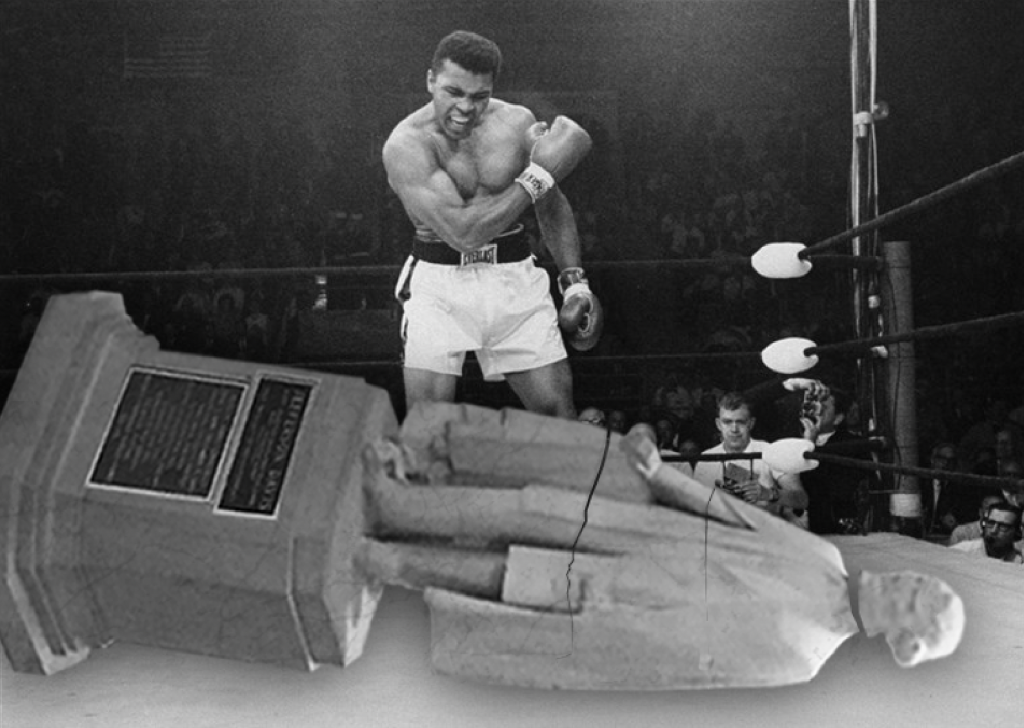
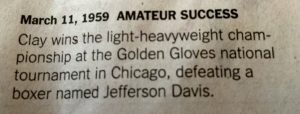
Please sign the petition below to remove the statue of Jefferson Davis currently in Kentucky’s Capitol Rotunda, and replace it with a tribute to Muhammad Ali, “the Louisville Lip” and “the Greatest of All Time.”
I just heard from the Ali family: It is the Champ’s belief that Islam prohibits three-dimensional representations of living Muslims. Accordingly, I have adjusted the petition to call for a two-dimensional representation of Ali (a portrait, picture or mural) in lieu of a statue.
UPDATE (Tuesday, December 2, 2014)
In this interview with WHAS-TV’s Joe Arnold, Governor Steve Beshear endorses the idea of honoring Muhammad Ali in the State Capitol (although he disagrees with removing Davis). Arnold explores the idea further on his weekly show, “The Powers that Be.”
Click here to check out WDRB-TV’s Lawrence Smith’s coverage of the story.
And here’s my op-ed in Ali’s hometown paper, the Louisville Courier-Journal.
UPDATE (Saturday, June 4, 2016)
In the wake of the 2015 Charlestown tragedy, in which a Confederate flag-waving murderer united the nation against racism, all of the most powerful Kentucky policymakers — U.S. Senator Mitch McConnell, Governor Matt Bevin, Senate President Robert Stivers and House Speaker Greg Stumbo — called for the removal of the Davis statue from the Rotunda. Today, as we commemorate last night’s passing of Muhammad Ali, there is no better moment to replace the symbol of Kentucky’s worst era with a tribute to The Greatest of All Time.
UPDATE (Wednesday, June 8, 2016):
Great piece by Lawrence Smith of WDRB-TV in Louisville on the petition drive to replace Jefferson Davis’ statue in the Capitol Rotunda with a tribute to Muhammad Ali.
UPDATE (Thursday, June 9, 2016):
Excellent piece on the petition drive by Jack Brammer that was featured on the front page of the Lexington Herald-Leader.
Highlight of the article:
Miller said he has received a few “angry comments” on his call to honor Ali.
“One of them encouraged me to kill myself,” he said. “You can quote me that I have decided not to take their advice.”
UPDATE (Friday, June 10, 2016)
The petition drives continues to show the Big Mo(hammed): check out these stories from WKYU-FM public radio in Bowling Green and WKYT-TV, Channel 27 in Lexington:
UPDATE (Saturday, June 11, 2016):
Still not convinced? Check out this excerpt from today’s New York Times:
By John Y. Brown III, on Fri Mar 1, 2013 at 12:00 PM ET
The conventional wisdom is that as you age (into your middle years) you first become mellower but as you age beyond, shall we say, the middle years midpoint, you become less patient and more irritable (some might charitably call it more assertive).
So, is that all true?
I have decided only partially. I like a good deal of the impatient “assertiveness” (aka irritability) comes from realizing the backlog of years and years of not being assertive enough—-and trying to catch up and clean the slate before we run out of time.
And maybe even get in the last word. With that rude sales clerk, or call center “relationship manager” or waiter who always seems to give us short shrift.
And who, if we had an 18 year old’s body and a 70 year old’s temperament, would try to stare them down before inviting them outside.
But since we have a 49 year old’s temperament and 49 year old’s body, resort to much subtler passive-aggressive tactics, albeit still tougher than ever before. And tip them only 13%. Instead of the standard 15%.
I can’t wait to see them again when I’m 55 –and even more “assertive.” That petulant boy is only getting 11% tip when age 55 rolls around!See More
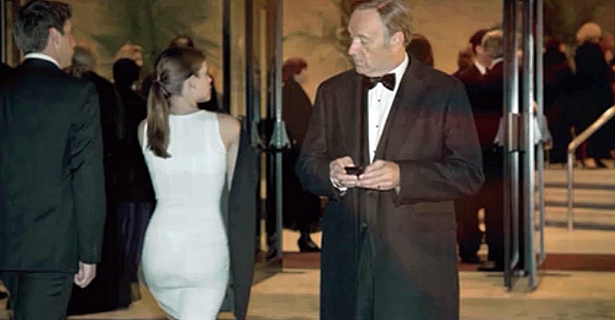
In one exemplary scene in Beau Willimon’s highly addictive ‘House of Cards’ series, House Majority Whip Frank Underwood visits his sometime paramour, ambitious reporter Zoe Barnes. Within 20 seconds of his climax, she demands the vote count on a pending bill. Frank resists, and a mild disagreement ensues during which he asserts that, despite being twice her age, she “always seems to leave satisfied.”
“How do you know I’m not faking it?” asks Zoe. “Are you?” he asks.
“Doesn’t it say a lot that you can’t tell?” she replies.
Several ‘House of Cards’ reviewers have alluded to the show’s verisimilitude. And the New York Times just started a series about the realism (or not) of the show’s portrayal of journalism. But I haven’t seen any current or ex-legislator analyze its depiction of legislative life – the hits and the misses. As with sex, it’s not always easy to know what’s real and what isn’t.
As a former lawmaker and Missouri Congressional candidate, I’m somewhat acquainted with this world. Let me try to clear some of this up.
Here’s what the show gets right
There’s a thin line between transactional sex and actual prostitution.
In the culmination of a first season theme, an impassive Zoe tells post-coital Frank, “As long as we’re clear about what this is, I can play the whore. Now pay me” (with information). Although I doubt the terms of most arrangements are quite that explicit, I saw transactional sex as a legislator. However, the journalist/legislator pair strikes me as unlikely; legislator/staff and legislator/lobbyist were more frequent pairings, and you could often see the dividends it paid for both parties.
District life and legislative life occupy parallel universes – but when problems arise, district issues come first.
Often legislators face simultaneous crises in parallel spheres – one policy-oriented, one constituent-related. Successful legislators – no matter how high-ranking – address district crises first. An example came in Episode 3 when a young constituent of Frank’s dies in a car accident after being distracted by a phallic roadside sculpture whose erection Frank had supported. A local official who covets Frank’s seat pushes the girl’s parents to sue, dragging Frank into the mess. Despite being deep in Hill negotiations on a critical bill, Frank spends two days back home negotiating a settlement. The untimely death of a constituent may not seem capable of bringing the nation’s business to a halt. But savvy legislators understand that absent re-election, no other goal can be fulfilled.
Being a legislator requires extraordinary multitasking skills.
These days, everyone multitasks. But legislators are often required to multitask on a more emotionally and/or intellectually demanding level. Viewers saw a dramatic example of this during the above storyline, when Frank negotiates with the chief lobbyist for the teachers’ unions while making a tray of sandwiches he was about to share with the bereaved parents. He threads the needle, giving just enough ground to keep the negotiations alive, while maintaining focus on his distraught guests.
Constituents do not mince words.
After Rep. Peter Russo takes a dive and allows a military base in his district to close without putting up a fight, he returns to his office to find a deluge of hate email, with constituents calling him, for instance, a traitorous piece of shit. I can promise that I was called that and far worse by constituents, as were many of my close colleagues. Indeed, a bitter enemy of mine only wrote me one pleasant email in my career – the day I resigned.
Like golf, politics is a game of inches.
The shift of just two votes on Russo’s job creation bill leads to a series of events which spiral out of control, leading to tragedy. Had those two fence-sitting votes gone the other way, the bill would’ve passed and Russo would’ve been a hero back in his district, rather than an embarrassment. I can think of several presidents – or near-presidents – who could confirm this. Kennedy beat Nixon by less than one vote per precinct. George W. Bush beat Al Gore by a butterfly ballot. And Clinton was impeached because of a dress that wasn’t laundered in a timely fashion.
Here’s what they get wrong
Except in very intimate settings, legislators do not tie campaign donations to pending legislation in such bald terms.
As Episode 9 opens, Frank convenes 15 to 20 legislators – along with a dozen staffers – to push Russo’s job creation bill. When asked to explain their apprehensions, one legislator says, “I’ve already been approached by Sancorp with re-election funds.” Another chimes in: “They offered me a donation package with eight different drilling companies.”
Any legislator who said something like this would appear to be for sale – and could be risking serious legal trouble if they ultimately voted with the company in question. With few exceptions, legislators publicly pride themselves on their inability to be bought, and would not – especially in a room of 30 people, including others’ staff – blurt out links between campaign donations and specific legislation, even if they know such links exist. A legislator would either say it privately to another trusted legislator or aide or, in a larger group, would couch it in acceptable terms, code language such as “Sancorp approached me as well, and made it clear that this bill is extremely important to them.” Pork-barrel bills that reach the floor offer funds to at least 218 districts.
Read the rest of… Jeff Smith: What “House Of Cards” Gets Right — And What It Doesn’t
I’m loving this black and white striped Ralph Lauren tie that I got on sale for a client at Bergdorf Goodman. Originally $150, it rang up as $69. The deals these days are out of control.
When contributing RP Jeff Smith, a state senator representing St. Louis, found himself behind bars for political missteps, he discovered a unique business world churning in prisons.
He saw that a meager prisoner’s salary quickly leads to ingenuity. You have to figure out how to get what you want without much money. What Smith saw on the inside struck him as very similar to business leaders he had come in contact with outside of the penitentiary.
He’s been released and has landed a job teaching at the New School. One of his crusades is to figure out a way to harness the ingenuity he experienced behind bars and getting ex-cons back on their feet with a business plan.
Jeremy Gregg works with the same population that Smith found so underutilized and inspiring. Gregg is the chief development officer of the Prison Entrepreneurship Program, where inmates take classes on how to build a business.
Minnesota Public Radio’s “The Daily Circuit” discussed harnessing prison ingenuity to get ex-cons on their feet.
Guests
Jeff Smith: Assistant professor of urban policy analysis and management at the New School
By Jonathan Miller, on Thu Feb 28, 2013 at 12:00 PM ET
I have been listening this week to a lot of music from an alternative rock band from the late 80s and early 90s named “Mother Love Bone.”
I know. Great band but name is hard to explain away if I died unexpectedly in a car accident and the police on the scene noticed my IPod set to Mother Love Bone pictured with their gifted and androgynous lead singer, Andy Wood, who died before their debut album from a heroin overdose.
Which is why I am mentioning this now. If some tragedy befalls me and there is talk of my “disturbing interest” for a man my age in a rock band named (there is no subtle way to pronounce it) “Mother Love Bone” —please someone chime in and say it was just a “passing phase” and that I was much better known for my love of classical music, Beethoven, Bach and the boys.
Who, be quick to add, showed clear signs of androgyny too but no one ever mentions that and maybe they (Andy Wood, Beethoven and Bach) were just all great musicians and we should leave it at that.
By Jonathan Miller, on Thu Feb 28, 2013 at 10:00 AM ET
Fascinating piece in this week’s The New Republic about how the brilliant Netflix series “House of Cards” reflects the misogynistic treatment of women journalists in Washington. I can attest that the phenomenon Marin Cogan reports is equally true in Frankfort (and perhaps other capitals), and applies to women staffers as well:
In popular fictions of Washington, everyone is a prostitute in one way or another; when it comes to female journalists, though, the comparison is often tediously literal. “I can play the whore,” Barnes later tells her very own congressman, House Majority Whip Francis Underwood. It’s not that sex never happens between political reporters and their sources, as David Petraeus’s affair with his biographer, Paula Broadwell, recently reminded us. It’s not even that women (and men) don’t sometimes flirt in the process ofnews gathering. It’s just that the notion of sexy young reporters turning tricks for tips is not how news is usually made in the nation’s capital. For every Judith Miller, the ex–New York Times reporter who would sometimes quote her live-in lover, former Representative and Defense Secretary Les Aspin, there are dozens of female journalists for whom the power of appropriations is not an aphrodisiac. We have not “all done it,” as Skorsky claims. And yet, the reporter-seductress stereotype persists, in part because some men in Washington refuse to relinquish it.
As a political reporter for GQ, I’ve been jokingly asked whether I ever posed for the magazine and loudly called a porn star by a senior think-tank fellow at his institute’s annual gala. In my prior job as a Hill reporter, one of my best source relationships with a member of Congress ended after I remarked that I looked like a witch who might hop on a broom in my new press-badge photo and he replied that I looked like I was “going to hop on something.” One journalist remembers a group of lobbyists insisting that she was not a full-time reporter at a major publication but a college coed. Another tried wearingscarves and turtlenecks to keep a married K Street type from staring at her chest for their entire meeting. The last time she saw him, his wedding ring was conspicuously absent; his eyes, however, were still fixed on the same spot. Almost everyone has received the late-night e-mail—“You’re incredible” or “Are you done with me yet?”—that she is not entirely sure how to handle. They’re what another lady political writer refers to as “drunk fumbles” or “the result of lonely and insecure people trying to make themselves feel loved and/or important.”
These are the stories you don’t hear, in part because they don’t occupy the fantasies of the mostly male scriptwriters of Washington dramas and in part because women reporters are reluctant to signal to any source—past, present, or future—that they might not be discreet or trustworthy. Such stories tend to fall on the spectrum somewhere between amusing and appalling. Sometimes they reach the level of stalking: One colleague had a high-profile member of Congress go out of his way to track down her cell-phone number, call and text repeatedly to tell her she was beautiful, offer to take her parents on a tour of the Capitol, and even invite her to go boating back home in his district…
Studies suggest that men are more likely than women to interpret friendly interest as sexual attraction, and this is a constant hazard for women in the profession. The problem, in part, is that the rituals of cultivating sources—initiating contact, inviting them out for coffee or a drink, showing intenseinterest in their every word—can often mimic the rituals of courtship, creating opportunities for interested parties on either side of the reporter-source relationship to blur the line between the professional and personal. A source may invite you to meet at the bar around the corner from your apartment. If you agree, he might offer to pay for the drinks and walk you home. One Washington climate reporter remembers an environmentalist stroking her leg at one such outing and noting, disapprovingly, that she hadn’t shaved.
“I always remind young female reporters to be wary about falling victim to the ‘source-date,’ ” says Shira Toeplitz, politics editor at Roll Call. “You’re on a second glass of something, and it occurs to you, he may be misinterpreting this as a date. I advise them to drop an obvious clue along the lines of, ‘I’m going to expense this.’ ”
By Jonathan Miller, on Thu Feb 28, 2013 at 9:15 AM ET
If you haven’t yet subscribed to The Recovering Politician‘s KY Political Brief (click here RIGHT NOW to do so), here’s what you missed over the past few days about the potential epic 2014 U.S. Senate battle between Ashley Judd and Mitch McConnell:
2014 SENATE DERBY — Most Kentucky state Democratic Senators lukewarm on Ashley Judd candidacy – KY Public Radio’s Rae Hodge – “Taken as a whole, Democratic state senators were unenthusiastic about the idea of a Judd candidacy. But not all. Walter Blevins (Morehead), Kathy Stein (Lexington) and Gerald Neal (Louisville) expressed direct support for a Judd candidacy. Three declined to answer: Louisville’s Perry Clark and Denise Harper-Angel, and Frankfort’s Julian Carroll, a former governor. The rest were lukewarm—and many expressed enthusiasm for Alison Lundergan Grimes, the Kentucky secretary of state and another rumored candidate. Regardless, a single thought emerged from each response: Democrats must unify behind one candidate, if they want to replace McConnell.” [WFPL]
—ICYMI: Jonathan Miller discusses possible Judd Senate bid on HuffPost Live [TheRP]
—Judd’s decision on run at office may be close – CNHI’s Ronnie Ellis – “Actress and activist Ashley Judd may be getting closer to a decision on whether to challenge Republican U.S. Sen. Mitch McConnell. Larry Clark, the Democratic Speaker Pro Tem of the state House, told CNHI News Wednesday Judd called him and they talked about the race. Later, House Speaker Greg Stumbo, D-Prestonsburg, said Judd had called his cell, but he hadn’t spoken with her so far.” [CNHI]
TWITTER TURNABOUT — Progress Kentucky apologizes to Mitch McConnell’s wife over ‘Chinese’ Twitter messages – WFPL’s Phillip Bailey – “The group’s Tweets accused former Secretary of Labor Elaine Chao, who was born in Taiwan, of moving American jobs to China and that her “Chinese (money)” was buying state elections. Critics slammed the comments as racially offensive, and a national backlash against the group was ignited. Progress Kentucky executive director Shawn Reilly says they remain dedicated to educating voters about McConnell’s record, but their messages “included an inappropriate comment on the ethnicity” of the former labor secretary.” [WFPL]
—Group under fire for McConnell tweets also faces FEC questions [POLITICO]
WILL JUDD RUN? — Ky. voters react as Judd’s liberal positions are detailed – WHAS-TV’s Joe Arnold – “As Judd inches closer to a decision, her outspoken nature is yielding decades of pointed and controversial comments which Kentucky Democratic strategists concede are a gold mine for the campaign of potential opponent, U.S. Sen. Mitch McConnell (R).” [WHAS]
—Daily Caller: Ashley Judd’s biggest problem: Her history of bizarre comments [Daily Caller]
—Mother Jones: Ashley Judd is not the next Todd Akin [Mother Jones]
AL MAYO: McConnell Could Seize the Day, writing for KY Political Brief – “With the sequestration cuts looming, and a deadlock already in place between Senate Democrats and House Republicans, McConnell is in the perfect position to help effect an agreement via compromise.” [KPB column]
To preface this entry I would like to say the following; I am very opinionated and if you are easily offended, quit reading now.
Now, that we have crossed that bridge I’d like to get into the subject at hand.
I was in the Baltimore Airport recently and I went to the magazine stand to look for some reading material. There were dozens of different magazines covering subject’s matters from money to parenting to exercise. However, I started to see a trend that did not set well with me. It seemed like every magazine cover was obsessed with physical characteristics highlighted by “Ripped Abs in 30 days” “Lose 30 LBS without Dieting” or my favorite, “Reduce Your Belly Fat by Eating this Fruit.” If that isn’t bad enough, the covers of these magazines make things worse.
On the “Muscle Mags” you have an Incredible Hulk like figure with muscles in places most people don’t have places. On the other side of the coin the magazines aimed at women have relatively thin, almost emaciated cover models. What is going on here? What is the “media” trying to tell our society?
Now, I have no issue with the people on the covers of these magazines, they are in great shape (in most cases) and it’s their job to look like that. I myself have trained; physique athletes, a Miss America contestant and other “body conscious” athletes. I have no issue in competing in something that judges your body in some way. What I do have issue with is the projected image of what is beautiful and in shape. It is unrealistic for the average people that picks up one of these magazines and expect to look like these people. Most of these individuals have been athletes all their life, have put in the hard work to look the way they do and have a great genetic profile. Should that stop them from trying? No! But should it convince them that because they saw this on a magazine cover that they are inadequate if they don’t look this way? Our society’s opinion on what is acceptable, beautiful and realistic is warped.
A study found that Detroit’s declining population, decimated economy and chaotic administration has led to its dysfunction. How can the city turn itself around?
Adam Zemke @adamzemke (Ann Arbor, MI) Michigan State Representative
Jeff Smith @JeffSmithMO (Montclair, NJ) Assistant Professor in the Urban Policy Graduate Program at the New School; Former State Senator for Inner City St. Louis
John Celock @JohnCelockHP (Washington, DC) HuffPost State Government Reporter
John Patrick Leary (Detroit, MI) Asst. Professor of American Literature
Stefen Welch @stefenj (Detroit , MI) Partner Coordinator at Detroit Employment Solutions Corporation


 Blog this!