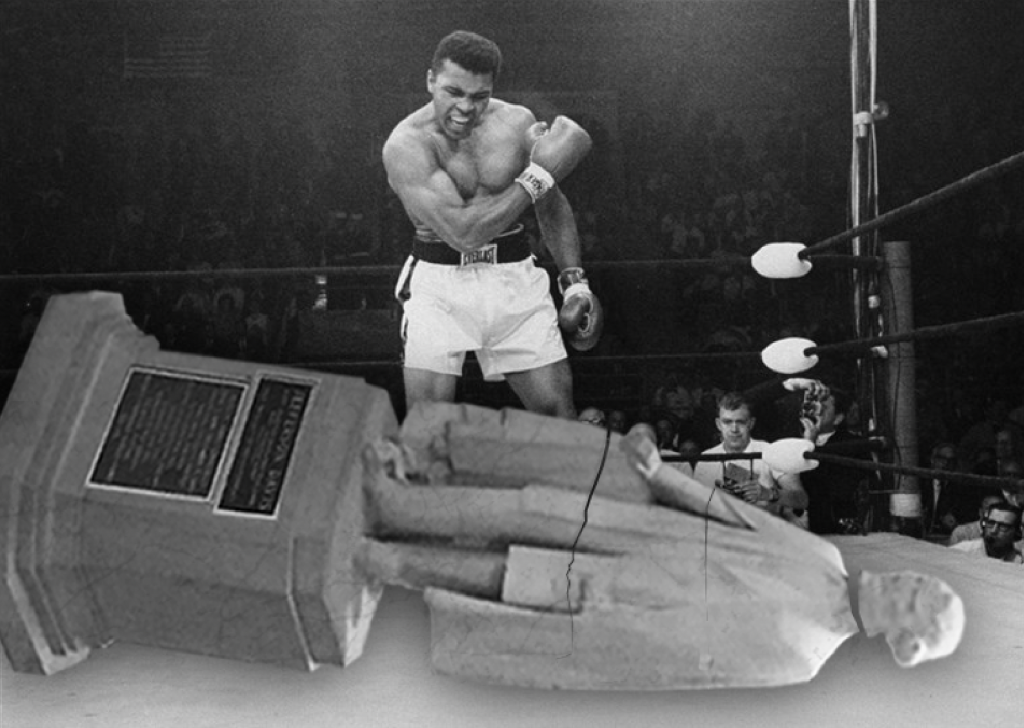
Please sign the petition below to remove the statue of Jefferson Davis currently in Kentucky’s Capitol Rotunda, and replace it with a tribute to Muhammad Ali, “the Louisville Lip” and “the Greatest of All Time.”
I just heard from the Ali family: It is the Champ’s belief that Islam prohibits three-dimensional representations of living Muslims. Accordingly, I have adjusted the petition to call for a two-dimensional representation of Ali (a portrait, picture or mural) in lieu of a statue.
UPDATE (Tuesday, December 2, 2014)
In this interview with WHAS-TV’s Joe Arnold, Governor Steve Beshear endorses the idea of honoring Muhammad Ali in the State Capitol (although he disagrees with removing Davis). Arnold explores the idea further on his weekly show, “The Powers that Be.”
Click here to check out WDRB-TV’s Lawrence Smith’s coverage of the story.
And here’s my op-ed in Ali’s hometown paper, the Louisville Courier-Journal.
UPDATE (Saturday, June 4, 2016)
In the wake of the 2015 Charlestown tragedy, in which a Confederate flag-waving murderer united the nation against racism, all of the most powerful Kentucky policymakers — U.S. Senator Mitch McConnell, Governor Matt Bevin, Senate President Robert Stivers and House Speaker Greg Stumbo — called for the removal of the Davis statue from the Rotunda. Today, as we commemorate last night’s passing of Muhammad Ali, there is no better moment to replace the symbol of Kentucky’s worst era with a tribute to The Greatest of All Time.
UPDATE (Wednesday, June 8, 2016):
Great piece by Lawrence Smith of WDRB-TV in Louisville on the petition drive to replace Jefferson Davis’ statue in the Capitol Rotunda with a tribute to Muhammad Ali.
UPDATE (Thursday, June 9, 2016):
Excellent piece on the petition drive by Jack Brammer that was featured on the front page of the Lexington Herald-Leader.
Highlight of the article:
Miller said he has received a few “angry comments” on his call to honor Ali.
“One of them encouraged me to kill myself,” he said. “You can quote me that I have decided not to take their advice.”
UPDATE (Friday, June 10, 2016)
The petition drives continues to show the Big Mo(hammed): check out these stories from WKYU-FM public radio in Bowling Green and WKYT-TV, Channel 27 in Lexington:
UPDATE (Saturday, June 11, 2016):
Still not convinced? Check out this excerpt from today’s New York Times:
By Nancy Slotnick, on Tue Sep 17, 2013 at 8:30 AM ET
I met my husband on the street. So meeting strangers in public space is not foreign to me, even though I am shy by nature. I am counterphobic I guess. And I am also in the business of helping people to meet.
I had the opportunity to attend a tremendously interesting conference at Harvard this week about public space: its design, its uses and its politics. It was called Putting Public Space in its Place. It was organized and chaired by Professor Jerold Kayden, who has an organization that advocates for the Privately Owned Public Spaces (POPS) of New York City. These spaces have largely been neglected and abandoned. As a result, the owners have either privatized them or let them languish in the majority of cases. I’m interested in the question of re-claiming public spaces for the public, and especially for the purpose of human connection.
Because I am in the matchmaking business, I think a lot about the way people meet their potential dates. I always hear from clients; “Where do I go to meet people? Is online dating the only option? I see people on the subway or at the park that I want to meet, but it seems too awkward- what can I do?” We get the term “ice breaker” from the fact that it can feel as cold as ice to break through the defenses that people have up, especially in a big scary place like New York City. A warm smile can be all you need if you dare. But because smiling at a girl or guy you like can be close to impossible, I’m thinking a warm matchmaker may be necessary. Industry experts say I’m getting warmer.
Public space needs a hotspot. I’m not talking about the Wi-Fi kind. Vast open public space can be a wonderful canvas for design-o-philes, but Fred Kent, founder and president of Project for Public Spaces, calls for creating smaller enclaves, a process that he coins “placemaking.” This type of user-friendly design will encourage social use that is fun and engaging. (I am paraphrasing here so I hope Fred will forgive me.) This type of public space set-up has the capacity to spread the love naturally.
But when it comes to meeting new people and facing rejection, especially in public, there is a missing ingredient that extends even beyond great design. In my experience in the singles scene, people need shepherding. At the conference they call it stewardship. So I will just call myself the Stewardess of Love. That sounds sexy! Coffee, tea or a date? That’s what Matchmaker Café is.
By Erica and Matt Chua, on Mon Sep 16, 2013 at 1:30 PM ET
I have been testing a life theory. I state what I want to as many people as possible until someone says, “you know what, I’d be happy to _______ for/to you.” It started as a joke that if someone won the lottery, I’d make myself the easiest friend to shop for.
When a friend suddenly find himself with too much money and want to show their generosity, with who do they start? It’d be hard, I mean, what do you, newly rich, gift to your still proletariat friends? If this happens to any of my friends as soon as they start thinking of what to give whom they’ll realize: “Chua wants a Bentley! I can do that!” In their post lottery winning exuberance they’ll get me one, then start working down the list of other friends.
As days pass the realizations of not being as rich as imagined will settle in, the tax bill becomes real, and with each friend the gifts will become less and less glamorous until the newly minted friend is handing out Mentos, individually, not even whole packs, saving the rest of his winnings for himself. Of course, I’ll be rolling like Kobe Bryant in my Bentley while other friends’ fresh breath is wearing thin.
A Bentley she is not, but she made the impossible happen.
I’ll be honest, I don’t think I’ll ever get a Bentley, but say you have one sitting in your garage, not sure what to do with it, and you read this…you consider how much joy it would bring me and give it to me, after all you’re clearly rich enough to gift a Bentley if you just have it sitting around…(I’m also looking for a Rolex, another thing I’d never buy myself, but would bring a smile to my face every time I get to answer, “do you have the time?”). In testing this theory over the past few years I’ve gotten many things and opportunities I never really expected.
Read the rest of… Matt & Erica Chua: Dreams Come True: Route 40
By John Y. Brown III, on Mon Sep 16, 2013 at 12:00 PM ET
Want to really know someone? You know what I mean? I mean…”really know their souls?” Not just how they want you to think about them…or the way they are when times are good and things are going their way.
I also don’t mean knowing someone in a crisis situation. I mean just knowing their real temperament, their respect for others and their sense of themselves and their place in the world.
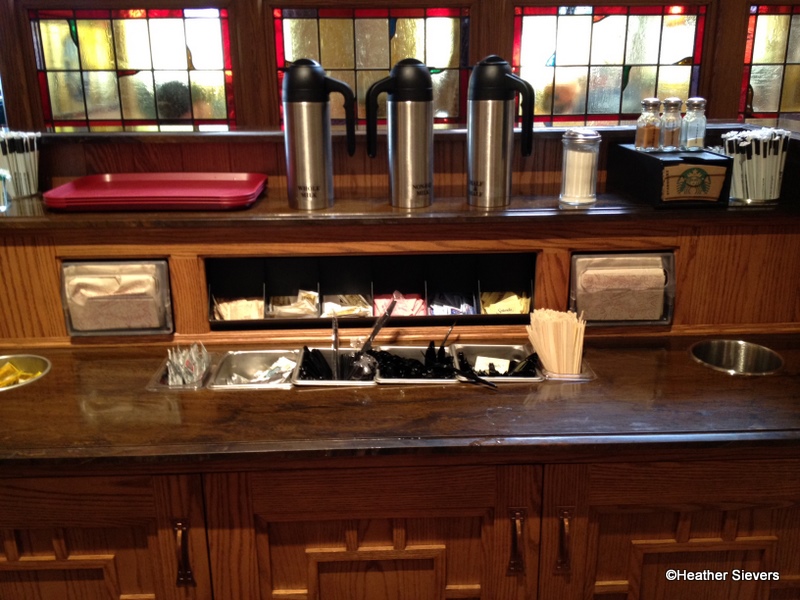
If you do, there is not better way to do this than watching how they conduct themselves at the Starbucks condiment bar when it is crowded.
Some people, when it is their turn, act like they own the condiment bar all by themselves. When it is their turn they take their sweet time getting their sugar and 2% milk…just like they like it. They obviously have high self esteem but show a lack of respect for others. They tend to be in middle-management and think they have all the answers.
Another group of people don’t even need much sugar or half-and-half but take their sweet time getting it ….in fact, they take much longer than is actually needed. These people don’t have high self-esteem but are actually struggling with low self-esteem and being flagrantly passive aggressive toward others. Being at the condiment bar at Starbucks for them is viewed as a time in their day where they feel they have power over others–and they wield in irresponsibly and excessively. They abuse the condiment bar rules of engagement. They tend to be corporate executives and bored housewives.
What about the people who use the last bit of cream and don’t get it re-filled and instead leave it for the next person who discovers there is no cream left? These are the social deviants who are simply out for themselves. They tend to be stock brokers and lawyers.
Still another group gets very nervous at the condiment bar and starts nervously hurrying to get out of the momentary limelight into the safety of their car. They don’t take the time to put the right amount of sugar and cream in their coffee but will usually at least get the cream and sugar right if they are getting coffee for another person. These people are co-dependent and struggle to see themselves as “worthy” —even worthy of having cream and sugar in their coffee. They are the saddest condiment bar personality type. These types are usually at the bottom of the food chain at work and apologize for even being there.
Finally, there is the type that doesn’t even use cream and sugar but will go to the condiment bar to steal napkins they don’t need for their car. Does this make them criminals? No, not really. But you don’t want to go into business with them….and if you do you can be sure you will always be getting the short end of the stick. They tend to be CEO’s.
Oh yeah, there is one more condiment bar group. The kind that watch others and draw conclusions about their personality. They tend to be the ones who always get stuck with the empty half-and-half canister. And they usually write a lot on Facebook.
Dan Pink always makes me think. Each of his books elicits an “AHA” moment with staying power. Free Agent Nation changed the way I think about work and relate to institutions forever. A Whole New Mind rescued the right side of my brain from its inferiority complex and ignited a long-term love affair with design thinking. Dan’s book, Drive, is no different. It has crystallized my life-long instinct that our thinking about motivation and incentives is out of synch with the possibilities of the 21stcentury. Time to reboot motivation.
The 20th century was all about management. The North Star was how to get more people to go through the motions efficiently. Seeking personal meaning in work was a distraction. The best workers follow the rules, work hard, and smile. Work boiled down to an algorithm rendering out any creativity or autonomy. Fulfillment and empowerment were HR buzzwords and the “soft stuff” relegated to off-site retreats that don’t get in the way of real work. Incentives in the industrial era were all about carrots and sticks. Motivation was based solely on external factors including compensation, title, office, and promotion opportunities.
Early in my consulting career I worked for a boutique firm that specialized in sales force incentive compensation programs. I was consistently amazed by the gaping disconnect between the home office that inevitably over-engineered its goal setting and compensation practices and the actual behavior out in the sales territory. Sales representatives made quick work of these elegant plans figuring out how to game the system to optimize earnings. They cherry-picked the incentive plans based on experience, likelihood of earning a payout, and implications for the following year. The annual dance was de-motivating and rarely resulted in self-directed effort to maximize either the short or long-term value of customer relationships within a sales territory.
I have observed legions of managers attempting to manipulate the dials of industrial era tools to optimize the output of employees. While it was clear to me that this approach sucked the meaning, autonomy, and motivation out of work for most employees it had the unfortunate advantage of delivering short-term business results, until it didn’t. The game changed when computers began to replace people doing repeatable work tasks. Technology also enabled repeatable work that still requires human involvement to move to lower cost locations. If it can be reduced to an algorithm it can either be virtualized or moved. This work is dehumanizing and uninteresting. Industrial era work has left the U.S. and it is not coming back. The work remaining to do requires both a new set of 21st century skills and a new approach to incentives and performance management.
Contributing recovering politician Jeff Smith, who spent a year in federal prison for lying to federal authorities about a minor campaign finance violation, offers advice to his fellow pol/prisoner/hoopster Richie Farmer, set to spend some time in the can for public corruption charges. Here are excerpts from Smith’s piece in the (Louisville) Courier Journal:
Use your basketball skills to help others. Running the point and making your teammates better may be an effective way to build alliances.
• Be careful on the court. Some people who have it out for you may exploit the opportunity to try to hurt you on the athletic field and not get in trouble for it….
Don’t break prison rules.
• This may seem contradictory. The last rule suggested that you should tolerate prison rule-breaking — and you should. But try not to violate rules yourself.
• Don’t gamble. If you lose, you’ll be in debt and you do not want to be compromised like that. If you win, someone will be angry and may figure out a way to get his money back — a way that might leave you unrecognizable.
• Don’t “hold” anything someone asks you to hold. Even if it looks innocuous, it’s probably got contraband inside of it…
Don’t look for trouble.
• Don’t change the TV channel. There is a stringent seniority-based regime when it comes to TV watching, and your celebrity does not entitle you to alter it in any way.
• Don’t stare. There is generally no reason to make eye contact unless someone says your name.
• Don’t eat the Snickers. During orientation, you’ll watch a mandatory sexual assault prevention video featuring a guy warning you not to eat the Snickers bar that may be waiting for you on your bed in your cell. (The actor ate the one left under his pillow, unwittingly signaling the predator who left it for him that he was ready and willing.) All the guys watching the video will laugh. But take the video’s message to heart: Don’t accept sweets from anyone.
By Jonathan Miller, on Fri Sep 13, 2013 at 5:00 PM ET
When we last left episode 5.13, “To’hajilee” of “Breaking Bad,” we were left with a tense cliffhanger — who would survive the standoff between the Neo-Nazi allies of Walter White and DEA law enforcement — with Walter and his former partner, now-bitter enemy, Jessee PInkman, in the crossfire?
We know from the flash-forwards at the beginning of the season that Walter survives. But what about Jesse? Walter’s DEA brother-in-law, Hank? Hank’s loyal partner Gomez?
My initial thought was that only Gomez would die — it is too early and too banal for Jesse and Hank, now the series’ moral centers, to perish.
But how would it be possible, given the Neo-Nazi’s massive weaponry, for only Gomez to survive?
So my bet is on a truce being reached, with no deaths. What say you?
By Jonathan Miller, on Fri Sep 13, 2013 at 2:30 PM ET
The San Francisco Chronicle ran a great piece this week on my friend, John Roulac, who as CEO and Founder of Nutiva, has turned hemp seeds into a $70 million/year business. I excerpt a few of my favorite passages from the interview, which you can find here in full:
Q:Why do you think you’re one of the fastest-growing companies? Is it the popularity of your products? Is there no competition? Or is it a particular way you’re running your company? Because $70 million for hemp and chia seeds, really?
A: We’ve been fortunate that the categories we’re in – organics – are fast growing. We have a lot of competition. But the fact that we were pioneers gives us an advantage. I’ve also been good at predicting the next big super food.
Our distributors thought we were crazy when we started doing coconut oil in 2003, given concerns about saturated fat. But now we’re the No. 1 seller of organic virgin coconut oil. We also have strong brand loyalty. And I think the fact that we’re focused on only four items helps. Focus is important.
Q:Let’s talk about hemp and chia seeds and coconut and red palm oils. Why do you think they’ve become popular with consumers?
A: The American people have been subjected to a science experiment, fed on a steady diet of genetically modified industrial foods grown with huge amounts of pesticides and made with preservatives and chemicals. That diet produces diabetes, cancer, heart disease, hormonal disruption and allergies. Even our dogs have issues. In the 1960s and 1970s our dogs ate food and ran around happy. Now they have all kinds of problems.
Q:Are you sure it’s the dogs and not their owners?
A: Maybe so, but people know something is wrong. They’re in search of an answer. Turning to a diet based on ancient principles is a good place to start. They’re returning to a time when people in other parts of the world ate a lot of coconuts, ate a lot of chia seeds. People are still going to eat pasta and salads, but they know if they make 10 to 15 percent of their daily calories nutrient-dense foods they’re going to be healthier.
Q:Who are these customers?
A: Our prime customers are women between 25 and 60.
Q:Is there concern that these are trendy foods right now that could eventually go out of style? For instance, does anyone buy acacia any more? Or carob? What ever happened to carob?
A: (Laughs) Are almonds trendy? I don’t think so. But I see your point. The trick is knowing what people want to eat a few years before they do – or before Dr. Oz. I have been able to make those predictions. Then the biggest challenge is supply.
Q:Are you constantly looking for the newest super foods to stay relevant?
A: I search the world over. I’m pretty sure we’ve identified two new ones.
Q:Really? What are they?
A: Well, we’re not quite as secretive as Apple, but we’re still in the research phase and not ready to make any announcements. Keep checking our Facebook page.
Q:What’s the end goal for Nutiva?
A: To see Monsanto bankrupt. We would like to create an organic, non-GMO world, even if customers go elsewhere to buy it. If they want to buy it from us, that’s great, too. But we have plenty of business. The important thing is to change the supply chain and make it more organic and more healthful.
By John Y. Brown III, on Fri Sep 13, 2013 at 12:00 PM ET
I guess you could call them Atheist Enthusiasts. Seems like a growing group of people these days like to take on the Big Guy and prattle on and on about it.
I think it makes them feel powerful. How couldn’t it? I hardly ever win an argument with my wife. I can’t imagine what it would feel like feeling like I won argument against God.
I just don’t understand people who like to gab on and on about what they don’t believe in. Makes me suspicious….like they are trying to convince themselves more than those they are lecturing.
I mean….I don’t believe in UFOs but I don’t go around telling people about it everyday. It just never occurs to me because I am at peace with it.
Which makes me wonder if atheist enthusiasts who also don’t believe in UFOs create groups and write books about not believing in UFOs. If so, I want to be clear I am not in that group of UFO non-believers…but in the more dignified group that doesn’t believe in UFOs.
When was the last time you updated your headshot? What, you don’t have a headshot? No problem…read on for how to plan it, what to wear, and how to get it done with aplomb.
Having a good headshot never seems urgent until something like a speaking engagement comes up or someone is writing a profile of you, and then all of a sudden you really need one. Even though this may not be at the top of your to-do’s, trust me, people are checking you out online — and forming impressions of you based on what they see. And thanks to Google Images, any public pictures of you are going follow you around long-term. Below are 9 tips for getting headshots that would make your mama proud:
1) Wear solid colors as much as possible. If you’re wearing a patterned tie, make sure the pattern is not too busy or large in scale, since that will draw attention away from what people want to see to begin with — that handsome face of yours. Showtime’s CEO Matt Blank above gets it right with his clean, crisp look.
2) Speaking of color, make sure the shade you have on flattersyour skin tone. I can’t emphasize enough how important it is to wear the right colors. (You can figure this out by having a color analysis done — contact me for info, or more loosely by asking people whose judgement you trust what colors they think you look best in.)
Bonus tip: If you have light colored eyes, play them up by wearing a color that matches them.
3) Get your hair cut 5-7 days before photos. That’s about the right amount of time for a new cut to “settle” in, especially if your hair stylist tends to cut you very short (sometimes they do this to make the cut last longer if you have trouble fitting appointments in). You can also get it cut closer to the date of your headshot, and let him or her know you’ll be taking photos within the next couple of days and not to go too short.
4) Choose your outfit carefully depending on the purpose of your photos. For example, the whole idea of a business headshot is to show people that you’re trustworthy, professional and approachable yet self-assured. If you’re in a field like finance or law, go with a suit and tie. For more creative and casual fields like advertising or technology, you can wear a blazer and dress shirt, or just the dress shirt. Whatever you plan on wearing, bring a few options to the shoot.
5) Consider the background. For something traditional in feel, have your photos taken in-studio. For a more interesting vibe that’s still business-friendly, do them on location in your office — if you’re an executive, you might place yourself in front of a window overlooking the city, or stand powerfully in your office. If your photos are for personal use, or your industry is more casual, go outside and shoot in a park or in front of a cool background. See the image above of Jay Penske or my client Chris’s “after” photo for examples. Once you know what background your photos will be shot against, be sure that the colors you’re wearing don’t blend into that.
Read the rest of… Julie Rath: How to Get Killer Headshot Photos


 Blog this!