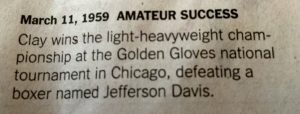
Please sign the petition below to remove the statue of Jefferson Davis currently in Kentucky’s Capitol Rotunda, and replace it with a tribute to Muhammad Ali, “the Louisville Lip” and “the Greatest of All Time.”
I just heard from the Ali family: It is the Champ’s belief that Islam prohibits three-dimensional representations of living Muslims. Accordingly, I have adjusted the petition to call for a two-dimensional representation of Ali (a portrait, picture or mural) in lieu of a statue.
UPDATE (Tuesday, December 2, 2014)
In this interview with WHAS-TV’s Joe Arnold, Governor Steve Beshear endorses the idea of honoring Muhammad Ali in the State Capitol (although he disagrees with removing Davis). Arnold explores the idea further on his weekly show, “The Powers that Be.”
Click here to check out WDRB-TV’s Lawrence Smith’s coverage of the story.
And here’s my op-ed in Ali’s hometown paper, the Louisville Courier-Journal.
UPDATE (Saturday, June 4, 2016)
In the wake of the 2015 Charlestown tragedy, in which a Confederate flag-waving murderer united the nation against racism, all of the most powerful Kentucky policymakers — U.S. Senator Mitch McConnell, Governor Matt Bevin, Senate President Robert Stivers and House Speaker Greg Stumbo — called for the removal of the Davis statue from the Rotunda. Today, as we commemorate last night’s passing of Muhammad Ali, there is no better moment to replace the symbol of Kentucky’s worst era with a tribute to The Greatest of All Time.
UPDATE (Wednesday, June 8, 2016):
Great piece by Lawrence Smith of WDRB-TV in Louisville on the petition drive to replace Jefferson Davis’ statue in the Capitol Rotunda with a tribute to Muhammad Ali.
UPDATE (Thursday, June 9, 2016):
Excellent piece on the petition drive by Jack Brammer that was featured on the front page of the Lexington Herald-Leader.
Highlight of the article:
Miller said he has received a few “angry comments” on his call to honor Ali.
“One of them encouraged me to kill myself,” he said. “You can quote me that I have decided not to take their advice.”
UPDATE (Friday, June 10, 2016)
The petition drives continues to show the Big Mo(hammed): check out these stories from WKYU-FM public radio in Bowling Green and WKYT-TV, Channel 27 in Lexington:
UPDATE (Saturday, June 11, 2016):
Still not convinced? Check out this excerpt from today’s New York Times:
My meet-cute with New York City took place in 1999. A horse my grandfather and uncle had co-bred, Charismatic, was favored to win the Belmont Stakes for the Triple Crown. I flew up with my parents and brother to watch the excitement unfold.
Devastatingly, during the big race, the thoroughbred broke its leg and finished third. This I blamed on Long Island.
Offering solace was the city, with its sprawling swagger, sensory deluge, and gritty sophistication. It swiftly and aggressively earned a place in my affections.
Several more visits ensued, including a friend’s bachelorette party, where I was increasingly intrigued by New York and its many haunts, especially the little-known cafés and hideaways. For whatever reason, I was always there in the summer, when the city was at its muggiest and most potent.
My most sweltering summer there took place a few years ago, when I attended a program at Columbia University. In addition to writing and attending classes, I got to know Morningside Heights better. I quickly found that one of the best ways to do this was eating my way around the area. Along Broadway and Amsterdam Avenue, a slew of quirky eateries became favorites, from the famed writers’ hangout The Hungarian Pastry Shop, to Nussbaum & Wu (for bagels and attitude), to many hole-in-the-wall Mexican joints (the neighborhood abuts Harlem). While I explored other parts of town as much as I could, I focused most of my attentions on the Upper West Side.
So it was with anticipation that I had a chance to rekindle my affair with the City that Never Sleeps a few weeks ago. One of the most intriguing ways to explore a city is through friends that live there. Every neighborhood has its gems, and the savviest guides are the locals. On this trip, I visited friends in several different areas and sampled some tantalizing dishes and beverages along the way.
Here is a brief tour of a few of my stops. Maybe you’ll understand why I’m already coveting my next rendezvous with the city.
I stopped by to join in The Bourbon Review‘s http://gobourbon.com/ 5th year anniversary party, which attracted a host of well-wishers and Southern expats. Swanky, with a vintagevibe, this hotspot boasts an encyclopedic array of whiskeys.
A sister restaurant of the illustrious Eleven Madison Park, NoMad puts out the red carpet for your taste buds. You can’t go wrong with anything you order here, but don’t miss the foodgasm-inducing roast chicken with truffles for two.
You can eat the Eastern European comfort food here any time of day, but this quintessential East Village spot is best late at night. Try the potato pancakes with applesauce and sour cream. You won’t regret it.
The chain lives up to the hype, with a mouth-watering menu of paninis, a vast displayof homemade chocolates, a butcher counter, and a profusion of pasta. Pick up a sopprasetta sandwich and chilled champagne for an al fresco lunch with friends. (We laid claim to the breezy rooftop of our friend’s office, the Tiffany’s headquarters).
By John Y. Brown III, on Thu Sep 12, 2013 at 12:00 PM ET
Do we parents really raise our children?
Or do they secretly really raise us?
Some days I feel like Rod Serling will step out from the next room and start explaining this entire hoax — that all along our children have patiently and lovingly been guiding us into adulthood. And as the youngest approaches age 18, facing the horrifying feeling that you are not ready for her to leave because you are not yet fully an adult.
===
Parenting and job classifications
If I had to pick the two professions that best align with the traditional mother and father roles….
I would say for mothers it would be Life Coach.
For fathers I would say Talent Agent.
Ironically, fathers often secretly believe they are a Life Coach to their wives. While wives are convinced they are really like a Talent Agent to the husband.
And kids assume their job has always been Life Coach for both parents.
By John Y. Brown III, on Wed Sep 11, 2013 at 12:00 PM ET
I remember in my high school psychology class learning that ages 40-55 were the most “productive years.” (I hope that has since been adjusted to 45-60. But I digress.)
The theory goes that we spend our first 20-25 years getting educated and the next 15-20 mastering a trade or profession and then achieve at our work at the highest levels during that next phase (40-55) because we are finally “ready” and adequately “prepared.”
I am now age 50 and can report (at least in my case) that theory is at least half true. Maybe even 60% true.
But what about the other 40% that makes these years the “productive years?”
I think the other 40% of the cause of our spike in productivity is the looming sense of our own mortality.
At around age 40 we realize we don’t have the luxury to wait until we can produce the perfect concerto, write the best selling novel, deliver the life-changing lecture, launch the brilliant new business idea, or are finally ready to manage like a CEO case study before “going for it.” At age 40 perfection stops being our teacher and starts being our nemesis. And so we just start producing whatever we can and realize, to our surprise, it is better than we expected and others don’t notice the deficiencies (or at least don’t notice them as prominently as we feared.)
It is not that we have reached a point in our careers where we have finally matured or ripened to an ideal level where we can now produce at prodigious levels. Rather, we have reached the point in the game of our life where we either put some points on the board or risk being shut out.
It reminds me in football games of the final minutes when teams coming from behind go into their “Hurry Up Offense.”
These teams may not have scored a single point in the first half, but in the “Hurry Up Offense” they may post 14 points in 5 minutes. They must be in what psychologists call “Their most productive time of the game,” right? Or maybe they are simply playing against the clock. Or both. About 60% and 40%.
I think it is both.
So now…I am ready to start my day. “Huddle up. Wide receiver go for first down. On one. Break!”
By Artur Davis, on Wed Sep 11, 2013 at 10:00 AM ET
After a week of national debate, I think I follow the arguments for the pending Syrian force resolution before Congress: air strikes won’t threaten Bashar al-Assad’s hold on power; and they may or may not deter Assad from continuing the devastation of his own citizenry (which, by the way, has been well underway for the better part of two years without any attempt at American intervention.) Bombing would enforce the conscience of an international community that also happens to be conspicuously unwilling to act, even under the auspices of the usual fig leaves, NATO and the UN Security Council. True, Assad is not even remotely on the verge of exporting his destruction to his neighbors, and there is not a shred of evidence linking him to any credible threat to our homeland. But we should push ahead in the interests of future presidents having the flexibility to rattle sabers with credibility: and by the way, you are likely guilty of being an unsophisticated strategic thinker or an isolationist if you disagree.
That’s a lot of caveats, and concessions, in the service of a hypothetical. No surprise, then, that the prospects for Syrian resolution are crumbling in the House of Representatives, and the backlash has even generated the inconceivable—a bipartisan coalition for restraining Barack Obama’s consistently limitless vision of his authority. But despite the weakness of the substantive case for air strikes, it’s still worth addressing the institutional one that is becoming the rationale of last resort.
The defenders of the Syrian resolution assert a variety of fearful consequences if Congress actually asserts its prerogative of limiting a president’s war-making authority (never mind the irony of suggesting that the system is broken when it works exactly as it is constitutionally supposed to). But the specter of future chief executives suffering a dangerously weakened hand when they rhetorically draw “red lines”, or assert that renegade dictators “must go”, assumes the hand is a particularly strong one now: in fact, that strength is always tied to the precise nature of the national interest at stake, and a yes or no vote won’t change the calculus.
Read the rest of… Artur Davis: The Real Consequences of a “No” on Syria
By Jason Atkinson, on Wed Sep 11, 2013 at 8:30 AM ET
I shot this Saturday and Sunday at Camp 584 and for those who’ve never seen a silver lab, meet Gunnel. This is only 4 minutes long and rest assured, for my big film, Why the Klamath Matters, we have a team of professionals.
By Lauren Mayer, on Tue Sep 10, 2013 at 3:00 PM ET
Combing this past week’s news stories for a song idea was fairly discouraging – I can’t find anything funny about the possibility of air strikes against Syria, not to mention the human rights atrocities there. I’ve already done a song about Congressional gridlock, the sequester just keeps getting more depressing, and while Anthony Weiner has made a few headlines, it’s been for rage-aholic rants, not for titillating texts. Moreover, I realized many of my weekly songs are my way of responding to unpleasant news, hoping to find some humor in what otherwise would have me yelling, Weiner-style, at the computer, t.v. screen or newspaper.
But one happy story popped up, and not only is it good news, it’s also completely bipartisan, non-political yet totally newsworthy, and makes me smile whenever I think about it – Diana Nyad’s record-shattering swim from Cuba to Florida. After finally achieving a feat she’d been attempting unsuccessfully since 1978, as she emerged from the water she made three quoteable points, including a graceful acknowledgment of the team supporting her, but the one that struck me was “You’re never too old to chase your dreams.”
We have longer life expectancy today than ever before, and yet our culture still puts such a premium on youthful achievement that we feel like failures if we haven’t won a Tony Award or been a celebrity guest playing ‘Not My Job’ on “Wait Wait Don’t Tell Me” by the age of 30. (Or made our first million, or won an Olympic medal, or dated a member of One Direction, or whatever your particular dream happens to be.) So to celebrate the achievements of a woman who’s been eligible for AARP for 14 years gives me renewed faith in possibilities for those of us over 50. (Which is when you start getting those AARP mailers, as if it wasn’t hard enough to hit that milestone!)
So I am celebrating Ms. Nyad’s accomplishment in song, as well as acknowledging other feats achieved by AARP-eligible folks. And sure, I haven’t really had any videos go viral (despite the line I love to use from my 17-year-old, who saw that a few had topped 1,000 views and informed me that it was ‘viral for old people’), but who knows? It took Diana Nyad 35 years from her first attempt to achieve her dream – and posting youTube videos is much less strenuous!
“Diana’s Song (You’re Never Too Old To Chase Your Dreams)”
Judging from media coverage, one would think the emerging solution to the Syria predicament arrived somewhat randomly. But when considering the supposedly“random” sequence of developments on Syria, what emerges is something far more strategic:
A) President Obama, on the eve of the G20 summit, reminds international leaders that chemical weapons containment is a shared obligation:
“My credibility is not on the line. The international community’s credibility is on the line.”
B) During the G-20, Obama and President Putin (Syria’s enabler to date) find time during the G-20 Summit to meet on Syria:
President Obama met privately with Russian President Vladimir Putin Friday in the midst of their public dispute over how to respond to a chemical weapons attack in Syria. Mr. Obama told reporters at the G-20 summit in St. Petersburg, Russia, that his conversation with Mr. Putin was “candid.” And he said a looming United Nations report about chemical weapons use by the Syrian regime would make it tougher for Mr. Putin to oppose punishing Syria militarily.
C) Secretary Kerry supposedly off cuff response to a reporter’s question if there wasanything Syrian President Assad could do to avert an attack: “Sure, he could turn over every bit of his weapons to the international community within the next week, without delay,” Kerry said. “But he isn’t about to.” Russia seizes the opening created by Kerry’s comment:
Speaking in London earlier today, John Kerry appeared to issue a long-shot ultimatum to Syrian President Bashar al-Assad, suggesting that if he turned over his complete stockpile of chemical weapons within the next week he could avoid an attack from the United States. The State Department, however, would later walk back those comments, saying they were a “rhetorical argument” and not an actual proposal, adding that Assad “cannot be trusted” to take such action …. [T]his afternoon once Assad and his strongest ally, Russia, caught everyone off guard by suggesting that Kerry’s ad-libbed solution was actually workable.
D) Within a couple hours, Russia presents Kerry’s “rhetorical” comment as a solution. Syria responds immediately: “Syria today ‘welcomed’ an offer by Russia to put its chemical weapons arsenal under international control so that they could eventually be destroyed’”:
Syria’s Foreign Minister Walid al-Muallem, who met with Lavrov in Moscow earlier in the day, responded almost immediately. “The Syrian Arab Republic welcomed the Russian initiative, based on the concerns of the Russian leadership for the lives of our citizens and the security of our country,” Muallem told reporters, according to Russia’s Interfax news agency. The proposal also received quick support from United Nations Secretary General Ban Ki-moon and British Prime Minister David Cameron.
By John Y. Brown III, on Tue Sep 10, 2013 at 12:00 PM ET
Parking lot logic.
It is great to wake up on the right side of the bed. To feel like this is your day. To have your mind clicking; memory fired. To have one of those days when you feel it is all coming together.
Yet no day, no feeling, no waking up on the right side of the bed can compete with the sense of supreme invincibility ine gets when driving into a crowded parking lot and instantly finding a good parking place.
Sure there are moments that I feel I am up to the task….but let me quickly find a good parking spot in a crowded parking lot and I am ready to take on all comers.
What the heck is up with that?
Especially since I woke up feeling good about myself today but can’t catch a break parking today.
By Artur Davis, on Tue Sep 10, 2013 at 10:00 AM ET
While the political world is consumed with Syria—and the close question of whether Barack Obama’s muddled case for intervention is bolstered by worries about the institutional damage to the presidency that would come from a “no” vote on his Syrian resolution—a perceptive piece by two Democrats, William Galston and Elaine Kamarck, on the travails of the Republican Party, deserves a serious read. In their essay “How to Save the Republican Party, Courtesy of Two Democrats”, Galston and Kamarck outline Republican misconceptions about the electoral environment that as they point out, almost identically mirror what pre-Clintonian Democrats surmised about their party on the heels of successive presidential losses: (1) faith that there is a non-voting segment of the electorate that would be energized by a move toward an undiluted, ideologically pure version of the party’s ideological message and (2) that a solid majority in the House of Representatives and a majority of governorships are proof of an underlying electoral strength that will eventually reassert itself at the presidential level.
Anyone who has perused this site can guess that I am aligned with much of the Galston/Kamarck critique, and that I view what they call the “hyper-individualistic libertarianism” that is dominant in conservative grassroots circles as a liability for Republican aspirations to raise their vote shares with minorities, under 35 professional women, and white working class voters: in fact it is a liability about equal to the constraints interest group liberalism posed to eighties era Democrats trying to resurrect their appeal to southern moderates, white ethnics, and suburban professionals in the aftermath of Reagan.
But while Galston and Kamarck are singing off the right hymnal, I’ll advance one huge cautionary note that partly explains why conservative reform still struggles to resonate with GOP activists and primary voters. Any advocate of the kind of conservative evolution I would favor has to come to grips with an intrinsic contrast between the respective policy successes of Reagan Republicans (more muted than memory usually serves) and Obama Democrats (more sweeping than either camp prefers to acknowledge).
A generation ago, the Reagan era managed to rewrite one dramatic element of the domestic policy framework—namely, a sizable reduction in marginal tax rates—but to an extent that was downplayed then and obscured now, that framework was undisturbed in most other aspects. Discretionary spending was not sharply diminished; the entitlement structure was solidified; legal policy was turned rightward at the edges, but not in a manner that criminalized abortions or undermined affirmative action; and the regulatory footprint was mostly indistinguishable in 1989 from what it was in 1981.
Read the rest of… Artur Davis: One More Threat to Conservative Reform



 Blog this!