By Ronald J. Granieri, on Thu Jun 16, 2011 at 8:30 AM ET
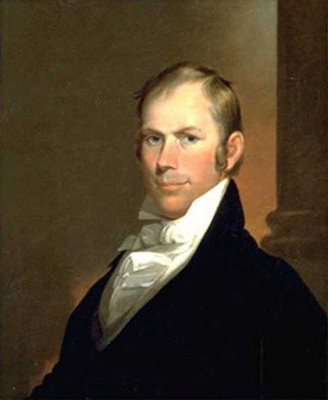
Syracuse University Professor and Friend of RP Ronald J. Granieri tackled an important subject recently for The American Interest magazine: Henry Clay, the Great Compromiser and — more importantly — the namesake of the RP’s high school. Here is his fascinating take on the legend from Lexington and how he has come between two GOP politicians in Kentucky today:
This past February, Senator Rand Paul (R-KY) used his maiden speech on the Senate floor to attack one of his home state’s most cherished historical heroes. Standing at Henry Clay’s Senate desk, Paul criticized the legacy of the Great Compromiser. “Henry Clay’s life story is, at best, a mixed message”, Paul said. “Henry Clay’s great compromise was over slavery. One could argue that he rose above sectional strife to carve out compromise after compromise trying to ward off civil war. Or one could argue that his compromises were morally wrong and may have even encouraged war, that his compromises meant the acceptance, during his fifty years of public life, of not only slavery, but the slave trade itself.”
Paul admitted that there were no questions before the Senate with the same moral force as slavery; he nevertheless went on to pose a series of rhetorical questions about whether America’s current national debt problems might not be best solved by strong attachment to principles rather than compromise.
Paul’s speech raised eyebrows not merely because of its aggressive tone, unusual for freshman Senators, but also because his apparently abstract references to Clay were to many a sign of tensions between Paul and his senior colleague, Senate Majority Leader Mitch McConnell. McConnell had favored a different candidate in Kentucky’s Republican primary and, more to the point of Paul’s message, he has often counted Clay among his political role models. A portrait of Clay adorns McConnell’s Senate office, and he once told an interviewer that Clay “understood the need for compromises that were truly important for the country. . . . I think that remains just as true today as it did in 1820 or 1850.”
By Ronald J. Granieri, on Wed Jun 8, 2011 at 8:30 AM ET
Last week Speaker of the House John Boehner (R-OH) introduced H.Res 292, which declared that President Obama “has failed to provide Congress with a compelling rationale based upon United States national security interests for current United States military activities regarding Libya,” and placed the White House under a 14-day deadline to respond to these concerns and to explain why the action is justified under the War Powers Act. The resolution passed 268-145, and was immediately denounced by the White House as “unhelpful and unnecessary.”
On its face, this routine—the Republican-controlled House passes a measure designed to annoy the White House, and the White House responds with annoyance—is not particularly unusual these days. In this case, though, the back-story is much more interesting. The original impetus came not from Republicans, but from liberal activist Rep. Dennis Kucinich (D-OH), whose resolution calling on President Obama to withdraw troops from Libya within two weeks and accept other restrictions forced Boehner’s hand. The House rejected Kucinich’s more forceful resolution, but just as many Democrats joined in supporting H.Res 292, many Republicans, especially Tea Party icons Ron Paul (R-TX) and Michelle Bachman (R-MI), voted for it, and Boehner himself realized that the House needed to put together some sort of resolution.
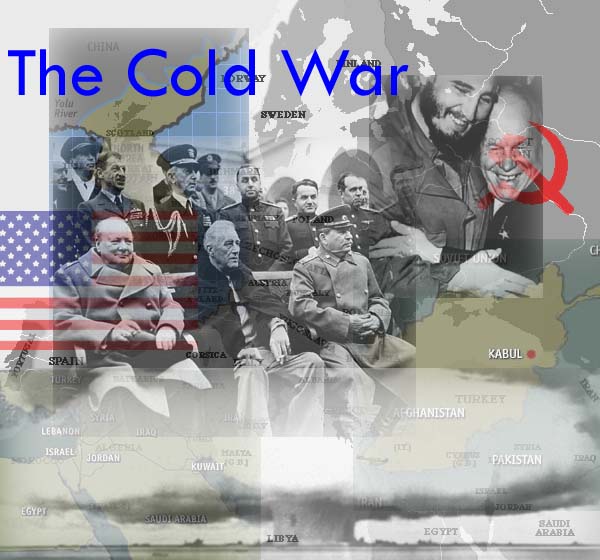
The real issue here goes beyond the immediate politics of the day. It is decades old, and it relates to the ways that the Cold War destroyed the constitutional balance between the Executive and Legislative branch. The Constitution clearly says that only Congress has the power to declare war, but the Executive has control over foreign policy.
The permanent emergency of the Cold War, with troops stationed overseas, intermittent crises requiring fast action, and Congress members unwilling to appear weak on national security, all tipped the balance very far in favor of the President. Added to this was the President’s ultimate control over the nation’s nuclear forces (what Garry Wills has called his “Bomb Power”), which made both Congress and the concept of declaring war appear essentially irrelevant. Encouraged by a broad bipartisan consensus in favor of containment, the US Empire grew exponentially after 1945, and with it an increasingly imperial presidency.
Read the rest of… Ronald J. Granieri: The Imperial Presidency — Now and Forever?
By Ronald J. Granieri, on Mon May 30, 2011 at 2:30 PM ET
My Godfather, Bill Mellan, had an easy smile and a big laugh. He was instantly likeable, and was a loving father to his boys as well as a devoted husband to the love of his life, my Godmother Mary Jean.
He was also a veteran of the Battle of the Bulge, who had received the Bronze Star for bravery. I heard this last fact not from him but from my mother. Uncle Bill was much too kind and self-effacing to puff himself up with tales of military glory. I never heard him talk about his war experiences, and am under the impression that he kept the stories of his heroism to himself. That kind of quiet heroism is valuable and rare in a society where too often people cannot rush to a microphone fast enough to tout their latest insignificant accomplishment, and it just one reason why I admire him.
I am not a big fan of the propaganda about “the Greatest Generation,” which strikes me as too much Baby Boomer self-regard masquerading as filial piety, as if praising their parents now will make up for the awful things they said about them back in the 1960s. But I have nothing but respect and praise for those who did serve, and who, after doffing their uniforms, returned to build American society as loving husbands and fathers and hard working friends and neighbors. Those are true heroes. People like my Uncle Bill.
By David Snyder, on Fri May 20, 2011 at 8:30 AM ET
Not being much of a writer, but having known the RP for going on 30 years, I was offered the opportunity to contribute to the blog. The theme of all first timers on this site is (in the RP’s own words), “how you got to your second act.” Although I am not a recovering politician, I am a recovering lawyer.
I spent ten years practicing law and I am proud to say – IT CAN BE DONE – you can make it out alive. And there is life on the outside. This is in no way meant to disparage attorneys. Many on this site (the RP included) are attorneys, as are my own father and many friends. So many attorneys do great work and are still engaged in and excited by the practice of law, and it really is amazing to see. Law still remains the most noble of professions.
But I also know there are many like myself who had their fill and needed to move on. I was typical of many solo practitioners – doing criminal defense and smaller litigation cases, wills and trust work, and eventually part of a small firm, doing more complex business litigation. And I reached a point where the fight of other’s battles became a thankless and ungratifying place to be.
I had always wondered where my life would go if I left the practice of law. And as fate would have it, while I was contemplating this issue in my law office in downtown Cincinnati, an opportunity arose that put me on the path I am on today.
While considering my future in 2002, I was visited by my financial advisor who, while performing an annual review, began recruiting me. And within a day, I was already on my way to meetings, interviews and a whirlwind of education and licensing for four months that led me to Northwestern Mutual and being a Financial Advisor, where I have been the past 8+ years. The fit was perfect. I already had the legal background and a good knowledge of planning from the legal perspective and add to that the financial/investment education and the proper licenses and credentials, as well as a very supportive wife, and I was set to go.
Within a month, my entire perspective on being a professional had changed. While leaving an appointment in that first month, the clients actually thanked me for spending time talking with them and discussing their financial planning. No one had ever done that while practicing law and my life had been transformed. I knew I had found a home in this profession. I realized that I had a passion for this work. I have the privilege of making an impact, making a difference, of working with individuals, protecting families and businesses, and more importantly, building wealth in a most tax efficient manner.
This is gratifying and satisfying, something that many lawyers never feel. Despite all of the good work that attorneys perform, much of it is thankless and that took its toll on me. Practicing law was work. Now I have a career.
I must say that it has not been easy and without certain trials and tribulations. Being self employed is great, but requires much work to build up a going business. And the biggest bridge I have crossed is toeing the line between personal and professional life. In no other business I have seen does a person actively seek out so many people that you already know in an effort to help them out and make them clients. That can cause strife when your professional relationship creeps into the personal relationship. And it is the burden that all who work as Financial Advisors must carry.
I was very recently confronted with this situation – a client who is a long time friend, and there is most definitely a fine line between the appropriate times for business and the times when the relationship must remain purely social. I am comforted by my passion, because I know that even when I walk along that line, I am operating from a good place and with good intentions. My heart and passion are in the right place and this career offers me the opportunity to help not only those I have just met, but also those persons I have known for so long and care so much about. Where else can you impact people, including friends and family and help provide them with the security and peace of mind they so desperately want and need?
So here I am, 8+ years later, happier and professionally satisfied. And while being self employed has its challenges, I can make my own schedule which allows me to attend my childrens’ sports activities and school programs, along with other extra curricular and charitable work I have begun.
To all the attorneys out there in RP land – I applaud you. But if you are like me, there is hope – find what you like and go after it. It can make all the difference.
By Jonathan Miller, on Fri May 13, 2011 at 12:00 PM ET
Our newest Friend of RP, Abigail Miller, made quite an impression when she made her TV debut at the ripe old age of 22 months. As you will see at the very end of the Friday Video Flashback below, Abby sits quietly as her older sister — then 4 year old, Emily — steals the spotlight with her adorable bravado, yelling “I’m for Daddy!”
Abigail actually had a unexpected speaking role that wound up on the editing room floor. After about the seventh take, Abby started to mimic her sister. Unfortunately, with the pacifier in her mouth, all that came out was “Mmm mmm mmm m!”
Abigail also appeared in an earlier commercial. Sitting in her high chair while her father recited his lines, Abby went to work on a chocolate popsicle for about 20 minutes. After the tenth take, popsicle fully ingested, Abby lifted her arms and yelled: “All done!” The director knew better than to rebuf his star, so shooting was shut down for the day.
Another cute aside: In the following ad, the little “future Democrat” holding the Miller for Congress sign about 5 seconds into the video is Conrad Bandaroff, son of the RP’s good friends, Holly and Craig Bandaroff, thoroughbred horse farmers who bred and co-owned Animal Kingdom, winner of last weekend’s Kentucky Derby. Unfortunately, the RP didn’t learn this fact until after he placed his wager on Derby Day.
By Jonathan Miller, on Fri May 6, 2011 at 2:15 PM ET
Tomorrow is a quasi-religious holiday in my home state — the one day we put aside our obsession with college basketball, and focus on something truly spiritual: a two-minute race, involving about 20 three-year-old thoroughbred horses and a bunch of vertically-challenged guys riding on top of them.
Wherever you are, you might have an opportunity to place a small wager on the race, or to select a horse’s name on a piece of paper from a punch bowl at a Derby party. Because The Recovering Politician‘s mission is to serve our readers with critical information at timely moments like this, our Contributing RPs, the Friends of RP, and even the RP staff have been asked to share their expertise and give you their recommended picks.
(OK, they’ve been bribed: Winning entries from the RP team will receive a bottle of mint julep mix; the funniest pick wins a box of delicious chocolate bourbon balls.)
So, with all the obvious disclaimers (adults only; gamble in moderation; if you wager at a track, consider your bet a contribution to Kentucky’s struggling horse industry; picking a horse by its color or name is often as effective as studying the Daily Racing Form; females, be sure to wear an outrageous hat to your Derby party–see an example to the right), here is the deeply-educated, passionately-considered handicapping of the RP team:
The RP: My brother-in-law, Clark Mandel, is a chiropractor who works with horses, and a very serious handicapper. His picks are in this order: Archarcharch, Pants On Fire, and Soldat. I will follow his advice, putting my big money ($5) on Pants On Fire because of Jeff Smith’s comment at the bottom of this post.
John Roach: If the track is dry, I like Mucho Macho Man and Nehro. For longshot plays, I like Twice the Appeal and Master of the Hounds.
Grant Smith (RP Staff): I’m going with Twice the Appeal. Not only is Calvin Borel the jockey, the horse’s position at Gate 3 only increases the odds that Calvin “Bo Rail” will be able to pull off his famous rail-riding antics all the way to victory.
Kathleen Kennedy Townsend: I am going with Twinspired…I like the cleverness of the name…and I have two sets of twins as nieces and nephews, and they inspire me with their grace and ability!
Kristen Hamilton (RP Staff): I love Calvin Borel, but if I were to pick one based on a name, it would be Archarcharch, because that is exactly what I said after taking finals. :/
Andrei Cherny: I say Mucho Macho Man in honor of Arizona’s Hispanic heritage.
Stephanie Doctrow (RP Staff): My favorite Derby horse has to be Stay Thirsty… I don’t know much about the horses this year, but as an upperclassman at a Big Ten university, I feel obligated to pick the one with that name!
Loranne Ausley: I was going to go with Watch Me Go as a Florida bred with a female trainer (only 2 female trainers tomorrow making them the 14th and 15th in history of Derby), but I am going with Pants on Fire. Not Florida bred, but ridden by a female jockey…..if they win, Rosie Napravnik would be first woman jockey to win the Derby! Only 5 previous female jockeys in the history of the race. Here is a link to a story in the St. Pete Times Politifact (yes, Politifact has opined on this because “Pants on Fire” is a term of art in their political fact checking world!)
Antics in the Derby infield
Zack Adams (RP Staff): Twice the Appeal. I’m betting on Calvin Bo-rail, winner of 3 of the last 4 Derbys.
Steven Schulman (Who attended the Derby infield with the RP while in high school): From personal experience, I can’t say there are horses at the Derby. But I will pick Mucho Macho Man. Of course.
Carte Goodwin: When I was living in Atlanta, a radio station used to periodically have a contest called Rock Band or Racehorse. The DJs would read a name, and callers would have to identify it — say Veruca Salt as a band, or Unbridled as a horse. So in honor of that contest, Santiva sounds like a good band name (or at least better than Pants on Fire.)
By Ronald J. Granieri, on Mon May 2, 2011 at 4:15 PM ET
I went to bed early Sunday night, and thus did not hear the big news about the capture and killing of Osama bin Laden until this morning when I received an email from the RP himself asking me if I wanted to write a response. After receiving the note, I turned on my radio (which is of course tuned to NPR, because I am a College Professor) and heard the details. My initial reaction was surprise, for two reasons: I was surprised that the search for bin Laden was still ongoing, and I was surprised by how ambivalent the news made me feel.
Historians have a bad and well-earned reputation for being killjoys, so I am sure that few will be surprised by my ambivalence, but I hope my thoughts on the subject can be a useful spur to further debate.
Certainly, the elimination of a terrorist mastermind and mass murderer with thousands of deaths on his conscience cannot be anything but a good thing, and I am happy to think that some of the families of bin Laden’s victims can enjoy the thought that the man responsible for such crimes as 9/11 has been brought to justice. I have to admit discomfort with the idea that the team of SEALs went in with explicit orders to kill rather than capture bin Laden for trial. At the same time I rather doubt that he would have been willing to be taken alive, and am aware of the enormous problems that a trial would have posed, so I do not think it makes much sense to cavil at that subject.
The real source of my ambivalence is the feeling that no one really knows what this will mean in the long run. The US has scored a major symbolic victory, but it does not mean the end of the conflict in which the US and its allies are presently engaged. Furthermore, the nature of that struggle demands that we not fall prey to complacency after one success, however satisfying.
Read the rest of… Ronald J. Granieri: The Death of Public Enemy #1
By Mark Nickolas, on Mon May 2, 2011 at 12:45 PM ET
Two quick thoughts/observations on the Bin Laden aftermath:
First, it is quite a sight to be met upon arrival at a subway station in Manhattan by police officers carrying automatic weapons in plain view. It lessens the amount of caffeine you need to get the day started.
Second, it dawned on me this morning while watching the news that, in the history of mankind, I doubt there’s ever been a more bad ass group of people going after a single man in one singular movement like there was yesterday with those 15 ‘Seal Team 6’ members — the most elite of the top secret, black-ops, U.S. special forces — landing their helicopters in Bin Laden’s backyard and then daring him to start a fire-fight. (Here’s a great link to an article about Seal Team 6’s historic mission.)
In fact, I can’t even think of a movie that assembled such a group. Just one of these guys equals Rambo. Imagine 15 of them at once…wild stuff.
By Mark Nickolas, on Thu Apr 28, 2011 at 8:30 AM ET
Last fall, at age 44, after 15 years in Democratic politics — or writing about it as an advocate and observer — I decided to challenge myself one more time and go after the thing that has interested me for quite a while: taking my experience and applying it to one of the most powerful mediums for affecting change: political documentary filmmaking.
I had come to believe that the documentary presents the greatest potential of informing the masses about the happenings in our society, providing itself as an important catalyst for political and social change. Think no further than Fahrenheit 9/11 or An Inconvenient Truthor even Super Size Meto understand how documentaries are able to circumvent the media or political filters and speak directly to the public about the issues of our time. They usually don’t force change quickly, but instead help to generate the critical mass necessary to alter perceptions and raise awareness, allowing us to re-prioritize our concerns as a society, rather than relying on the traditional media or, God-forbid, government officials to lead the way (are they still looking for those WMDs in Iraq that they both promised us?).
This time, I resisted the impulse to simply jump into the deep end of the pool and learn the craft of filmmaking on my own. If I were 10 years younger, who knows? But having recently moved back to New York City, I decided to do the thing that many of us 40-somethings frequently seem to long for – rather than just dream about – and that was going back to school. In my case, film school.
In brighter days...
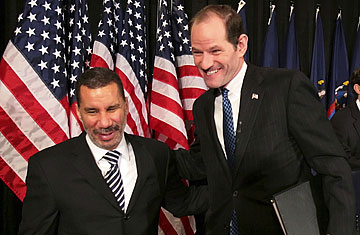
After taking a close look at some of the excellent film programs in New York City, I decided to go against the wisdom of pretty much everyone whose advice I sought, and applied to only one school. If I didn’t get in, I was fine with those consequences. I’ve done well in politics, and had just left a tumultuous stint working for Governor David Paterson as we tried, unsuccessfully, to keep the job that Eliot Spitzer suddenly handed him a few years earlier. I knew I would be okay if school didn’t pan out. Either way, I would have chased a dream and would no longer torture myself over whether or not to pursue it.
Ultimately, I applied to master’s program in Media Studies and Film at The New School. Being a UC Berkeley graduate, and a strong Democrat, I suspected I’d fit in quite well with the more renegade and avant-garde environment of The New School (after all, the school began a century ago largely from a group of breakaway scholars from Columbia University who refused to sign their government loyalty oaths). Beside, while NYU is renowned for its film school, it is geared toward traditional fiction films. If you want to go the documentary route, The New School makes much more for sense. So, I applied in October, got accepted in November, and began school barely a month later.
During orientation, I learned I was the oldest of my incoming class of about 70 students. That discovery came just as I pulled out a notebook and pen to take notes, rather than typing directly into a shiny MacBook Pro, as did a majority of my new classmates (note: I used a typewriter the last time I was in school in the late 1980s). It was a new world and, at first, awkward. Terrifying, actually. It’s funny how you don’t feel old working on a political campaign when in your forties, but feel ancient when you’re a new grad school student. Like, dinosaur-ancient.
Thankfully, that feeling largely subsides after a few weeks as you realize just how great of an advantage and head start you have on your classmates when it comes breath of experience, perspective and focus, all of which translates into your coursework and relationship with professors, one way or another. While most grad students are, understandably, still figuring out what they want to do after they’re done with school, an older student has a laser-like approach to figuring out the lay of the land, the right classes to take and professors to avoid, how to take advantage of all the networking opportunities during visits from filmmakers and distributors and producers, and, most importantly, a plan. As a result, the lectures and readings are remarkably interesting and you’re enjoying it too much to even contemplate meaningful procrastination. On top of that, it turns out that professors love older students because we have a purpose, are engaged by what they’re teaching, and we’ve been around-the-block long enough to intuitively know what matters and what doesn’t when processing large amounts of new information.
Read the rest of… Mark Nickolas: From the Political Trenches to Film School
By Lisa Miller, on Wed Apr 27, 2011 at 12:00 PM ET
Behind every man is a good woman.
And behind every good woman is a great woman.
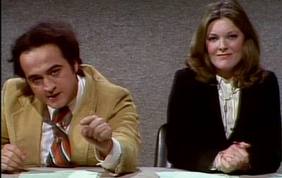
In 1975 when Jane Curtin, Gilda Radner, and Lorraine Newman were the feminine faces of Saturday Night Live, the late great John Belushi made it his mission to sabotage their success.
No kidding.
John Belushi and Jane Curtin
Jane Curtin said as much on Oprah Winfrey’s April 14 tribute to SNL. According to Curtin, Belushi apparently believed that “women were fundamentally not funny; and if a woman had written a piece for John, he wouldn’t read it during rehearsal, he’d whisper it.”
She went on to explain that this type of disrespect wasn’t at all an unusual feature of the workplace experience in the 70’s. A working comedienne (terrifically talented at that) in New York, on the most exciting new show on television, and Jane Curtin, as a self-employed woman — “could not even get a credit card.”
Why bring this up now?
Because I thought of this super good title while walking the dog three days ago. And I decided this piece can’t be about my life as an RP spouse as I had originally planned. That’s because watching Tina Fey sit with Curtin on Oprah’s famous couch illustrated how far women have come in 36 years. And that was deeply inspiring.
Today, Tina Fey is lauded as one of the most brilliant entertainers in T.V, and she is indeed a woman with a credit card — as well as loads of respect. Here’s what Oprah says:
“Tina Fey is the creator, writer, and star of 30 Rock — and former head writer of SNL — she is one of the smartest women on our planet right now.”
I wonder if she’s the smartest woman on all of the planets. She might be, and do you wonder too how she got to be so all that?
Fey said simply, “I was 5 when the show started, and I studied it all the time.” There it is, nourished by the brilliance of women before her, Fey now stands on the shoulders of those who blazed the trail. (For the purpose of this spiffy blog article, I wish she’d have been more specific in that sound bite about emulating women in particular. But maybe that’s exactly what she meant, eh?)
Anyway, it was a powerful statement when she said later about her own trail-blazing time on SNL that “the more women in the room to laugh at pieces written by women, the more everyone would agree to put it in the show.”
While the scary, loathsome dynamics of middle school girls might lead us to believe that girls will always and forever scratch each others’ eyes out, most adult women have each other’s backs. There is no doubt that we help one another in ways that make us cry with gratitude.
Consider all the stories of women all over the world: WomenforWomen.org, which helps women survivors of war rebuild their lives; United Prosperity, which guarantees loans to female entrepreneurs in developing countries; the nameless thousands of women volunteers who stand on call in the middle of the night at rape crisis centers across the world; or the women in your own family and in my family who say to each other, “I know your heart is breaking, and I know you will get through it because I did.”
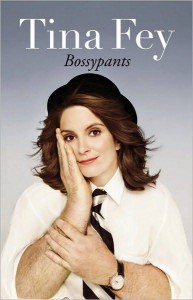
Click on Tina to review and/or purchase
Whether we realize and appreciate them or not, new generations build on the successes of their ancestors. It’s why the indigenous people pray that their current actions be “for the good of the children and the children’s children.” And it’s why Tina Fey can now be queen of comedy in an industry that is still predominately male.
I plan to read her new book, Bossypants, this weekend by the way. In it are many stories of her road to empowerment, success, and hilarity. Can’t wait.
And because I’m always looking for fantastic role models for my girls, they are each getting a copy.
Now it’s your turn: Whether you are female or male, tell a brief story below about the awesomeness of a woman in your life.