By Julie Rath, on Fri Jul 26, 2013 at 8:30 AM ET
Scorching hot temps got you down?
When it’s 90+ degrees out, you are definitely going to do some sweating.
But there are ways you can prepare so that you minimize the damage to your wardrobe and appearance.
Below are 11 tips for keeping cool and confident this summer.
Grooming
1) Take your morning shower with the coldest water you can stand, and use a cooling soap with mint.
2) When you get out of the shower, powder your feet, armpits and groin to help keep you dry. Menscience body powder uses cornstarch and zinc oxide instead of talc (which has shown to have negative health effects) and was formulated for all-over use.
3) Use deodorant with antiperspirant, which slows the production of underarm sweat.

4) Apply a cooling product like Korres’s Greek Yogurt Cooling Gel as needed, post-shower. It’s designed for sunburns, but does a great job relieving all sensations of heat from your body.
5) Face wipes also make you feel and look cool by absorbing grease and oil.
6) Get your hair cut shorter and more frequently during warm months (including cleanups for the hair on the back of your neck and around your ears).
Clothing
7) My guiding principle is that clothing should always fit impeccably, but in the summer months, I am OK with slightly looser fits to facilitate airflow, especially for items like linen shirts and pants.
8) Dark colors absorb sunlight and therefore heat, so opt for light colors like white, off-white, light grey, beige, and pastels, all of which present as more seasonally appropriate as well.

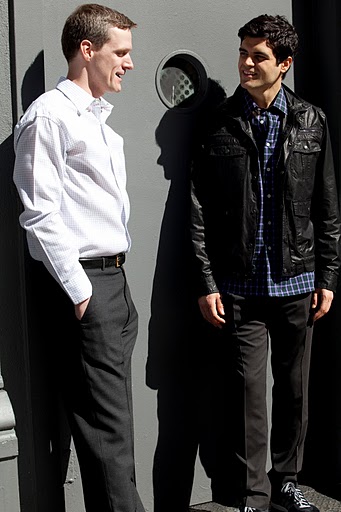
9) Choose natural fibers that breathe and are good at absorbing moisture. These include tropical weight wools, seersucker (not just for suits), linen (try in a tie if you wear one every day), hopsack, light cottons (opt for cotton broadcloth vs. a heavier oxford), cashmere, and silk. I like Bonobos’ lightweight chinos and the summer weight casual top above left and right. When shopping, be sure to read labels and avoid anything with nylon or polyester in it.
10) A quarter-lined or unlined suit jacket or sport coat will be lighter on your body than one with a full lining. (Note: this type of unconstructed jacket is inherently more casual than those with full linings, so be wise about where you wear them). If you go quarter lining, make sure the lining is made from Bemberg, which does a better job than silk of wicking moisture from your body.
Plan Ahead
11) Keep your office stocked with a backup shirt (especially good if you have a big meeting at the end of the day or dinner/drinks after work), face wipes mentioned above, and a bottle of deodorant. That way you’re set if things get sticky.
How do you stay cool and comfortable in the summer months and still look like you mean business?
By Josh Bowen, on Thu Jul 25, 2013 at 8:30 AM ET 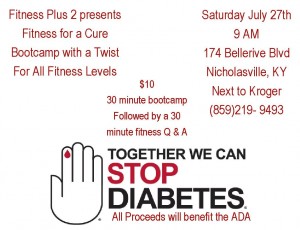 Click here to join us. Click here to join us.
Come join us Saturday July 27th at 9am for Fitness for a Cure, hosted by Fitness Plus 2.
174 Bellerive Boulevard next to Kroger’s.
We will be running a charity bootcamp for the American Diabetes Association.
Cost is $10 with 100% of the proceeds going to the ADA.
The fitness coaches from Fitness Plus 2 will take everyone through a 30 minute, tabata style workout with a nutrition Q and A to follow. The entire community is invited for this special event.
We will meet in the parking lot of Fitness Plus 2, next to Kroger’s. We will have a landing page for people to go and donate to the ADA for the bootcamp and for any other reason.
Please come out with us for Fitness for a Cure!
Click here to join us.
By Liz Roach, on Wed Jul 24, 2013 at 1:30 PM ET  Bearing heaving platters of sea island peas, roasted mountain trout, barbeque chicken and other vittles, waiters at the Whiskey Jar displayed a sampling of hospitality along with bottles of Foggy Ridge cider and Veritas Vineyards wines. Bearing heaving platters of sea island peas, roasted mountain trout, barbeque chicken and other vittles, waiters at the Whiskey Jar displayed a sampling of hospitality along with bottles of Foggy Ridge cider and Veritas Vineyards wines.
Slipping a bite of peach trifle into my mouth, I sighed and surveyed the spoils of supper. If this was a typical Southern Foodways Alliance (SFA) dinner, I was prepared to sign up for a lifetime membership.
Many other ambrosial meals and adventures awaited at the SFA’s 2013 Summer Symposium in Richmond, Virginia. The non-profit organization, whose members consist of chefs, cookbook writers, and other luminaries from the food world, in addition to a good number of eating enthusiasts, fosters a fellowship like no other.
From June 20-22, 2013, members shared in finger-licking good multi-course feasts, cultural forays, and delightful company. Centered around the theme of “Women at Work,” the event put the spotlight on Richmond and its storied, delicious food culture.
Below are a few snapshots of the weekend that will give you an idea of the goodness that took place.
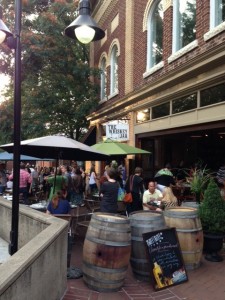
The opening night dinner took place at the Whiskey Jar in Charlottesville, VA

The glorious peach trifle at Whiskey Jar
Read the rest of…
Liz Roach: Taste Adventure — Southern Foodways Alliance Summer Trip to Richmond, Virginia
By Lauren Mayer, on Tue Jul 23, 2013 at 3:00 PM ET This is a particularly hard time to be a political humorist – so many news stories are volatile and disturbing. Topics like the Zimmerman verdict, abortion restrictions, cruel anti-gay legislation in Russia, and horrible heat waves don’t suggest anything funny, and besides, it feels inappropriate to joke about such sensitive topics. What’s an independent writer to do? (lacking the writing staff of The Daily Show)
Fortunately, cheating by prominent figures never goes out of style, and we’re getting a refresher course thanks to the New York City elections, in which Elliot Spitzer and Anthony Weiner are actually ahead in their respective races for Comptroller and Mayor. Apparently, the old adage is true, that any press isi good press, because name recognition seems to be more important to voters than the misbehavior which led to each of them resigning not that long ago. Mark Sanford has also returned to public office, after turning The Appalachian Trail into a permanent teenage boy joke. And just to make sure the whole subject stays current, now we have the Mayor of San Diego, Bob Filner, who is accused of harassing women employees with unwanted attention and suggestions that their work would improve if they weren’t wearing undergarments. (Filner vigorously refutes the accusations,insisting he didn’t do anything wrong, he just likes to hug people, but he knows he has a problem and will seek help. One of the odder denial/confession combos I’ve ever heard – but stay tuned, the city has opened a hotline for employees and constituents to make complaints. This could get really fun!)
So while these sex scandals won’t solve global warming or Congressional deadlock, they can help take our minds off of the more upsetting news stories for a few moments; we can chuckle with glee over the more salacious details (like Spitzer’s opponent turning out to be the madame whose employees he patronized; you’d think she’d prove to be a better financial planner, since she got him to pay $4,000 a pop . . . but I digress . . . )
By Nancy Slotnick, on Tue Jul 23, 2013 at 8:30 AM ET  “You never don’t know” is what my mother-in-law says when she means “You never know.” It must be said in a Polish accent with the conviction that only a Holocaust survivor could pull off while using a double negative. So by the theory of transitivity, “You never don’t know” equals “You always know.” I’m going with that theory. You always know. “You never don’t know” is what my mother-in-law says when she means “You never know.” It must be said in a Polish accent with the conviction that only a Holocaust survivor could pull off while using a double negative. So by the theory of transitivity, “You never don’t know” equals “You always know.” I’m going with that theory. You always know.
If you can tap into your instincts, and distinguish them from anxiety, you always know. “Is he the One?” You know. “Should I have that opening line?” You know. “Should I write that email to reach out?”
You know, but you don’t always listen to your gut. You talk yourself out of it.
Do you expect greatness to come your way or mediocrity? Or disaster? Murphy’s Law is more about Murphy than about a law of nature. I think Murphy attracted bad luck because he’s always expecting bad luck and it feeds on itself. Of course if you want to attract good luck you have to do the work. There’s plenty of good luck out there and it will come your way sooner or later. You just have to be prepared to seize your luck.
Here’s how: Let’s say you’re on a train traveling for the holidays, like I am right now. Let’s say you’re single and you secretly wish that the man of your dreams would sit next to you. You do hold out the hope for good luck. But you also dread the fat lady who talks your ear off or the crying baby that blocks the audio of Gossip Girl Season 2. Even though you’ve already seen it. You are tempted to just put your backpack up on the seat next to you, put on your headphones and go into “Do Not Disturb” mode. If you’re lucky, then the train is not sold out and you will get two seats to yourself. But is that what you really want?
 If you know that you want more, you may have to put your “Cablight” on, as I call it, and try to show that the seat is available for the right guy. There is a strategy you can employ. Put the backpack up as you scope the crowd passing by. Choose your target. He may not be your Brad Pitt, but pick the best one of the lot of train travelers with your mind’s eye and start your training to attract what you want in life. If you know that you want more, you may have to put your “Cablight” on, as I call it, and try to show that the seat is available for the right guy. There is a strategy you can employ. Put the backpack up as you scope the crowd passing by. Choose your target. He may not be your Brad Pitt, but pick the best one of the lot of train travelers with your mind’s eye and start your training to attract what you want in life.
As he gets about 2 seats away from you, move the backpack and look up. Make eye contact. This will be hard. Be vulnerable for a second and make it visible to him in your eyes. Then look away and go back to Gossip Girl so he doesn’t think you’re a stalker and he knows that you aren’t going to be annoyingly forward. Let him come to you. This should work if you do it right, with confidence and humility at the same time. It probably won’t though. Law of averages.
But if it doesn’t, get up and move seats. Why? Because you still have hope that there’s a better guy in another car. Because you’re willing to give up the comfort of a window seat near the Café car for the chance of finding something better. Someone better. Like Deal or No Deal with the universe. You believe that the banker has something good in store for you in that briefcase and you’re willing to take risks.
Read the rest of…
Nancy Slotnick: You Never Don’t Know
By Erica and Matt Chua, on Mon Jul 22, 2013 at 1:30 PM ET Contemporary artists are professional instigators. Their art challenges the status quo and cultural assumptions. Since culture is localized to each country and region, contemporary art gives a glimpse into their daily life and struggles, things which a traveler may struggle to discover through any other means. For this reason we’ve sought out contemporary art exhibitions while traveling the world.
In seeking out exhibits I’ve been especially drawn to installations that combine art and space to create experiences. One such place that stood out from description alone was Brazil’s Inhotim which the Telegraph called a “Versailles for the 21st century”. My hopes were high as my last visit to a meglomanic funded triumph over all things normal, Tasmania’s MONA, blew me away. Since the MONA was the best museum I’ve ever visited, Inhotim had a lot to live up to. Let me show you how it did and why Inhotim is one of the world’s best contemporary art destinations.

Out-of-the-way is the only way to explain Inhotim’s location. The benefit of the rural location outside Brazil’s third largest city is a space. Instead of building a museum, the billionaire creator, Bernardo Paz, chose to build a collection of art installations surrounded by one of the world’s best botanical gardens. City locations may have made it more accessible, but being able to do away with space constraint in this location makes it special. From entrance to exit, the meticulous gardens are a joy to explore between seeing works from today’s hottest contemporary artists such as Matthew Barney and Yayoi Kusama. Without the gardens it would be just another museum, instead of an amazing, all-day, experience.
Read the rest of…
Erica & Matt Chua: Inhotim
By Saul Kaplan, on Mon Jul 22, 2013 at 8:30 AM ET
Need to turn around your company? Trying to start a movement? Want to change the world? Easy Peasy! Just turn it in to a game. Everywhere we turn, it seems there are experts claiming that the best path forward is to engage people with elements of competitive play. The business world in particular has gone gaga for gamification.
I thought games were mainly for kids, and the occasional ice-breaker or temporary escape from reality. Why encourage more of them? As adults, aren’t we supposed to set aside childish things and get down to work on the problems of the real world?
Truth be told, I have always loved games. Stratego was a mainstay among my school buddies. We spent hour upon hour lining up red and blue soldiers to protect our flags. My family’s Monopoly games were epic battles, beginning with the fight over game pieces. (No, I get the Scottish Terrier!) The side deals we struck and the arguments that ensued still liven up family gatherings. In college I became a professional Risk player. Tell me you didn’t learn about the challenges of fighting a multi-front war from playing Risk. Who among us hasn’t attempted to conquer the world by way of Kamchatka?
Games ruled – till it was time to make my way in the real world where they didn’t. By the time online games exploded onto the scene, I was so immersed in reality that I managed to ignore them. I’ve never created a level-80 character in World of Warcraft, won the staff of life in Spore, mastered an artichoke crop in Farmville, or knocked over any pigs with Angry Birds. But others have – hundreds of millions of them around the world. Already, 5.93 million years of total time has been spent playing World of Warcraft alone.
One response to this is to despair of all that wasted time. Imagine if only a fraction of it had been focused on improving our education, health care, energy, and economic systems. Another response, though, is to say: if you can’t beat them, why not join them?
Jane McGonigal’s Reality is Broken makes a strong case for leveraging game design and mechanics to work on the big social challenges of our time. McGonigal suggests that the four defining traits of any game – a goal, clear rules, a feedback system, and voluntary participation – can be applied to any challenge. She even says game-playing makes us better people. The book is a passionate articulation of why we should pay attention to what is going on in the world of games.
 Reading McGonigal’s arguments from my perspective in the world of work and social system change, it seems it’s the voluntary part we should focus on hardest. Organizations have a lot of experience with goal setting, rules, and incentives. What we haven’t figured out is how to align work with personal passion and commitment. The big aha from Reality is Broken is that we enjoy games and spend so much time playing them because it is our choice. We volunteer to enter their fray. Meanwhile, the problem with work is that so much of it feels involuntary. Certainly no one forced us to take a particular job, but whatever sense of excitement or mission we felt as a new recruit has been lost in the daily grind. We signed on to make a difference by capturing Kamchatka and now find ourselves peeling potatoes. Reading McGonigal’s arguments from my perspective in the world of work and social system change, it seems it’s the voluntary part we should focus on hardest. Organizations have a lot of experience with goal setting, rules, and incentives. What we haven’t figured out is how to align work with personal passion and commitment. The big aha from Reality is Broken is that we enjoy games and spend so much time playing them because it is our choice. We volunteer to enter their fray. Meanwhile, the problem with work is that so much of it feels involuntary. Certainly no one forced us to take a particular job, but whatever sense of excitement or mission we felt as a new recruit has been lost in the daily grind. We signed on to make a difference by capturing Kamchatka and now find ourselves peeling potatoes.
Applying game design in the workplace can bring back the thrill of putting points on the board, beating the odds, and accomplishing important goals. Leveraging game mechanics can unleash passion, potential, and personal commitment. Games can help transform the weak links of social media connections and conversations into purposeful networks.
But even as we increasingly recognize the potential of games to help us change the world, let’s not get carried away. Shakespeare pointed out the problem inherent in gamifying all our endeavors. “If all the year were playing holidays, to sport would be as tedious as to work.” So yes, let’s introduce an element of play to make the office more engaging – but let’s not turn Monopoly into monotony.
This post originally appeared here on the Harvard Business Review site.
By Julie Rath, on Fri Jul 19, 2013 at 8:30 AM ET In case you missed it, Rath & Co. was featured onThe Early Show talking Casual Friday and what people can and can’t get away with.
The video can be seen here.
Below are more thoughts on the topic:
- When Casual Friday rolls around, make sure you don’t forget that you’re still going to work, so some level of “business” needs to be involved.
- They always say to dress for the job you want, and that’s a good rule of thumb. If you’re going to the beach straight from work, you can find somewhere along the way to stop and change. Swim trunks + office does not lead to promotion!
- Guys should beware of wearing shorts to work. Everyone is fitness conscious these days — that’s great. We know you spend hours at the gym working on your quads, but you don’t need to display those gams at work! A little mystery doesn’t hurt.
- I saw a guy walking down the street recently in dress pants and carrying his dress shirt with a messenger bag slung across his shirtless torso. It looked uncomfortable and beyond strange. Instead of tearing off your clothes as soon as you hit the elevator, look for light colors and breathable fabrics like linen and lightweight cotton. I also like a blend of microfiber polyester and rayon because it wicks moisture away from the skin and doesn’t wrinkle easily in humidity.
- If you work in a creative field like advertising and want to wear whatever you please so that you’re comfortable enough to channel that inspiration, be sure you’re not doing so in a way where you show too much skin. There are plenty of other ways to express creativity: bright colors, fun patterns (like the purple plaid Billy Reid shirt in image above) and unique accessories like an interesting belt from APC or a punchy tie bar from J. Press over a knit tie (see below).
 
Happy Friday!
By Josh Bowen, on Thu Jul 18, 2013 at 8:30 AM ET As many know, I am in the process of writing a book; titled “12 Steps to Fitness Freedom.” In the book I discuss a variety of topics but one in particular that is supremely important is goal setting. In the video below I discuss how to set goals and keep accountable to them. In my book I will be discussing, in more detail, the strategies it takes to have “fitness freedom.” Enjoy.
By Mark Nickolas, on Wed Jul 17, 2013 at 8:30 AM ET It’s been more than two years since I wrote my first piece for the RP. It was April 2011 and I had just entered the graduate Media Studies & Film program at The New School in New York City and was eager, bright-eyed, and knew little about how to make a film, yet alone feature-length documentary films. No doubt, while you can certainly become a successful filmmaker without spending $100,000+ for the formal training you can receive in graduate school, for some of us that is a worthy investment.
In May, I graduated with a newly-minted master’s degree and my filmmaking training wheels have been taken off. Now it’s time to see whether my talent can match my enormous ambitions. I’ve already completed one short film that has been receiving an unexpected amount of national attention in the past week and am already in pre-production on my first feature-length documentary that I landed last year.
So, I’m going to use this website as a personal journal of sorts as I head down this path. I’ll offer a behind-the-scenes style peek at what it means to be an emerging filmmaker in New York City and the things we must juggle, mine fields we must avoid, and obstacles we must clear in this hyper-competitive field where an early disaster can quickly dash your filmmaking hopes for good.
 I’ll admit it. This journey is very exciting but so enormously terrifying. A perfect mix, actually. I feel like I’m standing at Base Camp and looking up at Mt. Everest. But my 15+ years in politics prepared me in many ways to handle this moment. I’m certainly nowhere as intimidated by the grandeur of the stage or the media spotlight as my fellow (and much younger) classmates. I also seem to be able to get most people to answer the phone or return an email, if only because of my background and professional success in other somewhat related fields. I’ll admit it. This journey is very exciting but so enormously terrifying. A perfect mix, actually. I feel like I’m standing at Base Camp and looking up at Mt. Everest. But my 15+ years in politics prepared me in many ways to handle this moment. I’m certainly nowhere as intimidated by the grandeur of the stage or the media spotlight as my fellow (and much younger) classmates. I also seem to be able to get most people to answer the phone or return an email, if only because of my background and professional success in other somewhat related fields.
Those are important benefits, no doubt about it. But getting people to open the door is just the first of many steps. Whether I have actual talent to direct a film, am able to find enough donors to help fund the $400,000 budget — and can catch a few breaks — are the real questions.
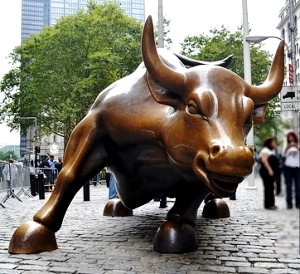
The great news is that it seems I’ve caught a few breaks already. As has been highlighted at the RP last week, my quirky short film — My Life in the Canyon of Heroes — has shined a good amount of unexpectedly national attention on me over the past few days. After the film made the finals of Smithsonian magazine’s short film contest, it was highlighted in a story in the Atlantic. That led to emails from NPR’s Marketplace and CNBC’s Power Lunch who wanted to interview me for segments. Marketplace was taped and ran on Friday. I just confirmed with CNBC earlier today that we are taping my segment next to ‘Charging Bull’ on Thursday morning and it will run on Friday (1-2 pm ET). There may be more interviews in the coming weeks.
My Life in the Canyon of Heroes from Mark Nickolas on Vimeo.
Funny how life works. That little film was never meant to see the outside of a classroom. It began as a final project in my ‘Cinematic Place’ class last spring. I only submitted it to the Smithsonian at the suggestion of Deanna Kamiel, my professor, and had completely forgotten about it until just before it made the finals when they contacted me for some clearance and rights information. And once it made the finals, the media storm happened on its own. I didn’t reach out to anyone and was as surprised as everyone else when the national media was interested in a 6-minute film about a talking 7,000-pound bronze bull.
Yesterday, I learned that I didn’t win any of the final Smithsonian awards. But how could I be upset? Thousands of people have seen and voted and commented on my first completed short film and I have national press clips heading into fundraising for my first feature project that are priceless. The journey ahead remains terrifying, but I just got a taste of the possible. Maybe I’m now at Camp 1 instead of Base Camp. But — come on — that’s the easy part of climbing Mt. Everest. I get that.
So, I head into my first film with a nice surge of confidence to keep the fear in check. It feels good. There are going to be so many ups and downs in the coming year. Student loans payments are already on the horizon and few get rich making documentary films. But I’m a dreamer and not afraid to go for it. Maybe I’ll be one of the few that make a name for themselves in this field. Maybe I won’t. But I’ll know that I gave it my best shot.
Next week, I’ll preview my feature-length film, tentatively titled A Cloud of Suspicion. I look forward to sharing my journey with you, even when it sucks and I’m battered and bruised from the constant rejection. That’s, apparently, what I signed up for.
|
|