By Saul Kaplan, on Mon Sep 9, 2013 at 8:30 AM ET A friend asked me this week, what is the single most important thing holding our economy back? Without hesitation I said our psychology is bad and negativism is getting in the way. We have allowed cynicism to slow progress, growth, and innovation. I am as cynical as anyone. Here in New England we are born with a well-developed cynical streak. In my home state of Rhode Island we have taken the art of cynicism to entire new heights. I am convinced we won’t climb out of this economic mess until we become more confident in our selves, our communities, and our opportunities. Psychology matters. A strong innovation economy creating higher wage jobs result from the decisions made every day by organization leaders and entrepreneurs. It is the sum total of these decisions on the margin to hire one additional employee or to invest one additional dollar which determine the trajectory of our economy. While many factors influence these choices in the end it comes down to psychology or confidence. We must find a way to move beyond our cynicism.
The imperative is to unleash the animal spirits. John Maynard Keynes had it right in his book, The General Theory of Employment, Interest, and Money, when he described animal spirits as the emotion which influences human behavior measured in terms of consumer confidence. Keynes got the math right. Positive activities depend on spontaneous optimism rather than mathematical expectations. Our decisions to do something positive can only be taken as the result of animal spirits, a spontaneous urge to action rather than inaction, and not as the outcome of a weighted average of quantitative benefits multiplied by quantitative probabilities. Amen.
Keynes stood on the shoulders of earlier philosophers who also asserted that psychology matters. David Hume, one of the most important historical contributors to Western philosophy, has been credited with laying the foundation for cognitive science. In his seminal work, A Treatise of Human Nature, Hume lays out his framework for a naturalistic science of man that examines the psychological basis of human nature. His views in 1739 were heretical and in direct opposition to the prevailing views of the rationalists, exemplified by Descartes. Hume concluded that belief rather than reason governed human behavior. I love Hume’s famous quote, “Reason is, and ought only to be the slave of the passions.”
 Before accusing me of being Polyanna-ish (optimist for sure) or having my head stuck in a history book (only partially stuck) consider what is going on around you. Everybody is pointing at everybody else. It’s the government’s fault. It’s the big bad industrial complex. There isn’t enough resource to go around. Democrats and Republicans are beating each other up incessantly while nothing changes (a pox on both of their houses). Change is hard. Life isn’t fair. And so it goes. Add your barriers and excuses here. OK, Can we move beyond admiring the problem now? How we love to admire the problem. Enough already. Before accusing me of being Polyanna-ish (optimist for sure) or having my head stuck in a history book (only partially stuck) consider what is going on around you. Everybody is pointing at everybody else. It’s the government’s fault. It’s the big bad industrial complex. There isn’t enough resource to go around. Democrats and Republicans are beating each other up incessantly while nothing changes (a pox on both of their houses). Change is hard. Life isn’t fair. And so it goes. Add your barriers and excuses here. OK, Can we move beyond admiring the problem now? How we love to admire the problem. Enough already.
We have an incredible opportunity in front of us. We must overcome our cynicism and bring passion to the fore as we optimistically try more stuff. Sure there are challenges but we live in a technology rich era with an unprecedented opportunity to enable purposeful networks focused on solving the big issues of day. How about starting with health care, education, energy, and economic prosperity? If we are waiting for institutions to lead the way we are going to be waiting a very long time. Clay Shirky has it right in his recent books, Here Comes Everybody and Cognitive Surplus. We are connected, communicating, and leveraging social media platforms in powerful ways. Collectively we are blessed with a cognitive surplus that is huge, obvious, and accessible to solve real world problems and redefine how value is created, shared, and captured. We just need to get on with it. It is time to stop admiring the problem. The biggest obstacle in our way is a negative psychology and lack of confidence to act. Time to unleash the animal spirits.
By Julie Rath, on Fri Sep 6, 2013 at 8:30 AM ET I’m not going to lie, the term POWER SUIT makes me cringe a bit. Yes, the right suit can help you look powerful, at least if it fits you perfectly, but just donning a suit does not by itself do the job. There are other pieces to the puzzle. So if you’re going into a situation where you want people to sit up and take notice when you walk in, read on for 4 easy tips on how to manage your appearance.

1) Straight lines and angles in patterns and clothing silhouettes signal authority. An easy way to apply the former is with ties: the tie above left is much stronger because of its angularity than the tie to the right with its curved lines. For silhouettes, you can see this everywhere from glasses, to suits, to sport jackets (if you wear glasses, my article on how to choose glasses frames is a must-read). For example, a squared-off jacket shoulder is more commanding than a soft shoulder.

2) Adopting the posture and body language associated with dominance, can change not only how others perceive you, but also how you feel about yourself. Check out this fascinating TED Talk by Harvard Professor and social psychologist Amy Cuddy. According to her research, if you spend just two minutes in “power poses” before going into an evaluative situation like a job interview (you can do them in a bathroom stall), the benefits will be considerable.
Read the rest of…
Julie Rath: What is Your Power Suit?
By Josh Bowen, on Thu Sep 5, 2013 at 8:30 AM ET
By Lauren Mayer, on Tue Sep 3, 2013 at 3:00 PM ET It’s a classic rite of passage every fall, parents taking their kids off to college and saying goodbye (after spending way more than they’d budgeted for dorm room essentials like bedding and Starbucks cards). And it can be an emotionally loaded experience, especially for moms like me who cry at the drop of a hat. (I tend to weep at the oddest moments, like the first time I saw my son tap dance in the opening number of ’42nd Street’ -that iconic moment when the curtain just goes up enough to see the ‘dancing feet,’ which is one of the most upbeat, cheerful scenes in all musical theatre. But I digress… )
For many parents, this is their first realization that their babies are leaving the nest, and it can be hard to let go. But I’m okay with that since I also went 3,000 miles away to college, and I’m thrilled for my son to have that experience too. The hardest part for me is feeling old – in my gut, I still feel like a college student, but walking around campus, I am clearly part of a troupe of aliens, adults who are irrelevant and unnecessary – and old. Of course I want to age gracefully, not to be one of those desperate middle-aged women who wear inappropriate clothing and overdo the cosmetic procedures. (As my hairdresser says, “Bangs, not Botox!”) But being a parent at a college campus is a huge wake-up call, reminding me that the ‘aging-gracefully’ time period I’d anticipated is actually now.
Plus there’s a heady sense of freedom at a campus – these kids are at the beginning of their adulthood, surrounded by interesting people, with opportunities to develop their minds and to train for their careers, with everything still being possible and nothing out of reach. No worries, no limits – who wouldn’t envy that? Fortunately, part of being a college parent is helping my son move into his dorm, and once I looked at the small, unairconditioned room and thin extra-long twin mattress, my envy strangely disappeared.
So this week’s video is dedicated to all parents who are taking kids to college, and all moms who cry . . .
By Nancy Slotnick, on Tue Sep 3, 2013 at 8:30 AM ET Eggs
Milk
Arizona Diet Iced Tea- Peach flavor
Sunchips Original
Organic baby spinach
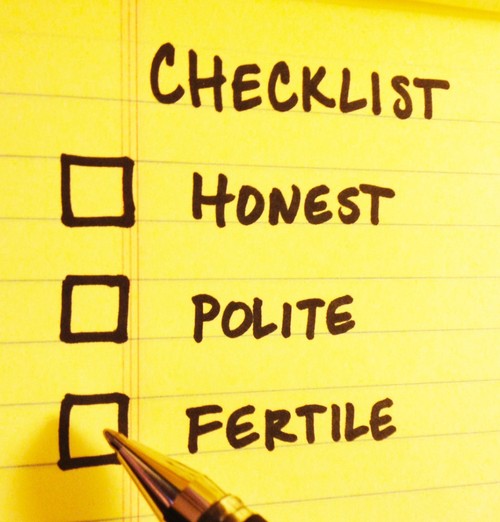
Oh sorry- that’s my grocery list. And it’s so easy to just go across the street and get it all. If only finding a mate could be so easy. Some people have a grocery list for what they look for in a partner. But is that a wise way to go about it? I’ve seen a lot of people seeking love in my years in the dating business and I have to say that the ones who are successful do not usually have a checklist the size of a dictionary. The people that I see using a spreadsheet to track their dates are generally too removed from their emotions to find love.
Matchmaker Café and other online dating sites are a kind of grocery store for dates. It seems like it should be so easy to plug in our criteria and have the internet machine spit out the answer. So why can’t we just order up the person we want like Chinese take-out? I would tip the delivery guy so well for that. But the conversation around the “checklist” always leads to one conclusion- that the chemistry and the checklist are at odds. How to have both is the big question.
 It can be done. So here’s the checklist for the resolution of the checklist question: It can be done. So here’s the checklist for the resolution of the checklist question:
- Do not have 73 things on your checklist- that’s only ok for reality TV stars on shows called “Miss Advised”
- Have 3 dealbreakers- that’s reasonable
- Have a picture of what you want that has details- that’s ok
- Let your picture morph if you meet someone you like
- Don’t be anal or rigid about your checklist
- Go with your gut- if you have passion about someone- listen to it
- If more than 5 friends have told you you’re too picky- you probably are
- If your checklist is too long, you need to look inward
- Recognize that the checklist is about being in control; Love is an out of control experience
- People are not objects, so you can’t order them up like groceries
- If you are a checklist person, you may be a narcissist
- If you are a narcissist, there is hope for you (other than being a reality TV star). But you have to want to change.
- You can’t outsource love, because of #10.
Read the rest of…
Nancy Slotnick: The Checklist
By Erica and Matt Chua, on Mon Sep 2, 2013 at 1:30 PM ET Charles Darwin may have made the Galapagos famous, but the wildlife is what makes the trip worth it. Giant tortoises more than 100 years old, playful sea lions, blue footed and red footed boobies, marine iguanas and bright colored crabs, there is something for everyone. The highlight of a visit to the Galapagos is seeing animals on their terms.

The grapsus grapsus also known as a red rock crab can be seen on almost every island
With less than 25,000 people living across the archipelago, each island is a true animal kingdom. The birds were just as curious about us as we were about them and the marine iguanas seemed completely unconcerned about our presence unless we were blocking their sun. The only animals that seemed a little skittish were the colorful crabs that coated the volcanic rocks like a red moss.
With the vast number of endemic species and so many of them far from shy it is a photographer’s paradise. Here are just a few of the different animals you can expect to see on a visit to the historic Galapagos Islands:

The most famous inhabitant of the Galapagos Islands are the blue footed booby
Read the rest of…
Erica and Matt Chua: Galapagos Wildlife
By Saul Kaplan, on Mon Sep 2, 2013 at 8:30 AM ET  Being an innovator is both a blessing and a curse. Innovators are constantly seeking to improve things by finding a better way. A questing personality is a blessing providing innovators with a source of personal pride, accomplishment, and exhilaration. At the same time an innovator’s job is never done. There is always a better way. A sense of perpetual incompleteness and never being satisfied torments most innovators I know. I think this blessing and curse dichotomy is the secret sauce that makes innovators tick. It motivates innovators to take personal risks, collaborate with unusual suspects to find a missing piece, and jump through incredible hoops seeking a better way. Innovators wouldn’t have it any other way. Being an innovator is both a blessing and a curse. Innovators are constantly seeking to improve things by finding a better way. A questing personality is a blessing providing innovators with a source of personal pride, accomplishment, and exhilaration. At the same time an innovator’s job is never done. There is always a better way. A sense of perpetual incompleteness and never being satisfied torments most innovators I know. I think this blessing and curse dichotomy is the secret sauce that makes innovators tick. It motivates innovators to take personal risks, collaborate with unusual suspects to find a missing piece, and jump through incredible hoops seeking a better way. Innovators wouldn’t have it any other way.
There is always a better way. It doesn’t matter how innocuous or small a thing from everyday life it is. You can always tell an innovator because they fixate on addressing small things with the same child-like enthusiasm they readily deploy to large complex societal problems. It’s the little things that often get innovators the most riled up. I learned this lesson the hard way and share one of many personal examples. After a long career as a road warrior strategy consultant I found myself at home trying to figure out what I was going to do next in my career. One morning I came downstairs and opened the cupboard that housed breakfast cereal for our three children and found it filled with twelve half-opened cereal boxes. You know the one I am talking about. Tell me you can’t relate to this important dilemma. I fell into the trap and loudly proclaimed, isn’t there a better way to organize this cereal. The response was immediate and resounding, thanks for the input, now go find something else to do, preferably out of the house! I know my wife is groaning reading this thinking, no, not the cereal box story again. Can’t you come up with a new story for heaven’s sake? P.S. regarding the cereal box story, the children and the cereal boxes have left home and I miss them both terribly. Innovators can’t help themselves, no matter how small the challenge, there is always a better way and they are driven to find it.
It’s not just the small things. If you are like me it bugs you enough to create new solutions in your head while stuck in an avoidable traffic jam when the information was knowable, when one part of the health care system has no clue of your experience with the rest of it, and when one government agency has no visibility to your history with the agency right next door. Don’t even get me started on education because it just makes me cry. It is inconceivable to me how we have let our public school systems atrophy to their current state. All of the innovators I know are outraged, screaming for transformational change, and willing to roll up their sleeves and help design a better way.
Innovators are constantly deconstructing life experience and coming up with new approaches to delivering value and solving every day problems. It is rarely about inventing anything new. Innovators often solve problems with existing technology and by recombining capabilities in new configurations to deliver value in a better way. Innovators are blessed to see a bigger picture enabling a larger palette from which to paint new solutions.
Innovators are also cursed by never being satisfied. The job is never done. Celebrations are muted and short-lived as innovators move on to explore the next better way. Ignorance is never bliss to an innovator. There is always a missing piece of information that torments innovators and keeps them up at night until they find it. And when they think they have a bead on it two more compelling questions arise and the constant quest continues. Innovators are generally anxious people who feed their anxiety by moving toward the edge where the best knowledge flows are. Innovators are perpetually exhausted not wanting to miss an opportunity to advance an idea, connect with someone who can help, or find that missing piece of information. It is a curse that innovators gladly accept and have reconciled themselves to live with. Innovators are never satisfied and incredibly hard on themselves, but they are convinced in their souls, seeking a better way is both noble and right.
Being an innovator is both a blessing and a curse. I am grateful to hang out with so many incredible innovators hoping that the blessing part will rub off on me. I already have the curse part covered.
By Julie Rath, on Fri Aug 30, 2013 at 8:30 AM ET Even naked isn’t naked enough in the ridiculous heat and humidity we’ve been having on the east coast. In my last article, I listed hot weather survival measures for clothing and grooming, but this time shoes are on my mind. If you’ve never switched up your footwear when the temperature rises and your dogs start barking, I urge you to consider it. You’ll look more seasonally appropriate, and your feet will thank you. Read on for Rath-approved picks in 8 categories of summer footwear.

1) Espadrilles These stylishly nonchalant espadrilles from Castañer ($150) are an excellent alternative to flip-flops for those wanting more toe coverage.
____________________________________________________________________________________

2) Leisure Shoes Ok, so this category is totally made-up. But the name fits these Riviera shoes ($80), doesn’t it? Don’t wear for anything other than leisure.
Read the rest of…
Julie Rath: Summer Footwear
By Josh Bowen, on Thu Aug 29, 2013 at 8:30 AM ET
By Lauren Mayer, on Tue Aug 27, 2013 at 3:00 PM ET For anyone who doesn’t known someone in 12-step recovery or who doesn’t have a folk-wisdom-spouting Bubbe (or Nona or Grammy or Nana, etc.), “the definition of insanity is doing the same thing and expecting a different result.” This perhaps-overused aphorism has so many useful applications, I won’t bore you with too many. (Let’s just say in our house, it applies to everything from why I don’t keep Reese’s Peanut Butter Cups in the house, to our current search for an alarm clock guaranteed to wake a 17-year-old boy.)
In politics, however, very few people seem to follow this wisdom. I imagine it’s partially because everyone is ‘preaching to the choir’ (another folk aphorism, although not one I ever heard from any Bubbe, which is Yiddish for Grandma . . . but I digress). That is, public figures mostly give speeches to please the people who already agree with them, which makes sense – constituents or fans know what to expect, and it also makes life much easier for political comedy writers who all start salivating whenever Donald Trump says he’s going to make any kind of announcement.
The insanity of repetition gets a bit out of control when it comes to legislation. It’s one thing for gun control advocates to come up with a variety of new laws, or for abortion foes to get creative in how they make it difficult for clinics to stay open – whether you agree or disagree, at least those groups are trying to adapt to reality instead of doing the same thing over and over. But what’s with the 40 votes to repeal the Affordable Care Act? On top of the fact that it’s getting to be a punch line, and these repeal votes are clearly fruitless, it does seem somewhat hypocritical for a supposedly fiscal conservative bunch to be wasting so much time and taxpayer money. (According to a CBS estimate, based on nonpartisan data about the cost of a congressional work week, each repeal vote costs $1.45 million, which makes the total over $50 million so far.) I don’t even want to think about how $50 million compares to my financial situation . . . but at least, on the brighter side, it makes the expenses for my college-bound son seem pretty reasonable by comparison.
At a certain point, it’s prudent to give up fighting and ‘surrender, Dorothy’ – so to help the GOP get unstuck, here’s a musical reminder that “Obamacare Isn’t Scary!”
|
|


 Before accusing me of being Polyanna-ish (optimist for sure) or having my head stuck in a history book (only partially stuck) consider what is going on around you. Everybody is pointing at everybody else. It’s the government’s fault. It’s the big bad industrial complex. There isn’t enough resource to go around. Democrats and Republicans are beating each other up incessantly while nothing changes (a pox on both of their houses). Change is hard. Life isn’t fair. And so it goes. Add your barriers and excuses here. OK, Can we move beyond admiring the problem now? How we love to admire the problem. Enough already.