By Josh Bowen, on Thu Dec 5, 2013 at 8:30 AM ET
The greatest minds in the human races’ history have always asked one question, Why? Einstein, Edison, Newton all posed the question of why and no matter how many times they failed they constantly pushed forward. The Power of Why.
Think about a child who is inquisitive, what do they ask repeatedly? Why? Why is the ocean blue? Why do I have to go to sleep at 8? Why do I have to go to school? Why why why? Their nature is to constantly pose the question of why so they can consistently
The why gives reason behind decisions and clarity behind things that are not yet understood. Reason and clarity are very big when discussing fitness goals: Why is getting in shape important to you? Why will having bigger arms or a smaller waist positively impact your self esteem? Why?
As you embark into a fitness regime it is important to remember why you are starting. From the mere example of you reading this means, on some level, you are interested in fitness. Either you; are wanting to start, wanting to continue what you started or are looking for fresh ideas to keep you going. Either way, we all go through a pre-contemplation phase when it comes to working out. Some decide to put both feet in and go after it others keep one foot in and the other out and then there are those that never start. The decision is a personal one but once we cross into the stage of doing something about our current situation, it is important to remember why we are doing it.
So here is what we are going to do…
I am going to generalize everyone and pose the following questions:
1. What outcomes are you wanting/expecting from exercise program?
2. Which of those outcomes is the most important to you?
3. Why is that so important to you?
 The answers to any of those questions can and will vary considerably. Everyone starts or continues and fitness program for different reasons. The importance to find the why behind the what. Is the answer to number one; more energy, less body fat or to be healthier? We can easily put those answers into three categories; how you feel, how you look and how your insides are functioning. Either way these are important to you.
Now we must pick one as our sole goal to focus on. This should be the driving force on your fitness journey, the thing you cannot live without. Once we have answered that we are on our way.
Lastly, we must instill the Power of the Why. Why is that goal important to you and why is it the most important to you? The answer will define your fitness experience and adherence. Is it because you’ve always wanted abs or because you felt better when you were 20 lbs lighter? At the end of the day we all do this for an emotional reason and to boost how we feel about us. Nothing more, nothing less. Fitness changes us for the better by supplying confidence and increased self esteem we may not have gotten from anywhere else. This is the Power of the Why!
Never forget your why and the reason you do this. On the days when you don’t feel well or you’re stressed from work. Remember your why. It is powerful beyond all comprehension.
PS: Write your most important goal down and the reason it’s so important on your mirror or car dash. When times get rough and you feel like quitting look at it and remember why you are here. Positive thoughts and energy creates positive outcomes.
By Lauren Mayer, on Wed Dec 4, 2013 at 8:30 AM ET Okay, maybe the older version of that title phrase (involving contempt) might still be true regarding annoying relatives. (My father used to insist there was just one small group of them who went from wedding to bar mitzvah to reunion, changing accents and clothing but otherwise identical, and including the great-aunts who commiserated about their digestive issues, the cousin who told offensive jokes, and the cocktail-swilling uncle who insisted on singing his off-key version of “New York New York” with the band. But I digress.)
However, I have noticed that when people get to know someone with a different political viewpoint, sexual orientation, or national origin, they are much more likely to view them positively. This has been strikingly true when it comes to issues like same-sex marriage, where even die-hard conservatives with gay relatives soften their views (unless they have another relative running for office on an anti-gay-marriage platform . . . . see Cheney: Dick). I know I’ve become more tolerant of conservative views with which I disagree since I found out a few of my best friends are Republicans and I took the time to listen to their reasoning. (I still disagree with them, but at least I don’t think of them as mutant aliens – remember, I live in the San Francisco area, where Republicans are as rare as Democrats were when I was growing up in Orange County.)
Speaking of growing up in Orange County, back in my day, Jews were equally rare, so I was usually the only kid in my class who could explain our holidays. I actually did have to correct one 4th grade classmate who had heard that Chanukah involved worshipping potato chips. (He’d heard something about potatoes and frying . . . love that 4th grade logic!) (Mind you, Jews can be equally ignorant, especially given the rampant commercialization of Christian holidays – when they were little, my sons were convinced that Christmas celebrated the birthday of Santa Claus.)
So in honor of Chanukah, I thought I’d offer a few pointers to help those of you who don’t celebrate it.
– Chanukah started several thousand years ago, so it isn’t part of an insidious war on Christmas
– Chanukah is a relatively minor holiday (we have TONS of them), so faux-Christmas touches like Chanukah bushes are not very authentic
– Latkes (potato pancakes) and sufignot (jelly donuts) are traditional and delicious, meaning the holiday is a great excuse to eat fried food
– Contrary to what some envious kids might think, Jewish kids don’t usually get 8 days of elaborate gifts (as a rule mine get one big present and 7 days of wrapped-up books, snacks, and socks . . . hey, I’m a working musician and this is my busy period!)
And in case you need any more clarification, here’s a little musical explanation –
“The Chanukah Cha Cha”:
By Erica and Matt Chua, on Tue Dec 3, 2013 at 8:30 AM ET After spending nearly three years on the road, we look back on all that we put up with to save a dollar. Were all the long bus rides and sleeping at airports worth it to keep the expenses in check?
HE SAID…
You’ll never hear me claim that there is a better way to travel than budget travel. Getting as close to the locals’ spending as possible is the best way to understand how their life is…and isn’t that why to travel? Not only the experiences, but also the differences between experiences in different places are enlightening. Exposing yourself to where the locals eat, stay and play will teach you more about a place than a tour ever would.
If I wanted something easy and comfortable I’d try to have that at home, not in some distant land. Why would I put my money towards temporary comfort instead of investing in permanent comfort? At home I want the most comfortable things possible, but on the road I want the most locally authentic experiences possible.
This does create some problems though. It’s caused us to end up in some places where I was deathly allergic to things. It’s led us to some pretty dirty places. It’s made us terribly sick. The romantic idea of living like a local is much better than it is in reality.

Here is one great example. We thought we had scored a great deal on a place to stay in Seoul, in a student building, on AirBnB. The listing made it clear that it could sleep two, evenings were quiet times, and there was free rice. They had me at the price, but I fell in love with the idea of free rice. See the photo above? That’s how we slept for three nights. On the fourth day I ran into the building manager, the same person who had checked us in, and he asked how we were sleeping. I responded that we were doing fine. Then he asked the key question, “would you like another mattress?” Why yes we would! How had he failed to mention this earlier, such as when the two of us checked in?
Read the rest of…
Erica & Matt Chua: Budget Travel Gripes
By Jonathan Miller, on Mon Dec 2, 2013 at 10:00 AM ET The Recovering Politician is proud to present the latest project by Friend of RP Mark Nickolas, recovering political blogger and now award-winning documentary filmmaker:
THIS IS NOT GRAFFITI: A Film on Revolutionary Graffiti & Art — a short film exploring use of political graffiti and street art as a catalyst for popular revolutions and uprisings around the world.
Please join me as a backer of Mark’s exciting new project at Kickstarter!
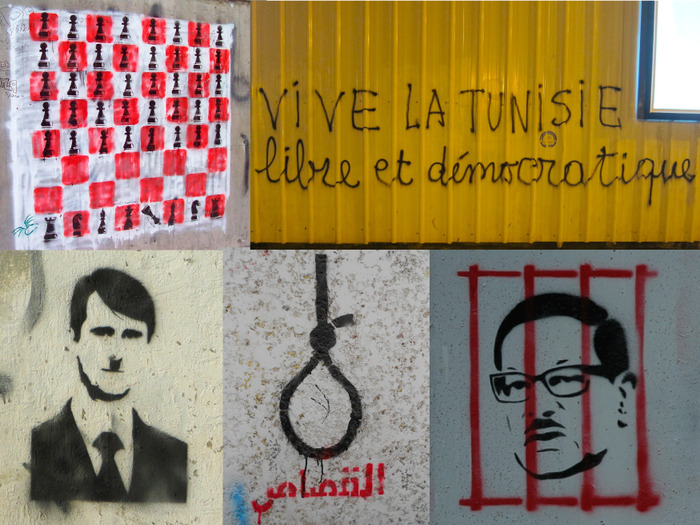
This Is Not Graffiti is a 20-minute short documentary film on the critical role that politically-charged graffiti and street art has played in uprisings and revolutions around the world, particularly the recent popular revolts in the Arab world that began in Tunisia in 2011.
Despite the preferred media narrative that the Arab uprisings were the ‘Facebook Revolution,’ what is often overlooked is the enormous impact that anonymous graffiti and street art played in galvanizing the public (particularly youth) and served as a revolutionary call-to-arms, where the walls became a canvas to speak truth-to-power and proved to be a powerful weapon of resistance.
In fact, the current conflict in Syria began simply with a group of teenage boys who, while watching the events in Libya and Egypt unfold on TV, spray-painted on their school wall the simple phrase “Your Turn Has Come, Doctor” — referring to President Assad, a Western-trained ophthalmologist.
Throughout the Middle East and North Africa, graffiti and street art became the prime communications vehicle for people to vent their anger, express their hopes and dreams, and demand action.
But this phenomenon is hardly new.
Graffiti dates back to walls of prehistoric caves. But its modern use as a political weapon came into plain view in revolutionary pre-war Europe of the mid-1900s, eventually coming into its own during the 1968 French riots where all across Paris, a groundswell of creative street expression came from striking workers and students, who spray-painted walls with poetic and philosophical slogans, speaking to its readers on a much more emotional level.
Since then, revolutionary graffiti and street art can be found all over the world and has played a vital role during times of political transformation and social instability, creating a shared public visual space which symbolically and physically challenges the establishment and the dominant ideologies, and has tremendously influenced the great social and political upheavals of the past century.
THE FILM
This Is Not Graffiti will examine this history and evolution while telling this global story by way of a local one, mixing interviews on the subject here in the New York City area with a week in Cairo talking with those who have made, studied, and been directly impacted by these words and images.
The film will also explore how this effort to demand change from governments has led to other calls, most prominently from women in Egypt — a country that recently ranked last in the Middle East for women’s rights — who have taken to street art to demand change from their own society.
A revolution within a revolution.
Please join me as a backer of Mark’s exciting new project at Kickstarter!
THE PLAN
We are seeking the funds in this Kickstarter campaign to fully produce, finish, and submit the film to festivals around the world by the end of Spring 2014. You join us on the ground floor for this endeavor.
We have been in touch with several of the people who we hope to visit with and interview on-camera, and are ready to begin production as soon as this campaign is successfully funded.
We will interview people in the New York City area in early January 2014, and then fly to Cairo in February during the third anniversary of the Egyptian revolution where we will spend a week shooting.
Editing, scoring, and finishing the film will be completed by April when we will begin an aggressive film festival campaign—domestically and internationally—where we fully expect the film will find a home for the next year or two.
THE FUNDS
Filmmaking is not an inexpensive endeavor and funds for independent documentaries are in short supply. Your donations will allow us to fully fund this film (***there will be no second Kickstarter project to finish this film, we promise!***), permitting us to:
• rent film gear: while we own much of the equipment needed, we will need to rent some lighting accessories, camera gear, and some additional audio components.
• transportation: a week in Cairo, Egypt for our very small crew will account for the vast majority of our travel costs, though there will be several days of production travel locally, as well.
• music: allow us to hire a composer for an original score for the film.
• crew: our very small crew of three will require very modest funds to pay for a cinematographer and sound recordist, and a small fee to direct and produce this project.
• post-production work: while we will handle a large majority of the work for this film ourselves, we will need to outsource some graphic design, audio work, color correction, and film transfers to specialty houses.
• film festival submissions: film festival submissions, even for shorts, run between $35 and $50 a piece, and an aggressive festival campaign will require 75-100 submissions, and the cost for us to attend our theatrical premiere.
• miscellaneous production expenses: production always requires small purchases that add up — from food for the crew and volunteers, to periodic runs to Office Deport or Radio Shack or Home Depot, to unexpected fees for traveling and driving, etc.
• Kickstarter rewards: though we were careful to create great rewards for our donors, we were also cost-conscious in making sure that they accounted for a reasonable portion of the overall budget to create, acquire and ship.
Please join me as a backer of Mark’s exciting new project at Kickstarter!
By Saul Kaplan, on Mon Dec 2, 2013 at 8:30 AM ET One of my biggest pet peeves is setting strategy one tactic at a time. It drives me crazy to be surrounded by people and organizations that think if they just work hard enough and do more things that a strategic direction and destination will emerge. It seems that most of the world works this way. It is terribly inefficient. How many people and organizations do you know that pedal the bicycle like crazy but never seem to arrive anywhere. They just keep pedaling harder hoping that something will eventually stick. It is exhausting watching them. Why not determine a destination and work hard on those things that help you get there. It seems so simple. Setting a strategic direction provides a way to know which tactics are aligned and contribute to reaching the destination. The destination may change along the way requiring different tactics, and that is OK, but not having a destination at all is a ticket to nowhere.
When John F. Kennedy said, “We choose to go to the moon” in 1961, Americans rallied around the destination. We believed it was possible and the goal of setting foot on the moon rallied a country to advance its global science and technology leadership. It was cool to study math and science and clear that innovation was the economic engine that would drive American prosperity. When Neil Armstrong set foot on the moon eight years later and said, “That’s one small step for [a] man, one giant leap for mankind”, we celebrated his achievement as if it was our own and knew at that moment that anything was possible. We have been trying to get that feeling back ever since. Today, we have no clear destination, in space or on earth.
 I am still trying to process President Obama’s plan to cancel NASA’s Constellation program for manned space flight back to the moon. OK, I thought, maybe he has a bolder more imaginative space destination in mind or a better way to get back to the moon. It turns out that the announced strategy identifies no new destination at all and has been called a “flexible path” focusing on enabling technologies. The destination will be determined later. Please say it isn’t so. It is impossible to be inspired with out a destination and it is terribly inefficient to develop enabling technologies with out an end in mind. I am still trying to process President Obama’s plan to cancel NASA’s Constellation program for manned space flight back to the moon. OK, I thought, maybe he has a bolder more imaginative space destination in mind or a better way to get back to the moon. It turns out that the announced strategy identifies no new destination at all and has been called a “flexible path” focusing on enabling technologies. The destination will be determined later. Please say it isn’t so. It is impossible to be inspired with out a destination and it is terribly inefficient to develop enabling technologies with out an end in mind.
My second thought upon hearing the new NASA strategy was that maybe President Obama wants to turn our attention and resources toward earth and create an inspiring space mission like focus on fixing health care, education, or climate change. We have no clear destination for any of these huge system challenges. We continue to play around the margins hoping that incremental changes will launch us toward systemic solutions. It isn’t working. We need to transform each of these systems and it will take “moon landing” like clarity and commitment to make it happen. So maybe the president plans to shift attention and resources away from space exploration toward transformation here on earth. No such luck.
It isn’t as if the NASA budget was cut freeing up resources for other priorities. The proposed budget actually increases NASA’s budget by 2% allocating $6B over 5 years to create a commercial taxi to the space station. The budget comes nowhere close to the $3B a year that the recent expert advisory panel suggested was needed to create a robust manned space program. So we appear to be lost in space and on earth. We will continue to invest in space technologies without a clear destination and we will continue to work around the margins of the important system challenges we face here on earth.
It is enough to make you scream. All I can think of is Ralph Kramden in the Honeymooners getting angry and red in the face, proclaiming, “To the moon, Alice”!
By Julie Rath, on Fri Nov 29, 2013 at 8:30 AM ET 
If you’re still rocking that North Face parka over your suit jacket, it’s time for an upgrade.
Nothing ruins a great look faster than a not-so-great coat. For some reason outerwear often seems to be at the end of peoples’ priority lists, but I can’t stress enough how important it is for your coat or jacket to be up to par with the rest of your outfit. Think about it: you walk into a restaurant to meet a date. Before you take your coat off, she’s already formed an impression of you. The same goes for your office elevator. People tell me all the time that they sneak in to their office building in junk clothes/shoes and change once they’re there, but if you’re riding up in the elevator with people in your office, the damage is done. So, have I convinced you of the merits of a good overcoat yet? Good! Here are my suggestions on how to choose one.
Fit: I see too many people around in oversized, too long overcoats – such a disappointing look! It makes me think of a little kid playing dress-up. Ideally, your overcoat should fit comfortably over a suit but still be slim enough to look stylish with just a shirt and pants. The best, most versatile length for a modern but still classic look is around your knee. It should hit anywhere from mid/low-knee to just above it, depending on how modern you want the look to be (the shorter you go, the younger the look). A good-fitting overcoat should make you look taller, leaner and broader across the shoulders.
Sizing: An overcoat is meant to fit on top of your suit, so when buying off-the-rack, start by going up one size from your suit. Try it on with a suit jacket or blazer and be sure it can close. The sleeves should cover your suit and shirt sleeves.

Buttons – Make sure it buttons to a location on your body that you’re comfortable with. I like this houndstooth check coat above from Balenciaga, but notice how low it buttons on the model’s body. If it’s too low, and you get cold easily, you might want to choose a coat that buttons a little higher. Remember that you’ll likely be wearing a scarf with it on very cold days which will give you additional coverage. What about the number of buttons? Most people will need 3 buttons for a classic single-breasted style, but if you’re very tall (over 6’ 3”), you should get 4.

Style: A single-breasted notch lapel creates a more conservative/traditional look, whereas a double-breasted peak lapel is more dressy, and also warmer due to the fuller coverage and double layer of fabric over your chest. Overcoats also come with a wide choice of different pocket options for you to consider: straight/horizontal, flap/slit, ticket/no ticket, breast pocket/no breast pocket. And make sure to consider whether you want a center vent in back or no vent at all. Don’t get locked in to the first coat you see just because it’s convenient. Look around to find the one that resonates best with you. Perhaps you wouldn’t have considered one with a leather collar like the above from Burberry Prorsum until you saw it in person. There’s a world of options!
 Color/Patterns – The most classic colors are navy, camel and grey (in that order), but you might also consider getting a pattern if you’re into that sort of thing. If you do go for a pattern, make sure to keep the rest of your outfit subtle. I’m anxiously awaiting this brown herrringbone which I ordered custom as a chesterfield (with a velvet collar) for a client. Color/Patterns – The most classic colors are navy, camel and grey (in that order), but you might also consider getting a pattern if you’re into that sort of thing. If you do go for a pattern, make sure to keep the rest of your outfit subtle. I’m anxiously awaiting this brown herrringbone which I ordered custom as a chesterfield (with a velvet collar) for a client.
Fabrics: There’s a huge range, from camel hair, to wool, to cashmere to blends. Do some research on the different weights that you’re choosing from and figure out how warm you need your overcoat to be before taking the plunge. I’ve seen people buy very heavy overcoats that they never wear because they’re just too warm. Know yourself and the climate you’re in (or that you travel to) and factor that in.
Investment: Remember when you purchase a high quality overcoat that it’s a classic piece which should last you at least 10-15 years. This is one place in your wardrobe where it makes sense to invest.
Where to buy: You can either go off-the-rack or custom. For the former, try department stores like Saks, Barney’s and Bloomingdale’s, along with specific brand boutiques like Hugo Boss or Prada. If you live somewhere without access to a lot of stores, you can look online. Websites like Mr. Porter and Suit Supply are good go-to’s. If you decide to go custom, check Yelp and local listings (like nymag.com here in NYC) for highly-rated clothiers or ask well-dressed friends/acquaintances where they go.
_____________________________________________________
Are you shopping for an overcoat this season? I’d love to know what you’re considering! Leave me a comment below.
By Josh Bowen, on Thu Nov 28, 2013 at 8:30 AM ET
Holidays present a nutritional nightmare for everyone, including yours truly. Cakes, egg nog, cookies, alcohol, etc. are served at every dinner party, work gathering and family get-together. You can’t ignore it, it’s the holidays and regardless of religious beliefs high sugar foods will be there. So to combat your holiday cravings, I compiled a list of strategies to help you throughout this holiday season. Here are my top 12 strategies to surviving the holidays and keeping your body in tact.
1. Know what types of foods will be where you are going and what you are going to choose to eat.
2. Don’t go to the table saying “you are going to eat healthy,” Don’t draw attention to it. The host will be mad if you are not sampling the food.
Fill the plate with veggies, fruits and lower fat fare. Start eating these foods first so you are not so hungry. Satiety.
3. Don’t say yes to every basket or cookie someone puts in front of you. Say no to Egg Nog!
4. Do not nibble throughout the day. All those bites add up.
5. If you are not cooking offer to bring a healthy alternative with you. Eat something healthy to fill you up sooner.
6. Have a healthy snack before the meal, that way you are not as hungry when you eat for real
7. Control stress. Stress makes everything worse.
8. Focus on weight maintenance vs. weight loss during the holidays. If you are currently overweight and want to lose weight, this is not the time to do it. Maintenance of your present weight is a big enough challenge during the holiday season. Don’t set yourself up for failure by making unrealistic goals for yourself.
9. Plan on NOT dieting after the New Year. Anticipation of food restriction sets you up for binge-type eating over the holidays (“after all, if I’m never going let myself eat this again after Jan. 1st, I might as well eat as much as possible now!”) Besides, restrictive diets don’t work in the long run. They increase your loss of lean body mass vs. fat, slow down your metabolism, increase anxiety, depression, food preoccupation, and binge eating, and make weight re-gain more likely.
10. Be physically active every day. Often, students’ busy holiday schedules (or lack of structured schedules) bump them off their exercise routines. Physical activity, especially aerobic activities (like brisk walking, jogging, bicycling, roller blading, and swimming) can help relieve stress, regulate appetite, and burn up extra calories from holiday eating.
11. Choose your beverages wisely. Alcohol is high in calories. Liquors, sweet wines and sweet mixed drinks contain 150-450 calories per glass. By contrast, water and diet sodas are calorie-free. If you choose to drink, select light wines and beers, and use non-alcoholic mixers such as water and diet soda. Limit your intake to 1 or 2 alcoholic drinks per occasion. And, watch out for calories in soda, fruit punch, and egg nog as well.
12. Enjoy good friends and family. Although food can be a big part of the season, it doesn’t have to be the focus. Holidays are a time to reunite with good friends and family, to share laughter and cheer, to celebrate and to give thanks. Focus more on these other holiday pleasures, in addition to the tastes of holiday foods. The important thing to remember is balance and moderation. It’s OK to eat too much once in a while. Just relax, enjoy the holidays, and remember what the season is all about.
Maintain perspective: Overeating one day won’t make or break your eating plan. And it certainly won’t make you gain weight! It takes days and days of overeating to gain weight. If you over-indulge at a holiday meal, put it behind you. Return to your usual eating plan the next day without guilt or despair.
By Lauren Mayer, on Wed Nov 27, 2013 at 8:30 AM ET Politics and show business make interesting but strange bedfellows – and one could say that’s both a metaphor and a literal statement (Jerry Brown & Linda Ronstadt, anyone?) For starters, there is substantial cross-over betwee the two fields – elections often seem more about show-biz glitz than issues, while actors complain about the ‘politics’ of casting. Plus celebrities frequently endorse candidates, who in turn may solicit those endorsements, or quote from plays and songs (or in the case of Herman Cain, lyrics from a Pokemon movie).
My career has been a hybrid of both, starting when I was a child trying to decide if my goal was to be a concert classical pianist or the first female president. (Yeah, I was an unambitious kid.) I wavered between going to law school or becoming a starving artist, and while I settled on the latter, I never lost my interest in politics. So it’s been great fun to combine both issues in these weekly videos, which has let me weigh in on current issues without having to mount a campaign. (I opted out of politics because of my thin skin and propensity to burst into tears at everything from Kodak commercials to being put on hold, not because of any skeletons in my closet – I have an embarrassingly unembarrasing past!)
But every now and then, a politician comes along whose entire career seems too theatrical to take seriously – sort of like the presidential campaigns of either Pat Paulsen (if you’re old enough to remember him) or Stephen Colbert (for everyone else). And we’ve had some doozies in this country – I’ve particularly enjoyed the hypocrites like Larry Craig, with his ‘I wasn’t playing footsie in an airport bathroom, I just have a really wide stance,’ or anti-gay activist George Rekers with his ‘rent-a-boy’ travel companion. However, nothing compares to Toronto’s Rob Ford – from denying he smoked crack to claiming he didn’t lie because reporters didn’t ask the right questions, to insisting that if bike riders get killed by cars, it’s their fault. In fact, more than a few people have wondered if his antics are just a giant performance art piece. – and I’m sure Anthony Weiner is wishing he’d run for mayor in Toronto, where his measly texted crotch shots would be child’s play. Meanwhile, Ford is defiantly staying in the public eye, despite being stripped of most of his authority and despite the additional allegations that come forward daily (from arrests for domestic violence to the checkered records of his driver and gym trainer). (And yes, “Rob Ford’s Gym Trainer” does seem like an incredible oxymoron.)
Rob Ford is larger than life, both literally and figuratively, and someone really should write a song about him. So I did.
By Josh Bowen, on Tue Nov 26, 2013 at 1:30 PM ET
By Liz Roach, on Tue Nov 26, 2013 at 10:00 AM ET “It seemed I was a mite of sediment / That waited for the bottle to ferment / So I could catch a bubble in ascent.”
 As Thanksgiving trots its way closer, many of us identify with the cheerful sentiment that Robert Frost describes in his poem, “In a Glass of Cider.” As Thanksgiving trots its way closer, many of us identify with the cheerful sentiment that Robert Frost describes in his poem, “In a Glass of Cider.”
Especially if you are lucky enough to be sipping one of the many high-quality hard ciders that are available now. From Virginia to New York to Washington state, producers across the U.S. offer many exceptional varieties.
This time of year, food columnists and wine experts argue like family over which of this or that wine may pair best with the myriad (and sometimes mystifying) dishes of Thanksgiving. Zinfandel? Pinot Noir? Dry Riesling? This year, I’m recommending a hard cider. It’s crisp, it’s refreshing, and it’s a traditional American beverage. The Pilgrims are said to have drank it, and it may pair surprisingly well with your Aunt Lulu’s green bean casserole and Cousin Alvin’s cornbread stuffing. As a bonus for your allergy-challenged relatives, it is gluten-free.
Thanksgiving pairings are all about accenting the feast of plenty while not distracting from it. Today’s ciders use an assortment of apples, including Pippins and Kingston Black, among many others. Most cider producers make several renditions, from dry to sweet. For meal pairing purposes, a drier version would work best. But if you’re looking for an aperitif or dessert drink to pair with the pumpkin bread pudding and pecan pie, go for a sweet or sparkling apple cider. You may just create a new ritual.
 While you indulge, be sure to toast and treasure those nearest and dearest to you, whether friends, relatives, or tablemates for a day. As Frost concluded his poem, “The thing was to get now and then elated.” There’s no better time to celebrate than while surrounded by loved ones and before a heaving table of fixings and fine draughts. While you indulge, be sure to toast and treasure those nearest and dearest to you, whether friends, relatives, or tablemates for a day. As Frost concluded his poem, “The thing was to get now and then elated.” There’s no better time to celebrate than while surrounded by loved ones and before a heaving table of fixings and fine draughts.
Although excellent cider options abound, here are a few suggestions
Potter’s Craft Cider (Charlottesville, VA) This young label produces two lively types of cider: the Farmhouse Dry and the Oak Barrel Reserve, which is aged in apple brandy oak casks.
Foggy Ridge Cider (Dugspur, Virginia) Try renowned cidermaker Diane Flynt’s First Fruit and Serious Cider to go with the main course, or the harder-to-find Foggy Ridge Handmade for dessert.
Original Sin Hard Cider (New York) In addition to the traditional apple hard cider, there are flavors such as Pear, Elderberry, and Heirloom Cherry Tree, which is made from heirloom apples and tart cherries.
Alpenfire Cider (Port Townsend, WA) Of the many wonderful choices from this organic producer, you may want to sample Smoke, which is triple fermented in whiskey and mead barrels, and benefits victims of the 2013 wildfires.
|
|


 The answers to any of those questions can and will vary considerably. Everyone starts or continues and fitness program for different reasons. The importance to find the why behind the what.