By Jason Atkinson, on Mon Oct 22, 2012 at 11:00 AM ET
We only have 24 Hours to go. If you want to donate, now is the time. Click here
I want to thank everyone, all 82 of your so far, who’ve believed in me, this idea, and this film.
I told Jeff Martin, the Producer, imagine 82 people from across the globe, standing together in one room, cheering us on.
For me, this is unfulfilled. Making this film, changing hearts and minds through the human side of this river’s recovery, is something I just have to do.
With a little more than two weeks until Election Day, GOP Senate candidate Todd Akin’s Saturday fundraiser was highlighted by a questionable analogy.
Two months after his “legitimate rape” comments sparked a firestorm of criticism, PoliticMo captured audio of Akin in Springfield, Mo., comparing Democratic incumbent Sen. Claire McCaskill’s work in office to that of a dog.
“She goes to Washington, D.C., it’s a little bit like one of those dogs, you know ‘fetch,’” Akin said. “She goes to Washington, D.C., and get all of these taxes and red tape and bureaucracy and executive orders and agencies and she brings all of this stuff and dumps it on us in Missouri.”
“It seems to me that she’s got it just backwards,” Akin added. “What we should be doing is taking the common sense that we see in Missouri and taking that to Washington, D.C., blessing them with some solutions instead of more problems.”
By John Y. Brown III, on Fri Oct 19, 2012 at 12:00 PM ET
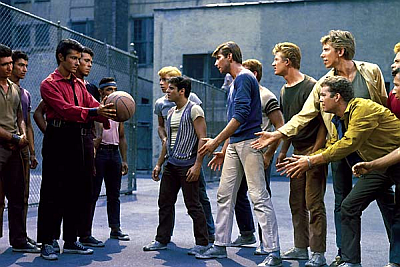
Street ball showdown!
East End Style.
It’s the sports equivalent of a gang fight. Two factions face off like the Bloods and the Crips—but instead of using automatic weapons they settle their differences on the basketball court. Sure it’s a little more civilized way of settling differences—but only a little. It’s still brutal, raw and puts everything on the line in a no-holds-barred free-for-all, where only one side emerges as a winner. Sometimes it’s in teams; sometimes a single player is selected by his “gang” to “represent” the entire gang in a game of one-on-one. It was the latter game that I found myself in the crosshairs of as my gang’s point person on a chilly, overcast morning back in the fall of 1971.
Some people say that high stakes gangland throw downs like this only happen in the inner-city, in the proverbial “West End.” Most the time that’s true. But not this time. The setting was the extreme East End at St Francis in the Fields elementary school, where I had just transferred for third grade and today was the first day of school. It was good to see my peeps again. I had been gone for a year—on hiatus. I had spent second grade at Sunnyland. No, that’s not what they called Juvee back then. It was a small private elementary school in Ft Lauderdale, FL where my family had moved the year before on business and I went with them. But my compadres at St Francis weren’t sure what had happened to me. Only that I had gone away for a while. And now I was back. And that’s all they needed to know.
The tension between third and fourth graders at St Francis in the Fields was palpable that first day of school—spilling over from last year’s unresolved tension between second and third graders, stemming mostly from tether ball disagreements.
Like the Hatfield’s and McCoy’s famous feud, no one could remember the details. Only that a rivalry had developed that wasn’t going away until it was settled. And today was the day. And this was the place. The third grade boys were feeling especially emboldened this day with me back. I was known in second and third grade circles in those parts as a fairly accomplished basketball player.
It soon became apparent to me that I was their ringer—and would represent my entire gang, or grade, as we settled our differences Old School. On the basketball court at recess after second period. The fourth grader’s choice of leader was not a choice at all. It was a forgone conclusion that no one dare question. His name was Allen Lavin. Allen was tall, athletic and handsome—and already good with the ladies (not afraid of cooties. In fact, fearless around the threat of cootie exposure.) I remembered him from a year earlier. I could easily picture him in my 8 year old East End mind one day playing in the NBA. I could imagine him dominating both on the court and then off the court wearing a full length mink coat while holding forth at the after party. He just had that charisma and cockiness of a natural leader who couldn’t fathom ever losing.
Allen Lavin was from a well-heeled horse breeding family in Oldham County. But don’t be fooled by his pedigree. Lavin was all about street ball—first and last—and everyone in the lower school knew he alone owned the basketball court when it was time for recess.
And then there was me. I was a bit of an enigma. A quiet but determined scrappy kid. Short but fast and with a bit of a chip on my shoulder that made me feel I had to prove something. I was the guy that could surprise you. And others felt it. I wasn’t like the Lavins. My family wasn’t part of the Establishment. We were more nouveau riche. Sure we could afford the private school tuition, but as they say on the East End streets, “We hadn’t gotten in country club yet.” And there were external signs of class differences too. I didn’t wear a belt. It wasn’t that we couldn’t afford belts…but rather I didn’t wear them because I had a mild sensory disorder that made some clothing articles, like belts, feel very uncomfortable to me. And then there was the other reason I kept to myself. I felt not wearing a belt gave me an advantage at sports. I wasn’t limited in my range or movement by a belt. There were aerodynamic reasons I chose not to wear a belt. And it made me lighter. And I knew I would need every advantage going up against Allen Lavin.
Read the rest of… John Y’s Musings from the Middle: Street Ball Showdown!
ICYMI, yesterday afternoon, The RP was the special guest on MSNBC’s hot new afternoon talk show, The Cycle, co-hosted by The RP’s friend — and contributing recovering politician — Krystal Ball.
After Krystal kindly promoted a certain spectacular year-and-a-half-old Web site, The RP gave a spirited defense of No Labels, the grassroots movement he co-founded that now involves more than 500,000 Americans in efforts to promote bi-partisan problem-solving as a means to fix our broken political system.
If you haven’t had the chance, please be sure to check out the No Labels Web site, and if you support their mission, sign on to the important cause.
We believe in Freedom and Equal Opportunity. We are optimists. We are idealists, not ideologues. We believe in American ingenuity.
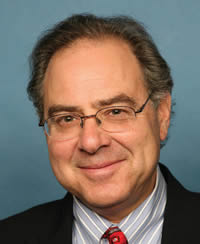
As this election season draws towards its conclusion, Democrats need to talk about our beliefs, our moral values, and what and who we care about.
At our recent Democratic National Convention, Democrats delivered moving messages based on moral values. The diversity of the speakers and participants emphasized over and over: “We’re all in this together.” The stories on-stage supported “We care about each other.” The economic theme emphasized “middle class expansion, not top down” and was based on the moral value, “equal opportunity.” The Convention was purposely short on policy, and long on visual images complete with verbal cues that emotionally touched the American people.
We, Democrats, in our hearts understand that no one makes it on his own without help from all of us. The stories around health care, women’s rights, sexual preference, discrimination — all spoke to our belief in the core values of Freedom and Equal opportunity: freedom from insurance company abuse, freedom from government intrusion into personal lives, freedom and equal opportunity to love and be loved.
Democrats love policy. We believe that if we simply explain issues, folks will understand. What we need now is to inspire people. What President Obama did when he made that historic run for President – stir the heart and soul of people who fundamentally believe in freedom, opportunity, ingenuity and optimism.
Here at the Economic Innovation Action Fund, we believe that a progressive economic agenda of growth and innovation and public-private partnerships is based on moral values. Education, Innovation and Infrastructure are not just policies. They are the foundation for the rebirth of our Democratic Party:
We believe in a better, more secure economic future;
We believe that every child should have an equal opportunity for a decent education;
Read the rest of… Paul Hodes: A Message About the Democratic Narrative
By John Y. Brown III, on Thu Oct 18, 2012 at 12:00 PM ET
The day (night really) that my life changed.
Not because of something I did. But because of something harmful I stopped doing.
We never know what the markers in our life will look like. The last time we pass a certain street, see a certain friend, embrace a loved one. We only find out afterwards and try to make sense of it after the fact.
Which is what happened to me on this night exactly 27 years ago. In fact, it was October 18th at around 2:30 am.
I had moved back home with my mother and was a listless, beleaguered and bewildered soul. I thought a string of bad luck I had recently endured had led me to drink excessively.
Turns out, I had the string of bad luck because I was drinking excessively.
I was up late alone watching the movie Reuben, Reuben –again. A movie about a rumpled, drunken curly haired poet who had traded whatever talent he once had to sponge off others he was happy to take advantage of—and time was running out for him. I suspect at the time I believed I related to something noble in his character–some potential he had but was throwing away. In retrospect, I related to the excessive drinking and manipulation of others–and mostly frittering away a life that could much more. In the final scene (after the one below), Reuben attempts suicide and before he can change his mind, accidentally dies.
That night 27 years ago after the movie ended, I walked the last bottles of booze out to the condo’s garbage chute and ceremoniously dropped them down one by one. And walked back inside.
And I have not had a drink of alcohol since.
It was perhaps my most important life turning point. I have never seen the movie since, but every October 18th I think of it. And thank God the end of that movie also ended a misguided and unfortunate period in my life. And that I have since—as a result of leaving booze out of my life—led a life that has given me the “much more” I sensed I was losing.
Why do I mention this?
I don’t say it to boast. Removing behavior that harms yourself and your loved ones, is not praiseworthy as much as common sense –and the least you’d expect of yourself. I suppose I share this because I know there are others out there tonight who feel alienated, lost, and confused and who may even be romanticizing destructive behavior by drinking to escape it all.
To them I hope to say, There is nothing heroic or romantic about wasting your life and hurting others.
And if you don’t agree, I believe you are confusing desperation for depth and self-absorption for self-reliance. And foolhardiness for uniqueness. And you are probably going to be the last person in the room to realize this. And that’s OK. You are, like me, about average.
And that’s a good thing. Because help is available. More help than ever in history.
And all you have to do to access it is to set aside the brilliant future you falsely imagine for yourself long enough to notice the unbearable reality of your present circumstances—and then pick up the phone and dial directory assistance on the telephone (411).
And then don’t hang up until you ask for the help you need.
And then breathe a sigh of relief that the awful movie of your current life is about to end. And a new story about your real future is about to begin.
And the new story of your life will still star you –not as an actor playing some imaginary part you thought you were supposed to but performed badly. Rather, it will be you simply playing yourself. A much more natural role that will introduce you to yourself. And allow those same people in the room to finally get to be around the person they’ve been waiting for. And here’s the best part. Eventually, you’ll come to like this person, too
The new movie could be about how to appreciate the poetry of a life lived by humbly following our better instincts –rather than merely rhyming words in the intoxicated hope of sounding clever. Or just about anything we want it to be.
I hope you don’t miss out on it. I’m grateful every day—but especially on this day every year–that I am not missing out on mine.
By Artur Davis, on Thu Oct 18, 2012 at 10:00 AM ET
In a recent speech to the Accuracy in Media conference, “ObamaNation: A Day of Truth,” contributing RP Artur Davis had high praise for former President Ronald Reagan, saying that “Reagan took liberty and freedom, which are very imaginative concepts, and he gave them a power they had never had before.”
Speaking of the media, Davis said, “They don’t matter as much as they used to matter. That’s just the reality. Think about it: The New York Times—their own ombudsman says that their liberalism permeates their newsroom. Their own ombudsman says that they treat the liberal agenda as a cause to be nurtured instead of something to be inspected or analyzed. Their own ombudsman said that.”
You can watch his full speech below, or read the transcript here:
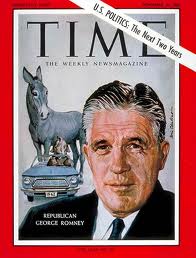
Krystal Ball advises that you check out this week’s piece from Buzz Feed Politics, “Making Mitt: The Myth Of George Romney.” Here’s an excerpt.
Everyone agrees: Mitt Romney is not like his father.
The late Michigan governor and 1968 presidential candidate George Romney is remembered as a principled man of spontaneity and candor. His example is regularly invoked by both admirers of his son’s disciplined campaign style and critics of Mitt’s back-and-forth pandering. George, it is said, told the truth about the Vietnam War before it was popular to do so, with an unfortunately worded comment about “brainwashing” by U.S. government officials that cost him the 1968 Republican presidential nomination. “Mitt learned at an impressionable age that in politics, authenticity kills,” historian Rick Perlstein wrote in Rolling Stone earlier this year. “Heeding the lesson of his father’s fall, he became a virtual parody of an inauthentic politician.”
This rejection of his father’s example, the thinking goes, is what has made Mitt a more successful presidential candidate — self-controlled but hard to pin down, flipping from moderate to conservative to moderate once again. It is observed that Mitt would never draw a line in the sand like his father did in 1964, when George dramatically “charged out of the 1964 Republican National Convention over the party’s foot-dragging on civil rights,” as the Boston Globe’s authoritative biography, “The Real Romney,” put it earlier this year. Outlets from the New York Times to the New Republic have recalled this story of the elder Romney’s stand against Goldwater’s hard-line conservatives. Frontline’s documentary “The Choice 2012” reported it as a formative event: “when Goldwater received the nomination, Mitt saw his father angrily storm out.” A Google search for the incident produces hundreds of pages of results. In August, Washington Postcolumnist E.J. Dionne cited the episode to write that Mitt “has seemed more a politician who would do whatever it took to close a deal than a leader driven by conviction and commitment. This is a problem George Romney never had.”
Only George Romney did not walk out of the 1964 Republican National Convention. He stayed until the very end, formally seconding Goldwater’s eventual nomination and later standing by while an actual walkout took place. He left the convention holding open the possibility of endorsing Goldwater and then, after a unity summit in Hershey, Pennsylvania, momentarily endorsed the Arizona senator. Then he changed his mind while his top aides polled “all-white and race-conscious” Michigan communities for a “secret” white backlash vote against LBJ’s civil rights advances — a backlash that might have made a Goldwater endorsement palatable at home. Finding the Republican label even more unpopular than civil rights in Michigan, Romney ultimately distanced himself from the entire party, including his own moderate Republican allies.
Exactly where the 1964 myth entered the public consciousness is difficult to pinpoint, but it has been promoted by Mitt, who made one of its earliest print mentions in an interview during his 1994 U.S. Senate campaign. (Romney’s longtime spokesman Eric Fehrnstrom did not respond to an inquiry about Mitt’s recollection of the incident.) “[My father] walked out of the Republican National Convention in 1964, when Barry Goldwater said, ‘Extremism in the defense of liberty is no vice,'” he told Bay Windows, a LGBT interest magazine in Boston.
By John Y. Brown III, on Wed Oct 17, 2012 at 12:00 PM ET
“And just like that….”
That’s how Forrest Gump explains life’s sequences. How we begin something seemingly randomly and it leads to the next thing and that leads on to the next thing. Until a whole chunk of our life is played out and seems not only to make sense to others— but seems perfectly planned out all along.
Except it really isn’t.
Or is it?
I don’t know. But I think Forrest perfectly embodies the beautiful simplicity of living life by a pure and inspired intuition. And if done well—as Forrest does so effortlessly—trying to figure out what the ultimate plan may be seems beside the point. Like an absurd distraction.
“And just like that…” is how, I think, we should endeavor to live our own lives. And let the plan take care of itself.
I think that may be the most important message in this profoundly simple (or simply profound) movie.
As our regular RP Nation readers know, contributing recovering politician and former Missouri State Senator Jeff Smith spent a year in a federal prison due to circumstances relating around a campaign finance violation. His pieces about his political rise and fall, and his observations about sex in prison have been this site’s most popular reads — by far.
A few months ago, he gave some helpful advice to former Governor Rod Blagojevitch upon the beginning of his prison term.
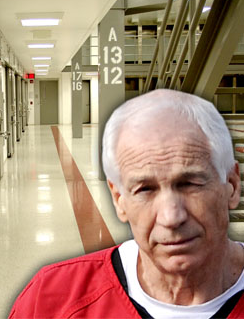
Today, he answers the question on the minds of many Americans: What can the nation’s most infamous pedophile — former Penn State assistant football coach Jerry Sandusky — expect during his life term in prison. It is certainly not what the mainstream media has reported:
Last week, the Washington Postran an AP story about what ex-Penn State coach Jerry Sandusky can expect in prison.
I’m not sure if they ran such an airbrushed version out of naivete or because it’s a family newspaper. But in case anyone is curious, let me see if I can shed a bit more light.
If prison were India, there would be two classes of untouchables: snitches and pedophiles. Child molesters try desperately to blend into the population. However, the most famous pedophile in the nation right now is going to have a hard time blending in.
1) According to the Post, Sandusky “will be able to watch college football, including Penn State, when the games are broadcast on ESPN or another major network.”
If the television set in the common area is tuned to the Penn St. game, then Sandusky just might be able to watch it. But if it’s not, and Sandusky – or any other newbie – walks up to try to change the channel, the result will not be pretty.
2) The Post notes that cards, dominoes, and board games. are popular prison activities in which Sandusky could participate.
No one will want to be seen playing cards with Jerry Sandusky. From the minute Sandusky walks onto the compound, he will be targeted, and anyone who voluntarily and publicly associates with him will immediately be suspect.
3) The Post writes that Pennsylvania prison cells are designed for two people, but it’s possible he could end up in his own cell or in a small dormitory.
It’s not just “possible,” it’s overwhelmingly likely. Given the fact that he will be in danger from the moment he arrives, I imagine that he’ll start out in isolation until emotions surrounding the case cool. If not, anyone Sandusky is placed with would have to fight Sandusky in order to preserve his own reputation, which would lead to the removal of one (or both) from the cell. The problem would likely continue for as long as Sandusky is placed in the general population.
4) According to the Post, Sandusky could be swapped in for an inmate in another state.
It’s possible, but it probably wouldn’t change anything for him: his face was ubiquitous around the country, not just in Pennsylvania.
5) Inmates, noted the Post, generally spend an hour in the yard, which might entail playing softball, though the bat has to be tethered and secured to the backstop.
The bat being tethered to the backstop would not prevent it from being used on anyone standing (or dragged to a location) near the backstop.
Read the rest of… Jeff Smith: What Sandusky Can Expect in Prison — And What the Washington Post Doesn’t Understand



 ICYMI, yesterday afternoon, The RP was the special guest on MSNBC’s hot new afternoon talk show, The Cycle, co-hosted by The RP’s friend — and contributing recovering politician — Krystal Ball.