By John Y. Brown III, on Fri Dec 21, 2012 at 9:15 AM ET
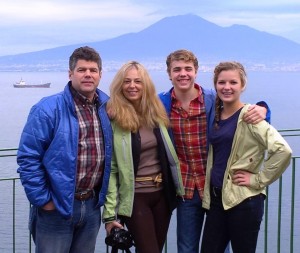
Well, the trip is about over now. The trip of a lifetime, for sure, for my family.
We’d never before been on a cruise or to the Mediterranean. And had the great good fortune of doing both. For that I am grateful.
And, as with all family vacations, the best is yet to come. It’s my experience that the memory of the vacation always exceeds the experience of it. Not sure why it works that way, but it does. For us anyway.
We saw a lot and learned a little and may be inspired to learn a lot more as a result of our travels.
It’s a great big world out there. Stunning in it’s breadth and diversity. And yet no matter where you go, people are just people–far more alike than different. Just making do with different circumstances.
For our trip of a lifetime we touched Italy, Greece, and Turkey.
I hope—if I can distill my thoughts of this trip to a single hope–that we learned an appreciation of the roots of all Western culture in Greece. In Turkey, I hope we recall the roots of all human history–from the Biblical to the political– and that the deep divide at present between Westerners and Muslims seems harder to understand when interacting face to face with one another. And finally, from Italy—oh, Italy–I hope we learned just a little bit about how to live and love with greater passion. That’s Amore!
And, of course, perhaps our greatest blessing: Returning to a place that we have the extraordinary privilege of calling home! The good ole U.S. of A. With a new term learned along the way that describes both where we have been– and where we are going.
By John Y. Brown III, on Wed Dec 19, 2012 at 12:00 PM ET
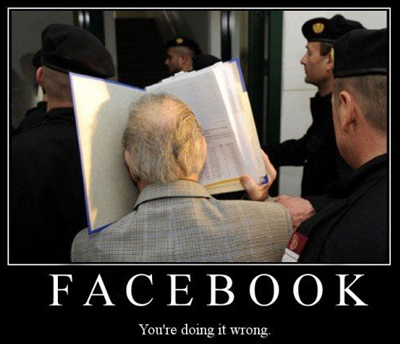
Why Facebook won’t ever save your life.
Today I was working from my car (something I do often) and both phones were out of charge and and I had left my charging cable at home.
I mean….the whole point of having a back-up phone is in case the primary phone runs out of power but it was drained too. Having a back up phone is especially critical if your primary phone is an iPhone (which holds a charge about as long as you can drive on a spare tire) And note, iPhones are terrible back-up phones to another iPhone. It’s like replacing your spare tire with another spare tire.
But here’s how I realized Facebook isn’t a great vehicle for a blast text message screaming out for help. Of course, I didn’t need to scream out for help. But I did have a few minutes left on my laptop which was connected to wifi. And it made me wonder what would happen if I did post in big bold letters on Facebook, “Help Me!!”
And I realized instantly what would happen if I was being beaten and kidnapped moments before posting my desperate plea for help….assuming I survived to check my Facebook page the next day.
I would have received maybe 25 “Likes” and had about 10 comments along the line of “Hilarious!,” “No, not him. I need help! LOL,” “You should use a red octagon sign,” “OMG, that happened to me once and all I got were “likes.” Good luck!” And maybe a few “shares.”
But, then again, if something like that ever did happen, it would make a really funny Facebook post.
By John Y. Brown III, on Wed Dec 19, 2012 at 10:00 AM ET
What if the most remarkable country in the world that has been negatively and unfairly defined by a single movie?
If you answered “Turkey” and “Midnight Express,” I’d say you and I agree.
In Ephesus today.
Here I momentarily forget what I’m thinking about and inadvertently find myself captivated by the tour guide’s explanation of the city’s history.
It happened many times today.
====
Kickin’ it with my girl, Ottoman style! ; )
One of the greatest sins we can commit is to have a chance to get to know extraordinary people.
And then not take advantage of it.
And you never know when the opportunity will present itself. So always be ready to talk. Even when your not sure.
This pic of a cat siting on a column led to some chuckles from my wife and daughter but then a nice lady with a very professional looking camera decided to take the same shot. I nudged my wife and daughter and said, “Told ya it was a good photo to take.”
The woman with the professional camera overheard us and, along with her husband, laughed. And that’s all I needed. Over the next 20 minutes I learned that Matt worked as a VC for 6 years before he and his wife, Erica, dropped out and became professional world travelers 2 years earlier. They’ve visited and written about 30 countries, mostly about economic development but also offering a sort of personal Trip Adviser take on each destination. (Think of Albert Brooks’ Lost in America —but working out. And going international.)
Next year Matt hopes to find himself in Standord’s MBA program. And deserves to be there.
And if that still isn’t enough to pique your curiosity, their website is titled “What if” with the tag line, “Living to never wonder, What if”
Extraordinary young people I have a feeling I’ll see again and already have suggested they write for a blog and would love to help these two any way I can.
And I never even took the time to go back and thank the cat for awkwardly sitting on that column and giving me an excuse to meet to fine young Americans–Living the American Dream. (without a sarcastic overtone)
====
Oh no you didn’t!
You didn’t really dismiss the idea of an American ever beating you in backgammon, before I did!
“Here, we play very fast.”
“In Kentucky, we just beat you. Whether you get beat playing in fast motion or slow motion is completely up to you.”
I wanted to say but didn’t. Instead, I said, “Oh, OK. Sure. Maybe we can play sometime.” ; )
Me with our world class tour guy and all round great guy….getting a free backgammon lesson from his KY friend.
“Many people think backgammon came from Persia. Actually, it came from Appalachia.” Something else I wanted to say but didn’t have the courage. ; )
====
Theology and social media? No!!
My deep insight of the day offered to our tour group.
In Ephesus our tour guide was explaining the “Letters” written from the area by Saul of Taursus and John and St John –and how these letters later became entire books of the Bible.
“Sir,” I offered, “Can you imagine what the Bible would look like if they’d had email back then and communicated informally via email, texts and Twitter? It would be a third of the length and filled with ridiculous acronyms and smiley faces and even a few LOLs!”
I’m pretty sure no one had ever made that point to him before and was pretty proud of my theological insight. ; )
LOL!
Read the rest of… John Y. Brown, III: An American in Turkey
Steven Spielberg delayed the release of his movie on Abraham Lincoln to avoid the charge of hagiography, not of the sixteenth president, but of Barack Obama. It was Spielberg’s intuition that there were enough aspects of the film that were susceptible to being twisted to partisan ends—from its similarity to the Democrats’ narrative of a progressive president fighting off a revanchist congressional opposition, to the Obama Administration’s early infatuation with Doris Kearns Goodwin’s Team of Rivals, which is credited as the primary source for the picture, to the linkage between the first American president to align himself with racial equality and the first president whose bloodlines crystallize that equality—to keep its premiere out of the election season.
So, “Lincoln” avoided becoming a bumper sticker in the final days of the last election. It has not managed to side-step a whole slew of efforts by commentators to make it an instructive template for political leadership: David Thomson’s assessment in the New Republic that the guiding principle of the film is the need for leaders “who can stoop to getting the job done” is mimicked by David Brooks’ assertion that the film elevates politics by showing the noble purposes to which ordinary political maneuvering can be deployed. Ross Douthat captures the argument that ”Lincoln” is a tribute to the revolutionary ends that can be achieved when moderates and ideologues align and temper each other.
I will venture a theory that while not one of these observations is wrong on the merits, that they all suffer from reading “Lincoln” through a certain wishful lens: in this light, Spielberg’s version (and Tony Kushner’s screenplay) of Abraham Lincoln is a model of what Barack Obama might develop into if he added more grit to the polish and the cool; or more broadly, this fictional president is an imagining of what any successful chief executive in the future might look like—savvy enough to coopt the hard-liners, tactical enough to accomplish heroic ends through hard-nosed means. In other words, these pundits see a high-minded primer on how a capable president might win friends and influence people: a home-spun, American Machiavelli.
But reading “Lincoln” as an instruction manual ignores the degree to which this film is almost subversively hostile to two of the favorite values of contemporary politics: authenticity and transparency. The blunt truth of this portrait of Lincoln’s presidency is a democratic reality that if it materialized tomorrow, we would find depressing and hardly idealistic. It is a closed universe of insiders who operated free of consistent public scrutiny, or ethics regulations, or even a softer code that words and deeds should be tightly connected to be credible. There is a void of disclosure and standards that is not remotely capable of being replicated today, and that we wouldn’t want to conjure up if we could. The point is not to treat Lincoln is anything other than great, but that his greatness operated in a zone not remotely like our own.
It is not just that Lincoln is “wily and devious”, in Thomson’s description in TNR, or that he takes “morally hazardous action”, in Brooks’ rendition, it is that the times he lived in extracted no particular price for such shiftiness. So, Lincoln saves the 13th Amendment at a critical stage by deploying a word game to fend off the news that a set of Confederate negotiators are offering a peace deal that might end the war without emancipation. The negotiators are not in Washington, Lincoln allows, despite rumors to the contrary and aren’t set to be there: the more complete truth is that they are holed up on the Virginia coastline, waiting for a presidential visit. The deceit is not a small one, and the movie to its credit captures both its importance and dishonesty: by bending the actual time line just a bit to make Lincoln’s dodging the decisive blow to enshrine freedom in the Constitution, Spielberg and Kushner are taking aim at our squeamishness over candor.
And it is not just the white lie over a southern peace offering. Another central point in the picture is the urgency of separating constitutional emancipation from a broader campaign to extend larger citizenship rights on blacks. In Spielberg’s mostly accurate telling, Lincoln’s rival for control of the House Republican caucus, Thaddeus Stevens (Tommy Lee Jones), equivocates at a key moment in the debate on the full implications of the amendment, and the film is complimentary of Stevens’ waffling, which is the exact rhetorical approach Lincoln himself brandished as a senate and presidential candidate and as the author of the Emancipation Proclamation. That it proved to be the shrewdest course in Lincoln’s day is hard to argue; what is impossible to argue is how aggressively such an evasion would be exploited in our climate (and how zealously we would argue for the dissembling to be unmasked if we were on the losing side).
Read the rest of… Artur Davis: Lincoln’s Lost World
By Jonathan Miller, on Tue Dec 18, 2012 at 1:30 PM ET
#TEAMJYB3:
Phat Americans.
The Anti-Immigration Movement in the US may have an unsuspecting ally.
The article I just read (click here) now shows obesity is a greater food problem than hunger. That’s a big story. But not nearly as big as the “story behind the story” –that I suspect may be true.
Americans gaining weight is nothing new. Buy why are we gaining weight so consistently and deliberately? I think it is because you can’t argue with the fact that obese Americans simply take up more space than if they were thin. And then there is the other seemingly unrelated issue: That being an American and “vocally anti-immigration” is uncomfortable at best and somewhat hypocritical at worst.
The first time I realized I had mixed feelings about immigration and found myself agreeing with Lou Dobbs, I weighed 165 pounds. That was 27 pounds ago.
I still haven’t articulated any of my concerns. But i have taken concrete anti-immigration in other ways. Making sure I physically take up more space as an American—space that could easily be filled by a very skinny illegal immigrant. At first it was only subconscious…but the harder I find it to lose weight, the more it got me to thinking about my real motive for over eating since watching that fateful Lou Dobbs interview several years ago.
It just all makes so much sense now.
Even as a young child when the ice cream truck came by I would more likely order a Red, White and Blue “Bomber” popsicle while the other kids would order “Push ups.”
America’s problem with gaining weight began at about the same time there was an increasing concern that we were pushing the immigration limits in the US.
Americans who are selflessly carrying extra-weight must have been doing so—at least in part—as a subconsciously patriotic act to make sure our country stay’s “right-sized”– for our children and our children’s children.
Sure, there is an element of passive-aggressiveness and nativism —and maybe some unflattering stereotyping of “outsiders” (and in a few isolated instances even outright prejudice) we portly patriots are guilty of. But let’s not lose sight of the fact that the only real prejudice we have is being a little too “Pro-American” for our own health.
So, next time you see one of us out and are tempted to roll your eyes at our lack of discipline —ask yourself, “What did I do today to curb rampant immigration in my country today?” It may just give you pause and remind you of the greater goal behind those who don’t believe it’s wrong to be more concerned for their country than their waistline.
And remind you, too, that the enthusiastic gleam you see in our eye– that you assume is our misplaced excitement about our next dessert order— may have more to do our determination to keep one more illegal alien from crossing the border because even though our ideals will always be compelling to others, the practical matter of available space is being decided not “one politician at a time” but “one Hot Pocket at a time. And by those who have courageously taken our “can’t say no” attitude and decided to use if for a higher nationalistic calling.
20 years ago American had about 200 Million Americans. We new our absolute maximum would be about 400 Million Americans. Or 300 overweight Americans. So the next time one of you smug little waif of an American sighs at the heavy guy sitting next to you on an airplane, to holding your disdain. And saluting instead. (And if you really want to “Thank us,” you’ll offer us your peanuts, too).
By John Y. Brown III, on Tue Dec 18, 2012 at 12:00 PM ET
One more reason to avoid the “Open Box” Sale Table.
Like all American consumers, I like a bargain. The sense that I, with some savvy, cleverness and sound judgement, paid less and got more than others. It’s a sort of game we play with ourselves. Best Buy is well know for these tables but they aren’t alone. Just the seeming leader in tech retail gimmicks, from “sales” to “open box” to “rebates” to “packeges” to “trading up” and “trading in” and so on.
So, when I walked into Best Buy this afternoon I gravitated to the “Open Box” Sale table announcing 20% additional off the open box prices. Pretty darned good deal, if you can find something you really need and want. So I dug through about 20 laptops….and narrowed it to two.
I researched both on my phone. Talked to a sales clerk. Browsed some more.Researched a little more. Talked to a second sales clerk and was back at the table, finally, to make my decision between the two finalist laptops.
Until a I had that feeling in my gut like I just realized I left home fully dressed but forgot to put my pants on.
Although that’s never happened to me. I have had to check a few times, being a little absent minded and easily distracted.
What happened?
One of the two laptops I was about to purchase was a laptop I traded in 4 weeks ago (for about $417) because I missed the 14 day return policy cut off by a couple days and had to “trade in” rather than “return” And the awesome price I was about to pay thinking I was outsmarting my fellow shoppers? $695.
After 30 minutes of sharp bargain hunting, I was on the brink of purchasing a computer today for $300 more than I sold the exact same computer for last month.
So does this mean I bought the other laptop from the Open Box table?
No. I decided given my shopping acumen so far today, I shouldn’t buy anything more expensive than a soft drink. At least while shopping alone. I found a PowerAde drink for $1.50 and don’t remember reselling it to Best Buy last month. And then I slinked out the door to bargain hunt in a less sophisticated environment.
By John Y. Brown III, on Tue Dec 18, 2012 at 9:15 AM ET
I’m not complaining. Being on a cruise ship is great.
Really.
OK. Not entirely.
It can be a little confining. But it’s mostly very pleasant.
However, it can play games with your mind.
For example, it just occurred to me that the real reason in Dr Suess’s Green Eggs and Ham that Sam-I-Am gave in and agreed to try –and then admitted he liked —green eggs and ham in a boat WAS NOT because he finally became open minded about the and discovered he liked the taste.
But rather he was feeling claustrophobic after being on that boat several days and was willing to say or do anything to wrap the story up so he could get back to dry land.
And now I really am going to bed. Before someone offers me green food and a fork. ; )
====
Cruise ships and Reincarnation.
I don’t really believe in reincarnation….but I’m no expert on the topic either. I just know what it means as a general matter and couldn’t help thinking of it yesterday when boarding our cruise ship.
There were several hundred of us. Maybe closer to 1000. Tall, short, skinny, heavy, loud, quiet, young and old— different ethnicities and skin colors, and temperaments and personalities from across those spectrums.
These were the assemblage of people fate had handed me to experience this voyage with. They would be the people populating my new world.
I didn’t know any of them but had to be careful not to pre-judge who I would get along with and who I wouldn’t. I’m always surprised in that way.But there we were. Like the first episode of Lost –only a lot more of them and none of us were cast for a TV show. And, fortunately, we weren’t really lost.
But we we will be discovering and experiencing things together and create a miniature microcosm of a world of our own for a week. And least that’s what i imagined.If we had longer–a few months or year or two together, maybe we’d develop a tribe or community or perhaps even a city and decide what our common characteristics are — they’d be arbitrary, of course (a desire for adventure and interest traveling my water and ability to live in close quarters with others, etc)—and try to define ourselves accordingly.
Picture #2: What a Mediterranean Cruise actually looks like.
And then, I suppose, after distinguishing ourselves from other “cruise ship cities or communities” we’d elect leaders to protect us from them.
That just seems so odd and funny. And yet it isn’t so far fetched compared to the way we humans do form tribes, communities, cities, states and countries.
Then again, I had a lot of time to think about it all because registration for the cruise was slow…and when I have free time on my hands, my mind wanders and my imagination takes on a life of its own. Especially if I’ve just taken a Dramamine tablet.
Actually, my first thought was “This feels like the first day at a new school.” That worked for awhile and I was good with that analogy and just trying to figure out where I’d fit in and wasn’t having much luck. But as registration dragged on….my thoughts moved from first days at a new school to how communities develop to what caused nations to go to war to what reincarnation must feel like to experience. And then we were all checked in, so I stopped there.
Probably a good place to stop. Besides, the Dramamine was wearing off anyway and it started to feel like I had simply boarded a cruise ship with my family and checked into my cabin. Geez. That sounds so overly-simplified and pedestrian. But could be that’s all there was to it.
I am a conservative who believes that any philosophy is strengthened by reexamination. I do regard theory as a valuable measure of whether a policy has integrity, and the lawyer in me accepts that hard facts make bad law, and worse, can unfurl dangerously unintended consequences: but an ideology that can’t grasp the real-world consequences of its aims is deeply flawed. I am, it so happens, a defender of the Second Amendment who thinks that the right to own guns is privileged by some of the most explicit words contained in the Constitution. I also remember Lincoln’s admonition that a constitution is not a suicide pact that is oblivious to the ways history has reshaped us.
So, in that spirit, I acknowledge that in the last two years the gun debate has turned a corner. The slaughter of children, on top of the massacre of Sikhs in a temple, and moviegoers in a theater, and constituents at a congressional fair, demands that level of humility on the political right; arguably, it’s a corner that should have been turned earlier when bodies of inner city teenagers started piling up in morgues and assault weapons started outnumbering drug paraphernalia in crack houses.
The operative legal and moral question is how to frame a gun policy that reconciles our Constitution and the freedom of law abiding gun owners with the appalling ease of marginal, pathological drifters building a personal arsenal.
Liberals will need to concede that banning firearms altogether is undesirable as well as unconstitutional, and that prohibitionist rhetoric only aids and abets the NRA’s own absolutist stance. They will need to demonstrate a much sharper sensitivity to the fact that handguns do serve the ends of self-defense in both middle class suburbs and urban neighborhoods, and that hunting is part of the national cultural fabric: much too much of the leftwing punditry on this subject overflows with a barely disguised regional and class based contempt. In addition, advocates of stricter gun laws should drop the misleading implication that there are no meaningful barriers to gun ownership: to the contrary, they should be stressing that the Brady Bill’s waiting period and the longstanding prohibitions on gun ownership by felons or the institutionalized demonstrate pathways to strengthening public safety without shredding the liberties of law abiding gun owners.
At the same time, conservatives would do well to recognize that the fact that gun ownership is a right does not immunize it from regulation—no more than speech is shielded from defamation suits, or restrictions against inciting violence or using words to conspire to achieve a crime; no more than the free exercise of religion precludes scrutiny of whether churches are complying with the obligations of their tax exempt status, or of whether government grants to faith based institutions are being validly spent. Similarly, the roots that gun possession hold in our culture surely don’t carry more sociological sway than driving or marriage, both of which require some method of formal registration. Lastly, just as liberals ought to abandon their fictions around existing gun laws, conservatives should also admit that the existing regulations around guns have hardly marginalized gun ownership or created some unreasonable barrier to gun possession.
My own preferred approach would be to avoid outlawing classes of weapons, even the most lethal, semi-automatic versions: whether or not a hunting weapon can be distinguished from a killing machine is debatable, but even skeptics of that proposition must allow that the task of separating firearms based on their mechanical characteristics is too slippery to rely on, and too imprecise to offer gun manufacturers any predictable notice of whether they are crossing the line. But a strategy that focuses on discerning more about the humans who would own the guns (especially high impact firearms) makes sense. To be sure, constructing a licensing regime is a challenging enterprise: a firearms knowledge test would probably have had no impact on the self-taught nutjobs at work in Aurora and Newtown, much less the ex soldier in the Sikh shooting; a background check couldn’t be allowed to devolve into a profile that punishes the unemployed or the dropouts or the socially disconnected.
Read the rest of… Artur Davis: The Emerging Moral Reality on Guns


 Well, the trip is about over now. The trip of a lifetime, for sure, for my family.


 What if the most remarkable country in the world that has been negatively and unfairly defined by a single movie?
 Oh no you didn’t!
 But reading “Lincoln” as an instruction manual ignores the degree to which this film is almost subversively hostile to two of the favorite values of contemporary politics: authenticity and transparency. The blunt truth of this portrait of Lincoln’s presidency is a democratic reality that if it materialized tomorrow, we would find depressing and hardly idealistic. It is a closed universe of insiders who operated free of consistent public scrutiny, or ethics regulations, or even a softer code that words and deeds should be tightly connected to be credible. There is a void of disclosure and standards that is not remotely capable of being replicated today, and that we wouldn’t want to conjure up if we could. The point is not to treat Lincoln is anything other than great, but that his greatness operated in a zone not remotely like our own.
 #TEAMJYB3
 It just all makes so much sense now.
 Liberals will need to concede that banning firearms altogether is undesirable as well as unconstitutional, and that prohibitionist rhetoric only aids and abets the NRA’s own absolutist stance. They will need to demonstrate a much sharper sensitivity to the fact that handguns do serve the ends of self-defense in both middle class suburbs and urban neighborhoods, and that hunting is part of the national cultural fabric: much too much of the leftwing punditry on this subject overflows with a barely disguised regional and class based contempt. In addition, advocates of stricter gun laws should drop the misleading implication that there are no meaningful barriers to gun ownership: to the contrary, they should be stressing that the Brady Bill’s waiting period and the longstanding prohibitions on gun ownership by felons or the institutionalized demonstrate pathways to strengthening public safety without shredding the liberties of law abiding gun owners.