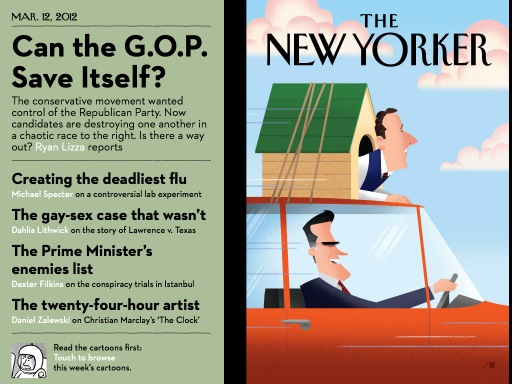
Good morning, and welcome to Super Tuesday! As Mitt Romney continues his quest to win the look-alike contest with the guy in the Levitra commercials — I mean, win the Republican nomination — here is your prix fixe menu for one of politicos’ favorite days of the year…
Appetizer: Anti-incumbent sentiment is at an all-time high. If you took high school civics, you know that incumbents have a 90+% re-election rate. In 2012, however, nearly 50% say they would vote out their congressman, and Congress’ approval rating is 9% (I bet Gaddafi had a higher approval rating). We won’t see turnover like that, of course, but there’s fear on Capitol Hill of a “Vote Them All Out” groundswell propagated by someone like Donald Trump. What do House Republicans have going for them, even though they could give back the congressional majority they won on the Tea Party wave in 2010? We’ve found Nancy Pelosi’s unfavorability numbers are 15 points higher than John Boehner’s. Not that people are pleased with Boehner, but tell them that Pelosi may become Speaker again, and they shudder. Look for a recycling of the anti-Pelosi videos and images from the best ads of 2010.
Read the rest of… Zac Byer’s Prix Fixe Politics: Super Tuesday Special
I’ve written previously about the challenges Barack Obama and other liberals have in building a communitarian case for their politics. I share William Galston’s perspective that the strains and dislocation in our society are at odds with the ideal of mutual obligation, and would add that a number of liberal-approved policies have contributed to that polarization. It’s worth pondering though, whether today’s conservatives do much better.
The short answer is that they don’t and often don’t try. At worst, most of the right fears that communitarian rhetoric is a cover for imposing an elite set of values over theirs, and for redistributionist tax and spend policies. To the extent there are conservative sympathizers (a Ross Douthat comes to mind), theirs is an enthusiasm for a localized brand of community, that relies on the vigor of private associations and faith based institutions. It’s a long way from the canvass Mario Cuomo was painting about a national “family”, or Obama’s contemporary efforts to draw from the unifying experience of the military or the mobilization of resources to build our national infrastructure.
On one hand, the conservative skepticism makes perfect sense. At a visceral level, the political right realizes that the cohesiveness liberals are invoking has pretty one-sided policy aims: realigning the tax burden, reaffirming the vitality of entitlements, and growing government’s reach into the economy, from capital markets to health-care to the energy sector. Conservatives also sense that liberals are not exactly agnostic in their viewpoints about the social values of a national “community”—it’s a pro-choice, pro gay marriage sensibility that openly distrusts any argument that incorporates, references, or elevates tradition or overt faith. Conservatives are quick to puncture the contradiction of embracing community while rolling eyeballs over some of its most conventional elements.
Read the rest of… Artur Davis: Conservatives and Community
By John Y. Brown III, on Mon Mar 5, 2012 at 12:00 PM ET
Always liked this song, wondered what the meaning was….and felt I could somehow relate. In some profound way.
You know what I mean? You feel you can related to a song without having any idea what the meaning is?
I speculated it could be stuck in the middle of life or middle of an important metaphorical dilemma or just stuck and waiting for some existential meaning or spiritual breakthough and learning to make the most of it (and grateful to have the person next to you to help make the journey worthwhile, a sort of Waiting for Godot)
Well, turns out the lyrics are based on an actual negotiation at a restaurant where the singer/songwriter was stuck between two others who were part of the negotiation.
Much like the video.
Oh well. I can relate to that too.
Was just hoping the song, and my life, had more profound meaning that this. But the older I get, the more I’m beginning to realize it may not.
And that I better enjoy the music, the good food, the conversation with the joker and the clown.
By Krystal Ball, on Mon Mar 5, 2012 at 10:00 AM ET
Rush Limbaugh issued an apology this weekend for calling Sandra Fluke a prostitute and a slut after she testified before Congress on women’s health care. This “apology” occurs after three days of Limbaugh slut shaming Ms. Fluke, insulting her parents and saying that Fluke should make a pornographic movie for his titillation.
On the fourth day, after a public outcry and the loss of at least six national sponsorships due to BoycottRush.organd similar efforts, Mr. Limbaugh now regrets his choice of words. This was too little, way too late. Especially since Mr. Limbaugh has a long history of offensive and vulgar comments.
No business should associate itself with such a pattern of repeated, reckless, personal abuse. If Rush wants to continue to have the opportunity to demean women in the future, that is his right. Good companies have many opportunities to promote their businesses without having to subsidize the denigration of women. Sandra Fluke wasn’t the first woman to be smeared by Rush Limbaugh, but she needs to be the last.
Two weeks ago, the House of Representatives held a hearing on access to contraception that included no women. Chairman Daryl Issa denied a Georgetown law student, Sandra Fluke, permission to speak on the absurd grounds that the hearing was about religious freedom, not birth control. After Democrats held their own hearing in which Fluke gave passionate, thoughtful testimony about a friend who lost an ovary because she couldn’t afford the birth control pills that would have reduced her ovarian cysts, Rush Limbaugh apparently felt the need to weigh in and decided to do so in the shameful, loathsome way that only Rush could. As I could never improve upon the words themselves for a distillation of the soul of Rush Limbaugh, here they are:
“What does that make her (Fluke)? It makes her a slut, right? It makes her a prostitute,” he said. “She wants to be paid to have sex. She’s having so much sex she can’t afford the contraception.” As if that wasn’t enough, he had to insult the most powerful woman in the legislative branch and Sandra’s parents:
“Can you imagine if you’re her parents how proud of Sandra Fluke you would be?” he said. “Your daughter goes up to a congressional hearing conducted by the Botox-filled Nancy Pelosi and testifies she’s having so much sex she can’t afford her own birth control pills and she agrees that Obama should provide them, or the Pope.”
Martin Bashir said he was left speechless on Thursday after hearing what he called “idiotic comments” made by Rush Limbaugh about Sandra Fluke, the Georgetown University law student who was denied the right to speak at acontroversial Republican hearing on contraception.
“So, Miss Fluke and the rest of you feminazis. Here’s the deal. If we’re going to pay for your contraceptives and thus pay for you to have sex, we want something for it. We want you to post the videos online so we can all watch,” Limbaugh said.
Bashir reread what he called Limbaugh’s ludicrous thoughts and asked his panel to comment. Democratic strategist Krystal Ball called Limbaugh “despicable,” “disgusting,” and a “loathsome individual.” She also defended Fluke and said Limbaugh was trying to shame her.
By Jonathan Miller, on Fri Mar 2, 2012 at 12:30 PM ET
James Fallows, my favorite national journalist, as well as a long time analyst of the presidency, offers some fascinating insight in his latest cover story for The Atlantic on what makes our President tick, and what this means for the future of his presidency:
Having seen a number of presidencies unfold, and some unravel, I am fully aware of how difficult it is to assess them in real time. What I feel I’ve learned about Obama is that he was unready for the presidency and temperamentally unsuited to it in many ways. Yet the conjunction of right-wing hostility to his programs and to his very presence in office, with left-wing disappointment in his economic record and despair about his apparent inability to fight Republicans on their own terms, led to an underappreciation of his skills and accomplishments—an underappreciation that is as pronounced as the overestimation in those heady early days. Unprepared, yes. Cool to the point of chilly, yes. For all his ability to inspire and motivate people en masse, for all his advertised emphasis on surrounding himself with a first-rate “team of rivals,” Obama appears to have been unsavvy in the FDR-like arts of getting the best from his immediate team and continuing to attract the best people to him.
Yet the test for presidents is not where they begin but how fast they learn and where they end up. Not even FDR was FDR at the start. The evidence is that Obama is learning, fast, to use the tools of office. Whether he is learning fast enough to have a chance to apply these skills in a second term—well, we’ll reconvene next year.