KET’s Kentucky Tonight program with host Bill Goodman will discuss industrial hemp this evening at 8:00 PM ET.
Scheduled guests are:
– Kentucky Agriculture Commissioner James Comer
– Kentucky State Police Commissioner Rodney Brewer
– Former Kentucky State Treasurer Jonathan Miller, founder of The Recovering Politician
– Dan Smoot, vice president of Operation UNITE
The program is live on KET and at www.ket.org/live at 8:00 pm ET.
Viewers with questions and comments may send e-mail to kytonight@ket.org or use the message form at www.ket.org/kytonight. All messages should include first and last name and town or county. The phone number for viewer calls during the program is 1-800-494-7605.
You can come back to this site at 8:00 PM and join a LIVE Twitter debate — all of your tweets that use #KYTonight will be published LIVE at The Recovering Politician.
Kentucky Tonight programs are archived online, made available via podcast, and rebroadcast on KET, KET KY, and radio. Archived programs, information about podcasts, and broadcast schedules are available at www.ket.org/kytonight.
For your reading prior to or after the show, click here for a 1998 report produced by the University of Kentucky on the “Economic Impact of Industrial Hemp in Kentucky.” As you read the report, keep in mind that farmers and scientists have developed dozens of new applications for the crop since the report was prepared 15 years ago. The key findings in the report include:
A market for industrial hemp exists in a number of specialty or niche markets in the United States, including specialty papers, animal bedding and foods and oils made from hemp.
Additional markets could emerge for industrial hemp in the areas of automobile parts, replacements for fiberglass, upholstery, and carpets. Using current yields, prices, and production technology from other areas that have grown hemp, Kentucky farmers could earn a profit of approximately $320 per acre of hemp planted for straw production only or straw and grain production, $220 for grain production only, and $600 for raising certified seed for planting by other industrial hemp growers. In the long run, it is estimated that Kentucky farmers could earn roughly $120 per acre when growing industrial hemp for straw alone or straw and grain, and $340 an acre from growing certified hemp seed.
Industrial hemp, when grown in rotation, may reduce weeds and raise yields for crops grown in following years. Several agronomic studies have found that industrial hemp was more effective than other crops at reducing selected weeds. One study found that industrial hemp raised yields by improving soil ventilation and water balance.
The economic impact if Kentucky again becomes the main source for certified industrial hemp seed in the United States is estimated at 69 full-time equivalent jobs and $1,300,000 in worker earnings. The total economic impact in Kentucky, assuming one industrial hemp processing facility locating in Kentucky and selling certified seed to other growers, would be 303 full-time equivalent jobs and $6,700,000 in worker earnings. If two processing facilities were established in Kentucky, industrial hemp would have an economic impact of 537 fulltime equivalent jobs and $12,100,000 in worker earnings. If one processing facility and one industrial hemp paper-pulp plant were established in Kentucky, industrial hemp would have an economic impact of 771 full-time equivalent jobs and $17,600,000 in worker earnings.
If just a fraction of the agricultural counties in Kentucky went into the industrial hemp business, thousands of jobs and sizable earnings would be created. If just one-fourth of Kentucky’s 90 agricultural counties went into industrial hemp business, approximately 17,348 jobs would be created and $396 million in worker earnings generated yearly.
These economic impact estimates reflect possible outcomes for Kentucky given a national industrial hemp industry that is focused in specialty niche activities that have been demonstrated to work in Europe. It is important to remember, however, that technologies are under development that may allow industrial hemp products to compete in bulk commodity markets. The economic impacts that would occur if these technologies were found to be commercially feasible would be substantially greater than those identified in this report.
By John Y. Brown III, on Mon Feb 4, 2013 at 12:00 PM ET
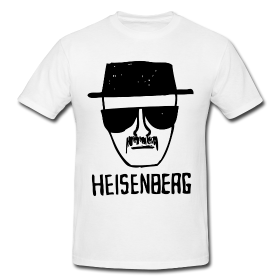
A kinder, gentler Breaking Bad?
I love this series but it can be over-the-top with fringe plot developments and crazy characters as the mild mannered former high school chemistry teacher, Walter White, becomes a successful meth dealer.
I was wondered the other night what it might look like if Breaking Bad had been written with a more mainstream and gentler, kinder theme. Maybe call it, “Veering incautiously” instead of the rogue sounding “Breaking Bad.” And instead of making Walter White an ever-hardening meth dealer, write a more mainstream method for handling his personal crisis. What if, for example, instead of cooking and selling meth, Walter instead became a celebrated shoe cobbler (selling custom made and hand crafted suede shoes that become very popular in some circles)?
Sure the series may have a different feel and tone, but would it also be more plausible? Would it widen potential audience appeal since more people can identify with shoe-makers than meth dealers?
Here’s a video clip giving us a peek of what this series might have looked like as Walter sells a pair of blue suede shoes to internationally known shoe fashion designer Tuco Salamanaca. (Just imagine shoes and not methamphetamine is being transacted in this scene.) Tuco is renown for his exacting taste and relentless drive for perfection in his shoe line. Despite being skeptical about Walter at first—and being obviously flustered that the shoes he tries on are too “tight” —Tuco is still won over by Walter’s attention to detail and skilled craftsmanship. In fact, so much so, Tuco buys them on the spot (even though they are an unusual “blue” shade) and suggests future purchases for his shoe line in pink and yellow.
But there is still the critical question, Would the series work as well with Walter as shoe cobbler —or is something lost.
Warning: Foul language even though we are pretending they are talking about shoe design.
But remember, the high end shoe market is a brutally competitive business. So this scene may not be too far off the mark. ; )
By John Y. Brown III, on Mon Feb 4, 2013 at 9:15 AM ET
From wardrobe malfunctions to Beyonce’s half-time show with more highlights than the first or second half, some are claiming the NFL is starting to use too much sex to sell football.
Starting?
Hmmm. I am old enough to recall this little Super Bowl commercial from the early 1970s.
It didn’t warp me or cause me to buy Noxema. Or to become a bigger Joe Namath fan.
It did to me becoming a Charlie’s Angels fan a few years later at age 13.
===
I have a confession to make.
You know how some people say that for many women going to the Kentucky Derby is all about the hats?
Well….I have a similar dirty little secret.
I watch the Super Bowl mostly for the commercials.
Then the football.
And then the hats.
===
My personal Super Bowl story.
It wasn’t way back when. Actually, it was year ago last January. The NFL had helped successfully pass anti-concussion legislation in over 30 states (mostly states with NFL teams) and now was going to the remaining states hoping to make a clean sweep on this important health issue for our student-athletes. Kentucky was selected because the timing seemed ripe.
Read the rest of… John Y. Brown, III: Super Bowl Wrap Up
By John Y. Brown III, on Mon Jan 28, 2013 at 2:15 PM ET
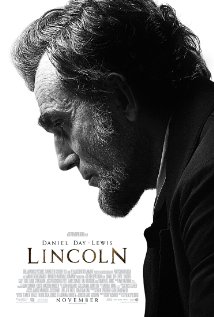
Lincoln and the power of story–and humor. And a lesson in leadership.
Throughout the movie Lincoln starring Daniel Day-Lewis, we are treated (as we should be) to multiple instances of Lincoln entangled in a tense and threatening situation only to hear him start his response with a story. The stories Lincoln tells are usually pithy, homespun, humorous and wise. They each sound at times like an Aesop’s fable all dressed up in grown up clothing. And often-times don’t even seem to be on point with the topic at hand. But work nonetheless.
This story-telling tic, or device, of Lincoln’s worked profoundly well for him. And for our nation.
The stories –and the time it took to tell them–communicated something much more important than an answer to the question posed. Which Lincoln would eventually get to.
First, the story was a distraction which defused an already overly tense situation. But the time Lincoln had finished his story, others present had had time to broaden their perspective and return to the ability to be reasonable rather than just react hastily. And the humorous punchline only helped punctuate this for the president.
Second, it brought everyone in the room together on an unrelated matter. Sure, everyone may be divided by the national conundrum they were debating, but for a few brief moments they were reminded that there was more than united than divided them by laughing together at a commonplace story. And if they could do that, perhaps they could agree on bigger issues. At least, I believe, that was the subconscious message achieved by Lincoln.
Three, Lincoln would re-establish through his story that he was “one of them” –just an ordinary fella not a slick, manipulative, self-serving politician. He could be trusted and was a person of goodwill trying to solve a thorny problem for reasons beyond merely self-interest. Like his familiar stories. He put his audience at ease with him and the process they were engaged with.
Read the rest of… John Y. Brown, III: Lincoln and the Power of Story
By John Y. Brown III, on Tue Jan 22, 2013 at 4:00 PM ET
Watching Silver Linings Playbook.
Albert Camus once wrote that fiction is a lie through which we tell the truth.
This movie is a story that tenderly and impeccably reveals the truth about life and the world we live in. All of us.
It’s supposed to be a brilliantly authentic and deadpan depiction of the world within the world of those laboring under the weight of mental illness. But it’s really not.
Silver Linings Playbook seems to me to be something more real and less mysterious. About finding extraordinary moments amid the utterly banality of life made possible by those who find ways to cope most graciously with a world insanely obsessed with the delusion of sanity.
By Lauren Mayer, on Tue Jan 15, 2013 at 3:00 PM ET
When people need a break from partisan politics, economic woes, traffic, overflowing email boxes, and the other challenges of modern life, many turn to the usual methods of escape – football playoffs, the 2-for-1 happy hour martini special, or catching up on “Say Yes To The Dress.” But for many of us, the ultimate escape is Downton Abbey, the PBS costume drama that has surprised even public t.v. fans and become a runaway cult hit.
And our devotion to the show can border on obsession – so to tell if you’re totally hooked, here are a few questions:
– Do you think Lord Grantham is blind to Thomas’s scheming, or just misses Bates so much that he doesn’t notice?
(and bonus point: Can you pronounce ‘valet’ properly?)
– Have you ever wondered how Daisy has worked in the kitchen at least since 1912 and by 1920 hasn’t found another job, used any of the money she got as a war widow, or in fact aged one bit?
– Was Lady Mary technically a virgin on her wedding night? (Which involves answering whether Mr. Pamuk’s heart attack was before or after they did or didn’t do anything, as well as debating whether Mary secretly wanted him to come to her room.)
– Have you started referring to Sybil’s husband as ‘Thom,’ or is he still ‘Branson’ to you? (And before they eloped, how many times did you watch a scene with them and shouted to the television, “Just kiss her already!”?)
– Will O’Brien ever confess about the bathtub episode which caused the miscarriage?, or if not, will she at least update her bangs?
– How does Anna get so much time off (to sleuth for her unjustly incarcerated husband) yet still manage to be both head housemaid and lady’s maid to the two girls?
If you understand these questions enough to answer any of them, then yes, you’re a Downton Abbey addict. However, if the questions make absolutely no sense to you and you fail to see the appeal of what sounds like a silly soap opera, try to see it from a fan’s point of view. Of course it’s silly, and like all good soap operas it’s full of ridiculous plot twists, overly convenient coincidences, and sappy, manipulative moments that make you cry even while you’re thinking, this is stupid.
BUT – and this is the key point – – also like a good soap opera, the characters engage the audience. Villains we love to hate, persecuted martyrs we root for, unrequited lovers we want to unite – Downton Abbey has all those and more, including the resident font of brilliant sarcasm, the Dowager Countess (and bonus points if you know her first name is ‘Violet’ but she should still be addressed as Lady Grantham even though Cora has superceded her as Countess). Plus Downton gilds all those soap opera traditions in a lovely veneer of historical details, fabulous period costumes and mellifluous English accents – so we get to feel intelligent while indulging in a guilty pleasure. Haven’t you ever known someone with a British accent, who can make even the most banal statement sound erudite? ( “Dahling, I’m terribly afraid that one must go to the loo” sounds ever so much more elegant than “I gotta pee.”) And we don’t mind the silly plot twists when the characters are dressed so beautifully (although am I the only one who wonders if they’re wearing equally period-authentic undergarments?) or using what look like real antique kitchen tools and feather dusters. Add in the magnificent Maggie Smith, who could read the phone book and make it witheringly brilliant, and it’s no wonder the show is such a success.
So here’s my version of the theme music (which is actually pretty strange and more suited to a Hercule Poirot mystery) in tribute to Downton Abbey fans and the people who love them but don’t quite understand them . . .
By Jonathan Miller, on Thu Jan 3, 2013 at 1:30 PM ET
If you haven’t seen Django Unchained yet — and you can stand the sight of a lot of fake human blood — go see it this weekend: It’s the best movie of the year.
That’s saying a lot: I loved Lincoln and Silver Lings Playbook and Argo and liked Skyfall a whole lot.
To whet your whistle, here’s a fun compilation — by the good folks at CollegeHumor.com — of all of writer/director Quentin Tarantino’s pop culture references in his earlier movies, arranged chronologically by subject matter:
By Jonathan Miller, on Mon Dec 31, 2012 at 9:15 AM ET
#TeamRP:
LESSON #24 from my fitness training Josh Bowen as part of my fierce and ferocious fitness challenge with #TeamJYB3:
Wearing a garbage bag while exercising does NOT necessarily help you lose weight. But it certainly makes you look stupid.
Or alternatively: Don’t follow the fitness advice of a mentally unstable movie character, even if he is being portrayed by the Sexiest Man Alive. (But go see Silver Linings Playbook — it’s terrific!)
Or perhaps, Jonathan, I knew Bradley Cooper. I’ve seen a lot of movies with Bradley Cooper. Jonathan, you’re no Bradley Cooper.





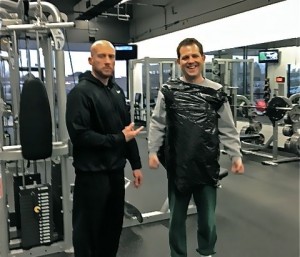
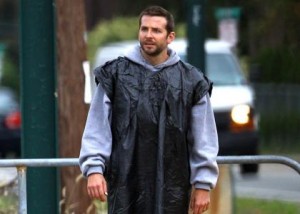 Or perhaps, Jonathan, I knew Bradley Cooper. I’ve seen a lot of movies with Bradley Cooper. Jonathan, you’re no Bradley Cooper.