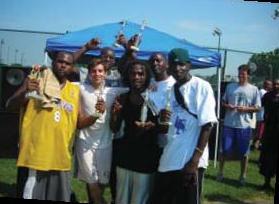
By Robert Kahne, RP Staff, on Wed Jun 29, 2011 at 10:00 AM ET The Politics of Basketball The New Orleans Hornets are still smarting because their second best player, forward David West, has opted out of his contract and is moving teams. Where will he wind up? The Big Lead says that if it is New Jersey, big things could happen. [The Big Lead]
The NFL isn’t the only league facing a lockout soon. The NBA is in severe danger of work stoppage. This piece lays blame squarely on the shoulders of the owners–and I agree with him more than just a little. [Hoops Hype]
When North Carolina State won the NCAA men’s basketball championship in 1983, basketball changed forever. If you are a hoops fan, you have probably seen the video–a 30 foot heave falling short, a magical tip in, and Jim Valvano running onto the court looking for somebody to embrace. When Jim Valvano died in the early 90s, the run became even more magical. This week, the man who made the tip, Lorenzo Charles, also died. This is the NYT obituary, and a more personal piece from a man who writes for Gawker. [New York Times] [Deadspin]
John Calipari has kept my Kentucky Wildcats in the news recently. After receiving all kinds of press for getting a raise, he has been asked several times about how a system could be devised in which college athletes get paid. Deadspin calls his plan “shockingly logical.” I call it “just.” [Deadspin]
The NBA draft happened last week. Here is the ESPN discussion of winners and losers. My winners: Detroit, Washington, Utah, Cleveland, and John Calipari. My losers: Sacramento, Houston, and The Big East. [ESPN]
By Robert Kahne, RP Staff, on Wed Jun 8, 2011 at 10:39 AM ET
I started watching the NBA in earnest back in 2004, when the Detroit Pistons defeated the Los Angeles Lakers in one of the most classic NBA Finals in history. That year, Shaq and Kobe were joined by Karl Malone and Gary Peyton in hopes that the two aging stars could vault them back to finals glory. It almost worked, but they ran into the tough defense of the Larry Brown coached Pistons. In stark contrast to the hodgepodge Lakers, the Pistons had a solid core of a team–Chauncey Billups, Rip Hamilton, Tayshaun Price, Ben Wallace, and Rasheed Wallace. That Pistons team was fun. They were hard working, defensive minded, and represented all that was good about basketball. I remember many people reveling in the failure of the hot shot Lakers and enjoying the success of the plucky Pistons.
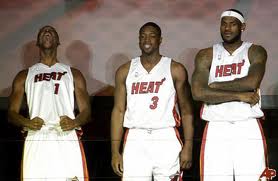
This year’s NBA Finals feature the Miami Heat, who remind me quite a bit of both teams from the 2004 NBA Finals. As any hoop-head will tell you, this Miami team features LeBron James, Dwyane Wade, and Chris Bosh; three men who came together in the offseason and acted quite foolishly, claiming they would win multiple titles with the three of them at the helm. Like the 04 Lakers, the Heat stumbled a bit in the regular season, and many wondered if these players coming together was a mistake. When the playoffs started in both 2004 and this year, the teams really kicked in. In the run up to the Finals, the Heat lost all of three games–one in each playoff series. The 04 Lakers, likewise, only lost five games before the Finals. Both the 2004 Lakers and the 2011 Heat have a lot in common–superstars, playoff mastery, and most importantly, general disdain from the populace.
Indeed, many people hate the Heat. Maybe for the way in which LeBron James left the Cavaliers, perhaps because of
This pep rally was a stupid Decision. “The Decision” or the introductory press conference, or maybe just because fans do not approve of a consolidation of talent. For whatever reason, people don’t like this Heat team. However, all the reasons I fell in love with the 2004 Pistons are present with this Miami Heat team. The Pistons had great defense and great chemistry. The Heat have both of those–LeBron James and Udonis Haslem have really stepped their defense up in the Finals, and this team really seems to enjoy playing together.
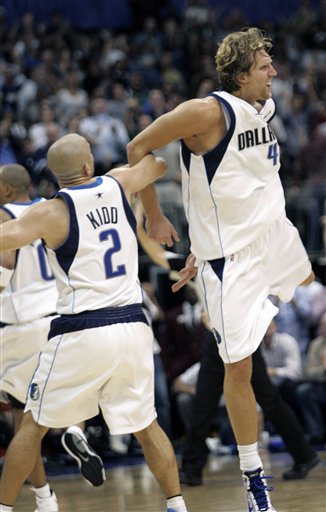
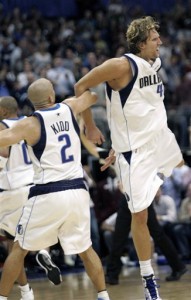 The Other Guys. While it may be in vogue for people to root against the Heat, for whatever reason, I don’t. I think too often our culture builds stars up, just to tear them back down. I reject that. This Heat team is full of great players, and I wish them success. However, the other side has their share of great stories also–Dirk Nowitzki playing for a title, Jason Kidd being in contention for a ring again, after so many near misses. Whoever you choose to support, the Finals have been great entertainment. I can’t wait for Game 5. You really should tune in.
By Jonathan Miller, on Fri May 27, 2011 at 12:30 PM ET Continuing my newly-established tradition of plagiarizing from Nick Hornby and sharing my pop culture Top Five lists (See my Favorite Breakup Songs , my Favorite Hoops Books, and the Most Jew-ish Gentiles), and in honor of my oldest RPette’s recent acquisition of an adorable bunny (named “Louie” not “Bugs”), I ask the question that has confused, even haunted my generation:
What’s up with all of the guys named “Doc” who’ve never practiced medicine or even earned a graduate degree?
Without further agonized perplexion, I hereby list My Five Favorite “Doc”s Who Weren’t Really Doctors:
5. (tie) Doctor J and Doctor K
Julius Erving (who supposedly got his nickname from a high school buddy) and Dwight Gooden (an homage to Erving — K stands for strikeout — that was later shortened to “Doc”) were two of the greatest athletes of the last three decades of the 20th Century. J was the fifth highest scorer in pro basketball history, the first great populizer of the slam dunk, and one of the most graceful and elegant atheletes to ever play the game (And how ’bout that ‘fro!). K was one of the most feared and dominant baseball pitchers, whose brilliant career could only be stopped by drug use and injury. And yet, despite their greatness, there is no sensible reason to award them with the title of doctor. (At least J gathered a few honorary degrees after his career ended.)
4. Doc, the Dwarf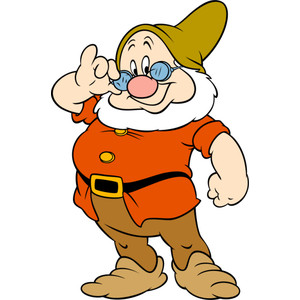
Doc wasn’t necessarily the brightest of the dwarfs — he seemed to stammer and lose his train of thought quite often — but he held sway over the rest of the crew, with the possible exception of Grumpy, of course. (Here is a great summary of his life and career.) Doc’s authority emenated from being the gray eminence of the group, the centered, moral authority. Yet there was no evidence whatsoever of a medical license or doctoral dissertation at an accredited university. Indeed, it took the efforts of a fully-heighted fellow (The Prince) to relieve Snow White of her food poisoning ailment.
Read the rest of…
The RP: What’s Up Doc? — My Five Favorite “Doc”s Who Weren’t Really Doctors
By Jonathan Miller, on Mon May 16, 2011 at 8:30 AM ET As evidenced by my very first post on this site, I am a passionate and often times irrational fan of the University of Kentucky Wildcat basketball team.
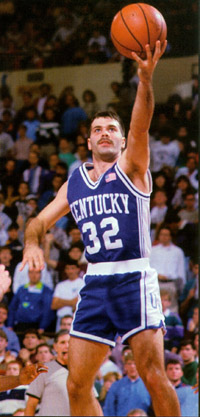
One of my favorite all-time players was a rural Eastern Kentucky-reared shooting guard named Richie Farmer. Farmer played during a pivotal Wildcat era: the first four years of Coach Rick Pitino’s rebulding mission, which followed a series of recruiting scandals that had brought the team to the brink of an NCAA-imposed death penalty. The ragtag squad of lesser talents –through unselfish, gritty play — over-achieved to the point of almost scoring one of the biggest upsets in college basketball lore. (Ugh — yes, this was the 1992 regional final against Duke University that provided the worst moment in world history.) The squad is still known popularly as “The Unforgettables.”
Indeed, Farmer was the most popular player on the team, and one of the most-beloved Wildcats of all time. His country roots, his trademark mustache, and his history as a prolific scoring, home-grown high school “Mr. Basketball,” made him into a living legend, particularly among those extraordinarily passionate rural fans who live to the far west and far east of Central Kentucky’s “Golden Triangle” that extends between Lexington, Louisville and the southern suburbs of Cincinnati.
Frankly, after Richie was overwhelmingly elected the state’s Agriculture Commissioner and occupied an office directly across the hall of mine in the State Capitol Annex when I was State Treasurer, I was a bit starstruck. While famously oratorically challenged, Richie turned out to be a decent, kind, friendly neighbor.
And while Richie endured a little negative press when first entering office — the new fellow-GOP Governor had hired Farmer’s relatives to state jobs — the press mostly treated Farmer with kid gloves. Farmer got away with things for which other state officials would have been crucified: such as spending thousands of taxpayer dollars in 2006 to distribute Richie Farmer bobbleheads at the state high school tournamen; or running a seemingly endless loop of state-financed television ads promoting Kentucky produce, starring himself and his Unforgettable teammates.
But when State Senate President David Williams chose Farmer to serve as his running mate in his 2011 gubernatorial campaign, the scrutiny became considerably more intense. And in recent months, a steady stream of articles have revealed Farmer’s ultra-liberal spending practices during an unprecedented state fiscal crisis:
Taking three aides on a $10,000 taxpayer-financed Caribbean junket.
Pocketing some of his excess campaign funds.
Giving top staff big raises while the rest of state government was taking cuts.
Purchasing more than $400,000 worth of new cars for his office, including a new luxury SUV for his personal use.
Refusing to voluntarily take a few furlough days — as every other elected executive branch official did — in salary-cutting solidarity with career state employees who were furloughed under statute. (Ultimately, he did, after considerable pressure from the public and perhaps Williams.)
Renting, at taxpayer expense, a luxury hotel suite for the state high school basketball tournament even though he lives less than 30 miles away.
Read Farmer’s responses (usually through a spokeman) in each of the links. An obvious sense of entitlement resonates: He deserves special treament, doesn’t he?
And who could blame him for feeling this way? Since a young high school student, Farmer has been treated as something of a demi-god. UK basketball players are our local royalty: They live in a specially equipped luxury dormitory; They are coddled by administrators and boosters; They are literally the biggest men on campus.
For nearly his entire life, Farmer’s been told that he’s special, he’s different. Why wouldn’t he think that he’d be exempt from the same budget slashing that the faceless, nameless bureaucrats have to endure? This is perhaps why David Williams, a bit inartfully, excused Farmer’s luxury expenditures on his “celebrity status.”
But a more careful argument might focus on Richie Farmer’s four-year period of indentured servitude to the University of Kentucky and the general fan population. For four years, Farmer provided enjoyment to millions of Kentuckians, as a teenager and young adult, with no pay, and with all of the privacy complications that much older celebrities have to endure.
So readers, I ask you to weigh in. Do we owe our former athletes a special compensation for the joy they brought us for free and the inconveniences they must endure? Or once you enter politics are you held to the same rigorous standards that we apply to everyone else in the arena?
Do you find Farmer’s conduct par for the court? Or is Richie’s behavior unforgiveable and unforgettable?
Comment away below:
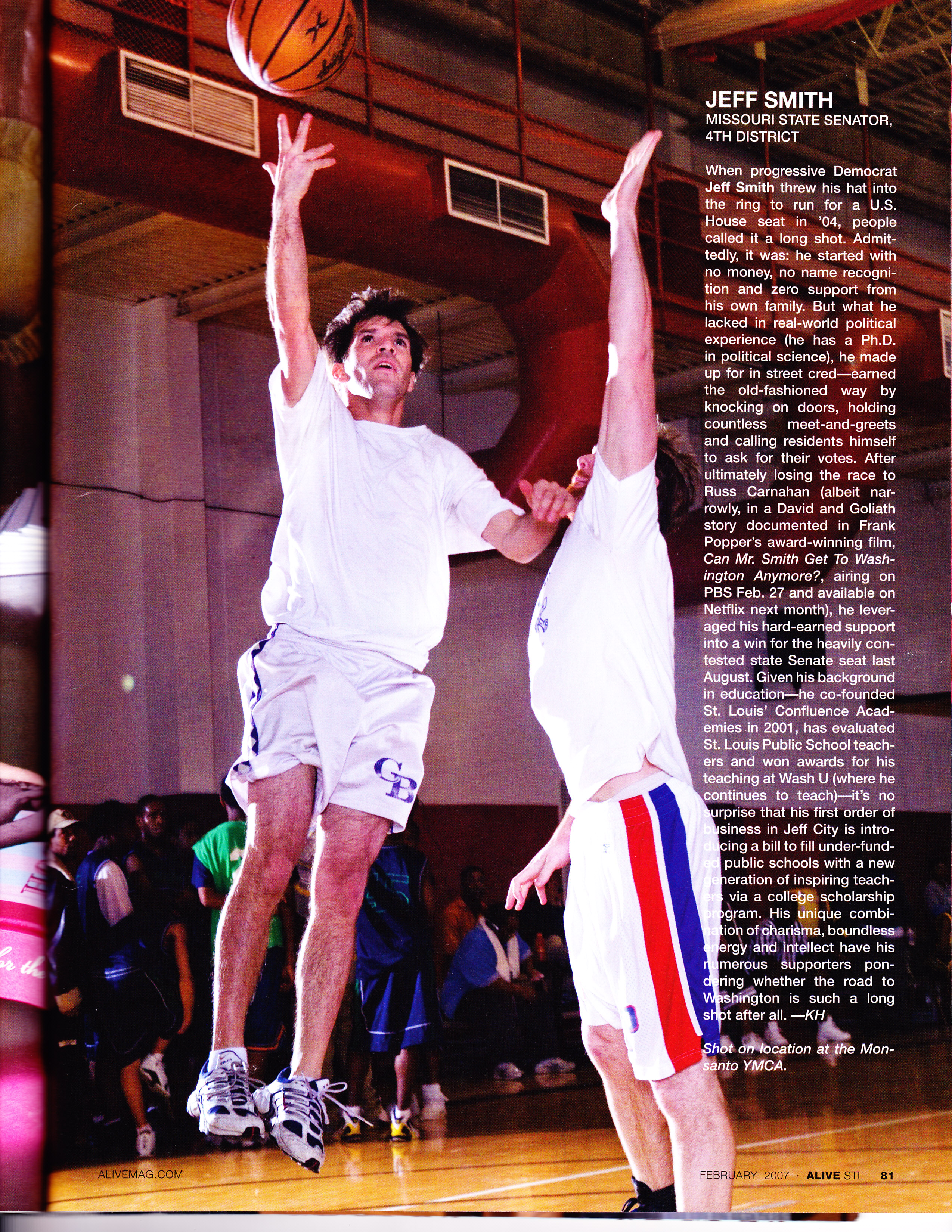
By Jeff Smith, on Tue Apr 26, 2011 at 12:30 PM ET The recent attention to local and national politicians’ racial gaffes reminds me of my own.
As readers may be aware, politicians have lately dredged up one of the ugliest aspects of our nation’s history: slavery and the subsequent century of brutality and discrimination. Haley Barbour has often tripped himself up, beginning with his 1982 watermelon comment. More recently he’s praised the ignominious Citizens Councils and declined to condemn a proposal to venerate Confederate war hero and founding KKK Grand Wizard Nathan Bedford Forrest with an honorary license plate.
Former Virginia Sen. George Allen of “macaca” fame had another recent gaffe, where he twice (erroneously) assumed that a tall black reporter was an athlete. Even the ever-poised Alex Trebek may have slipped up.
Closer to home in St. Louis were the comments of State Sen. Maria Chappelle-Nadal, who compared the black state legislators opposing her on a bill – that is to say, all of them – to “house slaves.”
***
I spent years walking a racial tightrope in city politics. I represented a district that was roughly 55% black, 6% Asian, 5% Bosnian, and 4% Latino. Since it was also estimated to be 15% gay, the percentage of straight white males like me was likely in the single digits.
Not that I minded. I actually found it exhilarating. At first.
See, I’d grown up in a mostly white, middle-class suburb, but about 10% of my graduating class was comprised of black kids bused from the city as part of a school desegregation program. By my senior year, they comprised most of the basketball team, and as point guard, it was my job to lead the team.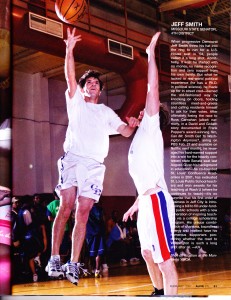
My co-captain once told me that when he came out to our school freshman year, he was three years behind us academically. That pissed me off. It also made me want to learn more about the history behind the inequity. So at UNC-Chapel Hill, I majored in African-American Studies.
Conservatives like to invoke the guilty white liberal. I wasn’t guilty as much as obsessed. I wanted to immerse myself in the city’s black community and help black kids get to college.
So I came home from UNC and worked in the city public schools. Frustrated at the system’s dysfunction, I co-founded a charter school whose enrollment was 99% black. I served on the boards of non-profits focused on racial justice and black uplift. I coached basketball for a decade at a boys club where the only white people I saw were the occasional white refs. I taught ACT prep courses for black high school players in danger of becoming Prop 48 casualties. And when I played, it was with strangers in one of the small parks that dotted the corners of the city’s North Side, where the competition was fierce.
The point is, when I jumped in the race for Missouri’s 4th Senatorial District, I felt at least as comfortable around black people as I did around white people.
Read the rest of…
Jeff Smith: My Macaca Moment
By Jonathan Miller, on Tue Apr 19, 2011 at 12:30 PM ET My teenage daughter and I BOTH love it. So go forth, click, buy & read! Furiously patting myself on the back for sucessfully introducing Nick Hornby’s masterpiece, High Fidelity, to my 17-year-old daughter, I’ve decided to make a tradition of aping the protagonist’s habit of breaking down pop culture categories into top five lists. (See my post on Top Five Breakup Songs here).
And now that the depression of March Madness has dissipated, and the ennui of the NBA playoffs has set in, there’s no better time to pick up a great book (or five) about basketball.
Unfortunately, with the qualifiation of the word “great” in the sentence above, there are not many to choose from. While the literary elite has focused its attention on the diamond or the gridiron, hoops have been sorely neglected.
There are, however, some exceptional exceptions. Click on the book covers below to preview and/or purchase):
1. The Breaks of the Game by David Halberstam
The best book on basketball — and in my not-so-humble-by-any-means opinion, the best book on any sport, exclamation point — celebrates its 30th anniversary this year. You probably have never heard of it, and I wouldn’t have either, had I not read Bill Simmons’ The Book on Basketball (See #3 below). The late, Pulitzer-Prize winning reporter Halberstam followed the 1976-77 Portland Trailblazer NBA Champs in the years following their title, through injuries (most prominently to star center Bill Walton), dissension, trades, discontent, and sometimes, triumph. Halberstam eloquently illustrates through his prose that basketball — as I argued in my inaugural RP post, “Why March Madness Matters” — is the ultimate communitarian sport: Players and teams only can achieve greatness when individuals put aside their selfish needs to advance the common good.
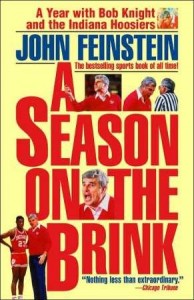 2. A Season on the Brink by John Feinstein 2. A Season on the Brink by John Feinstein
The best book on college hoops was born when John Feinstein was granted permission to spend the year with the University of Indiana Hoosiers and its coach, Bobby Knight, who is perhaps the most controversial and polarizing team leader of his generation in any sport. This uncensored examination of how the pressures of the sport affect a coaching staff and its mostly teenage squad of players captures brilliantly how big-time college sports has emerged to transcend (some will say, offend) the Athenian ideals of amateurism, and become a professional institution of its own. And remember — this was written after the 1985-86 season, in the infancy of the March Madness phenomenon, which many argue began with the 1979 NCAA Championship, pitting a different kind of hoosier — Indiana State’s Larry Bird — against Earvin “Magic” Johnson of Michigan State.
3. The Book of Basketball by Bill Simmons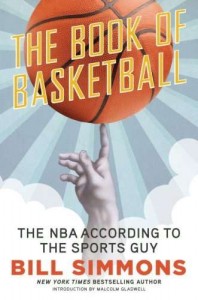
To be clear (as admitted in the subtitle, “The NBA According to the Sports Guy”), this is really “The Book of Professional Basketball.” But despite mostly ignoring the finer collegiate variety of the game, this is a fascinating read — the kind of book that both provides tidy places for reading breaks, but also encourages you to read on and on. Simmons is at times hilarious, profane, and viciously jingoistic (He is a self-admitted Boston Celtic fanatic). The reader’s thirst for hoops information is fully slaked through reams of statistics, colorful stories, and witty pop-culture-laden metaphors, but Simmons also weaves through the book a wonderful narrative theme, borrowed from his favorite basketball tome, Halberstam’s The Breaks of the Game (See #1, above): “The secret of basketball is that it’s not about basketball…Teams only win titles when their best players forget about statistics, sublimate their own games for the greater good and put their egos on hold.”
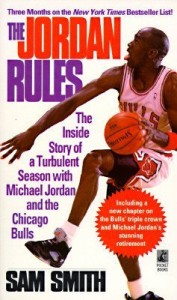 4. The Jordan Rules by Sam Smith 4. The Jordan Rules by Sam Smith
The book that famously tarnished the uber-Man Michael Jordan myth created by Nike and the NBA (and discussed brilliantly by David Sirota in his new book, Back to Our Future), vividly captured the human side of the living legend: his temper tantrums, his biting critiques of his teammates, and his emerging super-sized ego. But the book also demonstrates how Jordan’s Zen-master coach Phil Jackson was able to direct Jordan and his teammates to emerge as one of the greatest squads in NBA history, by focusing the star’s attention (Here we go again!) away from personal scoring statistics to unselfish team play.
5. Duke Sux by Christian Laettner
In this touching — sometimes even moving — confessional memoir, former Duke University All-American center, Christian Laettner, apologizes to college hoops fans everywhere for the arrogant attitude of his squad, of the Duke student body, and most importantly, of himself. A key chapter is dedicated to his asking for forgiveness for his famous foot-stomping of Kentucky Wildcat reserve Aminu Timberlake during the historic 1992 NCAA Regional Finals, and his admission that the Blue Devils’ NCAA Championship that year should be vacated and given to the Kentucky Wildcat squad that almost beat them during the Greatest Game Ever Played/Worst Moment in World History.
—-
OK, OK. I might have made up one of the books above. (I told you this genre was bereft of classics!)
Please guess which one is the fake in the comments below. Or let me know what great hoops books I’ve missed.
By Robert Kahne, RP Staff, on Wed Apr 6, 2011 at 10:00 AM ET
The University of Connecticut wrapped up the NCAA Men’s Basketball championship. Congratulations to Kemba Walker and his merry band. You have no idea how hard that is for me to say. [One Shining Moment]
After VCU made the final four, every team in need of a good coach came calling for their coach, Shaka Smart, despite the fact that the Rams finished the regular season with 10 losses, good for fourth in the Colonial Athletic Association. Smart opted to stay at VCU. They gave him a raise from $325,000 to $1.2 million. The kids playing ball? They still make $0. [Gregg Doyel]
Speaking of how much money coaches make, did you know Geno Auriemma makes $1.6 million? This is an interesting post asking whether or not men’s basketball is asked to subsidize women’s basketball too much. It’s anti-Title IX, and makes a lot of resonant points. The main postulation here is that no one could have predicted that men’s college basketball could have exploded into the “hyper-profitable behemoth” which it has become, and now it is expected to subsidize all other sports. No matter what your thoughts on Title IX, this is worth your time to read. [The Big Lead]
Speaking of the popularity of men’s college basketball, in true Gawker fashion, Deadspin has obtained an e-mail from some sorority sisters (Chi-Os, for those of your who are into that sort of thing) who are bringing Kendall Marshall, John Henson, and Harrison Barnes to their formal. Don’t take pictures of them with alcohol, please. [Deadspin]
Moving on to the professionals, the Piston’s honored Dennis Rodman by retiring his #10 jersey. This article is a really nice portrayal of the night for one of the most maligned players in the history of the game–who happens to be maybe the best defender to ever play the game. It’s also been announced that he will be in the hall of fame class of 2011. [Detroit Free Press]
Rodman broke through in the early nineties as a member of Detroit’s “Bad Boys.” If any team fits that description in today’s NBA, its the Miami Heat. The most talented team in the league who everybody loves to hate overtook the Celtics for the #2 spot in the Eastern Conference last night. Stephen A. Smith sat down with Dwayne Wade to talk about the Heat. Deadspin summarized the interview. [Deadspin]
Sally Jenkins of the Washington Post defends the athletic scholarship in a column for the newspaper. I don’t really agree with much of what she says–in my opinion, college players ought to be paid–but she’s got some very interesting points which you really ought to read. [WaPo]
By Jonathan Miller, on Fri Apr 1, 2011 at 12:00 PM ET An uninformed visitor to my old Kentucky home this week might conclude that they’d mistakenly walked onto the compound of a Prozac-fueled utopian cult. An odd but euphoric delirium had descended upon the hills, hollers and hamlets of the Bluegrass State. Men and women walking more upright, a bounce in their steps, a huge grin on their faces. You couldn’t meet a stranger: In grocery stores and city parks and shopping malls, neighbors who months before felt nothing in common were now greeting each other with warm words, high fives, and fist bumps. Weeks from now, we’ll return to our regional camps, our partisan corners. But for now, we’re united; the sun’s shining just a bit brighter.
The Wildcats have once again made the Final Four. March Madness matters.
Smack Laettner with your mouse click to watch the worst moment, well, in all of history I’m often asked by my friends from urban America how a Jewish pischer like me could win statewide election in an inner notch of the Bible Belt. It’s simple: There’s only one state-sanctioned religion in the Commonwealth, and that’s Wildcat basketball. Besides, Kentucky features some of the most rabid anti-Christian hatred in the country. Anti-Christian Laettner, the aptly nicknamed Duke Blue Devil, that is.
It’s been common cause of that same coastal elite to declare the recent demise of college basketball. Just last week, the expositor of all that is right and just — the New York Times — asked “Does College Basketball Really Matter Anymore?” Much blame for the sport’s so-called march towards irrelevancy is directed at the National Basketball Association’s controversial “one and done” rule that permits pro teams to draft 19 year olds who are at least a year out of high school. Since many exceptional underclassmen leave for the NBA instead of staying all four years to graduate, the argument goes, the college talent pool is drained thin, diluting the excitement of the sport.
Dicky V just hates "one and done." Even the over-polished-teeth-gnashers who make bank by hyping the sport have decried the rule’s impact on the game: Cue lovable loudmouth broadcaster Dick Vitale, who termed the one-and-done system — in his own inimitable style — as an “absolute joke and fraud to the term ‘student-athlete.’” Meanwhile, the rest of the chattering class’ perennial echo chamber lambasts Kentucky coach John Calipari for daring to master the rules he was given and actually recruit players with the expectation that they would leave for the pros after a year in college. As the Final Four approaches and smaller schools such as Butler and Virginia Commonwealth are adopted by the rest of the country, the Cats are branded with a scarlet “W” and charged with undermining the Athenian ideal of amateur athletics, as well as contradicting the purity of the sport, the value of higher education in general, and the American Way. Quipped Washington Post political reporter/conventional wisdom decoder Chris Cillizza on the eve of an NCAA tourney ballgame last year, tongue lodged only partly in tweet: “Is there anyone in America not rooting for Cornell over Kentucky tonight? And if so, can they rightly be called American?”
 George (at left, above) is VERY young looking, for a 50-year-old A Sarah Palin-like appeal on behalf of a New York-based Ivy League squad?! Just slightly more serious and playful is the needling I’ve endured from my decades-long “frenemy” George—an insufferable Dukie, natch. He asks how can I, a progressive, Harvard-educated, policy-wonk, invest my emotional well-being in a semi-pro team of mercenaries with a league-lagging 2.02 GPA and a pitiful 31 percent graduation rate?
The truth is that since middle school, much of my kind—the jump shot-challenged intelligentsia, that is—have scoffed at the popularity, coddling, and public financing of the jock culture. College is our sacred realm—for academics, scholarship and research, not professional sports-grooming. Like Major League Baseball, why can’t the NBA establish its own minor league system that encourages talented high school athletes to bypass college entirely? Ironically, this argument was advanced on Op-Ed pages nationwide by Richard Hain, a mathematics professor at…wait for it…Duke University.
There’s no question that colleges need to do a better job of preparing student-athletes for the postgraduate work force, particularly since the vast majority will never gasp a whiff of sports-related riches. But scrapping the current system and replacing it with a glorified intramural product would suffocate an invaluable national asset.
For while the literary and media elite have branded cerebral baseball and primal football as our national pastimes; college basketball, particularly here in the heartland, really does matter. And flaws and all, big-time, big-money college roundball is not only the people’s sport; it’s also good public policy.
Read the rest of…
The RP: Why March Madness Matters
By Jonathan Miller, on Thu Mar 10, 2011 at 4:41 PM ET LAUNCH DATE: APRIL 1, 2011
In just a few days, a new entry to the blogosphere will revolutionize the way Americans think about politics.
All right…I doth promote too much. I am a recovering politician after all.
I can promise, however, that The Recovering Politician will present a unique forum for spirited, reasoned, civil dialogue — dispatches from a few dozen folks who’ve actually served in the arena; and now having left, are liberated to share their experiences and critiques of the system without partisan bias or interest group pressures.
Don’t expect interminable political blather; our contributors will also share their opinions and ideas about business, religion, sports, pop culture, you name it. And you’ll be encouraged to join the conversation through your comments.
Be prepared to join us on April 1. In the meantime, feel free to surf around the bare bones of the site: check out our mission, sign up for my email notification list, and join me on the social networks: Facebook, Twitter, etc — you can find the links and forms above.
So strap in tight, liftoff is in T minus 12,000, 11,999, 11,998…
Best,
Jonathan Miller, The Recovering Politician
|
The Recovering Politician Bookstore
|