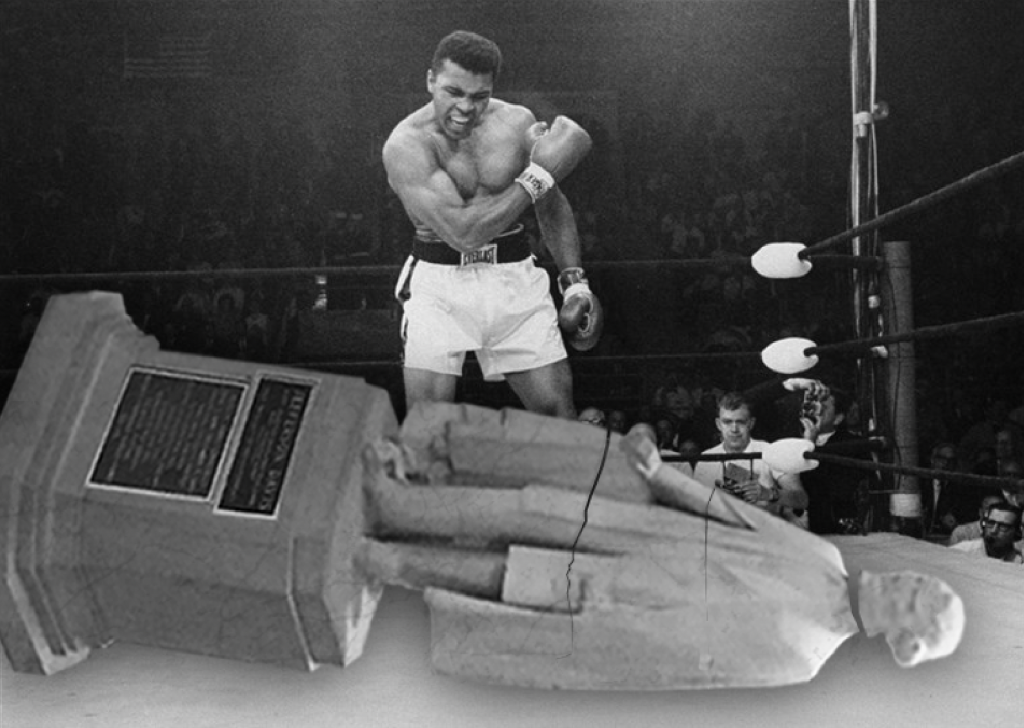
Please sign the petition below to remove the statue of Jefferson Davis currently in Kentucky’s Capitol Rotunda, and replace it with a tribute to Muhammad Ali, “the Louisville Lip” and “the Greatest of All Time.”
I just heard from the Ali family: It is the Champ’s belief that Islam prohibits three-dimensional representations of living Muslims. Accordingly, I have adjusted the petition to call for a two-dimensional representation of Ali (a portrait, picture or mural) in lieu of a statue.
UPDATE (Tuesday, December 2, 2014)
In this interview with WHAS-TV’s Joe Arnold, Governor Steve Beshear endorses the idea of honoring Muhammad Ali in the State Capitol (although he disagrees with removing Davis). Arnold explores the idea further on his weekly show, “The Powers that Be.”
Click here to check out WDRB-TV’s Lawrence Smith’s coverage of the story.
And here’s my op-ed in Ali’s hometown paper, the Louisville Courier-Journal.
UPDATE (Saturday, June 4, 2016)
In the wake of the 2015 Charlestown tragedy, in which a Confederate flag-waving murderer united the nation against racism, all of the most powerful Kentucky policymakers — U.S. Senator Mitch McConnell, Governor Matt Bevin, Senate President Robert Stivers and House Speaker Greg Stumbo — called for the removal of the Davis statue from the Rotunda. Today, as we commemorate last night’s passing of Muhammad Ali, there is no better moment to replace the symbol of Kentucky’s worst era with a tribute to The Greatest of All Time.
UPDATE (Wednesday, June 8, 2016):
Great piece by Lawrence Smith of WDRB-TV in Louisville on the petition drive to replace Jefferson Davis’ statue in the Capitol Rotunda with a tribute to Muhammad Ali.
UPDATE (Thursday, June 9, 2016):
Excellent piece on the petition drive by Jack Brammer that was featured on the front page of the Lexington Herald-Leader.
Highlight of the article:
Miller said he has received a few “angry comments” on his call to honor Ali.
“One of them encouraged me to kill myself,” he said. “You can quote me that I have decided not to take their advice.”
UPDATE (Friday, June 10, 2016)
The petition drives continues to show the Big Mo(hammed): check out these stories from WKYU-FM public radio in Bowling Green and WKYT-TV, Channel 27 in Lexington:
UPDATE (Saturday, June 11, 2016):
Still not convinced? Check out this excerpt from today’s New York Times:
By John Y. Brown III, on Wed Nov 20, 2013 at 12:00 PM ET
Sometimes you just have to be tough and put your foot down.
About 25 years ago I became a regular and admiring reader of Business First magazine. I have read it loyally ever since, which is another 25 years.
One of my favorite sections is the “In Person” section that tells about a person in the Louisville community and humanizes him or her with personal details while also explaining their professional arc and future plans. And there is a box off to the side where you get the “personal stats” about the person. Their family, favorite books, favorite movies, what music they have on their iPod, who inspired them, hobbies, favorite TV shows and so on. It’s a lot of stuff, trust me.
Well, here’s the thing. I don’t like admitting this because it sounds kind of vain and probably is. It is vain. But each week for 25 years I read this section and wonder if Business First might do one of those In Person pieces about me sometime soon and I run through each of those questions and answer them myself. And it takes more than just a minute or two.
Well…take 52 weeks (issues) a year and multiply it by 25 years and you have 1300 consecutive weeks of rejection— where not only did I feel slighted by not getting asked to do the In Person section but I wasted several minutes each week imagining how I’d answer those personal stat questions.
Not all of the answers were true, of course. I’d have to balance out the answers so people would be impressed with TV shows I watched, music I listened to and books I was reading –even if I wasn’t reading anything at all. I certainly wasn’t going to say “Nothing” when asked “What books are you reading.” I at least would put down a couple of best sellers and maybe a fiction book or two and probably one classic, like, I don’t know–the Odyssey or something fancy from a long time ago so people will read it and say, “Wow. That John Brown guy is pretty learned compared to the books other profiled people pretend that they are reading.” Everybody knows they are exaggerating about some of it.
If people were completely honest they’d sound like someone who doesn’t deserve to be profiled in In Person because they wouldn’t be any more interesting sounding than you are me. Maybe worse. Think about it. What if they answered it honestly and said,
“Books: “None so far this year but skim the newspaper from time to time. I may read something next year or listen to it on tape. Nah. Probably not. I do enjoy browsing bookstores and read the covers so I don’t waste money buying books I won’t ever read;
Favorite TV: Weather Channel and Girls on HBO;
You get the idea.
In my case I was going to pretend I understood opera if they asked me and say something like, “Yes, I enjoy opera a great deal. Especially the signing. Much of it is sung in Italian, in case your readers didn’t know. I’m reading the Odyssey right now, too.”
I would have had to lie about what music I listen to as well. I probably would have said classical and country (It is Louisville, KY). I couldn’t say “Pearl Jam and the Red Hot Chilli Peppers, Steely Dan , US3 and Mos Def. And, oh, I like to sing out loud sometimes when I’m in the car by myself. But only sound good when I’m singing to James Taylor. I just don’t have a voice like Eddie Vedder or Anthony Kedeis.”
If I answered like that people would think I was nuts because 50 year olds aren’t supposed to act like that. Even though they do. They are getting older (we are, not “they”) and want to hold on to a few youthful things. Just because it makes us feel better and, well, old dogs struggle with learning new tricks. And that applies to people too. At least those over about 45 years old.
Anyway, after waiting 1300 weeks and thinking through all my real favorite things and pretend favorite things (to impress others), I am giving up this game. I am tired of waiting and feeling rejected
Dang it! I’m just done with the whole thing. It’s over. I have decided tonight I am not going to prepare for the In Person profile piece in Business First any more.
And if Business First ever calls and asks me to do the In Person profile, which they won’t, I’m going to tell them they had their chance–1300 times and I didn’t make the cut and now they can’t have me even if they want me. That I am going to do a In Person profile piece with another magazine and say I am not at liberty to give them the name. (That would be a lie, of course, but give them a taste of their own medicine.) If they asked me later I’ll tell them the big national magazine went under the week they were doing my long and big profile.
Well, it feels good! I feel free. Liberated!
And kinda feel like celebrating by watching an episode of the Real Housewives of New Jersey. Or an episode of Girls on HBO. I really like both those shows. And don’t have any hobbies anyway.
By Lauren Mayer, on Wed Nov 20, 2013 at 8:30 AM ET
Don’t get me wrong, nostalgia has a big place in my life. I love elements of the past, including Victorian novels, big band music from the 1920s, and full-skirted cocktail dresses from the 1950s. But I wouldn’t want to live in any of those eras, largely for practical considerations (I was one of those annoying kids who couldn’t read The Little House books without wondering how and where they went to the bathroom, and much as I love Jane Austen-esque romance, I wouldn’t really want to live without antibiotics, electricity, or the ability of women to own and inherit property, which of course was the issue driving most of the romance anyhow).
A lot of things have improved over the years, and one advantage of getting older is that we get to see change for the better. I gaped at my mother’s stories of her college sorority (which had “girdle checks” every morning) kicking her out for dating my father (who wasn’t in an approved fraternity, on top of being Jewish), and my kids are horrified when I tell them about learning to type on a manual typewriter, or that until I was in 8th grade, girls weren’t allowed to wear pants to school.
Now my boys can look forward to telling their kids about when gay marriage wasn’t a universal right – They were born in the mid-90s, so they’ve seen the whole progression of the issue. (In fact, the first wedding my older son attended was that of my college best friend and his partner, who had a commitment ceremony when my son was 3, and I served as the ‘best man’. For a few years after that, David was puzzled when he saw an opposite-sex couple get married.)
Since my kids are 17 and 20, I hope I have to wait awhile for grandchildren (although I do expect them eventually, boys, in case you’re reading this). So in the meantime, I will rejoice as each state adopts marriage equality and come up with an appropriate song – here’s my tribute to Hawaii.
All the tears, the weeping, the searching for an understanding of what it meant — this is what I saw and remember.
Three years before Dallas, Senator John Kennedy came to Lexington on October 8, 1960 for a rally on the big yard in front of U.K. Our Dad got us up before sunlight, my brother Keen and me, to get to campus at the step-side corner of the stage.
Almost no one was there. Hundreds arrived, finally several thousand, boisterous and excited, especially the loud group of students chanting “We want Nixon” near us. The place was roaring when Kennedy hopped onstage, where various leaders were waiting. Our grandfather, Keen Johnson, was among them.
As the event ended Kennedy worked the front line right where we were, so our Dad pushed us up to reach out to the candidate as he left.
We managed to get in the long motorcade to the airport. It was near there that I saw the extraordinary Wilson W. Wyatt of Louisville cheering Kennedy. Wyatt shouted “Huh-rah for Kennedy” — not hooray, but a classy, uniquely toned encouragement.
Funny what one remembers.
Then 50 years ago, when Mr. Briscoe Evans came over the intercom at Morton Junior High it was to say that “President Kennedy has been shot. I repeat: President Kennedy has been shot.” I was in study hall, last period, a Friday. Miss Conner, the dear, elderly teacher serving as proctor, was visibly upset.
Within the hour Evans’ came back on to say the President was dead. Miss Conner buried her face in her hands and wept. She was shaking. We sat in shock, awkward middle schoolers unable to adequately take it in.
My concern grew as school was dismissed for the weekend and teachers were in the hallway, openly crying, even panicked it seemed. I had never seen anything like this.
Kids on my street walked home many days. As we came down the block my friend’s mother stood in their driveway, sobbing. They were Catholic. She cried over and over in the days ahead.
When we reached our house our mother was standing in the doorway too upset to speak.
On the day of the funeral there was the muffled drumbeat, the rider-less horse, the tear-stained face of the former First Lady through her thin black veil, the salute of a little boy to his father.
America watched all of this.
In time Dr. King would be murdered. We were in high school by then. That summer during Boys State at Eastern Kentucky University Robert Kennedy was shot. Then-Speaker of the House Harry King Loman of Ashland, the moderator, told us when RFK was gone.
Mitchell Nance of Glasgow was elected governor of Boys State. All of us thought about public service that week, the price some paid. I recall thinking what a decent guy Nance was. He went on in life to serve on the bench in Barren County.
Months passed. Nixon would rise. Then fall. Years would go by. Reagan would be shot in the first hundred days of his presidency. It happened the week I filed to run for Lexington city council, bringing back the continuum of losses. It all seemed to connect as if the word transition were not a post-election acion, but a way of life never quite understood in advance.
The glorification of Kennedy went on for weeks; clearly this continues. There is much to show for his inspiration, much promise in his step, many poignant moments.
America watched Kennedy. After he refused to wear a top hat to his swearing-in on a truly frigid day, my brother and I told Mom we would never again wear the hats she insisted we have. This pledge became a family laugh line.
Back then, people watched politics in different way. Many were glued to political party nominating convention coverage, or State of the Union addresses, or even presidential appearances from the Oval Office. They spoke of such things matter-of-factly, having paid attention.
You could say that not much else was competing on TV. But there is more to it.
Many, like my brother and me, were “children of the war” — born of parents brought together in the after years of World War II. Parents of this generation paid attention, listened differently than today. Most had heard Roosevelt. All had heard Truman or Ike, their general. It was a duty to listen.
The violent moment of Kennedy’s death left many to lament the death of an era. Some others, though, re-doubled their efforts to see public ideas, moving into action.
In many American moments there has been the deep question of what it will take to unite us. The shock of murder, especially in a schoolhouse, is one. Disaster and tragedy call on us to do something, do what we can, stretch to help.
Given the current moment, however, what losses must we suffer, realize or remember?
Just as failure can often teach more than success, tears may teach us what matters most of all. So might many recollections help us take hold of this piece of time, grow better together, closer to our purpose.
Ask more, just as Kennedy said.
Once when bucking establishment opinion and direction, Kennedy famously scoffed: sometimes the party asks too much. Indeed so.
What today is asking very likely has less to do with party matters, but more to do with what really matters. A simple prayer would ask that we listen, hear the answer.
Bob Babbage is a leading lobbyist who heads Babbage Cofounder. He served Kentucky as secretary of state and state auditor, and often appears in the media for moderate context and perspective. Reach him at Bob@BabbageCofounder.com.
By John Y. Brown III, on Tue Nov 19, 2013 at 12:00 PM ET
Early this morning I realized I was in the wrong lane and was about to miss my turn. I quickly turned on my blinker and slid over to the next lane in time to turn.
However, the driver behind me, was not only frustrated by my last minute lane switch, but she also felt the need to express her displeasure audibly by laying on her car horn– four times. One short perfunctory honk followed by a series of three very long and dramatic honks that seemed to create a melody of disgust toward me and seemed to foreshadow some sort of revenge being plotted against me.
I waved in my rear view mirror that I was sorry and appreciated her generous and courteous allowance for my car to cut in front of her while at the same time duly noting her understandable frustration.
I thought that was the end of our exchange but had that sneaking feeling characters in horror movies get when they are being followed. Not by someone who was curious about me; but by someone who would like to do bodily harm to me.
After a couple of miles a recognized a car that had pulled up beside me and was hovering –and the driver, an attractive but angry blond-haired woman, waving her hands as if to say, “I hate everything about you and hope you burn in Hell for cutting in front of me two miles back.”
How do you respond to that? I acknowledged her but then pretended she was only trying to wave hello to me and acted like I was excited to see my friend and waved back enthusiastically. That is not the reaction she was hoping for and she staid beside me and motioned again in some way that I couldn’t understand but seemed to reflect a sense of frustration that I was ever born. I waved enthusiastically again and again she motioned her frustration that I wasn’t “getting it.”
So then I had a brilliant idea. I held up my left hand and pointed to my ring finger and mouthed the words. “I am married. I am flattered that you are interested –but no way, I am spoken for and am very happily married.” And then added, “Sorry, I’m not selling what you are trying to buy!” And then shook my head in mock disgust I drove off in a huff!
But smiling mischievously. And hoping she would eventually laugh at herself and the situation too.
But still checking my review mirror periodically throughout the day.
By Erica and Matt Chua, on Tue Nov 19, 2013 at 8:30 AM ET
What picture comes to mind when you think of South America? Jungles? Maybe. Machu Picchu? Possibly. Beaches? Of course. Colonial architecture? Certainly. Countless tourism brochures and TV shows have etched the picture of South America’s colonial gems into minds everywhere. The reality though is different. Colonial architecture is far and few between in the modern cities of South America. From Rio to Lima, South America isn’t the centuries ago throwback that many visitors expect. Then where should time traveling wannabes go? Bolivia.
After a tumultuous start to the millennium, Bolivia has made startling progress both in embracing the new and restoring the past. It can be argued in fact, that Bolivia didn’t shake colonization until it elected its first indigenous president, Evo Morales, in 2006. That was the first time, since being colonized almost 500 years prior, that the indigenous, still a majority of the population, took control of their country. Evo, a polarizing figure, has led an effort to both to restore the historic sights and modernize the country. From my first visit 10 years ago to today, the changes to the naked eye are remarkable.
Read the rest of… Erica & Matt Chua: South America’s Best Colonial Towns
By Jonathan Miller, on Mon Nov 18, 2013 at 3:00 PM ET
Great piece in today’s Newsweek by Pema Levy. Here’s an excerpt.
When the rollout of President Obama’s health care law turned disastrous, Senator Mitch McConnell, Republican leader in the Senate, might be excused for suspecting divine intervention. Fighting for his political life — and the Senate seat he has held for 28 years — against Democratic challenger Alison Lundergan Grimes, currently Kentucky’s secretary of state, the embattled McConnell set to work using Obamacare to attack his opposition.
“Anything short of full repeal leaves us with this monstrosity,” McConnell said at a press conference in Kentucky last week. “The question you should be asking [Grimes] is, are you for or against getting rid of it?”
McConnell is one of many Republicans hoping to win in red states next year by campaigning against the troubled health care law. But it may not be the killer issue he hopes it is: In Kentucky, of all places, Obamacare is going remarkably well.
“Most people don’t sign up for something until the deadline,” said Jonathan Miller, a Democrat and former Kentucky state treasurer. “If that is true in Kentucky, then the positive success the program’s been having is only the tip of the iceberg.”
…
For the success of its affordable health care campaign, Kentuckians can thank second-term Democratic Governor Steve Beshear, whose ambitious plans have been thwarted by Republicans in the state legislature. With one in six Kentuckians uninsured, Beshear saw health care reform as the place he could make his mark. He bypassed the legislature to become the only southern state to expand Medicaid and implement a state-run insurance exchange. Then he set about making sure the law worked.
“He’s a lame duck and he’s term-limited,” said Republican Trey Grayson, a former Kentucky secretary of state. “This could be his legacy.”
Beshear, who tried unsuccessfully to unseat McConnell in 1996, may be helping Grimes as well as the uninsured. “Kentucky’s exchange has been a model of success for the nation,” said Rep. John Yarmuth, the lone Democrat in Kentucky’s congressional delegation. “As more Kentuckians receive coverage, opponents’ attacks of the law will ring hollow.”
“I think that ultimately this could really backfire on McConnell,” said Miller. “The fact that he’s using so much time and energy to tie her to [Obamacare] could ultimately be a waste of resources.”
McConnell’s situation mirrors a predicament that former Massachusetts governor Mitt Romney faced during his failed 2012 presidential bid, when the central message of his campaign — a flailing “Obama economy” — began to conflict with improving economic forecasts. As unemployment dropped in key swing states like Ohio and Florida, Republican state governors began to tout economic progress, undermining Romney’s argument that the president didn’t know how to fix the economy. Romney’s message was further eroded when unemployment fell below 8 percent – a symbolically important number – just one month before the election.
“It’s a little jarring when you see a governor talk about how great [Obamacare] is and a senator talking about how terrible it is,” Grayson said.
Still, Grayson, who campaigned against the Affordable Care Act during a 2010 Senate bid in Kentucky (he lost to Senator Rand Paul) believes McConnell is right to go after Obamacare now, presenting himself as a stalwart opponent to an unpopular law. Also facing a primary challenger from the right, McConnell seems to have little wiggle room on the issue. And since neither Obama nor Obamacare is popular in Kentucky – a state that backed Romney by 23 points over the president last year – strategists see McConnell’s attempt to tie Grimes to the two as the right tactic.
…
McConnell will try nationalize the race, tying Grimes to Obama and the reputation of the health care law nationally, Miller said. For Grimes to win, “this has to be about Kentucky versus D.C., and she can use Obamacare as a way to say, ‘Things are better in Kentucky than in D.C. and I want to take that Kentucky attitude to D.C., against the guy that is the ultimate symbol of what’s wrong with D.C.’ I think that’s where she has a very potent message.”
By John Y. Brown III, on Mon Nov 18, 2013 at 12:00 PM ET
There continues to be evidence of an alien people invading planet Earth. Nothing definitive yet but more than just a gut feeling.
These aliens look stunningly like we do. Almost indistinguishable from a distance with identical facial features except they exude more confidence and seem to have, as would be expected of any superior species, seemingly inexhaustible energy.
The main difference that I’ve been able to discern in this alien race trying to displace me is their “youthful appearance.” Most look much like I did 30 years ago only with a much keener fashion sense. And ssmarter, too.
They laugh to an annoying degree about just about anything, which is to say about nothing at all. They seem “happy” in the face of circumstances that no human could be truly happy. This is what gives them away.
They seem taller, too, than most normal humans.
They turn up where you least expect them. Often as checkout clerks at Target or “technicians” at Valvoline. They work the drive-thru windows at fast food restaurants and hold “car washes” on Saturdays. Some are starting to show up in jobs like mine which means they are reaching critical mass. Something has to be done. And quickly!
All I know for sure is that they are real and they are here to displace me. I am not delusional with paranoia but worry about saying anything publicly for fear of being called crazy. I just feel it in my bones.
Shhhh. Wait. One is waking up now in my house. I must monitor their activity. They have even found cunning ways to persuade me to give them money. And car keys. It’s seems like some sort of mind control trick they play on us.
They have voracious appetites and large sharp teeth. When I see one and they look hungry I am starting to fear they might eat me.
I am, I suppose, a willing participant in this alien take-over of our once great planet Earth. I can’t believe this is happening. And yet it is.
It makes War of the Worlds almost laughable. Except this time it is real.
It may be time for real Earthlings to start thinking about a new planet where things can be like they used to be. ; )
By Artur Davis, on Mon Nov 18, 2013 at 10:00 AM ET
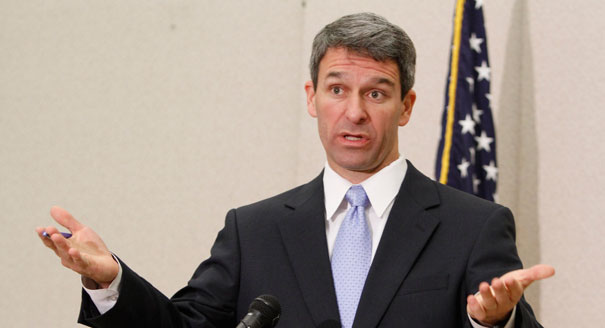
The prospect of a genuine strategic rethink by Virginia Republicans lasted about two hours, before the off base exit polls gave way to a far narrower than expected loss by Ken Cuccinelli—the kind of “might have been” that provokes more rationalizations than insights. Perhaps predictably, I am in the camp that thinks a game plan of squeezing every last drop out of the political base with no credible appeal to the center, and abandoning state issues in the quest for a referendum on national healthcare policy, was actually lucky to hit 46 percent of the vote (and required a final week of Democratic coasting to get that close).
Because the first part of that formulation has been analyzed to death, I’ll dwell on the second part: the curiosity that the famously articulate Cuccinelli never defined on his own terms why his unfettered conservatism was a virtue. In the perverse way that opposites tend to resemble each other, Cuccinelli’s campaign actually mimicked his Democratic opponent, Terry McAuliffe , by avoiding any discussion of much of the policy landscape that will surface on the next governor’s desk: neither nominee got around to addressing the decision by the state’s flagship university to downscale its tuition assistance plan for low income students; both offered weak and shifting positions on the nature of the state’s energy production future; neither spoke to the question of whether federally adopted Common Core standards ought to be adopted in local school districts; and the subject of whether Virginia will move toward softer or tougher standards for unemployment assistance never came up. The unresolved dilemma of what or who will make up the difference if the federal internet sales tax proposals that are intended to finance a chunk of Virginia’s new transportation plan never materialize? It’s a wide open guess that neither would-be governor got around to mentioning.
The one state level issue that was debated in the race that just ended was, of course, whether Virginia should accept federal expansion of its Medicaid program. But “debated” is a relative term, given that Cuccinelli framed the subject almost exclusively as one of whether Virginia should embrace the Affordable Care Act writ large and McAuliffe’s advocacy for expansion never made its way into a single one of about 35 iterations of his statewide ad buy.
McAuliffe’s contribution to the substance free nature of the race at least made political sense: in focusing on Cuccinelli’s hard edged positions, McAuliffe made the point that his opponent’s governorship might pursue its share of distractions and that coalition building was not exactly a dominant part of Cuccinelli’s history. Fair or not, complete or not, that is at least an accounting of the risks in right-wing leadership, and McAuliffe’s shortchanging of specifics was a necessary concession to his own thin public record and his penchant for superficiality over fine print.
In contrast, a Republican candidate with a reputation for smarts and fluency in defending his views left his agenda so vague, so insubstantial that McAuliffe’s parody of those same views was all but uncontested–unless an undecided voter or a moderate Democrat was persuaded that the kind of man who is “attentive to details and serious” (one stunningly bland GOP ad) and who labored to overturn a wrongful conviction (another Cuccinelli spot that got lost in its own weeds) couldn’t possibly wage a crusade against birth control).
My own guess is that Cuccinelli’s advisors concluded that the social issue terrain was too unwinnable to defend and that a counter-attack on McAuliffe for, say, favoring late trimester abortions offered more risk than reward. (and presumably, that reminding voters of Cuccinellii’s principled opposition to mandatory ultrasound exams in advance of abortions would only dampen the fervor of the pro life grassroots who had been career long allies). It is also true that Cuccinelli took a stab at some of the themes that are at the essence of conservative reform—like middle income tax relief and expanding charter schools and parental choice in school district assignments. But the reform bent of his candidacy was overwhelmed by the exponentially greater advertising dollars and rhetorical energy attacking McAuliffe on ethics and investments; and on the related bet that “McAuliffe, the flashy wheeler dealer” would prove more off-putting than “Cuccinelli the extremist.”
It’s telling that a Republican who extols the benefit of state government at the expense of federal power offered such a scattered narrative about what conservative state governance would actually look like. Its telling and depressing that Team Cuccinelli assumed that the substance of a conservative policy platform wouldn’t provide the potential of both energizing his base and co-opting independents. It’s not only the center that seems to lack confidence in its persuasive powers.
My friend and Boston Globe innovation columnist, Scott Kirsner, has launched an interesting new on-line platform for corporate innovation executives. You will want to check out and subscribe to Innovation Leader where you will find lots of food for innovation thought and where this post originally appeared.
I used to think that if I just yakked long and loud enough, I could convince CEOs to embrace transformational innovation. It took me 25 years as a road warrior consultant, author, and accidental government bureaucrat to realize that proselytizing doesn’t work. If leaders don’t want to change, all the consulting jargon and fancy PowerPoints in the world won’t convince them to.
In those situations, no matter what lofty rhetoric the CEO uses in public or at company retreats about “creating an innovation culture” and encouraging everyone to think outside of the box, the best result you can hope for are incremental innovations to improve the performance of today’s business model. You never get transformational new business models — and you always get frustrated if you were hoping for bolder change. If you want transformational innovation, you have to find leaders who want transformational change and are receptive to organizing differently for tweaks than for transformation. After learning this lesson the hard way over many years, I no longer try to convince CEOs who don’t want to change, and instead try to find those CEO’s who do.
Here’s my list of 10 questions you can ask a CEO to tell if they are really serious about transformational innovation:
1) Do you agree transformational innovation goes beyond breakthrough products to include business model innovation — entirely new ways to create, deliver and capture value?
2) Will your employees tell me that failure is a career-limiting move, or that the company celebrates experimentation?
3) How much time do you spend strengthening and protecting the current business model, versus designing the next one?
4) Do you have clear and discrete objectives for both incremental and transformational innovation? Do you organize differently for each?
5) Does your organization invest in R&D for new business models as it does for new products, services, and technologies?
6) Are you prepared to have your organization disrupt itself? How do you see that playing out?
7) Do internal ideas and projects that threaten to cannibalize the current business model get squashed — or nurtured?
8) Do you have a process for allocating resources for transformational innovation projects that lies outside of the control of business units?
9) Do executives with responsibility for exploring transformational business models report to you, or to another line executive responsible for today’s business?
10) Are you willing to create a sandbox to explore transformational business models? Would you carve out a part of your current business/market to serve as an ongoing real-world innovation lab?
A few words of advice about using these questions in the real world… Tread lightly, since no CEO likes to be put on the spot and drilled with a laundry list of questions. Pick a few of the ten to put into your own words to help you discern whether the company you work for, or are thinking about working for (or with), has a leader who shares your appetite for transformational innovation. Better to know what kind of environment you’re going into in advance than to learn painful lessons later.
By John Y. Brown III, on Fri Nov 15, 2013 at 12:00 PM ET
You know those conversations you have after a certain age that you didn’t see coming….and are mostly pointless and make you laugh at yourself.
These kinds of conversations begin happening after about age 40. Sometimes they begin just as a conversation with yourself. Other times another person or persons may be involved.
But they become a staple you rely on to fill up empty air.
Tonight after dinner with friends my wife and I were driving home and I had a few crumbs on my face from dessert.
I told Rebecca that when I die and they are preparing my body to please make sure I don’t have crumbs on my face. I am still going to be a little self-conscious even though I have passed on. I don’t want people at my funeral talking about me (or remembering me) as a slob and their last image of me is as a sloppy eater. I think that was a fair request.
And then I pointed out to try to put an amused smirk on my face so it would look like I was thinking of something funny–even though I wasn’t still alive. I know it’s mostly for “affect” and that is supposed to be shallow. But when you are dead, I’m guessing, the whole shallow versus deep thing doesn’t matter as much. Looks are more important. Because that’s about all you can do. Be looked at. You can’t make up for a bad looking image with a winning personality at that point. I do often have that amused smirk on my face when alone like I am thinking of something mildy funny and I think it will be a good look for me, posthumously. It is certainly a lot better than the current norm of being remembered with absolutely no expression on my face like you are are indifferent to everything around you. Or bored to death. And certainly better than having dessert crumbs at the corner of your mouth and on your chin.


 Blog this!