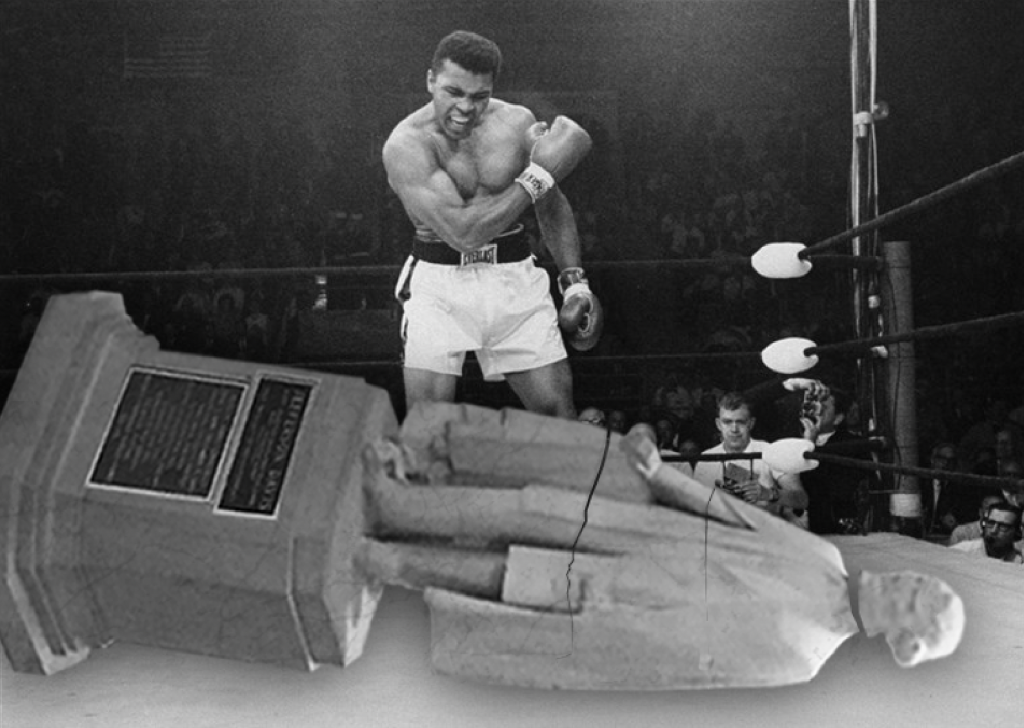
Please sign the petition below to remove the statue of Jefferson Davis currently in Kentucky’s Capitol Rotunda, and replace it with a tribute to Muhammad Ali, “the Louisville Lip” and “the Greatest of All Time.”
I just heard from the Ali family: It is the Champ’s belief that Islam prohibits three-dimensional representations of living Muslims. Accordingly, I have adjusted the petition to call for a two-dimensional representation of Ali (a portrait, picture or mural) in lieu of a statue.
UPDATE (Tuesday, December 2, 2014)
In this interview with WHAS-TV’s Joe Arnold, Governor Steve Beshear endorses the idea of honoring Muhammad Ali in the State Capitol (although he disagrees with removing Davis). Arnold explores the idea further on his weekly show, “The Powers that Be.”
Click here to check out WDRB-TV’s Lawrence Smith’s coverage of the story.
And here’s my op-ed in Ali’s hometown paper, the Louisville Courier-Journal.
UPDATE (Saturday, June 4, 2016)
In the wake of the 2015 Charlestown tragedy, in which a Confederate flag-waving murderer united the nation against racism, all of the most powerful Kentucky policymakers — U.S. Senator Mitch McConnell, Governor Matt Bevin, Senate President Robert Stivers and House Speaker Greg Stumbo — called for the removal of the Davis statue from the Rotunda. Today, as we commemorate last night’s passing of Muhammad Ali, there is no better moment to replace the symbol of Kentucky’s worst era with a tribute to The Greatest of All Time.
UPDATE (Wednesday, June 8, 2016):
Great piece by Lawrence Smith of WDRB-TV in Louisville on the petition drive to replace Jefferson Davis’ statue in the Capitol Rotunda with a tribute to Muhammad Ali.
UPDATE (Thursday, June 9, 2016):
Excellent piece on the petition drive by Jack Brammer that was featured on the front page of the Lexington Herald-Leader.
Highlight of the article:
Miller said he has received a few “angry comments” on his call to honor Ali.
“One of them encouraged me to kill myself,” he said. “You can quote me that I have decided not to take their advice.”
UPDATE (Friday, June 10, 2016)
The petition drives continues to show the Big Mo(hammed): check out these stories from WKYU-FM public radio in Bowling Green and WKYT-TV, Channel 27 in Lexington:
UPDATE (Saturday, June 11, 2016):
Still not convinced? Check out this excerpt from today’s New York Times:
When I was an exercise science student at the University of Kentucky, I had to take swimming in order to graduate. Why? Who knows but also would think it would be difficult. I’m not an avid swimmer, I do better under the water than on top but I absolutely hate cold water. I freeze easy and it’s hard for me to move any part of my body. The very thought of cold water makes me cringe but I needed this class to graduate and I was taking it in January no less. The first day of class the teacher throws us in the water to see where our “skills” were. Back stroke, front stroke, butterfly all your favorite Olympic disciples were graded. She would decide if we needed to be in the class or would need to drop it. I couldn’t of done worse. I damn near drowned in the water and ran out of gas easy because it was so cold. Did I mention I don’t do cold? Anyway, the next class the teacher pulled me aside and asked me to drop the class. Appalled, I asked why and she replied “you don’t have the skills to pass my class.” I told her I wouldn’t be dropping her class and I would show up an hour early everyday to practice. Her reply, “good luck.” Seriously, who makes swimming hard?
So everyday I showed up to the UK aquatics center an hour before class to practice my strokes. I braved the cold weather and cold pool, to get use to it so I could show this teacher she was wrong. I was consistent and with my consistency, I saw progress. Real progress. So good I amazed this teacher and I got an A in the class. Now, everyone should get an A in swimming, that’s not impressive, the point is I was consistent and I got better. Much better. We have to apply this principle to fitness. You can’t expect great results with minimal effort. The infomercials lie to you. Using a Shake Weight is not going to help you lose 15lbs, it’s just that simple. But also with that, you can’t expect significant results if you are not consistent in two areas:
1. Your workouts
2. Your diet
So here are two strategies to help with consistency as we make this fitness journey together:
1. Commit less- This may sound weird but as I’ve said before we often commit too much too soon that it becomes sensory overload and we quit. It becomes too much to maintain. Had I told the teacher I would be in the pool five days a week, there would be no way for me to keep that pace consistent (nor would I want too). Commit to what you think you can do. This works for your nutrition as well. Commit to eating one vegetable at dinner, 3 nights per week. Any one can do this. This creates momentum. There is great value in little, everyday successes. Foundation is always something to build off of.
2. Commit more- Contrary to the above, some people may be able to commit to more because they are ready for more. If this is you make consistency a commitment, a marriage. Start what you finish and don’t let off the gas pedal.
In order to see progress we NEED consistency. It is vital to anything we want to accomplish.
By John Y. Brown III, on Wed Jan 1, 2014 at 12:00 PM ET
Passing down (and up) traditions and wisdom from generation to generation.
Sunday night my son was walking out to his car with a short sleeve shirt on and I yelled “Johnny, wait a minute. How are you going to stay warm?”
Johnny replied, “My car, Dad. It has heat.” “I know that,”
I said, “But what if you have a flat tire or your car breaks down? It would be a good idea to keep a jacket or blanket in your car, just in case. I know I am irrritating you with advice like this but my mom told me the same thing when I was walking out of the house at your age without any socks on in the middle of a snow storm.”
Johnny, looking at me not irritated but amused shot back, “Did you do it? Did you keep a blanket or jacket in your car after that?”
“No. No, I didn’t,” I said. “But it was still pretty good advice. You know?”
“Look, Dad,” Johnny responded, “You are forgetting you had two parents you got your genes from. Grandmommy, who constantly is giving advice; and Big John, who never takes any advice. And I have the same genes so it’s just a waste of both our time for you to keep trying to tell me what I should do. It may be a good idea. But you didnt do those things and neither will I.”
We both laughed and agreed that was the wisest advice passed between father and son in a long time.
Yes, once again it’s time for end-of-the-year rituals. Maybe you come up with the type of resolutions that help gyms make a fortune from people who join and never show up. Or perhaps you scour critics’ lists of ’10 Best’ or ’10 Worst’ lists of the year’s movies, t.v. shows, political scandals, etc. Some families have charming New Year’s traditions. When I was a kid, we would eat chocolate fondue, drink Andre Cold Duck (hey, I was 8, I thought it was classy) and watch old Abbott & Costello movies (on a projector my mom borrowed from the school where she taught – this was way before DVDs and videos, although despite my own kids’ rude comments about how old I am, it was WAY after one-room schoolhouses). When my own kids were little, I would let them watch the televised countdown from Times Square (of course, when they were younger, I was able to convince them that midnight in New York was the same in California, thus enabling me to get them to bed at 9 p.m.) (Which was not intended to get back at them for the ‘mom, you’re old’ teasing . . . but I digress.)
My earliest comedy-song-writing influence was Tom Lehrer’s great album, “That Was The Year That Was” (hold on, you’ll see how it relates). I wanted to reference that album in relation to this week’s song, but in researching which year he’d meant (which turns out to be mostly 1964, although the album was released in 1965), I learned that he had been the resident songwriter for performers on the US version of a British weekly TV program, “That Was The Week That Was,” and the record featured Lehrer finally performing those songs himself. So weekly comedy songs are part of a long tradition!
Anyway, as inspired by Mr. Lehrer, here’s a musical recap of the year’s highs and lows, or as some might say, “from the sublime to the ridiculous.” Happy New Year!
By John Y. Brown III, on Tue Dec 31, 2013 at 12:00 PM ET
Thought for the day (Perception and problem solving)
When faced with a new and unpleasant predicament I like to think of the best part about it, the worst part, the slver lining and the reality of the entire situation.
For example, today I am congested and have a cold.
Best part: I can sound like Barry White when I talk to my wife.
Worst part: My wife keeps clear of me while I am contagious.
Silver lining: Sometimes I fully recover from my cold and am no longer contagious before my voice completely heals and I can sound like Lou Rawls for a couple of days when I talk to my wife. (Lou’s voice isn’t as deep as Barry’s was but still sounds low, slow, melodic and smooth.)
The reality of the entire situation: It’s too bad I can’t sing with or without a cold.
Now, that doesn’t necessarily mean I should take singing lessons instead of taking Advil. It only means I should at least seriously consider that option.
What is it about Champagne that so aptly embodies New Year’s Eve? Is it the effervescence, the silky luxury of a liquid that personifies decadence?
Is it the exoticism of a wine that most reserve for special occasions?
As surely as sequins and “Auld Lang Syne,” you will see gallons of the beverage imbibed on this night.
Perhaps it’s because New Year’s provides one last chance to indulge in a spell of revelry before settling into the quiet sobriety of winter resolutions.
Whether you’re hosting a New Year’s dinner party or just want a toast-worthy drink to pour before hitting the bars, it’s a good opportunity to brush up on your bubbly knowledge.
Of course, legitimate “Champagne” only originates in the region of France by the same name. All other bubblies are actually sparkling wines, and there are many interesting choices. California makes some excellent versions, as do Washington state and Virginia.
For inexpensive but lively European sparklers, try a Spanish Cava or a German Sekt. The Italians offer an array of fabulous sparkling wines, from the dry Prosecco to the sweeter Asti. There are also fizzy Shirazes, Rosés, and Lambruscos, all of which set a festive tone for merrymaking.
Sparkling wines are famous for their versatility with food pairings. A dry type complements everything from foie gras to spicy curry to apple pie. It’s also wonderful on its own. Save the sweeter kinds for before or after dinner, as they can overwhelm the palate and diminish the taste of many dishes.
As you’re perusing the Champagne aisle of your local wine shop, keep in mind the dryness vocabulary. From driest to sweetest, the range is Extra Brut, Brut, Extra Sec, Demi-Sec and Doux.
Ready to rollick? Here are a few picks to kick-off this boisterousnight.
For a semi-sweet Italian sparkler, try: Martini & Rossi Asti.
For a fruity, Californian sparkling wine, try: Schramsberg 2009 Brut Rosé
For less than $10, this dry Cava is an absolute steal: Jaume Serra Cristalino Brut.
For classic French Champagne from a storied brand, go for: Taittinger Brut Reserve NV.
Cheers to a fantastic year and to many new memories in the making!
By Erica and Matt Chua, on Tue Dec 31, 2013 at 8:30 AM ET
“Going where no man has gone before” is every adventure traveler’s dream. Sadly though it isn’t possible. Unless you explore the deep seas, there are very few places a person can go and be the first. We travelers like to imagine ourselves discovering something new, doing something that has not been done before, but the reality is that we’re just going where others have stood before. While the places we go may impress our geography challenged friends or our ninety-year old Great Aunts, there are no roads not traveled. It’s awesome to be among the few to have visited North Korea and Antarctica, but as Shania Twain would say, “it don’t impress me much”. The most impressive places are those where you share experiences, make friends, which, consequently, draw many other tourists. The Salar de Uyuni, a must-see on the South American Gringo Trail is one of those over-touristed, wonderful, experiences.
Situated on Bolivia’s border with Chile, the Salar de Uyuni is a well traveled 3-day tour that typically starts in one country and ends in another. It is a common destination shared by South American backpackers as “everyone” does it. Why does everyone go here? Crazy photos created by the reflecting salt flats and the dry atmosphere. The curiosity that the Salar de Uyuni is the world’s largest salt flat doesn’t draw tourists…it’s the cool photos.
Americans have to pay a “reciprocity fee”, which can be done at the end of the tour. Until then we were the responsibility of the tour company, which found it easiest to put us all in one Landcruiser. Two Brits decided to come along with us, because, well, let’s be honest: Americans are pretty awesome.
Read the rest of… Erica and Matt Chua: The Gringo Trail — South America
By John Y. Brown III, on Mon Dec 30, 2013 at 12:00 PM ET
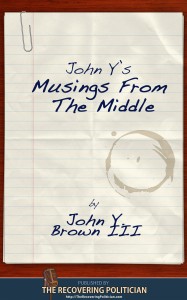
Click here to purchase his first book
My second book and the fear of too much success.
I almost have enough new posts to put out a second book of Musings from the Middle before Christmas. But am not sure I have the time to risk having a blockbuster best seller.
It made me think of the time as a teenager I was shooting craps with friends and had failed to roll a pass for 10 consecutive rolls.
My logic before doubling down my bet for the 11th roll was “Since I had failed to roll a pass 10 times in a row I had much greater than usual odds to succeed on my 11th roll.” But I didn’t and lost my last dollar.
Later a math teacher explained to ne that if I flipped a coin 10 times in a row and it was heads each time on the 11th flip it would still only be a 50-50 chance of it being tails. I never liked that math teacher and always thought he was overly pessimistic about life.
So since my first book only has sold in the very high two digits (almost low three digits) and is ranked, like, two trillionth in sales rank on Amazon.com my old logic is returning and telling me if the first book was a complete sales failure the chances of a second book being a great success is pretty much guaranteed. At least if you look at the numbers, understand my logic, and have an optimistic mathematical view of the world, unlike my former math teacher.
Sometimes you just have to go for it and take the risk in life even when logic dictates you won’t have the time to handle your overehelming success. Just do it anyway and figure it out later.
And besides, what’s the worst that can happen? Sales jn the high two digits again? Heck, that would only means a third book would likely be a sure NY Times best seller.
In 2012, just prior to the November presidential election. I wrote in RP, a closing argument on behalf of my chosen candidate, Jill Stein of the Green Party. I asked readers to try to imagine a political party really wanting America governed progressively. Imagine its platform stressing the environment, social justice, human and civil rights, peace. and disarmament. I had concluded, the two-party duopoly, may claim they support advancing these values, but the truth, upon closer analysis, proves they do not.
The election results showed only about 1.8% or 2.3 million of the combined popular vote were cast for any third-party candidate. All third-party campaigns had been predicting a better turnout than in the past, but like most, I knew, at this time, a third-party candidate would not win the election. Nonetheless, I felt good about my pragmatic and principled vote for Jill Stein.
The control exerted by the present two-party duopoly leaves third-party candidates little hope of being elected to a major office, until fundamental changes in our electoral process occur. Such candidates have continued to run and by doing so, have influenced election outcomes while often shifting national conversation.
The question remains, has anything changed in America since the 2012 presidential election, which would improve third-party chances in the future? Do the majority of Americans, regardless of party affiliation, think a capable and robust third-party is needed?
The Gallup organization, for the past 10 years, has been asking this question. In October 2013, they reported their latest’s poll results. Perhaps it was a surprise to some, but voters polled have said “yes!. The majority of Americans, now believe a major third-party is needed.
Presently, Americans see dysfunction, by both political parties, in the way government works is within a point of it’s all time low, suggesting, Americans are fed up with the way the major parties are handling things, even going as far as saying the best solution is a major third-party initiative in 2016.
Lookin at the numbers: 26% of Americans say the two major political parties are doing an adequate job, yhgt 60% say the two major parties are doing such a poor job that a third party is needed. Is that a big change from previous polls? Not really, although that 60% the highest Gallup has ever seen on this question over the last ten years.
Also, for the first time in U.S. history, Gallup found, given the inability of the Republican and Democratic parties to agree on the most basic of government functions, 52% of Republicans and 49% of Democrats believe a third party is needed to adequately handle today’s problems. Expectantly, 71% of independents support a third-party initiative.
How about other demographics? You might expect young voters to favor a third-party. You would be wrong! Young voters, aged 18 to 29, perhaps due to difficulty finding a job paying a living wage, the pressure of going to college, then trying to payoff exorbitant college debt has caused them to take their eye off of politics. According to Gallup, this demographic polls the highest, saying the current system is OK. It’s the 50 to 64 year olds, probably worrying about healthcare, Social Security and Medicare who most want a third-party choice.
Also, what about the idea of divided government? Most of us, along with some pundits and commentators, have come to the conclusion having divided government, as it is now, with the Presidency and Senate controlled by the Democrats and the House of Representatives by the Republicans lead to the kind of paralysis we are seeing in Washington. But, the Gallup poll found there is no pent up demand by the American public for one-party control of all three branches. It is just the opposite.
25% say it is better for the country to have the same party in control of the Presidency and Congress,
38% say the political party of the President and the Congress makes no difference, and 28% say it is better to have the President and Congress of different parties. Matter of fact that 25% is, by a few points, the lowest interest in having a single party government in the 10 years the Gallup organization has been conducting this poll.
Similarly, according to a new CNN/ORC poll, the current Congress is not just bad, it is terrible. Two-thirds of Americans think it is clearly the worst Congress in their lifetime.
CNN wrote: “That sentiment exists among all demographic and political subgroups. Men, women, rich, poor, young, old, all think this year’s Congress has been the worst they can remember,” “Older Americans, who have lived through more congresses, hold more negative views of the 113th Congress than younger Americans”.
Amazingly, despite the terrible results of these two polls, well over 85 percent of the current members of Congress are expected to be re-elected in 2014! Upcoming columns will explore the question, is there not something wrong with the design of an electoral system when the connection between job performance and election outcome can be so weak?
Just hope and desire for a third party is not sufficient to ensure there will be another successful one. Unfair structural factors contrived by the two-party duopoly for the presidential and congressional elections and the parties’ own abilities to deceitfully, yet skillfully, adapt to wavering public opinion and preferences, then altering their campaigns, helped the Republican and Democratic parties remain the dominant parties for more than 150 years. Emerging third parties have challenged their dominance but not been able to sustain any degree of electoral success.
All hope for a third-party presidential victory may not be lost. It has happened before in U.S. history. Do you know which President was the last successful third-party candidate?
===
Gary Yarus is a student of political movements, a progressive populist, a Green Party pro-democracy advocate and the curator of an online magazine, covering democracy, ecology, peace and social justice called “The Beacon” ( http://bit.ly/TheBeacon ). Email: gyarus@me.com
Maybe we need to bang together the heads of mad scientists and mad designers.
If we are waiting for randomized double blind studies to tell us how to address the big social system challenges of our time including health care, education, and energy we will be waiting a very long time. That is not how we will transform these systems. It will take passionate exploration, which is more iterative than traditional scientific methodology. It will take design thinking and process combined with powerful storytelling to create novel networked systems to deliver the value we need and expect in the 21st century. We need to try more stuff.
Last week I spoke at the Business of Aging: Ontario Innovation Summit in Toronto. It was a great event attended by many innovators from across the public and private sector. Attendees all shared a passion for focusing innovation on the opportunity emerging as the silver tsunami of an aging global population rapidly approaches. I shared my point of view on the need to do R&D for new business models and systems and our work at BIF in the Elder Experience Lab. As I always do, I blathered on about design and storytelling tools as the key enablers to system change, in this case developing age friendly environments and communities.
The reaction was largely positive but during a panel discussion I was reminded that many are still stuck on a perceived conflict between design thinking and analytical thinking, between design process and scientific method. They are not mutually exclusive. We need to apply our opposable minds to borrow from both approaches to design new systems while measuring what works and is most likely to scale.
I was asked by summit organizers what I thought would be the most important innovation to enable an age friendly society by 2020. I replied:
Perhaps the most important innovation for an age-friendly society by 2020 does not require inventing anything new at all. Maybe it just requires all of us to reexamine our assumptions about the elder experience and ways to enhance it. Innovation is a better way to deliver value, in this case, designing environments and systems that enable elders to age in their own homes and communities with dignity. The innovation may be nothing fancier than bringing the voice of the elder directly in to the conversation and designing a better experience recombining existing capabilities and assets in new ways to serve the needs of society’s elders.
Most of today’s innovation conversation is through the lens of the institutions that comprise the current elder care system. The elder’s voice is missing. Tweaking the current system will not work. Adding technology to the current system will not work either. We need to design new system approaches to enhance the elder experience and to prepare for the imminent silver tsunami of baby boomers that will bring a completely new set of expectations and desires to the age-friendly conversation.
It is not technology that is getting in our way. We have more technology available to us then we know how to absorb. It is humans and the institutions we work in that are both stubbornly resistant to change. Rather than applying technology in a sustaining way to try and improve the current institutionally based elder care system we need to experiment with technology as a disrupter to enable new system approaches that enable elders to age in place. We need system level innovation designed around the elder to create environments and care models that enable a more age-friendly society.
It is odd for me to represent design thinking and process in the debate when my training is as a scientist and MBA. The reason I hang around so many smart designers is that I don’t think the old tricks alone will enable the system change we need. We need to borrow from both approaches to pave a new way. It is messy but necessary. Lets bring together the mad scientists and mad designers and see what happens.


 Blog this!