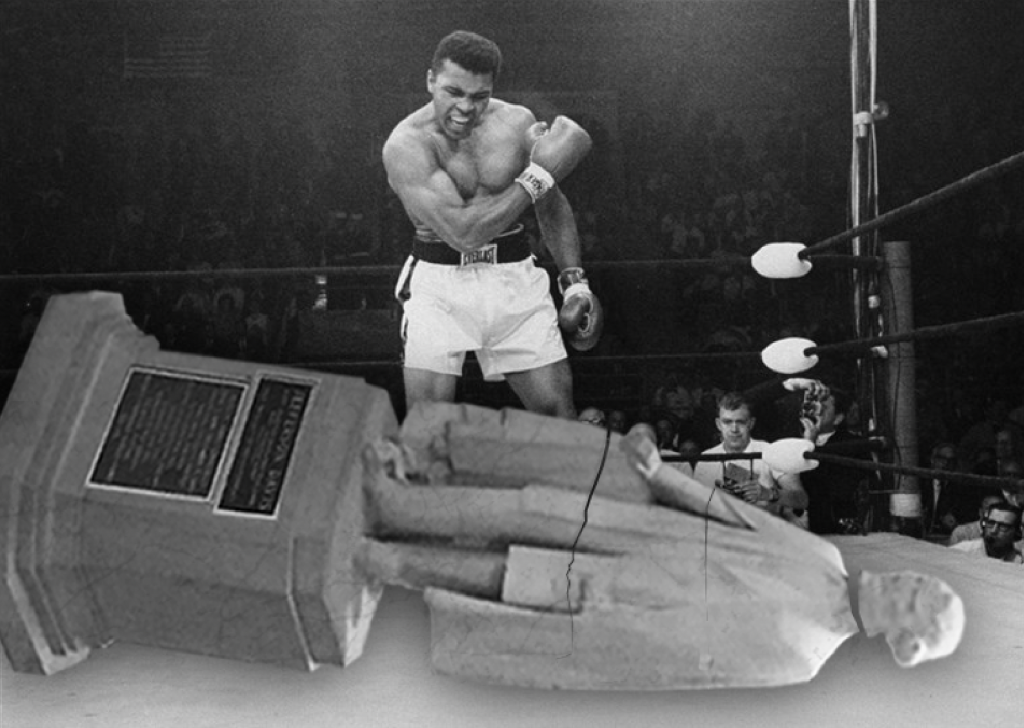
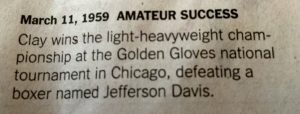
Please sign the petition below to remove the statue of Jefferson Davis currently in Kentucky’s Capitol Rotunda, and replace it with a tribute to Muhammad Ali, “the Louisville Lip” and “the Greatest of All Time.”
I just heard from the Ali family: It is the Champ’s belief that Islam prohibits three-dimensional representations of living Muslims. Accordingly, I have adjusted the petition to call for a two-dimensional representation of Ali (a portrait, picture or mural) in lieu of a statue.
UPDATE (Tuesday, December 2, 2014)
In this interview with WHAS-TV’s Joe Arnold, Governor Steve Beshear endorses the idea of honoring Muhammad Ali in the State Capitol (although he disagrees with removing Davis). Arnold explores the idea further on his weekly show, “The Powers that Be.”
Click here to check out WDRB-TV’s Lawrence Smith’s coverage of the story.
And here’s my op-ed in Ali’s hometown paper, the Louisville Courier-Journal.
UPDATE (Saturday, June 4, 2016)
In the wake of the 2015 Charlestown tragedy, in which a Confederate flag-waving murderer united the nation against racism, all of the most powerful Kentucky policymakers — U.S. Senator Mitch McConnell, Governor Matt Bevin, Senate President Robert Stivers and House Speaker Greg Stumbo — called for the removal of the Davis statue from the Rotunda. Today, as we commemorate last night’s passing of Muhammad Ali, there is no better moment to replace the symbol of Kentucky’s worst era with a tribute to The Greatest of All Time.
UPDATE (Wednesday, June 8, 2016):
Great piece by Lawrence Smith of WDRB-TV in Louisville on the petition drive to replace Jefferson Davis’ statue in the Capitol Rotunda with a tribute to Muhammad Ali.
UPDATE (Thursday, June 9, 2016):
Excellent piece on the petition drive by Jack Brammer that was featured on the front page of the Lexington Herald-Leader.
Highlight of the article:
Miller said he has received a few “angry comments” on his call to honor Ali.
“One of them encouraged me to kill myself,” he said. “You can quote me that I have decided not to take their advice.”
UPDATE (Friday, June 10, 2016)
The petition drives continues to show the Big Mo(hammed): check out these stories from WKYU-FM public radio in Bowling Green and WKYT-TV, Channel 27 in Lexington:
UPDATE (Saturday, June 11, 2016):
Still not convinced? Check out this excerpt from today’s New York Times:
“To be yourself in a world that is constantly trying to make you something else, is the greatest accomplishment.”- Ralph Waldo Emerson
Recently I was reading an article I found on Facebook called “5 Regrets of Dying,” and the first regret was “I wish I’d had the courage to live a life true to myself, not the life others expected of me.” This got me thinking about life in general and how I see people who live their lives for someone else and not for themselves.
I can be accused, justifiably so, for being a workaholic and someone who is passionate and borderline obsessed with his work and craft. But I will say for all that I sacrifice; personal time, vacations, time with friends and family, I do my work, not because I have to but because I want too. I lead this life the way I want. Everything is my choice. Some people will love me and some won’t. That is the nature of life.
So putting fitness aside, I thought I would write about life in general. And pose the question to everyone; “Are you living to die or dying to live?” Here are five steps to separate yourself from everyone else and be who you are suppose to be:
1. Radical Self-Responsibility
We have become people who always point the finger at others. As to say it is always someone else’s fault or problem why we are where we are. At the end of the day, the responsibility falls on our shoulders. If you didn’t workout today, that is your fault. Manage your time better. In order to get out of the usual and become someone of distinct characteristics, we must take full responsibility for everything.
2. Stop Caring What People Think
Right or wrong we all care what people think of us…to a degree. I care what my family thinks of me. However, I do not let them sway me one bit. Some people will love you, others will not, stop caring what those who only want the worst for you, think. “Wolves do not fret over the onions of sheep.” Are you a wolf or a sheep? You pick?
3. Stop Being So Superficial
At the end of the day, we will all die and the way we looked or the things we had will not matter. What will matter most is the impact we had on the people we leave behind. Treat your body right but don’t obsess. Have nice things but realize they are only just that, things.
4. State Your Opinion
This is a difficult one. In today’s landscape, having an opinion can be looked at as a hindrance more than a benefit. However, I was always taught to stand up for your beliefs and to give your opinion if asked. To this day I do not shy from stating my opinion no matter how unpopular it is.
5. Realize Life Will be Over Soon
To quote a phrase, “I’m not here for a long time, I’m here for a good time.” None of us are here for a long time. We are given a certain amount of time on this earth and we must make the most of it. If you want to try something, go try it. You want to start your own business, go start it. Fear absolutely nothing and careless what anyone has to say about it. Leave a legacy someone could be proud of. It will make a vast difference in the world, trust me.
We were all meant to be extra-ordinary in our lives. But you can’t do this from your desk or your couch at home. You must get off your ass and change your mindset on being you, the real you. Show people who you are. It will make a world of difference.
By John Y. Brown III, on Wed Aug 6, 2014 at 12:00 PM ET
TMI? (Too much instruction?)
I just tried to look up on YouTube “How to whistle using a blade of grass” to prove to myself how incredibly exhaustive “How to” videos are on YouTube.
And I found one!!
But what really caught my attention is that 45,459 people had “viewed” the video.
Including me.
(It’s actually an excellent instruction video, you know, if you are interested and don’t already know how to.)
And I will point out that to date no one has yet put out a “How to” video on how NOT to whistle using a blade of grass.” So there is still a vacuum waiting to be filled.
One of my favorite college classes examined children’s literature through the lens of cultural attitudes towards childhood. For example, the Brothers Grimm wrote all those dark, scary tales of witches & evil forests because in their day (early 19th century), childhood was just a smaller version of an awful adulthood. Poorer kids had to work on farms or in factories, even wealthier kids succumbed to disease, and stories had to prepare them for the general dangers of the world. In the Victorian era (later 19th century), children were viewed as pure and angelic, so their books were supposed to help enhance their innocence. And by the 20th century childhood really evolved into a separate phase of life, where books could enhance kids’ imagination or teach them valuable lessons. (And reading all these stories was a welcome change from typical academic fare – I loved sitting in the library, where my classmates were absorbed in Advanced Principles Of Molecular Biology or The Sociolinguistics of Anthropology, and they’d look over to see me enjoying “The Little Engine That Could.” But I digress . . . )
Sometimes, however, we would run into a classic piece of children’s literature that didn’t fit this historical trend – and in the case of some, like the Lewis Carroll ‘Alice’ books, as college students we naturally concluded his influence was pharmaceutical instead of cultural. Rabbits with pocket-watches? Disappearing grinning cats? Drinks & cakes that changed her perspective? (Okay, you can explain the Mad Hatter by the fact that the chemicals used in hatmaking were so toxic, they caused brain damage, hence the expression ‘mad as a hatter’, but Carroll’s Hatter was still pretty weird.) And for generations kids have enjoyed the strange, surreal world of Alice, thinking nothing in their lives would ever seem so crazy.
Until lately – the political scene has gone so out of whack, not even Lewis Carroll could have written it . . .
By John Y. Brown III, on Tue Aug 5, 2014 at 12:00 PM ET
My son just went skydiving…And didn’t tell me until after the fact.
“My son?!” I exclaimed when my wife and daughter told me. “I cannot believe my son—my flesh and blood–could muster the nerve to jump out of an airplane! I could never do that!”
To which my daughter Maggie wryly replied, “At least he’s not doing the kinda things you did when you were his age!”
Game, set, match to Maggie.
A good and loyal sister –and best family comeback of the year.
By Erica and Matt Chua, on Tue Aug 5, 2014 at 8:30 AM ET
What makes a “Great Walk”? This question haunted me after reserving our spots on the Milford Track. Reputedly one of the world’s best hikes, reservations are required months in advice at the cost of almost $250 USD per person for the four day, three night, hike. What kind of public park hike requires you to carry all your stuff, cook your own food,and costs over $50 a day? After a year of traveling on less, paying that much to hike uphill seemed absurd. That said, having made the payment, we’d soon find out how great this Great Walk is.
After a beautiful boat ride to the trailhead the first day is lovably short hike through moss-covered forests.
Read the rest of… Erica and Matt Chua: Hiking the Milford Track
By John Y. Brown III, on Mon Aug 4, 2014 at 12:00 PM ET
I have decided that people in NYC aren’t really rude. They just aren’t very people smart and don’t know how to handle it.
Like the kid in high school who strughled with math and would say things like “Math is stupid!” or “No one will ever use this stuff. What a waste of time!” He wasn’t being rude but what we will call “Math rude” because he was confused about how to do math and was afraid others might notice.
I know this happens for a fact because I was “Foreign languages rude” myself. And “Chemistry rude.” And “Music appreciation rude” and Pre-calculus rude,” too.
So if a New Yorker is brusque with you for no apparent reason, don’t get angry or get your feelings hurt. Just remember, it’s not you. They are just being “math rude.”
John Hagel speaks with satisfying precision. He has kind eyes and stern glasses, which together dominate the screen during a Sunday-afternoon Skype conversation.
As co-chairman of Deloitte’s Center for the Edge, Hagel hunts for unexploited capability on the “edges” of business and makes the case to include them on the CEO’s agenda. “The edges are most fertile areas for innovation,” he says. They are an important place to watch, because what happens at the edges transforms the core.
Hagel’s research encompasses geographic edges (overseas economies), demographic edges (younger generations entering the workforce, their unmet needs), and the edges of technological discovery. If there’s anything his work has taught him, it’s that the manual is less of an asset than the “ability to respond to unexpected events.”
Hagel believes that we are approaching fundamental revaluation of the role corporations play in our lives.
Corporations in the first half of the 20th century were built around what Hagel calls the “push” business model. The greatest asset of these vertically integrated, gargantuan structures was their knowledge stock — aggressively protected trade facts and formulas that allowed them to forecast with reasonable accuracy which direction to “push” operations.
However, this push model is failing in the face of expanding digital technology infrastructures, Hagel claims. Reinforced by long-term policy shifts toward economic liberalization, barriers to market entry have been significantly reduced on a global scale. The pace of our transactions has increased, the lifespan of knowledge stocks has decreased and competitive intensity in the US economy has doubled in the last 40 years. Hagel calls this “the dark side of technology” — a counter-narrative to the Silicon Valley script of dazzling possibility.
But Hagel sees an antidote to this volatility: openness. “People are realizing that they need to collaborate to survive,” he says, “You have to give up your secrets, your competitive advantage. It’s the only sustainable edge.” Hagel calls this new order the world of “pull,” and he describes it in his book, The Power of Pull: How Small Moves, Smartly Made, Can Set Big Things in Motion.
“Pull,” a splendidly iconoclastic antidote to traditional American corporate culture, means moving away from hub-and-spoke networks where knowledge was selfishly guarded to mesh networks that favor collaboration. Pull rejects claims to have all the right answers and instead favors asking smart questions.
“When people come at you with a façade as if everything’s under control, it does not generate trust,” Hagel says. “Admitting you don’t know something is a prerequisite to making progress.”
Rather than showing strength, influence in an uncertain economy paradoxically comes from expressing vulnerability. Yet Hagel says he had to learn the value of vulnerability. As a boy, he was often subject to his mother’s hostile temper.
“The key lesson that I took from my childhood was that my needs did not matter,” he explains. Upon his entry into management consulting, Hagel readily embraced the maxim that the client’s needs had to come first. “For the first part of my career, I was a servant of others,” he says. “The idea that others could help me was completely foreign to me.”
Hagel attributes the shift in his thinking to a talk he gave at the Collaborative Innovation Summit hosted annually by the nonprofit Business Innovation Factory (BIF) in Providence, RI.
“Saul Kaplan invited me to be a storyteller at BIF6, and I’ve talked a lot and in various conferences and settings, and that seemed perfectly fine,” Hagel says. “But then he said, ‘We want you to talk about a personal experience and what you’ve learned from it,’ — and that was very scary.”
“Stories are not my thing. I am a person of reason and analysis,” began Hagel’s BIF6 story. But sure enough, he shared two tales of formative childhood experiences in a passionate expression of his business philosophy that later became the story of that year’s Summit. “It was the first time I ever got on stage and talked about myself,” he reflected in hindsight.
The experience was an incredible catalyst. “It really unleashed a tremendous sense of potential and possibility, that by sharing my personal experiences, by talking about things I didn’t know, and I connected with people in a way that I would never have had I just given my standard speech. I can’t wait to be a storyteller at BIF10 in September.”
“The key lesson I got from the BIF Collaborative Innovation Summit,” Hagel says, “is that innovation is ultimately not about ideas, it is about personal connection.”
This is the first of a 10-article series originally published on the Time website, authored by myself and Nicha Ratana, of conversations with transformational leaders who will be storytellers at the BIF10 Collaborative Innovation Summit in Providence, RI, on Sept. 17-18.
By W. Carlton Weddington, on Sun Aug 3, 2014 at 7:30 AM ET
Our newest contributing RP, former Ohio State Representative Carlton Weddington, is currently serving a three-year sentence at the Allen Correctional Institution in Lima, Ohio for charges of bribery, election falsification and filing a false financial disclosure statement.
Columbus seems to be unfortunately well represented in protective custody (PC), but fortunately, very few people recognized or know who I am.
I am a little surprised that so many know very little about politics or government. Cleveland and Cincinnati also are represented, and the neighborhood, side of town, or project you came from will dictate what kind of reception you receive from others.
Association with a gang is prevalent as well: The Aryan Brotherhood (AB) dominates among white inmates and Heartless Felons among black inmates — Gangsters’ Disciples, Bloods, and Crips also are represented. Religious affiliation provides some with a sense of protection if they are Muslim. If merely housing men who have broken the law is all that is desired of Ohio’s Department of Rehabilitation and Corrections (ODRC), they have met the standard. These men, if they get out, will return home with no more education, programming or sense of purpose than when they arrived, and those that remain within the system are destined for a life’s experience of mental, physical and social ills that ODRC is not equipped to handle.
Never in a million years did I think I would be sitting behinds bars in a state prison interacting with some of Ohio’s notorious high profile murders, rapists, pedophiles, drug dealers, robbers, drug addicts, gang members, and snitches; but in 2012, that became a reality. A who’s who of individuals that you heard about on the news, read about in the papers or that T.V shows did reports about; they all seemed to have ended up in A.O.C.I. in protective custody.
Almost two years later — these same men who if I were told I would have to be confined with for more than 2 minutes, let alone 2 years, I might have taken my own life in fear that whatever heinous act that got them here — I might meet the same fate, but now I have no fear of. In fact, mostly I feel sorry for them because my mental strength and education out-matches whatever means they used to victimize others on the outside.
Most inmates I encountered abandoned the difficult path of study, self discipline, and rehabilitation for the instant gratification of prison life that leads to the perpetuation of the street life that brought them here. In PC alone, my first year in East 2 Block (where they house us are called blocks), I lived among “The Angel of Death”, “The Handcuff Rapist”, The 1-75 Murderer”, Matt Hoffman who murdered a family and stuffed them in a tree, and since then in West 2, “The Highway Shooter” and T.J. Lane “The School Shooter”.
Weddington and Harvey
For 6-plus months I celled with one of America’s most notorious serial killers — although now in his early 60’s this soft spoken, openly gay and unassuming man was once know as the “Angel of Death”. Donald Harvey still scares many of PC’s other inmates even though he’s a stroke survivor, and he moves a little slower than usual. His resume proceeds him, even after serving 25 years of a life sentence for murders associated with his work as an employed medical assistant at the local VA and hospitals in Northern Kentucky, and Cincinnati, Ohio.
Read the rest of… Carlton Weddington: Living with a Serial Killer
By John Y. Brown III, on Fri Aug 1, 2014 at 12:00 PM ET
Have a failed marketing campaign? Are you still, after attempting multiple promotional strategies, still struggling to break through?
Here is one of my father’s favorite explanations. Mine too.
Maybe the dogs don’t like it:
Once upon a time a pet food company created a new variety of dog food and rolled out a massive marketing campaign to introduce the product. Despite hiring a first-rate ad…vertising agency, initial sales were very disappointing. The agency was fired and a new agency and a new campaign was launched. Sales continued to disappoint. If anything, they fell even further. In desperation, the CEO called in all of the top executives for a brainstorming session to analyze what had gone wrong with the two campaigns and how a new campaign might revive sales.
The meeting went on for hours. Sophisticated statistical analysis was brought to bear on the problem. One VP argued that the mix of TV and print ads had been messed up. Another argued that the previous campaigns had been too subtle and had failed to feature the product with sufficient prominence. Another argued that the TV ad campaign had focused too much on spots during sporting events and not enough on regular programming with a broader demographic. Another argued the opposite–not enough sports programming had been targeted. After the debate had raged for hours, the CEO felt they had accomplished very little. He asked if anyone else had any theories that might explain the failure of the new product. Finally, one newly hired employee raised his hand and was recognized.


 Blog this!