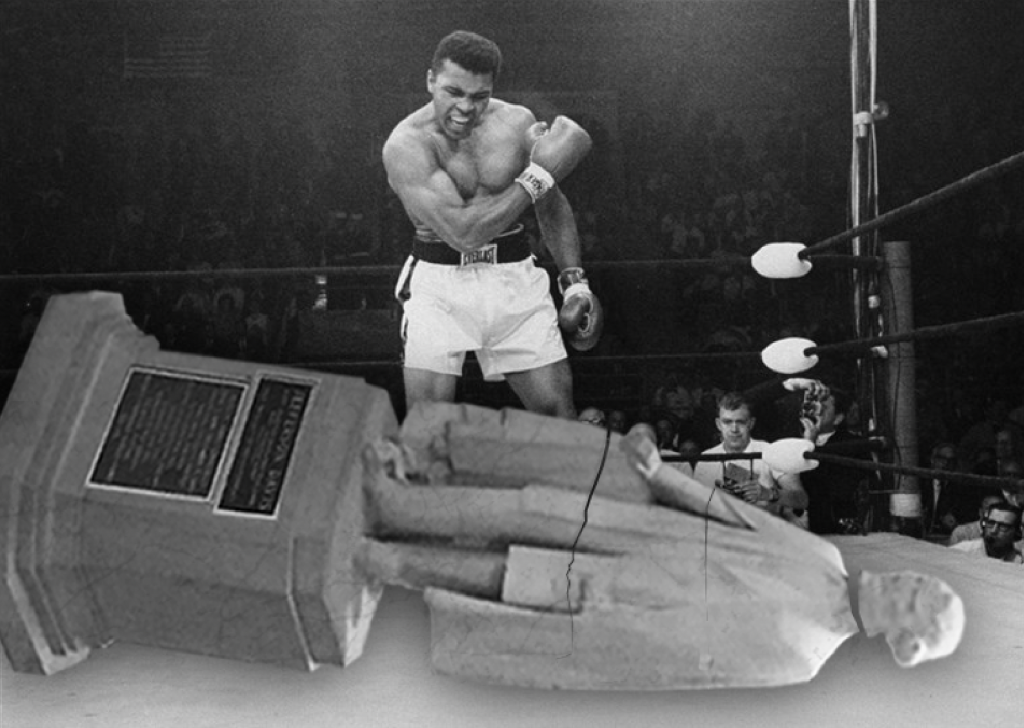
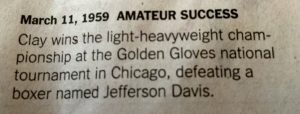
Please sign the petition below to remove the statue of Jefferson Davis currently in Kentucky’s Capitol Rotunda, and replace it with a tribute to Muhammad Ali, “the Louisville Lip” and “the Greatest of All Time.”
I just heard from the Ali family: It is the Champ’s belief that Islam prohibits three-dimensional representations of living Muslims. Accordingly, I have adjusted the petition to call for a two-dimensional representation of Ali (a portrait, picture or mural) in lieu of a statue.
UPDATE (Tuesday, December 2, 2014)
In this interview with WHAS-TV’s Joe Arnold, Governor Steve Beshear endorses the idea of honoring Muhammad Ali in the State Capitol (although he disagrees with removing Davis). Arnold explores the idea further on his weekly show, “The Powers that Be.”
Click here to check out WDRB-TV’s Lawrence Smith’s coverage of the story.
And here’s my op-ed in Ali’s hometown paper, the Louisville Courier-Journal.
UPDATE (Saturday, June 4, 2016)
In the wake of the 2015 Charlestown tragedy, in which a Confederate flag-waving murderer united the nation against racism, all of the most powerful Kentucky policymakers — U.S. Senator Mitch McConnell, Governor Matt Bevin, Senate President Robert Stivers and House Speaker Greg Stumbo — called for the removal of the Davis statue from the Rotunda. Today, as we commemorate last night’s passing of Muhammad Ali, there is no better moment to replace the symbol of Kentucky’s worst era with a tribute to The Greatest of All Time.
UPDATE (Wednesday, June 8, 2016):
Great piece by Lawrence Smith of WDRB-TV in Louisville on the petition drive to replace Jefferson Davis’ statue in the Capitol Rotunda with a tribute to Muhammad Ali.
UPDATE (Thursday, June 9, 2016):
Excellent piece on the petition drive by Jack Brammer that was featured on the front page of the Lexington Herald-Leader.
Highlight of the article:
Miller said he has received a few “angry comments” on his call to honor Ali.
“One of them encouraged me to kill myself,” he said. “You can quote me that I have decided not to take their advice.”
UPDATE (Friday, June 10, 2016)
The petition drives continues to show the Big Mo(hammed): check out these stories from WKYU-FM public radio in Bowling Green and WKYT-TV, Channel 27 in Lexington:
UPDATE (Saturday, June 11, 2016):
Still not convinced? Check out this excerpt from today’s New York Times:
By Brooke Masters, on Tue Aug 12, 2014 at 1:30 PM ET
Slowly, ever so slowly, banks are being forced to clear away the fog and mirrors that have protected their balance sheets from the prying eyes of investors and sceptics.
Last month, UK banks became the first in the world to disclose their total borrowing, known as leverage ratio, on a standardised basis.
They haven’t done this willingly – the Bank of England insisted – and their disclosures are all surrounded by lots of hemming and hawing about how the leverage rules are still changing.
The results are instructive. The UK’s five biggest banks are considered among the best capitalised in Europe on the traditional measure of core tier one equity divided by risk-weighted assets, which includes everything from home mortgages and small business loans to complex derivative contracts, each multiplied by a factor intended to reflect the amount the bank could lose. The ratios range from 12.3 per cent at HSBC down to 10.3 per cent at Royal Bank of Scotland.
The disclosed leverage ratios strip out the effect of risk modelling, which has the effect of more than doubling the size of every bank’s balance sheet and more than tripling that of Barclays. These numbers partly reflect the size of low-risk, high volume businesses. But they will be a boon to critics who think some banks have been tweaking their models to cut their capital requirements.
Read the rest of… Brooke Masters: The Leverage Story Banks Want to Hide
By John Y. Brown III, on Tue Aug 12, 2014 at 12:00 PM ET
Done!
Almost…
A little over six months ago I saw a friend, Kent Oyler, and told him I had just started a diet. He asked me my weight goal and I said I didn’t have one yet and he thought that was a mistake. I agreed and then asked Kent, since he was my height and in great shape, what he weighed. He told me and I said that was my weight goal. It was 27 lbs for me to lose.
Last night I reported to Kent that I was actually only 3 lbs away from my goal of reaching his his weight. But Kent then reported that he had actually gained 3 lbs this summer and we were now at the exact weight.
I raised me arms in exultation….feeling, for a moment, like I had achieved my goal of attaining Kent’s weight. But being honest with myself my real goal is still about 3 lbs away and I’m hanging in until I reach, well, both goals!
By John Y. Brown III, on Tue Aug 12, 2014 at 9:29 AM ET
The life of a comedian is rarely a funny matter.
The deep source of humor for the professional comic almost always seems to be a survival mechanism that just happens to work better than all the other survival mechanisms tried before it that came up wanting.
Sometimes that defense mechanism —that life antidote— stops working, too. And there may be no back-up fortification for when a joke doesn’t work anymore. And that deep source of humor can cruelly transform itself into an all-encompassing darkness that envelops and even suffocates, figuratively or literally, the same person it served so well.
And for a brief moment, like today upon the news of Robin Williams’ apparent suicide, the world gets a glimpse of that over-sized and heavy heart and sees that you weren’t just a silly boy looking for the next pratfall and a few more well-earned laughs. But that you were working always on something far more complicated, serious and sorrowful than your comedy repertoire ever belied.
How ironic that the man who brought more laughs and lightness to the world over the past four decades —more than probably any single person on our planet—today leaves that same world so deeply saddened and distressed. Then again, the genius of so many great comics is that the flip side of their humor –pain and emptiness–is never too far away from their punch lines. And probably much closer than the audience realizes.
As prodigiously hilarious and zany as he always seemed to be, I believe Robin Williams was, first and last, a very serious and sensitive man. Who we never got to know all that well. But will certainly miss terribly.
Inscribed on almost every “World’s Best” hikes list is the Routeburn Track in New Zealand. All too often the reality fails to meet the hyped expectations, but Routeburn does not disappoint. From start to finish the trail wow’s you so much that the work of hiking is forgotten.
The sun rising outside the Routeburn Falls Hut, a fine start to our final day on the track. This is a view hikers traveling in the traditional, Queenstown to Te Anau, direction are given on their first day.
Having completed the Milford Track just days earlier we chose to hike in the opposite direction of most, starting from Te Anau and hiking towards the comforts of Queenstown, the de facto capital of New Zealand tourism. We had been discouraged by the weather report in the Department of Conservation office: freezing temperatures and snow at the level of the campsites.
Traveling with $25 warm-weather sleeping bags and yet to rent a tent, news of snow was unwelcome. Given our experiences with rental tents we made the expensive decision to change from camping to staying in hut dormitories. Even though the huts were listed as booked we learned that there are a couple extra beds always available for a difference of $36 NZD ($28 USD) per person ($54 NZD for huts versus $18 NZD to camp in high season). Being budget travelers as we are, we lamented the cost, but decided that if greeted by rain, snow and freezing temperatures, this was the right move.
Read the rest of… Erica and Matt Chua: Hiking the Routeburn Track
By David Goldberg, on Mon Aug 11, 2014 at 1:30 PM ET
“He’s got pretty persuasion. She’s got pretty persuasion. Goddamn, your confusion.” Pretty Persuasion – REM
Interviews can be deceiving and confusing. When you meet a candidate in person, you can get a lot of false positives. The candidate is on her best behavior, well prepped and aiming to sell you on herself as a great hire. Often, you will find yourself enjoying your conversation enough that you get persuaded to hire someone who really isn’t the right fit for the role. That is why I believe interviews are for weeding people out but real references are the best barometer for making a job offer. I have learned this through years of experience and mistakes. My friend Thomas Layton, the former CEO of OpenTable and current Chairman of Odesk, helped me confirm this approach when I started at SurveyMonkey in 2009.
In my early days at SurveyMonkey, 100 percent of my time was spent on HR-related issues, specifically recruiting. At the time, SurveyMonkey was 14 people in Portland– my first priority was to scale the team. From a small office in Menlo Park, California, I had to find and hire talent. I had to interview everyone personally and make most of the decisions myself.
This meant tracking down and calling real references – a job most delegate to HR. I don’t think you learn much from references listed by the applicant. Those people are clearly going to say good things. You need to get real information from someone who you trust. Most of the people we hired in the beginning were two degrees away- that is, they were referred or connected to someone I knew. This allowed for honest feedback on the candidate’s strengths and weaknesses. If we didn’t have that direct reference to talk to, I used LinkedIn to find people who had worked with the person. Each role was different but some things were universal. I needed people who could flourish in a startup like culture but could also understand how to scale. Would he be willing to do his own work or did he just view his role as a manager, telling others what to do? How did she solve scale problems when they occurred? You can ask candidates those questions but it is much more valuable to understand how the person actually behaved in real situations.
Cultural fit is also important and impossible to figure out in an hour interview. How does the person work with peers, manage people and deal with stress? You can ask your real reference those questions; get past the “pretty persuasion” of the interview. I learned the hard way that someone who looks great on paper may not fit with our culture. Their experience simply didn’t carry over to their job with us. It turns out that people with seemingly relevant experience just are not interchangeable. A person who was an all-star at one company might not be able to repeat that performance in your organization, because his success may have derived from relationships with the previous employer, or her team may have propelled her achievement.
On the other hand, many people may not have the experience you feel is required for a job, but are just really smart, talented and motivated. When you take a chance on these employees and get it right, they become home grown talent – essentially your farm team. These are likely to be the carriers of your culture, and some of the best, most loyal employees because you took a chance and developed them from within. I have found it has worked to have a mix of experience and raw talent- the two types learn from each other.
At SurveyMonkey, we’ve moved talented people within the organization to give them room to stretch and grow — finance folks to business development roles, customer ops to engineering. It is much easier to take a chance on someone who already has proven themselves for you in another role than bring an experienced outsider in- the internal hire has all the boxes checked except experience.
As the company has grown, my time spent on HR-related matters has shrunk. Still, nearly one-third of my responsibilities relate to talent and culture. We are a company that defines success by getting and keeping the right people. I still do my own calls for all key hires and look for good spots to build that farm team of great talent. Let resumes and interviews be used to reject candidates but rely on real references to hire people.
By John Y. Brown III, on Mon Aug 11, 2014 at 12:00 PM ET
My cell phone –an ATT Android–has a visual voicemail feature that tells me when I have a new voice mail message.
But wait, there’s more.
The visual voicemail app also, with some voicemails, will delay the notification for several hours. Or even a day.
I know what you are thinking. It must not work right. But I figured out what really must be going on.
This feature, I have to assume, somehow measures the enthusiam of the caller and will delay notifying me of the call accordingly –to the extent the person doesn’t seem eager to talk to me.
I mean, what else could it be? Right? There’s no other reason I can think of for the voicemail to work this way.
Dang. Technology sure is amazing.
Oh, so yeah. When you leave me a voicemail be sure you sound enthusiastic so I will get it right away.
Irwin Kula is an eighth-generation rabbi known for his fearless attitude about change — a rare quality among religious leaders who tend to adhere closely to tradition.
Kula, president of the National Jewish Center for Learning and Leadership (CLAL) in New York and the author of Yearnings: Embracing the Sacred Messiness of Life, has dedicated himself to opening up the wisdom of his 3,500-year-old faith to be in conversation with the world.
Kula preaches the “highest possible institutional barriers between church and state,” with the “lowest possible communication barriers.” He welcomes intermarriage and interfaith dialogue. He recognizes God not as a “Seeing Eye,” but in “experiences of love, caring, and connection.”
Many consider Kula progressive; others, disruptive. But Kula maintains that institutionalized disruption is essential to adaptation and growth.
Rabbi Kula looks like the wise man of children’s books. He has a handsome widow’s peak, and speaks with homiletic pauses and animated hands. When asked about how his beliefs developed, he answers in stories.
At 14, Kula was thrown out of the private parochial school he attended for challenging the Torah. “I would ask a class of 25 students questions which were probably a touch ‘teenagerish’,” he recalls. “I’d ask, ‘You don’t really believe this — God splitting seas? Come on, this is not what this is actually saying’.”
This rebellious streak would come to define his practice.
The problem with most religious leadership, Kula claims, is that its mission is to convert the non-affiliated. “Religion is not about creed, dogma, or tribe,” he counters. “We need to stop judging our success by membership dues — this isn’t about how many hits. First and foremost, religion is a toolbox designed to help human beings flourish.”
Kula claims that he finds himself often at odds with the concept of “God” as commonly invoked in the American public arena. To him, this is the God of touchdowns and wars, an intervening God who “casts out” unless one “buys in.” “No religious or political system has a hold on being moral,” Kula says. “Systems are only as good as their people.”
For most of his rabbinic appointment, Kula kept these views to himself. Only after the September 11 attacks did he begin to more openly preach what he himself practiced.
“I was very unnerved, knowing the religious impulse compelled that,” Kula says. After the tragedy, he shut down his teaching for three months to reevaluate his role as a spiritual leader. When he returned to the synagogue, he had made the decision “never to teach Judaism again simply to affirm the group’s identity.”
In 2013, Irwin Kula recounted the narrative of his spiritual conversion to a packed theatre of global business leaders at the Collaborative Innovation Summit, an event hosted annually by the nonprofit Business Innovation Factory (BIF) in Providence, RI. On stage, the rabbi made an ambitious appeal to his audience, whom he knew to be composed of astute tinkerers and serial entrepreneurs: He asked them to join him in his mission to innovate religion.
Kula is a fervent believer in accessing insight beyond the religious tradition. “It’s really important to speak to non-incumbents,” he maintains. “The less you speak exclusively to your own ‘users,’ the better shot you have of keeping your own practices from becoming incredibly distorted.” His CLAL runs a program called Rabbis Without Borders, dedicated to fostering open dialogue across cultural and religious barriers.
Stories of innovation often feature “two kids in a garage.” Kula’s goal has been to tell an innovation story from the cathedral. “Religion’s just a technology,” his BIF talk began. “How the hardware of humanity gets used will depend on the software.”
His talk covered how the rapid advancements of the digital infrastructure age demand that we broaden our ethical horizons: What are the new crimes? In this new order, who is included and what are their rights? As we redefine morality, the need to innovate faith becomes especially pressing.
“The most interesting businesses ask ‘impact on society’ questions, which are more complex than ‘killer app success’ questions,” Kula reflects in hindsight. “At BIF, I asked, ‘What would happen if we applied innovation theory to religion, to compress the resources it takes to create good people?’”
Kula looks forward to returning for BIF10 in September.
“If a homily is 15 minutes in church, it’s 18 minutes at BIF,” he says. “As conferences go, BIF embodies total equality between the storytellers and their audience. In many ways, it’s the best of what a spiritual community is — we’ve got to bottle that.”
By John Y. Brown III, on Fri Aug 8, 2014 at 12:00 PM ET
It is easy to poke fun at the decade of the 1970s but there is a two word answer that is sufficient, in my mind, to shut down every critic of that decade.
Marvin Gaye
Is there any situation or mood that this song –or entire album– can’t make a just a little bit better? (Especially on a Saturday afternoon)
I don’t think so.
Yeah, the 70s were an important and soulful decade. If you don’t believe me, just listen to Marvin.
For most of my clients, Summer means t-shirt time. How does yours fit? Don’t laugh — even though it’s just a t-shirt, it should fit you as well as all of the other items in your wardrobe. Below are 4 key points to watch for when determining whether to buy that next beefy-t:
1) The shoulder seam should hit directly on the edge of your shoulder. When a t-shirt is too big, these seams hang off your shoulder and make you look sloppy. But wearing a shirt with the seam right on the edge of your shoulder will make you look fit and trim.
2) The length of your sleeve should hit about halfway down your bicep. Again, this will be the most flattering to your build.
3) When you pinch the sleeve edge, there should be 1-1.5 inches of extra fabric.
4) The hem of the t-shirt should hit about halfway down the fly of your pants. Any longer than that will throw off the balance of your upper and lower body (aka make you look short), and anything much shorter than that won’t give you enough coverage.
Now, it’s your turn. Try on your favorite t-shirt…how does it measure up?
By John Y. Brown III, on Thu Aug 7, 2014 at 12:00 PM ET
Now I find out!
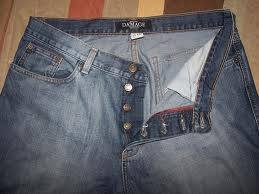
I finally lose enough weight to buy a pair of designer men jeans–as opposed to “Dad jeans” –and find out almost all have a button-fly instead of a zipper. I am serious!
What is happening to the male population? C’mon guys. What self-respecting male would prefer button-fly over a zipper? And if they did, what would the reason be?
It isn’t for practical reasons or to impress women. I am pretty sure my wife couldn’t care less about my fly stylings. Is it to impress other men like women who dress for other women?
What happened to my gender while I was overweight and in dowdy clothes?
Surely I didn’t lose all this weight just to be able to wear a svelter pair of Dad jeans, did I?


 Blog this!