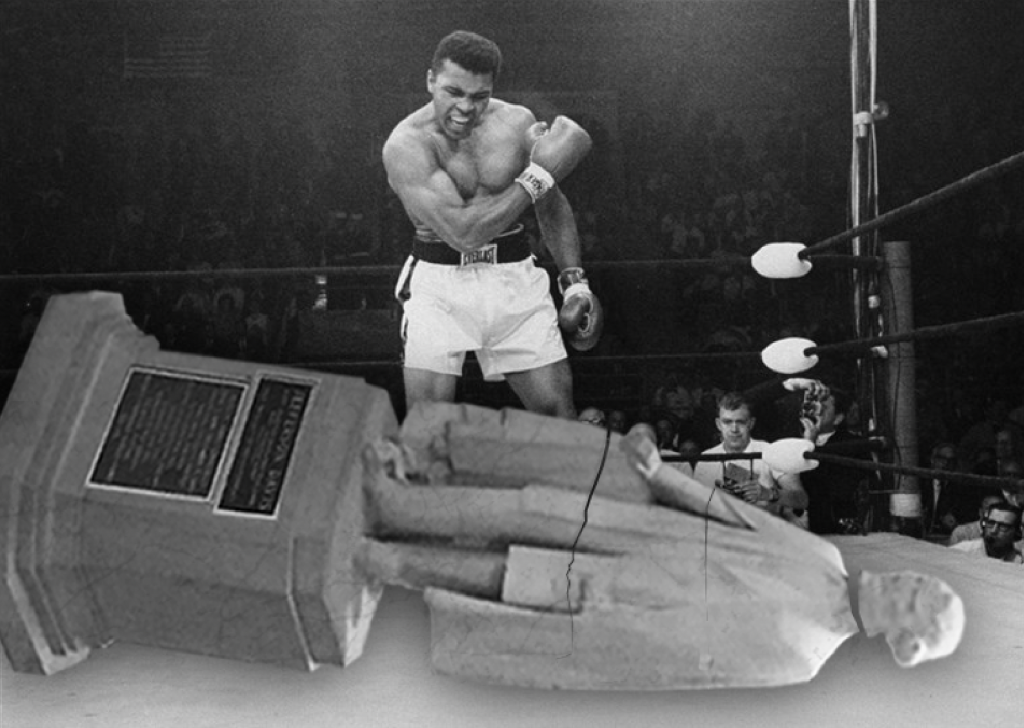
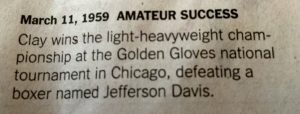
Please sign the petition below to remove the statue of Jefferson Davis currently in Kentucky’s Capitol Rotunda, and replace it with a tribute to Muhammad Ali, “the Louisville Lip” and “the Greatest of All Time.”
I just heard from the Ali family: It is the Champ’s belief that Islam prohibits three-dimensional representations of living Muslims. Accordingly, I have adjusted the petition to call for a two-dimensional representation of Ali (a portrait, picture or mural) in lieu of a statue.
UPDATE (Tuesday, December 2, 2014)
In this interview with WHAS-TV’s Joe Arnold, Governor Steve Beshear endorses the idea of honoring Muhammad Ali in the State Capitol (although he disagrees with removing Davis). Arnold explores the idea further on his weekly show, “The Powers that Be.”
Click here to check out WDRB-TV’s Lawrence Smith’s coverage of the story.
And here’s my op-ed in Ali’s hometown paper, the Louisville Courier-Journal.
UPDATE (Saturday, June 4, 2016)
In the wake of the 2015 Charlestown tragedy, in which a Confederate flag-waving murderer united the nation against racism, all of the most powerful Kentucky policymakers — U.S. Senator Mitch McConnell, Governor Matt Bevin, Senate President Robert Stivers and House Speaker Greg Stumbo — called for the removal of the Davis statue from the Rotunda. Today, as we commemorate last night’s passing of Muhammad Ali, there is no better moment to replace the symbol of Kentucky’s worst era with a tribute to The Greatest of All Time.
UPDATE (Wednesday, June 8, 2016):
Great piece by Lawrence Smith of WDRB-TV in Louisville on the petition drive to replace Jefferson Davis’ statue in the Capitol Rotunda with a tribute to Muhammad Ali.
UPDATE (Thursday, June 9, 2016):
Excellent piece on the petition drive by Jack Brammer that was featured on the front page of the Lexington Herald-Leader.
Highlight of the article:
Miller said he has received a few “angry comments” on his call to honor Ali.
“One of them encouraged me to kill myself,” he said. “You can quote me that I have decided not to take their advice.”
UPDATE (Friday, June 10, 2016)
The petition drives continues to show the Big Mo(hammed): check out these stories from WKYU-FM public radio in Bowling Green and WKYT-TV, Channel 27 in Lexington:
UPDATE (Saturday, June 11, 2016):
Still not convinced? Check out this excerpt from today’s New York Times:
By Nancy Slotnick, on Tue Jul 16, 2013 at 8:30 AM ET
Paper towels are my guilty pleasure. Is that pathetic or what? But I’m totally serious. Especially the Viva ones, that are so soft and absorb everything. I never have to touch a sponge. My husband wipes up turkey grease with a Crate and Barrel hand towel and it kills me. Why? I wish it didn’t. I’m trying to train myself not to care. Shalom Bayit is the term for letting sh*t go for the sake of peace in the family. It’s more than that. It’s letting go of thinking that the way I do everything is the right way. Realizing that there are many ways to skin a cat. And that some of us would never dare skin a cat. But my husband would if we were hungry enough. I respect that. He does love cats too.
So I have to pull it together when he puts the Tupperware on the bottom shelf of the dishwasher. I stole that line from Liz Lemon on 30 Rock, btw. I was encouraged to know that I’m not the only one who worries about crap like that! But a little scared to think that I’m about as sexy as Liz Lemon sometimes. I used to be sexy though. And I think I still can be on a good day. In further tribute to Tina Fey, I don’t own Mom Jeans. But I’m not quite Nancy [MILF] on Weeds. That’s probably good news for my son, as well as for the paper towel industry, but it might not be so good for me.
By Jonathan Miller, on Mon Jul 15, 2013 at 4:30 PM ET
Call me biased — and I the first to admit I am — but I think this latest attack on Alison Lundergan Grimes by Kentuckians for Strong Leadership (i.e., McConnell’s people being paid by unknown, independent sources) is, to use a poker term, pretty penny-ante.
To summarize: Businesses in which Grimes has a small minority share failed to file their annual statements on time.
Ironic, since her office accepts the statements? Sure.
But troubling? Of course not. She has no involvement in the administration of these companies.
They’ve obviously been digging up dirt to whack-a-mole her for many months; and if this is all they have, they are in real trouble:
Records show Grimes-owned Company in “Bad Standing” with Commonwealth of KY
Secretary of State records show Grimes’s Glenncase LLC not in good standing with her own office
(Frankfort) If Alison Grimes hopes to prove she can be an effective Senator for Kentucky, she needs to get her own affairs in order first. A review of records filed with the Secretary of State’s office – which Grimes runs – shows that a business she owns – Glenncase LLC – is not in good standing with the Commonwealth of Kentucky. How does a business stay in good standing? By filing a simple form…with the Secretary of State’s office.
“Grimes’ disastrous campaign launch showed she wasn’t ready for prime time,” said Scott Jennings, a Senior Advisor to Kentuckians for Strong Leadership. “Now we find that a business Grimes owns isn’t even in good standing with her own office. Kentucky voters are quickly learning that Grimes’ political ambition exceeds her ability.”
Publicly available records show Ms. Grimes as the organizer of Glenncase, LLC. Her personal financial disclosure shows that she is a current owner of the company as well. Both records are attached to this release.
“Perhaps if Mrs. Grimes read her own press releases she would have remembered to keep her affairs in order,” Jennings said, noting that the Secretary of State’s office sent out two releases (June 20 release; July 9 release) admonishing Kentucky business owners to file with the Commonwealth.
“A business simply needs to fill out the right paperwork with the Secretary of State’s office to be in good standing,” said Jennings. “Grimes’ latest unforced error shows a lack of understanding of her personal business operations and of her current elected office, and calls into question her ability to effectively represent Kentucky in the U.S. Senate,” said Jennings.
Please Note: Grimes’ businesses didn’t live up to their responsibilities under Kentucky law – and her own office’s requirements – until after we pointed out her failure. After that, they hastily filed the paperwork they should have submitted earlier.
By Erica and Matt Chua, on Mon Jul 15, 2013 at 12:30 PM ET
Answering the questions we’re most often asked, every three weeks we’ll answer a FAQ to share what people want to know when they find out we’ve been traveling for over two years… LAST MONTH’S QUESTION:Will it be hard going home?NEXT MONTH’S QUESTION (on July 17):What are your biggest regrets of the trip? .
WHAT’S THE STRANGEST THING YOU’VE EATEN?
.
HE SAID…
Food and strange don’t really mix any more. I’ve made it this far is because I’ve eaten whatever is available, by committing myself to eating whatever is served wherever I find myself hungry. For the most part I have known what I was eating, but when I’m hungry there isn’t much difference between chicken liver and hot pink pizza…it’s what’s for dinner. So…what is strange to eat? Dog? Not strange for some people, and yes, I’ve eaten dog. Raw horse meat? I can’t tell you enough wonderful things about horse sashimi (Basashi), it’s deee-licious! Raw bull testicles? Had it, but I’d prefer Rocky Mountain Oysters, thanks. Have a foot fetish? Well I sure don’t, I’ll pass the pig trotters and chicken feet to my cousins…they seem to like them. Are these things strange?
Japanese people and I look at animals very similarly…
Read the rest of… Erica and Matt Chua: World’s Strangest Foods
By Mark Nickolas, on Mon Jul 15, 2013 at 12:30 PM ET
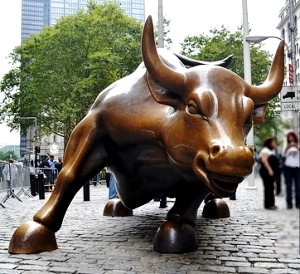
Friend of RP Mark Nickolas has hit the big time. His short film on Occupy Wall Street, and the famous bull that sits near the stock exchange, was the feature of a Kai Ryssdal story on NPR’s “Marketplace.”
Forget Lloyd Blankfein, Jamie Dimon or Warren Buffett. For the past 23 years, there’s been only one non-stop observer to Wall Street’s goings-ons.
The Charging Bull of Wall Street, the iconic 7,000-pound bronze sculpture, sits just a couple of blocks from the New York Stock Exchange. And is pictured in media reports, movies and just about any other popular representation of U.S. financial markets.
“He’s still just a temporary installation. There’s a city ordinance that says you can’t have a private work of art that’s on public property for more than a year,” says Mark Nickolas. “And I think they’ve just turned a blind eye to that rule.”
Nickolas says his movie is told from the point of view of the bull and so, perhaps, can personify Wall Street and New York in a very physical way:
“The fact that the Occupy protests actually began Vancouver, Canada, from his point of view as a New Yorker, there is this sense of ‘how can you target me? I began as a work of art, and who’s Canada to be lecturing us about protesting government.”
By John Y. Brown III, on Mon Jul 15, 2013 at 12:00 PM ET
My early days as a sports agent (wanna be)
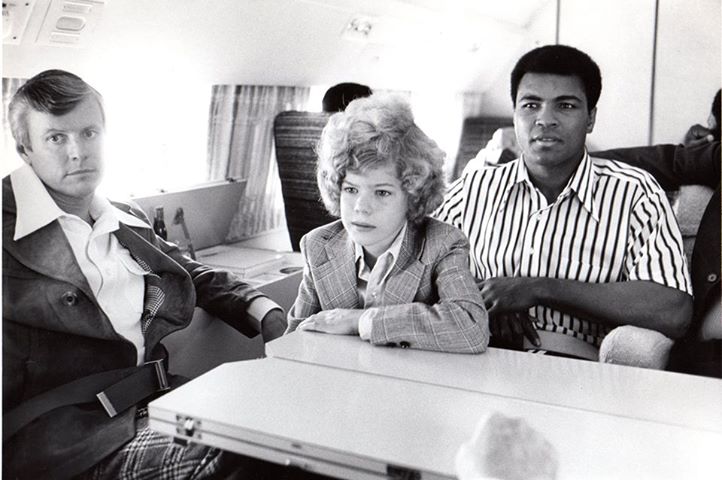
“Look, as long as I’m representing Muhammad, we aren’t fighting in Madison Square Garden or Yankee Stadium.
It’s either Freedom Hall or somewhere in Manilla in…wherever that is.
And I don’t want to hear that Don King’s name one more time. The guy is nuts and has lame hair and will never be able to compete with my doo no matter how hard he tries to copy me! I’m the original crazy-haired boxing promoter!
We clear fellas?”
===
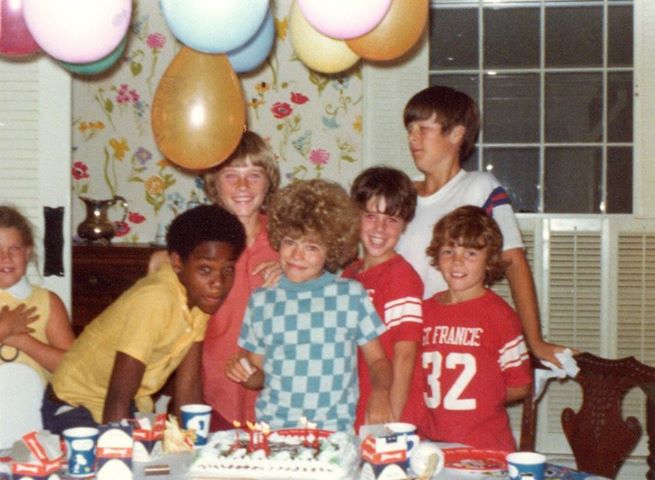
This picture may have been the pivotal conversation I had with Colonel Sanders when I was 3 to persuade him to sell KFC.
“Look, Colonel, if you sell controlling interest to Jack Massey and my dad, it’ll be like you can be a kid again.
You’ll have all the money you want to buy toys and candy and we can dress up like cowboys, Indians, superheroes, colonels and what not and play in the back yard all day and mom will make cookies and lemonade for us.
No more of these long boring business meetings and endless phone calls about earnings. It’ll be awesome!”
Or it may have been the conversation about me wanting another piece of birthday cake.
I just can’t remember.
===
Got game?! Kinda…. ; )
The apex of my athletics career….
At Freedom Hall performing at halftime basketball game in front of over 10,000 people as a member of the Bellarmine Junior Pros half-time entertainment.
We were good.
And Ken Fleming, future Metro Council member, was nearby. We won the Regional title for, well, not sure what they called us—half-time performers with basketballs, I guess.
They call themselves “recovering politicians”—political figures whose careers and dreams have come crashing down because of scandals. Two of them are Missourians.
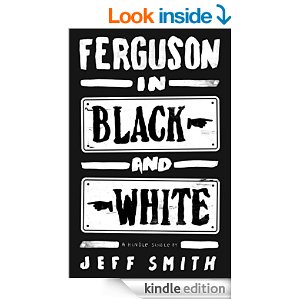
State Senator Jeff Smith was a rising star in the Democratic Party when he went to federal prison for a year for lying to federal investigators about a minor campaign finance law violation. Former Speaker of the House Rod Jetton was looking at a lucrative career as a political consultant when he became entangled in a one-night stand of rough sex. He avoided prison by pleading guilty to a misdemeanor charge. But his political career, like Smith’s, was ruined.
Smith knew as soon as he heard that an associate had been charged with a series of non-campaign crimes that he was political toast. “In just a few moments of weakness in that first campaign, I now realized that I’d thrown away everything that I’d worked for all my life,” he told county officials last November.
And Jetton realized as soon as his incident became public that he could not avoid admitting what he’d done—to his father, a Baptist minister. “That pretty much strips your pride away,” he has told us.
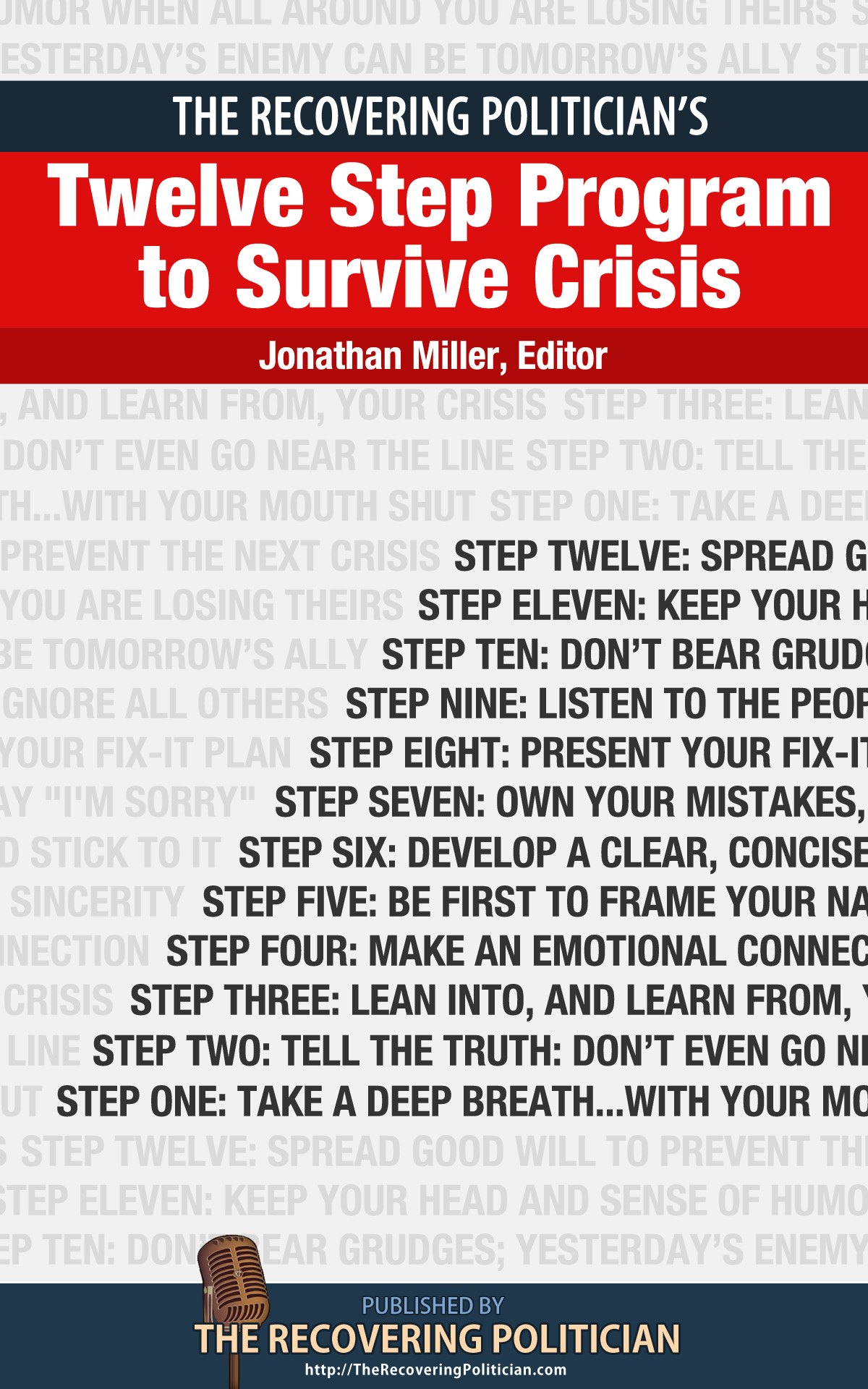
Their book is called “The Recovering Politician’s Twelve Step Program to Survive Crisis.” Smith and Jetton are two of about a dozen former office-holders whose lives have taken new directions since their falls from grace. Jetton now is in private business and is president of a political newspaper that covers the Capitol. Smith now is a political science college teacher in New York and has written several political articles for national magazines.
The book: The Recovering Politician’s Twelve Step Program to Survive Crisis, …
The key to unlocking the next wave of economic growth may be as simple as enabling more people to try more stuff. The industrial era was all about scale and squeezing out the possibility of mistakes. As a result we are too afraid to fail. Companies only take on projects with highly predictable results. Employees fall in line for fear of making career-limiting moves. How will we get better if the fear of failure prevents us from trying anything new? How will we make progress on the big system challenges of our time, if every time someone tries something transformational and fails, we vilify them? What if we reframed failure as intentional iteration?
Take the example of Better Place, the startup that set out to create a world full of electric cars with a novel battery swapping business model. In my book, The Business Model Innovation Factory, I highlight Better Place and its founder Shai Agassi as one of the best examples of business model innovation and the importance of a real world test bed.
In 2005 Agassi attended the World Economic Forum (WEF) in Davos, Switzerland. He was inspired by a framing question asked by WEF’s founder Klaus Schwab at the beginning of the conference, “How do you make the world a better place by 2020?” Agassi took Schwab’s question seriously and decided he would make the world a better place by reducing the world’s dependence on oil by creating market based infrastructure to support a transition to all electric cars. Agassi knew that the only way to accomplish his goal was through business model innovation and industry system change. OK, it didn’t work. After 6 years, raising $850 million in private capital and launching commercial operations in Israel and Denmark, Better Place filed for bankruptcy.
Read the rest of… Saul Kaplan: Reframe Failure As Intentional Iteration
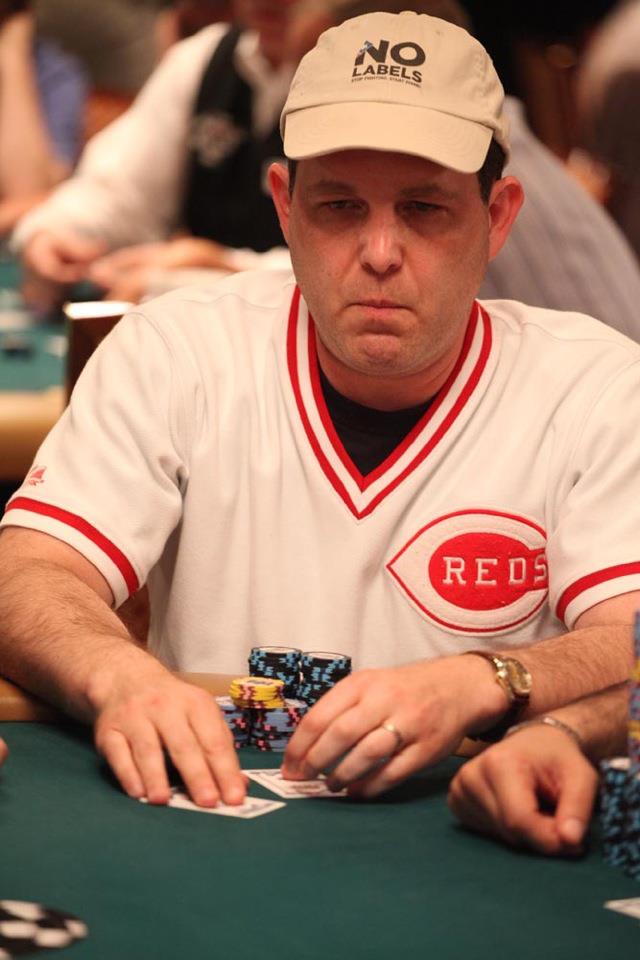
In his second of his series of World Series of Poker articles for Newsweek/The Daily Beast (here’s Piece #1), The RP interviews leading card sharks (including New York Times pollster/pundit Nate Silver) to draw some lessons for hyper-partisan Washington from the green felt.
The marriage of political advocacy and poker wouldn’t surprise close observers of both; indeed, the two zero-sum games are really two sides of the same chip. As esteemed political prognosticator and poker savant Nate Silver told me, “politics and poker share the feature of being both very prosaic and very poetic”: Building your chip stack by grinding with careful mathematical calculations is akin to developing a sound get-out-the-vote effort through micro-targeted polling and door-to-door canvassing; riding an electric run of great cards and lucky flops is as thrilling as being uplifted by a gifted political orator. Of course, Silver—who poetically surged to near the top of the of the leaderboard on Day 1 of the Little One event, only to meet a prosaic bustout on Day 2—concedes that poker is the “more refreshing” of the two contests: “It’s pure, undistilled competition, with no intrigue, no B.S.”
There’s also no disputing that the two games require similar skill sets. A career in politics could in fact prepare someone quite well for a life at the poker table. Consider:
• Serving up fiery, red-meat orations at partisan rallies or stump-speaking amid hostile, heckling crowds at open events can help a poker player perfect the art of projecting confidence… or alternatively, vulnerability… and shape a poker face to confuse opponents as to the strength of any particular hand.
• Retail campaigning—the hand-shaking, back-slapping, and baby-kissing—enabling someone to observe, listen to, and really understand people, can be employed powerfully in a game in which you have to read the strength of your opponents’ hands by their facial expressions and body language.
• Late-night, smoke-filled, back-room, legislative negotiations—tests of endurance and concentration—provide invaluable practice for sitting long hours at tables with adversaries who’d say or do anything to provoke you or otherwise knock you off your calculated strategy.
• Waiting out filibuster blockades, partisan stall tactics, and special-interest foot-dragging—to win even the smallest of policy victories—can equip anyone with the resolve to withstand days of numbing boredom at the poker table, and to resist all temptations to take risky gambits that could send the player to the rail.


 Blog this!



 AUDIO: Jetton interview 14:34
 AUDIO: Smith speech to Mo. Assn. of Counties 1:05:00