By Ronald J. Granieri, on Wed Mar 27, 2013 at 10:00 AM ET
German unification was one of the most dramatic developments in contemporary history, as well as one of the most unexpected. After decades during which the press and public measured political wisdom according to how well leaders managed the apparently permanent realities of German and European division, leaders in 1989 had to improvise responses to the literal collapse of the most concrete of those realities in Berlin. As much as German politicians had claimed for years to be hoping for this day, none had actual plans ready. Into this potentially dangerous vacuum stepped a most unlikely improviser. Helmut Kohl was a reasonably successful party leader of enormous bulk and moderate political gifts, generally underestimated even by his political allies and known neither for creativity nor dynamism. To the surprise of all, he proved remarkably adept at managing the international and domestic complications of 1989. Within thirteen months after the fall of the Berlin Wall, he rode successful reunification negotiations to a landslide victory in the first all-German democratic elections since 1932. Even if many of his decisions during those months can be (and have been) questioned, his place in history is assured.
Kohl’s story provides but one of many crucial insights into how the story of German reunification displays both the limits of realism and the unpredictability of history. That unpredictability reminds us of the role that individuals can still play in the modern world, even in the face of enormous complexity. For it was the combined actions of individuals, neither beginning nor ending with Kohl, who changed the world in 1989, and all students of international affairs can profit from reexamining that dramatic story.
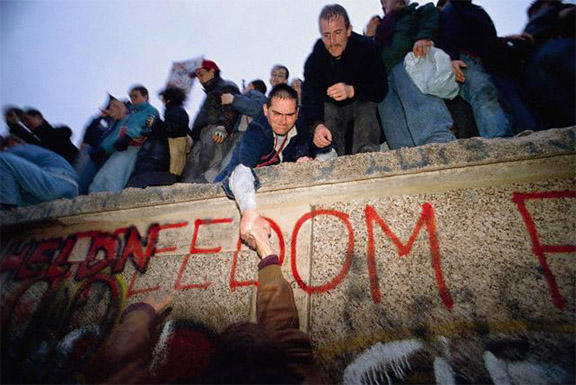
To appreciate just how important those individual actions could be, one has to remember the state of the world (and of most thinking about the world) in the 1980s. After decades of Cold War, the US-Soviet rivalry still shaped most global conceptions, on issues ranging from economic development to the world chess championships, not to mention the Olympics. Even as progressives decried the focus on East-West rivalry and advocated more attention to North-South issues of economic development, conventional wisdom dictated that intelligent people assume the existence of Eastern and Western blocs for as far as the eye could see. The sense that this rivalry was permanent, and required careful management rather than bold transformations, was pervasive. Indeed, that attitude was so widespread that when commentators spoke of the End of the Cold War at all, they imagined a world in which the United States and the Soviet Union, with their associated allies, still coexisted, though at a reduced level of tension, allowing the allegedly inevitable process of convergence to make their systems look as much like each other as possible. No one imagined one side would disappear. That would have been dangerously unrealistic.Nowhere were these assumptions more obvious than in Berlin. Although actual defenders of the “anti-Fascist protection barrier” were few outside of the upper leadership of East Germany’s ruling Socialist Unity Party (SED), the world had come to accept the presence of the Berlin Wall as the price to be paid for stability and security in Central Europe. President Ronald Reagan had declared “Mr. Gorbachev, tear down this wall!” when he spoke before the Brandenburg Gate in 1987, but his words were greeted at the time as the tired echo of anachronistic sentiments. No one really expected it to happen—perhaps not even Reagan himself, who by that time was committed to negotiating arms control treaties with the Soviets based on his positive assessment of his new partner, Mikhail Gorbachev. If anything, informed observers assumed that Gorbachev’s policies of Glasnost and Perestroika would stabilize the Soviet Union, making the situation even more permanent. That was, after all, why Reagan felt he had to ask Gorbachev to tear down the wall; no one else had the power to do it.
Read the rest of… Ronald J. Granieri: The Fall of the Berlin Wall, the Power of Individuals & the Unpredictability of History
By Lauren Mayer, on Tue Mar 26, 2013 at 1:30 PM ET
Hag sameach, happy Pesach, and how appropriate that the Supreme Court hearings on same-sex marriage will begin on the first day of Passover! Sure, most of us think of Passover in terms of biblical history, the one time a year we open the Manischewitz, or trying to find appetizing uses for matzoh (there are some great recipes online for chocolate-toffee-covered versions . . . ). However, Passover is also a celebration of a pivotal moment in history (the Jews escaping from persecution in Egypt), just as the Supreme Court case is a pivotal moment in the history of gay rights, and of the freedom of gay couples to have the same legal recognition as heterosexual couples.
I see some personal links between the events, as well. As a card-carrying Jewish mother, I like to joke that I’m secretly longing for a gay son (so he’ll go shopping with me, and he’ll never replace me with another woman). Plus Jews have lots in common with gay people, in that we’re often reduced to stereotypes and have experienced group discrimination – it makes sense that so many of us support marriage equality. (In fact, our synagogue performed same-sex ceremonies before they even considered interfaith marriages!)
Plus the connection between gay rights and being Jewish is what got me to The Recovering Politician in the first place. Last summer, I was researching ways to publicize my album of Chanukah comedy songs, and I came across an article about Chanukah music by Jonathan Miller. I wrote to him out of the blue, never expecting to get a response, but not only did he reply, he invited me to contribute to the site’s discussion of last year’s Chick-Fil-A controversy. I wrote about some of the same reasons, why Jewish mothers support gay rights, including a song about being a liberal Jewish mother, and joked that I should do a weekly song. Jonathan said Sure, I thought, Oh no, what have I gotten myself into?, and 8 months and 40 songs later, I’m still finding plenty of inspiration in current events.
So since a big part of the Passover Seder is to express gratitude, I’d like to officially thank you, Jonathan and The Recovering Politician, for launching a whole new creative venture and for providing a sane, civil community for discussion and sharing opinions.
By Nancy Slotnick, on Tue Mar 26, 2013 at 8:30 AM ET
“You know you’re in love when you can’t fall asleep because reality is finally better than your dreams.”— Dr. Seuss
My sister invited me to her first annual Dr. Seuss-themed Passover Seder. “I hope you’re serving Green Eggs, no Ham,” I quipped. But I was so excited for her! The idea is so fun and original and so antithetical to the Passover seders of our youth, that it is a demonstration of freedom in her life. Which seems fitting for the theme of the holiday. Freedom from slavery, escaping to a new world, doing stuff that makes us feel like we’re going to get in trouble, but getting away with it. I feel like Thing One and Thing Two.
“One is the loneliest number that you’ll ever do. Two can be as bad as one. It’s the loneliest number since the number one.” -–Three Dog Night
In my role as a dating coach, I’m helping single clients shoot for two. I have to convince them that two is better than one when most of them have experienced the above. I say in my marketing materials that I will help you to find “the One.” I should stop saying that, because it’s a misnomer. To say that you are looking to find “the One” makes the other person too important. I should say; “I will help you to find your Two.” You are your own Number One.
The song repeats though—“One is the loneliest number, one is the loneliest number, one is the loneliest number” just to make sure we remember. As bad as two can be, it’s better than one. I’ve been married for 11 years and my personal goal for freedom this Passover is to find the One within the Two. What does that mean to me? It means finding your own voice even in the face of someone you love, who disagrees with you. And in-so-doing, you make your relationship work better. It’s ironic. It sometimes feels like you have to get rid of the other person, like Moses with Pharoah. We want to get someone else’s permission to “Let my people go.” But all we need to do really is get out of our own way.
“No is the saddest experience you’ll ever know,” Three Dog’s song continues. It’s so true. I stopped saying No to myself. My husband and I saw the film “No” last week. It’s a true story about when an advertising campaign in Chile in the ‘80s had the opportunity to overthrow the prevailing dictatorship. They just had to get a majority to vote “No.” Which might not be hard if they could get a majority to vote at all. No one was going to bother to vote because they could not even imagine the life that could be possible with freedom. One of the most brilliant part of the campaign was that they added a + to the No and made it No+ or No Mas. No Mas Pinochet. No Mas Pharoah. No Mas oppression. Let our People Go.
By Erica and Matt Chua, on Mon Mar 25, 2013 at 10:00 AM ET
(What do you do when you have something amazing and you don’t want to share it? You tell people it’s terrible so that you can have it all to yourself. It was along that line of thinking that original settlers of Sirince named it Çirkince, which in Turkish means ugly. The founders discovered their own slice of heaven and didn’t want to share, so they called it ugly and lived happily ever after…until 1926. The small hamlet was renamed Sirince, which means pleasant. Now the perfect side-trip from Ephesus this pleasant little city gets it’s fair share of visitors. Pleasant may still be an understatement, but will hopefully keep the crowds at bay and preserve the beauty of this place for a few more years.
Şirince was settled when the Greek city of Ephesus was abandoned in the 15th century, but the “pleasant” town you see today dates from the 19th century. The old brick and stucco buildings with bright orange terra-cotta roof tiles and deteriorating wood shutters lend a medieval feel to the town. As you wind your way through the cobblestone streets the cafes draw you in and the welcoming owners beckon you to sit down for a hot drink.
Read the rest of… Erica & Matt Chua: The Prettiest Ugly City in the World
That hungry whirring noise heard around offices across the U.S. is the sound of March Madness brackets being fed to paper shredders everywhere. Bracket busting is reaching historic levels in this year’s NCAA Division 1 Men’s Basketball National Championship Tournament. Since the tournament was created in 1939 this is the first time there are no number 1 or 2 seeds in the Final Four. All of the country’s top eight teams, as annointed by the experts, will watch the Final Four from home.
That’s amazing. It’s the first time in March Madness history that two teams, Butler (8) and VCU (11), seeded 8 or worse in their bracket will play each other in the Final Four. So if you shredded your bracket, you’re not alone. According to ESPN Research only two people out of the 5.9 million who filled out and submitted brackets in the ESPN Tournament Challenge have the Final Four correct. Only two. That’s .000034%.
As I shredded my bracket I couldn’t help thinking about the parallels between innovation and bracket busting.
In many ways, from the time we are born, we are seeded into brackets. Education tracks, organization charts, and industry value chains are all brackets waiting to be busted. Experts are always telling us where we fit and what our role is. We are tracked into school programs at an early age based on perceived academic ability. We are placed into boxes in organization charts based on age and tenure, constrained from contributing beyond our “seed.” We work for too many organizations that only fight for market share within well-defined and accepted industry value chains.
Not only are we seeded into brackets created by someone else, we are expected to play our defined roles. Top seeds are supposed to win. Lower seeds make a valiant effort but lose to top seeds in the end. Most of us don’t even get an invite to the “big dance.” That’s the way it’s supposed to work because the experts say so…
Innovators, in their way, are bracket busters. While incremental improvements can be accomplished by working within current brackets and seeds, the biggest opportunities to create value come from transformational change, the kind of change that requires bracket busting. Solutions for the big social system challenges we face, including education, health care, energy, and entrepreneurship, require more than incremental change. The solutions we need require transformative bracket-busting business models and systems.
We need a new education system that doesn’t seed children into tracks and is designed to provide every student with a customized pathway to success. We need a new health care system that doesn’t track citizens through institutional and insurance sick care labyrinths and is designed for patients to champion their own pathways to wellness. We need organization structures that don’t constrain talent in boxes unleashing talent networks that enable everyone to contribute up to the limits of their imaginations. We need to transform industry value chains into value networks that break down boundaries between disciplines, organizations, and sectors to deliver value in completely new ways to students, patients, citizens, and consumers. We need more bracket busters.
So don’t be discouraged by your March Madness bracket now sitting at the bottom of the paper shredder. Celebrate the fact that none of the top seeds made it to the Final Four. Don’t settle for where you and your organization are seeded by so-called experts. Don’t allow anyone to say you aren’t allowed to go to the big dance. Don’t be constrained by brackets created by someone else. Create your own dance. Be the top seed in your own bracket. Be an innovator. Be a bracket buster.
(This post originally appeared here on the Harvard Business Review site.)
I’ve often wondered about certain strategies gym goers employ. The one strategy that has vexed my mind is a ritual of sorts and a lot of people do it every day. You know if you do something every day and expect a different result, that makes you crazy rightJ. It is at like the Holy Grail, the very reason people come to the gym and try to eat right, it’s the difference between a good day and a bad day, it is the end all be all. It is stepping on the scale! Don’t try to pretend you don’t do it because we all are guilty, especially in a place where there are scales and we are trying to lose weight, gain weight or stay the same. But the very fact people are control by this instrument, this measurement of body mass can be alarming and skewed. The end all be all may not be “all” its cracked up to be.
Let’s back track for a second. What are we trying to do? Most people? Answer is losing weight. Statistics show the most common goal for any gym goers is losing weight. But that should really be the goal? The answer is yes and no. If you are 50 lbs overweight and you need to lose 50 pounds then I would say losing weight would be a great goal for you. However, if you are trying to lose 10-20 pounds, does it really matter what the scale says as long as your body fat changes? Of course not! I use to tell clients all the time; if I could have you weigh the same weight you are today and look 100% different, would it matter what the scale said? 9 times out of 10, the number didn’t matter.
Read the rest of… Josh Bowen: End All Be All (Tales of the Dreaded Scale)
“Shit happens. I realized then that we always have the choice to either let it remain on the dung heap, or allow it to transform.”
I’m still celebrating International Women’s Day, but I’m calling it Fantastic InterGenerational Women in my Life Month.
I feel so lucky to know some really compassionate, hilarious, brave, nutty, wise, strong women, and they come in an array of decades. I often wish I could gather all of them into one room so that they could know one another. (Hmmmmmmmmmm! What are all y’all doing on my birthday this summer?)
This March 2013, I want to celebrate one Fantastic in particular, but I’m not sure of how she’d feel about the personal publicity, so I’ll use The Fake Name Generator here and henceforth refer to my friend by her alias.
Delvonia Fansmetonopolis is a dedicated rehabilitation therapist. In her 70’s she is beautiful and hip, and people feel they can tell her anything because she has such a welcoming way about her. She laughs with you when you laugh, and cries with you when you cry. Her heart is bigger than she is tall, and she truly wants healing for everyone—this is her mission.
While this mission may be true for most service professionals and healers, what’s unique about D is her dedication to her own personal healing. In her seventh decade, she is truly a role model who LIVES the healing she recommends to everyone. She’s not shy to confide that she is always learning, growing, finding new inspiration—that her health depends on physical, emotional and spiritual well-being. She teaches that here is no one magic pill, and having survived her own debilitating years of despair, D’s courage and commitment to a life of balance gently but surely precede her when she enters a room.
It’s this vital energy that is a gift to anyone seeking his/her own courage and balance. Because recovery is such a raw and painful process, the promise of healing carried in the aura of the facilitator means everything, even before a word is spoken, and certainly in the spaces between words.
Nearly three weeks ago, my friend needed an unexpected surgery on her spine. She was told that without it she would lose the ability to walk. No picnic either way—she felt she had no choice.
Though nervous, as anybody would be, D faced her surgery bravely and gets high marks for recovery to this point (though she was calling patients from her bed despite the fact that she barely had a voice in the days after surgery.) But it is something else entirely that inspires and moves me each time I talk to her.
Simply, my friend D is FULL of grace, love, patience, and gratitude.
How easy it would be to feel sorry for one’s self—the pain, the genetic misfortune, the inconvenience, the terror associated with this type of diagnosis. But instead, she has chosen to move with the very flow of her life; she is present in the now and she is finding a way to smell the flowers (well, she’s not bending down but she’s enjoying them symbolically)!
I wouldn’t have guessed that each of my “consoling” post-surgery calls to her would leave ME inspired and reassured, but they have, each and every one. D’s ability to see her situation as an opportunity for deeper healing is transforming her very situation.
By Lauren Mayer, on Tue Mar 19, 2013 at 5:00 PM ET
March always tends to be a rather bleak month. In most parts of the country, the charm of snow has definitely worn off, and even here in California, we’re getting a bit tired of gray cold weather. And there’s plenty of gloom and doom in the news, between various fiscal crises, a federal government paralyzed by partisanship, and Lindsay Lohan being sentenced to her 6th stint in rehab. But we Californians are always looking to find meaningful life lessons in our challenges, to let our spiritual selves rise above adversity. Which works great when I get stuck in traffic and do a few deep cleansing breaths, but it can backfire too. Constantly being told to find a brighter side, when there isn’t one, just makes us feel worse. I tried to find a silver lining in having a nasty cold and a huge work commitment that I couldn’t get out of, but I ended up just feeling like a spiritual failure with an ugly red nose. However, I remember hearing some wise words when my kids were younger and took Tae Kwon Do – the instructor told them to absorb blows by making sounds, so they’d release all that negative energy. (Or something along those lines – I may be mixing things up with old episodes of “Kung Fu.”) Which one could interpret to mean, Go ahead and vent – so I did, mostly by sending a couple of self-pitying texts to my closest friends, since my voice was out of commission. And sure enough, I felt better, on top of getting some really nice, sympathetic responses.
Spring will be here soon enough, and it will probably be easier to rise above fiscal cliffs and traffic jams when the weather is nice. But in the meantime, give yourself a break – instead of trying to look for the good in your challenges, go ahead, kvetch! (Which is Yiddish for ‘releasing negative energy.’ Or close enough . . . ) Here’s a song to help you:
By Erica and Matt Chua, on Mon Mar 18, 2013 at 10:00 AM ET
Part 1 of 4: FINDING A HOME. When we left home we hoped that we’d find the city for us. We’d walk the streets and feel comfortable. We’d savor the foods and feel fine if we got fat there. We’d see the homes and picture ourselves growing old there. It would feel like home. After visiting more than 200 cities, where have we decided to settle? Follow us on the second Wednesday of each month to discover what traveling the world taught us about where we want to call home.
The biggest question of all was what do we need in a home? Do we need the creature comforts of the developed world, or do we want the daily adventure of the developing world?
HE SAID…
Developing vs developed says it all, one is present-tense, happening now, one is past-tense, as in finished. I can’t lie, I love the idea of the developing world, the constant change, the action, the loose liquor laws, but I don’t think it’s for me.
The reason to live in the developing world is simple: it’s where money will be made for my generation. As the economies grow, so will the prosperity, get in early, play your cards right, and wealth will be created.
Vietnam, one of the places growth is happening today.
The downside of the developing world is the lifestyle. Sure I can live great, have a driver to deal with the endless traffic jams, have a housekeeper to clean, and have assorted other staff that I’ll never be certain what they do. Within a walled house everything seems great, but living with the crappy infrastructure, having to send my children to pretentious private schools, and being part of such a vast wealth distribution doesn’t interest me.
Read the rest of… Matt and Erica Chua: Finding a Home
Aside from the gorgeous weather, for me a sure sign of Spring is a sudden jonesing for the perfect lightweight men’s jacket. This time around, I’m expanding the search to jackets plural because there are so many fantastic options out there.
Here are a few that I’m especially fond of in varying styles.
This jacket is the smart result of another high-low partnership, this time between the middle-of-the-road UK department store John Lewis and Joe Casely-Hayford, British designer of luxury menswear brand, Casely-Hayford. I always love a leather jacket, and both the olive color and quilting nicely distinguish this lovely creation from all those black and brown leather bombers out there. ($604)
Read the rest of… Julie Rath: The Best Part of Spring — Lightweight Jackets


 To appreciate just how important those individual actions could be, one has to remember the state of the world (and of most thinking about the world) in the 1980s. After decades of Cold War, the US-Soviet rivalry still shaped most global conceptions, on issues ranging from economic development to the world chess championships, not to mention the Olympics. Even as progressives decried the focus on East-West rivalry and advocated more attention to North-South issues of economic development, conventional wisdom dictated that intelligent people assume the existence of Eastern and Western blocs for as far as the eye could see. The sense that this rivalry was permanent, and required careful management rather than bold transformations, was pervasive. Indeed, that attitude was so widespread that when commentators spoke of the End of the Cold War at all, they imagined a world in which the United States and the Soviet Union, with their associated allies, still coexisted, though at a reduced level of tension, allowing the allegedly inevitable process of convergence to make their systems look as much like each other as possible. No one imagined one side would disappear. That would have been dangerously unrealistic.Nowhere were these assumptions more obvious than in Berlin. Although actual defenders of the “anti-Fascist protection barrier” were few outside of the upper leadership of East Germany’s ruling Socialist Unity Party (SED), the world had come to accept the presence of the Berlin Wall as the price to be paid for stability and security in Central Europe. President Ronald Reagan had declared “Mr. Gorbachev, tear down this wall!” when he spoke before the Brandenburg Gate in 1987, but his words were greeted at the time as the tired echo of anachronistic sentiments. No one really expected it to happen—perhaps not even Reagan himself, who by that time was committed to negotiating arms control treaties with the Soviets based on his positive assessment of his new partner, Mikhail Gorbachev. If anything, informed observers assumed that Gorbachev’s policies of Glasnost and Perestroika would stabilize the Soviet Union, making the situation even more permanent. That was, after all, why Reagan felt he had to ask Gorbachev to tear down the wall; no one else had the power to do it.