By Nancy Slotnick, on Tue Jun 11, 2013 at 8:30 AM ET
I read recently that 35% of Americans suffer from chronic loneliness. Ok, I did read it on the American Bible Study building’s electronic billboard. But that doesn’t mean it ‘s not true. When I was single in my 20s, after a really hard break-up, I was so lonely that I could physically feel an ache in my stomach. Maybe that had some direct correlation to the emotional eating frenzy that was definitively not a sign of wallowing. No, that was not it.
With my coaching clients, I dole out a lot of strategy and advice. But the most valuable service I provide is a lifeline to a world where a healthy relationship can be a comfort. Unfortunately for the state of affairs on marriage in this country, loneliness is not confined to singles. But it is much harder to dig yourself out of the loneliness hole when you are single. I think of Uma Thurman in Kill Bill, banging and clawing her way out of the coffin that she was nailed into and buried 6 feet under. Almost impossible but she did it. Such is the work here. But it’s so worth it.
So how do you go from the isolation of living alone in a Facebook-induced haze of faux connection? Not that I am knocking Facebook. Geez, my wholeMatchmaker Café business is based on Facebook. But there’s a reason that all of this social networking makes us feel more lonely. We use it as an end in itself instead of a means to an end.
If you want to use Facebook for dating (which everybody does), take specific action. Connect with 10 old friends, message someone to ask them to set you up, or message me to stalk someone for you! (Yes, I do this and it’s very discreet – I’ll explain if you write me).
Don’t resort to emotional eating and watching the Real Housewives – that only makes it worse. Eat and drink from the cup of life – it’s scary but it’s the only way.
By Erica and Matt Chua, on Mon Jun 10, 2013 at 10:00 AM ET
WHAT WAS YOUR SCARIEST TRAVEL MOMENT?
HE SAID…
For reasons yet unknown I found myself quite intoxicated. Maybe it was the beer with lunch, or the beers between lunch and dinner, certainly the beer at dinner didn’t help, but no matter when and how, I needed to go home. Home was our friend’s Hong Kong apartment which we had arrived to the day before. He lived, conveniently for those of us of Chinese descent, above a 24-hour Dim Sum restaurant and a 7-11. While great neighbors, both of these establishments are as frequent as skyscrapers in Hong Kong, which means it could be anywhere on Hong Kong Island. If you didn’t know exactly where his street is and where to find his discrete door, you’d never find his place. Luckily for me, with built-in GPS, even in the state of inebriation I was in, I could found his place after leaving LOCAVORista and Michael to drink the night away.
Hours later I woke to the sound of the door opening I saw Michael enter…alone. He turned on the light, looked me straight in the eye and said, “I lost Erica.” This was an “oh-shit” moment. I asked what happened, to which he responded, “last I saw her she jumped over a median and was running. You wouldn’t believe how fast she is! I tried to catch her but she was gone…” She had little money on her, didn’t have a credit card, or any way to contact us. We had no idea where she could be, how to find her, or if she’d be able to find a safe place for the night. We thought about going to the police, but realized that was best done in the morning, hoping we would find her before we would need to explain ourselves.
We had lost Erica. This wasn’t the first time, but definitely the most serious. Losing Erica on the Macalester College campus at home was one thing, Hong Kong, a city we’d been in for two days, was another matter. Knowing this was a situation with no resolution we cracked open another beer and watched “Swamp People”, because, you just lost your wife…what else are you going to do?
Read the rest of… Erica & Matt Chua: He Said/She Said FAQ — Scariest Travel Moment
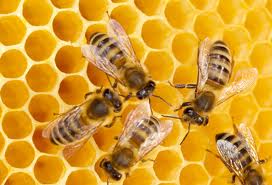
We can learn a lot about innovation by observing the social behavior of honeybees. Who hasn’t been riveted by devastating stories of colony collapse? This is serious stuff. From a honeybee’s perspective watching 35% of your fellow Apis mellifera get wiped out is no joke. From a human perspective, think of it this way, one out of every three mouthfuls of food we eat is dependent on honeybee pollination. Bees are responsible for about $15 billion in U.S. agricultural crop value. Colony collapse really matters. It’s worth paying attention to bees.
The term colony collapse disorder was first applied to a drastic rise in the number of honeybee disappearances in 2006. It’s an eerie phenomenon where one day worker bees swarm together in great numbers and the next they are gone, poof they just disappear, leaving behind an empty hive. It’s not as if they leave to join another colony. They leave to die alone and dispersed which is strange given the social nature of honeybees. Scientists have been working feverishly to determine the etiology of colony collapse disorder.
I read with great interest the recent announcement that researchers collaborating from academia and the military had found the answer. I am a sucker for a good collaborative innovation story where unusual suspects tag team across silos to solve a problem that neither of them could solve on their own. This one is a classic. Army scientists in Maryland working with academic entomologists in Montana solved the mystery. They applied proteomics-based pathogen screening tools to identify a co-infection comprised of both a virus and a fungus. They found the combination of pathogens in all of the collapsed colonies they tested. Hopefully their findings will quickly lead to pathogen mitigation strategies dramatically reducing the incidence of colony collapse disorder.
While I am glad the mystery is solved I can’t help asking, what is it about organizing in colonies that prevents bees from innovating themselves. And closer to home, aren’t bee colonies like hierarchical corporate structures? Maybe understanding the social behavior of bees in their colonies will help us understand why corporate structures are also vulnerable to colony collapse.
Read the rest of… Saul Kaplan: Innovation Lessons From Bees
If you’ve ever wondered what colors will bring out the handsome devil in you, you might want to consider having a color analysis done. This is a process by which someone trained in color drapes you in various fabrics to determine your optimal color palette. The idea is that the “right” colors will brighten skin tone, even out complexion, smooth skin texture, balance the shapes of your features and make you appear rested and younger. The “wrong” colors will dull skin and drain your coloring, making you appear tired and sallow…not cool at all!
Check out this video of me with the ever-dynamic Mary Schook on a Chinese news hour that aired this past weekend. In it, we discuss how colors relate to the Asian population, namely women:
Yes, color analysis may sound super girly, but it’s of particular relevance to guys, and here’s why: women can get away with wearing the “wrong” colors because they use makeup to help negate any ill effects those colors may have on how their skin looks. Most men, however, don’t wear makeup, so it’s crucial if they want to make flattering clothing choices that they know what colors will look fantastic on them.
If you’re in the New York Tri-State Area or metro-Boston and are interested in getting your colors done officially (and in English), contact me.
November 5th, 1994. The MGM Grand in Las Vegas, Nevada. A boxing match featuring potentially the future of the sport against an older, heavier, washed-up ex-champion. If you were gambler the smartest money would be on the young lion. However, this is real life and nothing is more dramatic than real life. On that a 45 year old ex-heavyweight champion of the world got lucky or did he? With one punch, George Foreman, knocked out Michael Moorer to capture the world’s heavyweight boxing a title, a title he hadn’t held for 20 years.
So was Foreman lucky or did something else happen? Was a lucky punch that any of us could of landed or was there something else to blame? Fitness and real life are one in the same. What you do for fitness affects every other aspect of your being. We are all given 24 hours in a day and we are all given one life to live as we choose. Ask George Foreman if he was lucky? He will tell you that the thousands of hours, all the blood, sweat and tears and the practice of going against the greatest (Muhammad Ali) prepared him for that moment. He caught lightening in a bottle, one more time. So can you.
A wise person once told me that if you are not doing something to make the world a better place AND making people around better, you are wasting your time. That you have to have an insatiable desire for achievement. Nothing should ever stand in your ways of what you want. I apply this principles to fitness; if you want something go get it. Don’t sit back and let it come to you because it won’t. “Big” George didn’t wait for it to come to him, he took it and made history. History is yours for the taking.
Michele Bachmann recently told us she was not going to run for re-election in 2014. While some people greeted her announcement with either relief (no more being confused by Minnesota having both legal gay marriage and Bachmann as a representative) or snickers (instead of a press conference, she posted a gauzy, underscored video that bore an eerie resemblance to those short films airplanes use to show you how to buckle a seatbelt.) But there were also many people who were distraught that she would be leaving public life, especially since Fox News is denying rumors that she would simply be moving there.
Of course her loyal followers are upset, but probably not nearly as much as comedians. One basic tenet of good comedy is to say outrageous things as though they were perfectly normal. (A great example of this is George Carlin’s segment in “The Aristocrats,” the cult movie about the world’s dirtiest joke. Carlin’s advice was to deliver off-color content as though one was describing how a carburetor works – the movie is worth watching just for that part!) Ms. Bachmann was a textbook illustration of this principle, maintaining her composure while expounding vehemently, and seriously, about everything from the IRS’s conspiracy to deny Tea Party members any health care, to “The Lion King” serving as a homosexual recruiting tool (convincing kids that they should be gay because a gay composer wrote the music). And facts be damned – when she was criticized for stating that Lexington & Concord were in New Hampshire, she simply explained that New Hampshire had as much right to be proud of “the shot heard round the world” as the actual location. My personal favorite was her claim that there was a suspicious coincidence in flu surges occuring during Democratic presidencies, like an outbreak under Obama and then the big swine flu epidemic in 1976 (which was under Gerald Ford’s watch, not Jimmy Carter’s, but whatever?). Frankly, at times I wondered if she were some sort of giant humor project, like Stephen Colbert’s brief run for president, and the whole thing would be revealed like Joaquin Phoenix’s odd ‘performance art’ on The David Letterman show.
But now she’s leaving – and while there will still be plenty of loony conspiracy theorists around, none of them will make writing comedy as easy as Ms. Bachmann has, because what she actually said needs no embroidering to be funny. (I discovered the truth of the axiom that real life is funnier than anything I can write when my kids started asking me about the facts of life . . . when I explained the whole thing to my younger son and asked if he had any questions, he said with great concern, “What if it gets stuck?” I told him that wouldn’t happen, not as long as he was 18 and she was Jewish . . . . Sadly, now that they’re older teenagers with cars, they’re not home enough to provide me with material. But I digress . . . )
I’d actually planned on doing a song for Ms. Bachmann during the 2012 election, but she dropped out before I got to her, so I’m grabbing this opportunity just in case she vanishes from public life and devotes her life to combating the scourge of gay liberal Disney-movie propaganda . . .
By Nancy Slotnick, on Tue Jun 4, 2013 at 8:30 AM ET
The hierarchy of communication:
Text
Chat
Email
Phone
Text is largely considered the lowest common denominator in the food chain of communication. Although arguably Facebook chat is lower. I mean you have to have someone’s cell # in order to text, right?
Yet I love texting. It’s quick and efficient and concise. And I am rarely concise- ask my husband. I once told a friend who was editing an interview of mine that I am better when edited, and he wisely said “Everyone’s better when edited.” (Thank you, Dave Adox) And here I babble.
Anyway, text forces me to edit myself, and I appreciate that. Apparently Harvard Magazine reported that young people say phone conversations slow them down. I agree! Yet a lot women (and some men too) feel that it’s rude to text in dating rather than calling. Who has time for all this calling? Who knows how to win at the game of phone tag these days? I sure don’t. These phone-o-philes think that they are standing up for healthy communication and true connection. They often have quite a moral high ground about it. I find their superiority complex on this topic to be unwarranted. The era of the phone call (ala “we talk on the phone every night”) has ended. This battle has been already lost.
I see texting as men’s revenge. The phone call era gave rise to a lot of annoyed guys and the phrase “chewing my ear off.” Many of these guys were pretty keen on technology and thus the text was born. Or maybe Al Gore invented it; I’m not sure.
Read the rest of… Nancy Slotnick: Text in the CIty
By Erica and Matt Chua, on Mon Jun 3, 2013 at 10:00 AM ET
The Middle Eastern version of the free market is the modern day souq. A visit to Dubai wouldn’t be complete without a stroll through the covered alleyways in search of exotic treasures and fine jewelry and silks. While these markets don’t offer the luxurious shopping experience of the Mall of the Emirates or the Dubai Mall they give visitors a glimpse into the origins of Dubai’s trade.
The Dubai Creek where many of the historic and still active souq’s are located is the foundation of modern Dubai. It originally served as a port for trading vessels plying to and from India, Africa and the Middle East. You can still see some of the old custom houses, but the creek is frequented more by local shoppers and tourists than by shipping vessels these days. Take a step back in time with me and take a peek into Dubai’s souq’s:
Gold Souq
The dazzling gold souk, located at the mouth of the Dubai Creek is a must vist for any visitor to the gold-obsessed UAE. The small shops are packed with large quantities of gold and shop-owners ready to bargain. Most of the gold is 22 carat and sold by weight with an additional charge for craftsmanship. The window shopping is excellent, but prices are high for prospective buyers.
Textile Souq
The textile souq’s alleyways are adorned with luxurious silks, yards of beaded fabrics, pashmina scarves and everything you need to outfit yourselif in traditional Emirati dress. If you want something special made any of the vendors will be happy to help you, just remember to bargain.
Read the rest of… Erica and Matt Chua: Dubai Souqs
Ever want to throw a shot put into the middle of an intransigent organization or system? I know I have. With a shot put weighing in at 16 pounds most of us had better either be very close to the target or consider a better way to catalyze change.
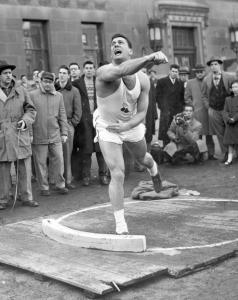
You probably haven’t heard of James Fuchs, who passed away on October 8, but he was a classic innovator. Fuchs was the best shot-putter in the world from 1949-1950. He won 88 consecutive meets, set four world records, and changed the sport forever. Fuchs teaches us about the difference between best practices and next practices.
Fuchs was a fullback on the Yale football team but injuries kept him from playing. He was also on the track team and while recovering from surgery for a leg injury he was limited to competing in discus and shot put. Fuchs became best known for shot put. Fuchs’ leg injury prevented him from using the standard and universally accepted shot put technique. State of art at the time was for a shot-putter to come to a complete stop before releasing the shot. Before Fuchs, shot put was all about brute arm strength. Athletes focused their training on weight lifting. All shot putters competed on a model of arm strength equals distance. That is until James Fuchs came along. Fuchs didn’t lift weights at all and weighed only 215 pounds, small for a shot putter.
Because Fuchs’ leg injury prevented him from using accepted best practice he invented a new practice that worked for him. Innovation is more about next practices than best practices. Fuchs came up with a fluid catapult motion that didn’t require him to stop short aggravating his injury. His innovative technique involved rocking back on one leg, swinging the other in front for balance, hopping forward and propelling the 16-pound iron ball forward. He had learned from a physiology teacher that legs are three times more powerful than arms. Fuchs, like all innovators do, took advantage of both existing constraints and insights missed by current competitors. His innovation became known as the ‘sideways glide’ working around his injury and taking much better advantage of the power of his legs. In 1949 Fuchs set a new world shot put record of 58 feet 4 ½ inches. In 1950 he beat his own world record three times with a personal best of 58 feet 10 ¾ inches. He had changed the sport forever. Fuchs’ sideways glide became the new best practice for all shot-putters. That is until innovation struck again and it wasn’t.
Read the rest of… Saul Kaplan: 16 Lbs. of Solid Iron Innovation
Sounds good, right? With some foresight and planning, you can save valuable time in the morning so you can have that extra 10 minutes in bed. Read on for 13 tips on getting out the door quickly, efficiently, and of course stylishly.
1) Lay your clothes out the night before. We learned this back in grade school, but at some point along the way we stopped doing it. If you have the space, get a wardrobe valet to keep things neat and visible as you make your selections. It also helps to check the weather so you can decide on what shoes and outerwear you’ll need.
2) Maintain an organized closet so that you can find everything you need the moment you need it. For my tips on how purge your closet, click here.
3) Once you’ve cleared out the things you don’t need, keep your clothing organized by type (suits with suits, blazers with blazers, shirts with shirts, etc.), then by color within each type. Again, it’s all about easy access.
4) If you don’t have heavy beard growth, shave the night before. This also reduces irritation.
5) Put your keys on top of anything you need to bring with you, like the Netflix envelope you’ve been meaning to mail for the past few days.
6) Keep all the things you know you’ll need right before you walk out the door in one handy place, for example in a basket in your closet, or in a hallway drawer. This might include a lint-brush, hair product, glasses, sunglasses, change for coffee/the paper, mobile device, wallet, office security badge, transit pass.
Read the rest of… Julie Rath: Do You Wish You Got More Sleep?


 So how do you go from the isolation of living alone in a Facebook-induced haze of faux connection? Not that I am knocking Facebook. Geez, my wholeMatchmaker Café business is based on Facebook. But there’s a reason that all of this social networking makes us feel more lonely. We use it as an end in itself instead of a means to an end.