By Erica and Matt Chua, on Tue Apr 15, 2014 at 8:30 AM ET South Korea is a testament to human will. It is one of only a handful of cultures that can claim 5000 years of continuous civilization. Of those 5000 years, the last century was one of the most difficult; few populations have ever been put through so much, yet it stands today as one of the world’s richest countries. Walking through its streets today it is hard to believe that just 60 years ago it was a smoldering war zone, having been leveled twice: WWII and the Korean War. From a tourist’s point of view the country has few draws as it seems like any modern country, until you look around and consider everything you see around you represents a miracle for even existing. South Korea jumped as many hurdles as any modern country ever has, making it a worthy stopover en-route to other Asian destinations.
……………………………………
DON’T MISS: Busan. Insert any positive superlatives about a gorgeous, modern, beachfront city here. MUST SEE: SpaLand (Busan), Beomeosa Temple (Busan), DMZ, War Memorial of Korea, Seoul MUST TASTE: A traditional Korean dinner, Hanjeongsik, composed of an array of small dishes (banchan, directly translates to “side dishes”).
……………………………………
TRIP PLANNING: A whirlwind weekend is enough to see either Seoul or Busan. Add more time to visit Gyeongju or Jeju Island GETTING AROUND: Public transport is fantastic inside Busan and Seoul, with affordable taxis everywhere else. To get between Busan and Seoul, take a bullet train and travel at 320km/hr (~200Mph).
……………………………………
OUR COST PER DAY (2 ppl): $54.60 COST OF A BEER: $2-3 at a chicken and beer restaurant, make sure to try the fried chicken, South Korean fried chicken is delicious. KEY MONEY-SAVING TIP: Cabs are cheap, but don’t try to cross the city in one as Seoul and Busan are huge and the fare will sky rocket quickly. Use public transport to get as close to your destination as possible and then a cab if needed. In both Busan and Seoul you can get a transport card that makes subway and bus riding hassle free. Tourist information centers can help you purchase these cards.
……………………………………
YOU NEED TO KNOW: Many/most of the young people know basic English. They may not be confident speaking, but if you need directions most can help you. IF WE KNEW WHAT WE KNOW NOW: We would have spent less time in Seoul as it can be done in just a weekend. HELPFUL LINKS TO LEARN MORE: Top things to do in Busan, Top 10 things to do in Seoul, Wikitravel. Please send us any sites you found useful and we’ll add them!
……………………………………
WE WERE THERE FOR: 2 weeks OUR HIGHLIGHT: Couchsurfing with an American in Busan. It was nice to have someone that understood everything we said after months of broken English conversations. WHERE WE WENT: Seoul, Gyeongju, Busan WE REGRET MISSING: Jeju-do (Jeju Island). We’ve heard many great things.
……………………………………
POPULAR ARTICLES
Click to read more about South Korea
.
Short on time? The highlight reel of our 3 week trip to South Korea including beaches, oceanside temples, fish markets, skyscrapers, fried chicken and more. Tour South Korea in under 15 photos!
14 Photos
Busan is the largest port city in South Korea and the fifth largest port in the world. The city is located on the southeasternmost tip of the Korean peninsula and is a source of pride for Koreans. As it should be, the wonderful beaches of Haeundae to the world’s largest department store in downtown this city should be a must-visit in Korea.
28 Photos
Gyeongju was the capital of the ancient kingdom of Silla (57 BC – 935 AD) which ruled most of the Korean Peninsula between the 7th and 9th centuries. A vast number of archaeological sites and cultural properties from this period remain in the city. Gyeongju is often referred to as “the museum without walls”.
26 Photos
Seoul is the capital and largest city of South Korea. A mega city with a population of over 10 million, it is one of the largest and most densely populated cities in the world. Historic buildings are tucked in amongst the skyscrapers and apartment buildings are everywhere. From the indoor markets to the arts district Seoul has many different sides. While it may not be built for tourists you get a glimpse into the hustle and bustle of living in South Korea.
29 Photos
By Julie Rath, on Fri Apr 11, 2014 at 8:30 AM ET Today’s post is courtesy of speech and communication specialist, Marjorie Feinstein-Whittaker, of The Whittaker Group. I was introduced to Marjorie by a client and have been thoroughly impressed by the progress she’s made with his communication skills throughout the course of my work with him.
 Many of us spend a significant amount of work time in meetings ranging from routine staff and management meetings, to client presentations, and more. Unfortunately, these frequent opportunities for education, collaboration, and communication are often perceived as boring, unproductive, and even contentious. One of the most important things you can do to make your participation in meetings positive is to be a good listener. By offering your full and focused attention, and conveying respectful and socially appropriate behaviors, you can build and maintain healthy long-term business relationships. This is easier said than done. Many of us have both verbal and non-verbal habits that can sabotage our best efforts. However, if you identify and address some of these behaviors, you can learn how to exude confidence, competence and poise. Many of us spend a significant amount of work time in meetings ranging from routine staff and management meetings, to client presentations, and more. Unfortunately, these frequent opportunities for education, collaboration, and communication are often perceived as boring, unproductive, and even contentious. One of the most important things you can do to make your participation in meetings positive is to be a good listener. By offering your full and focused attention, and conveying respectful and socially appropriate behaviors, you can build and maintain healthy long-term business relationships. This is easier said than done. Many of us have both verbal and non-verbal habits that can sabotage our best efforts. However, if you identify and address some of these behaviors, you can learn how to exude confidence, competence and poise.
If you typically:
1. Interrupt others – If you have an enthusiastic, perhaps impulsive personality, it may be difficult not to blurt out comments at inopportune times. Take a slow, deep breath, or silently count to three before you speak. If you inadvertently interrupt someone, acknowledge it by apologizing, and encouraging the speaker to go on. For example, “I am sorry for interrupting. Please finish what you were saying.” If you need to interrupt a speaker to get a meeting back on track, or give another participant time to reply, raise your hand slightly (to chest level), and acknowledge the speaker by name. “James, I’m sorry to have to cut you off, but I promised I would leave 10 minutes for Q and A.”
2. Have a trash-mouth –
If you are a person who litters their speech with expletives to get attention or express extremes of emotions, you are negatively affecting your professionalism and credibility. It is best to refrain from inappropriate or potentially offensive remarks. Work on expanding your vocabulary so you can explicitly and appropriately convey your thoughts and emotions. Instead of saying, “It was a damn good meeting,” try something like, “The meeting exceeded all of our expectations.” Learn how to choose your words carefully. Rehearse alternative ways of expressing your feelings and ideas in a more professional manner. If your colleagues include nonnative English speakers, be careful not to use unfamiliar figurative expressions, slang or colloquialisms which may be misunderstood or misinterpreted. Also avoid jargon or acronyms that might be unfamiliar to some members of the group.
3. See the glass as half-empty –
If you are the nay-sayer in the group, think of ways to re-frame what you say with a more positive spin. Instead of remarking, “That is never going to work,” or “That is a ridiculous proposal,” try something like, “This project is going to be challenging. Perhaps if we delegate the responsibilities, we can meet the deadline.”
4. Have “monkey-brain” –
If you sit in meetings and your mind jumps from one thing to another as if you were swinging from tree to tree by your tail in the jungle, you need to learn how to focus. Of course there are a myriad of external distractors, such as people walking past your office, interesting things outside the window, office chatter, and buzzing smart phones. There are also internal thoughts that may range from a growling stomach to how you feel about your co-worker on a given day. Learn how to be in the moment. Look at the person who is speaking, and really listen with your eyes, body and mind. Offer to take the minutes. This task will ensure that you are really engaged and listening mindfully.
5. Ramble, mumble, or speak too softly or rapidly –
Sometimes it is difficult to get to the point, especially if you are asked a question that you didn’t anticipate. Instead of answering immediately, take a breath, and organize your thoughts silently. Create a mini outline in your mind so you can stay on topic and avoid rambling. A convenient acronym to help you achieve this is T-I-E-S. T= re-state or paraphrase the question or topic I= introduce your main idea E= cite 2-3 supporting facts or examples S=summarize
Make sure you speak at a reasonable pace (not too fast or slow), and at an adequate volume (not too soft or loud). Finish the ends of your words, and don’t let your voice trail off at the ends of words. Try to minimize stereotypical and meaningless remarks such as, “Do you hear what I am saying,” and empty fillers such as “you know,” “It was like,” “uh,” etc. Pause silently, and speak when you have something worthwhile to say. Make sure you speak with varied pitch and intonation, and avoid a monotone (boring) delivery.
6. Send the wrong message without saying a word –
It is extremely important to be aware of what kinds of non-verbal messages you are sending through eye contact, gestures, and body language. For example, bouncing your leg, drumming your fingers, or rolling your eyes could convey impatience or frustration. Closing your eyes/pinching the bridge of your nose, looking away and yawning could convey boredom, and raising your eyebrows, covering your mouth with your hands could convey disbelief. Much of what we say isn’t spoken at all. Try to maintain appropriate eye contact with speakers, lean forward with your body, and nod to convey interest and attentiveness.
Of course, you cannot control what other colleagues or clients say or do in meetings, but you can control your reactions. You will find that being a good listener who is in the moment will have benefits that go beyond the Boardroom.

Marjorie Feinstein-Whittaker is owner and principal consultant at The Whittaker Group in Boston and is co-founder of ESL RULES. Her companies provide assessment and consultation services to both native and nonnative English speakers in a variety of fields. She develops and delivers specialized foreign and regional accent modification programs and customized workplace communication programs for those seeking to improve the clarity and effectiveness of their speech and communication. Marjorie works with clients from all over the world, both in person and via distance learning. Her training programs have been featured on The Today Show and many local media outlets.
You can contact Marjorie here.
-Content provided by Rath & Co. Men’s Style Consulting. Read more: http://rathandco.com/2014/03/follow-these-6-rules-for-success-in-any-meeting/#ixzz2xZ1CJ78r
By Josh Bowen, on Thu Apr 10, 2014 at 8:30 AM ET 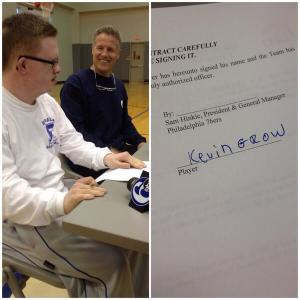
This week I needed something. I needed something that would instill positivity in my opinions of the world. Lately, all I hear about is death, disease, war etc. on the TV (one of the reason I do not watch television). And right on cue is a story about a young man with Down Syndrome who signed an NBA contract with the Philadelphia 76ers. A story about a boy who was his high school basketball team’s student manager who was given an opportunity to finally fulfill his dream of playing basketball…and made the best of that opportunity. This young man is unafraid of his situation and though his condition limits certain things, his enthusiasm and passion never waiver. It was refreshing. It was a feel good story. And maybe it is an example that could be applied to all aspects of life?

If you knew for certain you couldn’t fail, what would you attempt? Would you exercise more? Would save more money? Would you open a business? What would you do if you knew you couldn’t fail?
This young man has everything against him but shows heart and valor and a love for a game on par with the professional players he will be sitting with. He doesn’t think of failure, he thinks of opportunities and lets his passion lead the way.
I challenge you this week to think about what you would do if you knew you would not fail. Whatever that is, find a way to go do it. This young man did and his life is forever changed.
By Lauren Mayer, on Wed Apr 9, 2014 at 8:30 AM ET As a political humorist, I gravitate toward bad news and schadenfreude. This is hardly surprising since satirists are often inspired by idiotic comments, horrible laws, and ludicrous judicial decisions.
I’m getting ready to record an album of my “greatest hits,” songs from my weekly videos going back to the 2012 election, and I’m noticing how many of them were inspired by things that would have otherwise made me angry. These include Todd Akin’s “shut that whole thing down,” Paul Ryan blaming poverty on lazy inner city men, the NRA’s response to Sandy Hook, and the dire need for a minimum wage increase. And I’m not saying there’s anything wrong with this— humor has always been used to cope with difficulty by ridiculing authority, highlighting hypocrisy, and helping people laugh at what might otherwise make them cry.
However, it’s nice to change things up a bit. As my dad used to say, “Moderation in all things, including moderation.” (Which is either brilliant, or weirdly redundant. As were most of his aphorisms, including “Eschew obfuscation” – if you need a definition, ask a teenager who just finished SATs. But I digress.)
Last week there was still plenty of news to inspire dark humor, but the ACA enrollment news was surprisingly good. Add that to my love of word play and seeing a short-lived internet pun, and I decided it was time to celebrate instead of skewer. (Okay, I took a few digs at the Obamacare nay-sayers, but gloating is too hard to resist!)
By Erica and Matt Chua, on Tue Apr 8, 2014 at 8:30 AM ET The United Arab Emirates is a stage for the world’s super-rich to strut their stuff in pricey hotels, clubs and malls. For example, mall’s include ski slopes, ice arenas, massive aquariums and more high-end shopping than could ever afford. If the glitz and glam are too much, neighboring Abu Dhabi provides a taste of culture in the world’s most expensive mosque which puts the Taj Mahal to shame. For speed addicts, Abu Dhabi’s Ferrari World boasts the world’s fastest roller coaster, while the traditional camel market in Al Ain provides a welcome counterpoint. Even if you don’t have the money to roll with the Emerati, you can still enjoy their playground.
……………………………………
DON’T MISS: Sheikh Zayed Grand Mosque in Abu Dhabi, it has to be seen to be believed. MUST SEE: The Burj al-Khalifa (Dubai), the world’s tallest building, Al Ain camel market, Dubai Marina, Dubai gold souk and Sheikh Zayed Grand Mosque. MUST TASTE: Possibly there are better choices, but after two years of traveling we indulged on New York’s famous Shake Shack burgers and other American delicacies.
……………………………………
TRIP PLANNING: See the highlights of Abu Dhabi and Dubai in a weekend, but plan for a week to include Oman. GETTING AROUND: Make use of the excellent buses. Utilize airline’s free shuttles between Abu Dhabi and Dubai. Getting around is substantially easier if you rent a car.
……………………………………
OUR COST PER DAY (2 ppl): $64.71 COST OF A BEER: $5-$12 USD, alcohol is available exclusively at international hotels and pubs. KEY MONEY-SAVING TIP: Use Priceline for the best hotel rates, you can score a luxurious hotel for a great price due to the over-supply of hotels in both Abu Dhabi and Dubai.
……………………………………
YOU NEED TO KNOW: Conservative clothing is required and shows respect for Emirati culture, revealing clothing worn by men or women can be quite offensive. IF WE KNEW WHAT WE KNOW NOW: We would have spent more time in neighboring Oman. HELPFUL LINKS TO LEARN MORE: The New York Times recommendations for spending a weekend in Abu Dhabi.
……………………………………
WE WERE THERE FOR: 7 days OUR HIGHLIGHT: Experiencing 1.7 Gs of force on the world’s fastest roller coaster at Ferrari World in Abu Dhabi. WHERE WE WENT: Dubai, Abu Dhabi and Al Ain WE REGRET MISSING: The view from the top of the Burj al-Khalifa.
.
Ferraris, gold, mosques and camels. See the best of the UAE in only 23 photos!
23 Photos
Called the “world’s richest city”, Abu Dhabi is more than money. Rich with culture, entertainment and beauty it is a sight to behold.
17 Photos
“World’s _____” begins many sentences about Dubai. Home to many of the world’s best, Dubai doesn’t disappoint, see why for yourself.
By Saul Kaplan, on Mon Apr 7, 2014 at 8:30 AM ET  Here’s the thing about toothpaste tubes. You can squeeze all you want on one part of the tube and the toothpaste will only pop up in another part of the tube. Many of today’s important systems operate much the same way. Here’s the thing about toothpaste tubes. You can squeeze all you want on one part of the tube and the toothpaste will only pop up in another part of the tube. Many of today’s important systems operate much the same way.
The big challenges we face today including health care and education are systems issues that require systems solutions. These systems have evolved over a long time and are well intentioned. Players in the system work hard year after year to deliver value, improve their position, and create sustained incremental improvements. It is not enough. We need new toothpaste tubes. We can’t fix these system issues by squeezing harder on different parts of the tube. We need to design and experiment with new system level solutions.
Everyone loves to point fingers at the other players in the system as the cause of the problem. Health care is a classic example. Observing our health care system today is like watching an intense rugby scrum that is moving in slow motion hoping the ball will pop out. Finger pointing and incessant public policy debates galore. We love to admire the problems: It is the cost of drugs that is killing us. It is the high cost hospitals that are the problem. It is the insurance companies that are in the way of change. Doctors are the ones who are resisting change. If only the government would get its act together. If only patients would take more responsibility for their care. It goes on and on.
In education, the same movie is playing with different actors. It’s the unions that are getting in the way. Teachers are resisting change in the classroom. Administrators don’t understand what is going on in the classroom. Parents are not engaged. Public policy makers can’t make up their minds. If only private sector companies were more engaged. Students are unruly, undisciplined, and disrespectful. Everyone is blamed and nothing changes.
I’m not a cynic. I’ve seen and participated in many innovative initiatives that are trying to create systems-level changes within healthcare and education. And some of them have indeed succeeded in creating incremental value. But where are the disrupters? Where are the systems-level game changers? The problem is that great ideas coming from one silo are tried but quickly bump into the other silos and constraints of the system. Promising new solutions squeeze on one part of the toothpaste tube only to learn that when you squeeze on one part of the tube it just pops up in another. We need safe environments to design and experiment with new toothpaste tubes or systems.
 The student and the patient should be at the center of our redesign efforts in education and health care. We need to experiment at the systems level, trying new approaches to see what works. For instance, we’ve proven that innovation works at the school level with hundreds of successful charter schools across the country. Now we need to experiment at the district level to test new student centered system approaches that are not constrained by the way the current system operates. That is the only way we are going to learn what solutions can deliver value to the student at scale. The same thing is true in health care. We need to design and test patient centered system approaches that are more about well care than about sick care. We can’t get there by playing at the margins of today’s system. Squeezing today’s toothpaste tubes harder will not work. The student and the patient should be at the center of our redesign efforts in education and health care. We need to experiment at the systems level, trying new approaches to see what works. For instance, we’ve proven that innovation works at the school level with hundreds of successful charter schools across the country. Now we need to experiment at the district level to test new student centered system approaches that are not constrained by the way the current system operates. That is the only way we are going to learn what solutions can deliver value to the student at scale. The same thing is true in health care. We need to design and test patient centered system approaches that are more about well care than about sick care. We can’t get there by playing at the margins of today’s system. Squeezing today’s toothpaste tubes harder will not work.
By Julie Rath, on Fri Apr 4, 2014 at 8:30 AM ET Zzzzzzzzzzzzzzzzzzzz. Oh, excuse me, someone was talking to me about navy blazers, and I fell asleep.
The idea of navy blazers typically conjures memories of a first trip to Brooks Brothers for a rite of passage Sunday jacket, gold buttons and all. But not all navy blazers have to be a snoozefest. In fact, there are ways to take this conservative stalwart and give it a good shake-up. Read on for 5 tips on how to make a navy blazer your own:
1) Get it tailored so that it FITS you. I’ve you’re a current Rath & Co. client, or if you’ve been following me for some time, you know I’m a stickler for clothes that fit perfectly. So if you have a navy blazer that’s been hanging around your closet for a while, and the fit is within striking distance (the first thing to check is if it’s right across the shoulders), take it to a tailor you trust, and have him or her check the rest, including waist, arms and length, and make adjustments as needed. You’d be amazed at the 180 a jacket can take with a few nips and tucks.

2) Swap out those trad gold buttons for ones made of horn or gunmetal, like in the image above of a blazer I designed for a client. You’ll go from preppy to polished in no time.
3) Rather than standard navy, consider a blue with some kick to it, like midnight, cobalt or royal. Check out the same shot above of my client in his spanking new bright blue blazer. (His fiancée wasn’t complaining.)
 4) Instead of a solid, try a subtly patterned fabric, like this tone-on-tone windowpane (above left — you have to expand the image to see the pattern) I just picked out for a different client. A blue hounds-tooth or pin-dot (above center and right) would also work, as would blue tweed in cold weather. From 4 + feet away, these fabrics read as solid, but up close you can see the extra oomph. 4) Instead of a solid, try a subtly patterned fabric, like this tone-on-tone windowpane (above left — you have to expand the image to see the pattern) I just picked out for a different client. A blue hounds-tooth or pin-dot (above center and right) would also work, as would blue tweed in cold weather. From 4 + feet away, these fabrics read as solid, but up close you can see the extra oomph.
Read the rest of…
Julie Rath: Wake Up that Navy Blazer
By Josh Bowen, on Thu Apr 3, 2014 at 8:30 AM ET “You either prepare to succeed or prepare to fail…there is no in-between.”
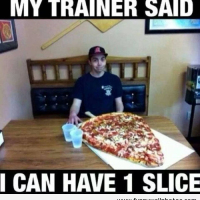
You have great intentions. You want to eat better. You want fitness results. But you didn’t bring any food to work today. So you go out with the rest of the crew and eat Mexican.
Is this you?
Professor JB here! I am prepared to take you through a course of food preparation. But first lets digress on why you would prepare your food:
1. Selection- I find that clients that prepared their meals ahead of time select better foods. Clients that do not prepare meals, tend to select whatever is available. Selecting whatever is available is a great way of messing with your fitness results.
2. Cost Effective- Today I fixed 3lbs of chicken and a half pound of rice. This will last for 10-12 meals. The total cost $60 or $5-6 per meal. To eat out and get the same meal would cost $10-15. That is a savings of $5-10 per meal. In other words, prepare your meals.
3. Results- Everyone wants results but few are willing to do what it takes to get them. If you want results, prepare your meals. It is that simple.
Now let us get down to the “nitty gritty” on how to prepare your food.
1. Prepare ahead of time- Take a day or two and prepare your meals for the week. Plan what you are going to have (in accordance of your goals) each day and only cook what you need.
2. Keep it simple- Try your best to keep it simple. A great protein source, a steamed vegetable and a small amount of carbohydrates (depending on goal) is a great way to prepare your meals.
3. Variety- If you want variety for taste purposes, use different seasoning and sauces to switch it up. Keep the additives to a minimum but also it is important to have fun with your meals. Getting a cookbook and trying different recipes is a great idea as well.
4. Fun- Try you best to look at this as fun, rather than a chore. This process is to help you see fitness results and keep you on track and more efficient.
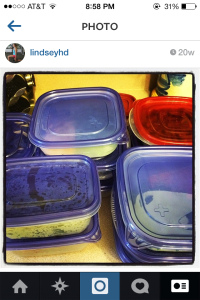
For you enjoyment, here are some of my lovely clients food prep pictures:


Yours in fitness,
By Lauren Mayer, on Wed Apr 2, 2014 at 8:30 AM ET like to joke that I have 3 boys, ages 17, 20 and 47. (One is my husband – cue rim shot.) Husband 2.0 came along when I was a single mother with really young kids, and he proceeded to endear himself to them by doing silly impressions (his Yoda and Scoobie-Doo sort of mesh together) and inventing a game he called ‘Dodgeball In The Dark,’ in which they raced around the backyard throwing whatever wasn’t nailed down. But he really bonded with the boys via male humor – first Simpsons, then Family Guy as they got (almost) old enough, with a healthy dose of “that’s what she said” jokes thrown in.
Many writers have weighed in on why women are less amused by this type of humor – in fact, Google “Why men love The Three Stooges and women don’t” and you’ll get over 2 million entries, with a wide range of explanations. I’m constantly trying to give my boys a bit of refinement and elegance, and moms are traditionally the ones who discourage rough-housing and bad language, but there is also something to be said in favor of letting our hair down a bit – especially since at my house it’s a losing fight anyhow.
I’ve learned to enjoy Family Guy (okay, it can be horribly offensive, but also really funny, and the song parodies are a riot), and I’ve been known to crack an off-color ‘that’s what she said’ on occasion. Plus this week, when I was at my wits’ end trying to figure out a topic for my song, Husband 2.0 suggested I do something juvenile with the rhyming name of Hobby Lobby – and this is the result. (Maybe we’re the reverse of the old saying about Fred Astaire and Ginger Rogers, that he gave her class and she gave him sex appeal. . . I give him class and he gives me bawdy humor suggestions?)
By Erica and Matt Chua, on Tue Apr 1, 2014 at 8:30 AM ET Palm trees, surfboards, sandy beaches and seafood are the images that come to mind when someone mentions Sri Lanka. The tiny island is known for it’s beaches, however their cultural sights are stunning, if expensive. The north of the country is definitely worth your time, maybe not all your money, but don’t let the ticket prices scare you away.While visiting Sigiriya, Anuradhapura, Polonnaruwa will all set you back a pretty penny, Dambulla is an easy and affordable day trip from Kandy.
If all these foreign names aren’t familiar, here’s a crash course: the ancient cities of Sri Lanka that lie north of hill country were formerly known as Rajarta, Land of the Kings. For 1500 years this was the heart of Sinhalese culture and today offers a glimpse into the past. In the last decade both Anuradhapura and Polonnaruwa were unearthed by archaeologists, revealing an incredible irrigation system. The enigma of Sigirya has been studied offering both royal and military explanations for the huge rock structure jutting out of the desert as a result of an extinct volcano. Possibly the oldest of the ancient cities are the rock cut Buddhist temples at Dambulla, which are thought to date back to the 1st century BC.

With the mini-history lesson out of the way we can jump right into photos of the phenomenal Buddhist caves in Dambulla. There are five separate caves containing over 150 Buddha images. Most of the paintings in the temples date to the 19th century, however the just barely ten year old structure at the base of the caves is your welcome to this ancient worship sight. If a spiritual place can be kitschy the entrance to the Golden Temple is just that. Although the enormous golden Buddha perched on top of the building claims to be the largest Buddha in the world (later research found it wasn’t even the largest one in Sri Lanka).

Past the kitschy entrance, several flights of stairs and hoards of feral monkeys carry visitors to the first of the caves. Devaraja Viharaya, the Temple of the King of the Gods, features a massive reclining Buddha. At the Buddha’s feet is Ananda, the Buddha’s loyal disciple.
Read the rest of…
Erica & Matt Chua: A Buddhist View of Sri Lanka
|
|


