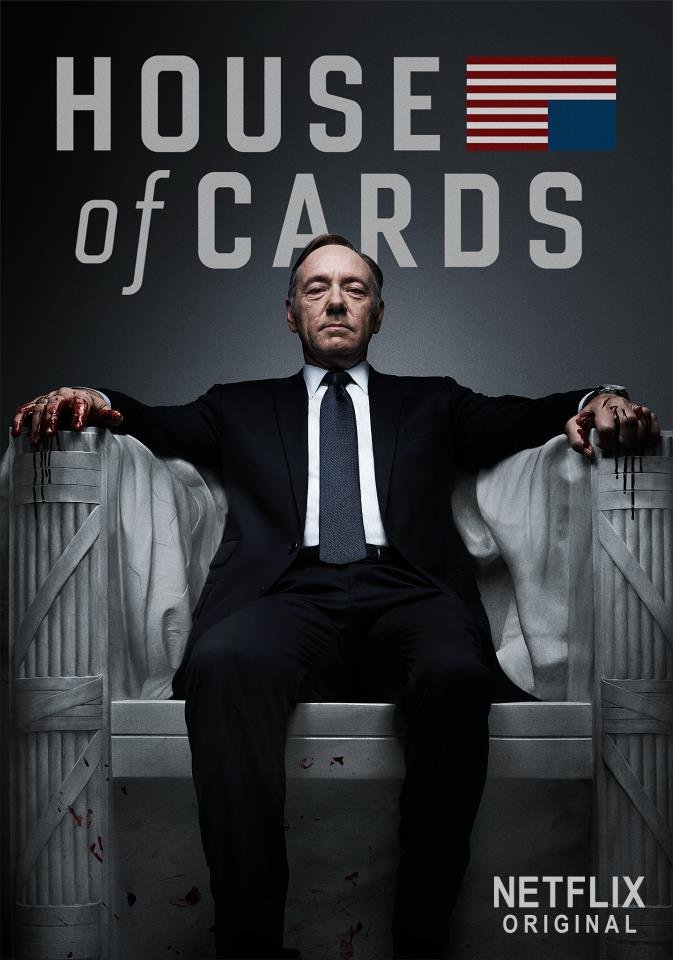
My guess is that if the Netflix political drama “House of Cards” had improbably gotten the backing of a network, it would have swiftly drowned at the hand of Nielsen ratings, and that hiatus or cancellation might have set in before Frank Underwood got to offer his sermon on the nature of forgiveness in a South Carolina church. There is no pop heroine like Kerry Washington’s Olivia Pope (“Scandal”) for a particular audience demographic to root for. And there is no precedent for ratings behind a plotline that doesn’t just include but hinges on the minutiae of governmental details. There may be the requisite sex and adultery and prostitution but they are for major stretches overshadowed with much grayer material: a would-be secretary of state whose nomination unravels over his reference as a college newspaper editor to “illegal occupied Israeli territories” and an impasse over performance metrics in an education bill.
So, this is a show that is destined to be read about more than it is actually watched (the number of viewing souls who know the toxic nature of testing standards for teachers unions and who get that the combination of illegal and occupied are fighting words is, thankfully, small). And then there is the inconvenience for a subscribed series depending on buzz that much of its fan base will not shout their allegiance from the rooftops, or the cultural equivalent that is Facebook: the show’s core of politically engaged people is culturally disposed to deny that it has time to watch television, much less engage in the binge viewing that a simultaneous download of the whole season invites.
But for the politically obsessed collective of Hill staffers, journalists, campaign operatives and ex politicians who have already watched, a decisive verdict: for all of the clichés it spouts about politicians, for all of the little implausible plot engines it relies on (of course, nothing so fanciful as the idea of a first lady enduring a presidential sex scandal and making her own run for president or a black state senator riding a speech to the White House in four years time) this is uncommonly good stuff, for the risks it executes and the vivid story it tells about things that are not inherently vivid.
The central figure, an oily Southern congressman named Frank Underwood (Kevin Spacey), is nothing new, nor are his penchants for lowball tactics and outwitting his peers by playing to their vanity or weaknesses. But the novelty is that for all 13 episodes, Underwood stays an unredeemed rogue–not the morally ambiguous striver who starts noble and turns bad, not the hero who has a dark side that he is trying to suppress, but an unmitigated, blissful damager of people. There is a deliberateness to the fact that for all of the specific policy detail that embroiders the narrative, there is never a moment when Underwood shows a flicker of interest in any of it for its own sake. And if David Fincher trusts his audience to wrestle with an array of shifting events and relationships (that would blur had these episodes been laid out over three months) he ventures even more faith in its capacity to stay absorbed in a villain whose only source of suspense is how low he will descend.
Underwood is not the only character whom the audience has to engage while being turned off by their sins. All of his intimates are caught in their own level of moral vacancy: Underwood’s wife Claire (Robin Wright), who cashes in on her husband’s status to run a not-for-profit whose agenda she will sell out without much compunction, just for the thrill of a score; the loyal chief of staff (Michael Kelley) who is Underwood’s henchman and whose only prize is a place in the orbit of a boss who keeps him at arm’s length and calls him by his last name; a young congressman, Peter Russo (Corey Stoll, brilliantly erasing the memory of a weak stint on a failed “Law and Order” remake), whose past is ridiculously compromised and whose only real interest in his career is that it seems to provide an organizing principle for his day; the young reporter (Kate Mara) who entangles herself professionally and sexually with Underwood to fuel her own career, and whose snideness and ethical carelessness make her almost as unsympathetic as Underwood. The relative paragons of decency: a young aide to Russo who tries to save him from his spiral, is still framed as a staffer covertly sleeping with her boss to climb the office ladder; another, a high level aide to Claire Underwood who acknowledges lying about the terms of her dismissal to exact revenge for her boss’s horse-trading with a lobbyist.
What producer David Fincher assumes is that a group of people wallowing in dirt and dysfunction are still watchable. Of course, he is right about that, as television routinely establishes, but Fincher’s gamble is that for most of this series, his characters’ routines are their own contained universe with no one to root for, no mystery to solve, and none of the contrived simplicity of a single narrative conflict.
In that way, “House of Cards” takes a chance that even the notably risk-taking “Homeland” doesn’t: for example, for 11 episodes of the show, there is not an obvious end in sight that Underwood’s machinations are meant to achieve (and when it materializes, it seems accidental); and for about the same stretch, most of the other characters have no endgame of their own. (Unless you fell for the unlikely scenario of Peter Russo’s continued sobriety, and Fincher squashes that rooting interest in some of the series’ few heart-wrenching moments). Imagine if “Homeland” were just a story about the torpor of a deceitful, embittered, returning POW instead of a spy saga about a sleeper terrorist. It is doubtful it would have lasted. Fincher, with great audacity, assumes a show about unappealing people climbing career ladders can work as a dramatic force and it is a large feat that he pulls it off—and doubly impressive that his material is the stereotypical vista of Washington vice, not the relatively exotic venue of mobsters in the “Sopranos” or the creative twist of everymen turned drug dealers in “Breaking Bad”.
At least one critic, Atlantic’s Ari Melber, has made the observation that the other unique perspective of this show is its intuition that it is the culture of politics that attracts flawed people, and that the familiar scapegoats, money and special interests, are only symptoms of the wasteland rather than the causes of it. It’s a cynically appealing perspective, but a short-sighted one. The more substantial reality is that the conniving side of politics is identical to the back-stabbing that goes on in academia and law firms, that the sordid compromises are not so different than doctors peddling medicines they have side deals on, or architects shortchanging some clients to favor others, or traders short-selling their investors’ stocks. The difference is that moral obliviousness in politics resonates while its professional analogues seem mundane (unless there is a lot of sex crammed in).
By John Y. Brown III, on Fri Feb 15, 2013 at 12:00 PM ET
Saying “no” when it is necessary is important. How you say no can be even more important.
As Mark Twain once quipped the difference between the right word and the almost right word is like the difference between lightening and a lightening bug.
His point was well taken as a maxim for literary precision.
But a similar emphasis should be placed on the manner or tone or context with which one delivers messages to others, especially messages with a negative impact. Like conveying that the answer to a request or proposal or simple question is “no.”
Simply saying the word no, may seem to be adequate for message purposes but is hardly ever sufficient for full communication purposes. It is only a partial response that ignores acknowledging the time, resources, preparation and hopefulness invested in the endeavor awaiting a final reply. And deserves more work on the responding end than a mere thumbs down.
Think of Mary Poppins; advice that a “Spoonful of sugar helps the medicine go down.” Good life advice with multiple applications.
The next time you say “no” to someone think of your role as being more akin to giving a eulogy to the deceased than serving as the executioner.
Unless, of course, you are in to that sort of thing. Some people secretly relish delivering harsh rejections– with an almost mild sadistic delight, But be ready to be haunted by the ghosts of bad news being explained badly (or sensitive news being explained insensitively).
The consequences of good and bad bedside manner is seen in every type of office everywhere….not just the ones inhabited by doctors and the medical profession.
So think of it this way. If good bedside manner is what distinguishes to a large degree great doctors from merely good technical doctors, couldn’t that be true in other professions too.
Good bedside manner is not something that requires a knowledge of medicine or other technical expertise. It merely requires a basic level of respect for the person or client or patron you are talking to. And the extra time to craft a sentence or two that uses both the word no and conveys the message thank you.
By John Y. Brown III, on Thu Feb 14, 2013 at 12:00 PM ET
The economic way of thinking. (The Slinky Test)
There’s a sucker born every minute, PT Barnum famously said. Including the evening of June 2, 1963 (my birth date)
I saw a later version of this TV ad when I was a child of about 5. And I had to have a slinky. Had to. Watch the way it curiously flops hypnotically down a flight of stairs. Or flops itself along the declining platform.
It was the “sizzle” not the “steak” (so to speak) that mesmerized me and made me feel I had to have this shiny toy.
So I insisted and wheedled and cajoled (even though I didn’t know what those words meant at the time) until my grandmother broke down and got me one.
And here’s the genius (or cunning) of good ole American marketing. The slinky did exactly as it was represented in the ad. If flopped down the stairs. And flipped down an incline.
So I did it again. And again the slinky flopped and flipped–just as it did in the ad. I didn’t want to admit it but, frankly, I was starting to get a little bored at this juncture. So
I ran the slinky down the stairs and incline one or two more times. And then I realized, “I think I’m done with this toy. Now what?” And shortly after that the economic agony of realizing you spent (or your grandmother spent) $4 in real money for about 50c in thrills sets in.
You can keep playing with the slinky until you get in about $6 worth of play, so your grandmother will remember your wise purchase the next time you want something you see advertised on TV. Or you can do as I did. Go in the basement and pretend to play with the slinky for about $7 or $8 dollars worth of fun to impress your sweet grandmother (who also warned you about the limits of a slinky).
And don’t we do that with many new purchases?
So the test for us should NOT be, “Does the product perform as represented?” But rather, “Does what the product claim to do —for personal or practical reasons—justify the cost?”
And if the answer is no, remind yourself how many hours you’ll have to spend in the basement pretending to be playing with a slinky to preserve your ability to make your next irresistible purchase.
(Note: I know the slinky is a lot more complicated than I make it sound and an ingenious toy. But mostly for ingenious kids. I just thought it looked cool going down the stairs and failed to calculate how much that was worth to me).
By John Y. Brown III, on Wed Feb 13, 2013 at 12:00 PM ET
My kind of rebel.
A friend was making his 8 hear old daughter attend the adult worship service which is an hour long and hard for a youngster to sit through without lots of restless squirming.
To cope the plucky little girl would stand and draw on the program. My friend got her to stop drawing where people could see what she was doing but couldn’t get her to sit without being firm.
Finally, he sternly , teeth gritted, said emphatically “Sit down now, young lady!”
And she did.
But two minutes later whispered to her dad defiantly, “I am still standing up in my mind.”
By Lisa Borders, on Wed Feb 13, 2013 at 11:00 AM ET
Wow – I’ve been doing this for a long time, and I can honestly say, I’ve never seen anything like this.
Last night, Twitter was blowing up. News outlets across the country were highlighting the success of our grassroots movement. Even Arnold Schwarzenegger and Eva Longoria were talking about No Labels:
Here’s the bottom line: When the president walked into the chamber last night, he had 45 No Labels problem solvers there to greet him. This was a truly unprecedented effort and the world took notice.
We broke through the noise and got noticed across the social media sphere.
We’ve turned a corner and with your help, there is no limit to what we can do.
Please join our growing army of hundreds of thousands of Democrats, Republicans and Independents, by clicking here.
Karl Rove has been spectacularly right about one big thing in his far-flung career: his calculation that Republicans in the late nineties and early 2000s needed to be rebranded as problem solvers, who had a formula to compete on Democratic terrain like education and health-care, outflanked Clintonian centrism when it was on the verge of realigning American politics. Rove was just as spectacularly wrong on another front, his blind spot on the risks of conservatism “going corporate” and turning into just another patchwork of special interests and powerbrokers.
It’s worth keeping the dual nature of Rove’s Bush era legacy in mind as he plots an ambitious effort to intervene in primary fights on behalf of Republicans who are…well, that part remains vague, but excludes at least candidates with a history of dabbling in witchcraft or who have a penchant for philosophizing on gynecology.
If Rove’s version of influence merely takes the form of injecting one more source of shadowy cash into races, then he has already misread recent campaign cycles. Deep-pocketed front-runners from Charlie Crist to Bill Bolling never made it past the starting gate, and it is the insurgents who have cleaned up in GOP state primaries who have been chronically under-funded. The missing element for the losers in these fights has not been a lack of cash to sustain ads or phone banks, but an inability to mobilize rank and file primary voters with either a policy vision or a rhetorical message beyond inside baseball about electability.
In an era where the activists who dominate party primaries award no extra points based on time served in office, or chits from funneling checks to local party committees, the populist, anti-establishment wing of the party has filled a void. In blunt terms, their fears are not getting outflanked with swing voters, but getting trammeled by a government that serves every agenda but theirs. They distrust “reform” as a code for more mandates. They are corrosively suspicious of political power because it seems too subject to being rented or bought by corporate power. And many of them have adopted a Manichaen view of politics that genuinely considers constitutional liberty and fiscal stability to be in some degree of jeopardy.
Read the rest of… Artur Davis: The House that Rove Built
By John Y. Brown III, on Tue Feb 12, 2013 at 12:00 PM ET
Identity management tool
I was asked by Apple iTunes a question to confirm my identity and allow me access to my account
The identity question ?
What was the first album you purchased?
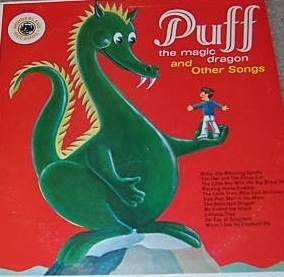
I answered–after considerable thought –Puff the Magic Dragon. It was 45 years ago but I remember it well.
But I was told “no” that wasn’t the album.
How do they know?
Can I find out from Apple what the album was I first purchased?
May be they will say the Monkees….but that was my second album.
I will call tomorrow to protest this block to my account and I will have affidavits from my mom and two sisters that, indeed, it was Puff the Magic Dragon.
Contributing RP and former Missouri State Sen. Jeff Smith talks about his political advice column, “Do As I Say,” which helps other politicians and professionals who find themselves in compromising positions:
By John Y. Brown III, on Mon Feb 11, 2013 at 12:00 PM ET
The difference between guys and dogs.
When a dog catches a car it pauses and looks genuinely confused….and saunters off knowing he miscalculated the payoff and feeling foolish (even by dog standards).
When a guy catches the equivalent of a car he has been chasing (so to speak), he seems uncertain for a nanosecond and then immediately projects the image of someone positively thrilled with his capture, of knowing exactly what he was doing and what to expect, and poses as if to say, “Seriously folks, have you ever seen such brilliantly successful car chasing before ? I didn’t think so.”
And then before any sliver of doubt emerges begins looking for the next car to chase (figuratively speaking) –as his audience watches on approvingly.
Other than this distinction guys and dogs are otherwise very similar.
By John Y. Brown III, on Fri Feb 8, 2013 at 12:00 PM ET
Leave ’em speechless. My inner-Superfly. And vivid imagination:
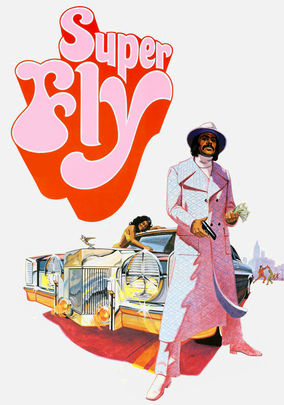
Me: I really don’t think you would have sent that snarky text this morning if you’d known the truth about what song I’d just listened to. That’s right. What song (and video) I had just listened to and watched. And was feeling. Superfly! Curtis Mayfield. Uh-huh. That’s right!
Texter: I’m sorry Mr Brown. I didn’t know.
Me: You’re sorry alright. Don’t text me in that sarcastic tone ever again.
Texter: I won’t, sir. I swear.
I love cool comebacks that I have with others during imaginary conversations I have in my head.
Sure, it’s not quite the same as if I actually said it during an actual conversation to an actual person. But it still sends a message. Maybe a message no one but me is aware of. But it sends a message to me that I’m not as important or feeble as I feel at the moment.
And, yeah, I’m pretty good at it, too. Like Yogi Berra said, “It ain’t braggin’ if you done it.” And I do have a lot of great comebacks that shut down rude people in their tracks. (Imaginary comebacks in imaginary conversations with imaginary people).
But as these fantasy conversations go, they are impressive, and plentiful, and I always get the last word. Leaving my rivals speechless and ashamed–and hopefully a little wiser the next time they find themselves in an imaginary conversation with me.


 What producer David Fincher assumes is that a group of people wallowing in dirt and dysfunction are still watchable. Of course, he is right about that, as television routinely establishes, but Fincher’s gamble is that for most of this series, his characters’ routines are their own contained universe with no one to root for, no mystery to solve, and none of the contrived simplicity of a single narrative conflict.