By Grant Smith, RP Staff, on Fri Jul 15, 2011 at 3:00 PM ET
Why avoiding office politics is NOT an option! [Fortune]
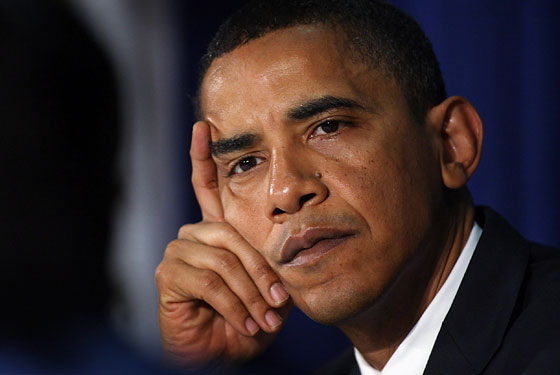
Why President Obama walked out of the debt-ceiling talks in the cabinet room. [Washington Post]
Why failure to reach a deal on the nation’s debt-ceiling could actually be a good thing. [CNBC]
The end of the era of the engineer: why one engineer argues this sector of the economy will add less value in the years to come. [Forbes]
Rupert Murdoch’s family agrees to appear before the British Parliament. [NY Times]
By Artur Davis, on Fri Jul 15, 2011 at 2:15 PM ET  House Democrats are demoralized by the end game on the debt ceiling, and they have reason to complain that their votes are being taken for granted. But on the substance, their hard line on health benefits is riddled with contradictions: maintaining the status quo on Medicare preserves a benefit/contribution structure that is hardly progressive and that privileges upper income individuals arguably as much as the Bush tax cuts that the same Democrats want to repeal. At the same time, the Democratic Caucus has largely been silent on the expiration of federal Medicaid stimulus spending, and the state downsizing of Medicaid programs, two events that are compromising the availability of health care for low income patients. House Democrats are demoralized by the end game on the debt ceiling, and they have reason to complain that their votes are being taken for granted. But on the substance, their hard line on health benefits is riddled with contradictions: maintaining the status quo on Medicare preserves a benefit/contribution structure that is hardly progressive and that privileges upper income individuals arguably as much as the Bush tax cuts that the same Democrats want to repeal. At the same time, the Democratic Caucus has largely been silent on the expiration of federal Medicaid stimulus spending, and the state downsizing of Medicaid programs, two events that are compromising the availability of health care for low income patients.
Political games aside, means-testing elements of Medicare makes it a fairer, more progressive program. It also does not neutralize the issue for 2012: to the contrary, Democrats can argue that their adjustments to the program are a more responsible approach than the Ryan plan, which hands over Medicare to the private insurance market and risks substantial premium hikes for middle and low income seniors. Finally, controlling Medicare costs frees up resources to shore up Medicaid, which is in dire straits and ought to be a more compelling liberal priority.
(Cross-posted, with permission of the author, from Politico’s Arena)
By Andrei Cherny, on Thu Jul 14, 2011 at 8:30 AM ET As most Americans return to work following Monday’s fourth of July holiday, so the nation’s political class also return to their jobs, following majority leader Harry Reid’s cancelling of the Senate’s scheduled Independence Day recess. Top of the agenda will be negotiations to avoid a crisis over the nation’s debt ceiling. But another issue should also top the agenda: the sluggish US jobs recovery.
The labor market has stalled again in recent months, while the debate over what to do about jobs has long been caught in a political cul-de-sac. The traditional economic tools of the right and left – tax cuts and government spending – have failed to offer much relief in a time when the economy is global, capital is mobile and a few extra dollars in a family’s bank account can go to purchase Chinese-made televisions and clothes at Walmart.
Injecting more money into the economy might have worked when we lived in a national, as opposed to a globalised, economy; when big businesses created most jobs; and when the paradigmatic workplace was the regimented assembly line. But America and other modern economies have entered what might be called the “new work order” – an economy where most workers are untethered from large institutions and bouncing from one job to the next. In this economy, each worker is, in effect, their own small business – responsible for guiding their own career and economic future.
 Although advocates of the top-down approaches of helping big companies or expanding big government may not realize it, we live in a bottom-up economy: today’s job creators are less likely to be industrialists throwing up factories than to be laid-off workers firing up their laptops in a Starbucks.
Research has shown that during the past generation, start-ups less than five years old have accounted for all net job growth in the US. The current challenge is that the recent economic slowdown is directly tied to a very real entrepreneurial slowdown. The number of new businesses with employees fell by more than 17 per cent between 2007 and 2009. The number of new employer companies in 2009 was at its lowest level since 1992. Self-employment rates have been falling in the past couple of years, even while a study this year from the Small Business Administration demonstrated that 65 per cent of the jobs created by start-ups between 1997 and 2008 were jobs that entrepreneurs created for themselves. As the study’s author put it: “Business creation is job creation.”
Read the rest of…
Andrei Cherny: A Jobs Plan for the New Work Order
By Jeff Smith, on Wed Jul 13, 2011 at 2:15 PM ET 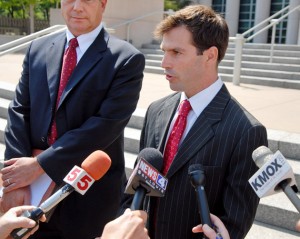 [Presidential candidate Mitt Romney’s fundraising underperformance] means a few things. [Presidential candidate Mitt Romney’s fundraising underperformance] means a few things.
1) A lot of donors who supported Romney last time are jumping ship or dodging him.
2) As the heir to “establishment” frontrunner status, Romney should’ve been able to cultivate most of the 2008 McCain donors. That hasn’t happened.
3) Given how much Perry raised within Texas alone for a gubernatorial race, and given the oil industry’s success amid the national recession, there will be ample money for him to compete on a national stage.
4) The sheer number of people who continue to give money to Ron Paul, when they presumably have children who ask for toys, puppies, and other things, is mind-boggling.
(Cross-posted, with permission from the author, with Politico’s Arena)
By Grant Smith, RP Staff, on Wed Jul 13, 2011 at 11:00 AM ET The Politics of Generation Y Revisited On June 15th, my esteemed colleague, Zac Byer, published a thoughtful piece on generation Y’s place in the world. Most importantly, he zeroed in on Gen Y’s strong attachment to nostalgia.
Perhaps most insightful, he theorized that this attachment to nostalgia is potentially rooted in a generational fear that what lies ahead may not be as bright as what has already passed.
At risk of sounding like a pessimist, one has to wonder, “what if the pessimists have this one right?” What if Gen Y – financially speaking – is destined to end up as a new “lost generation?”
Let’s look at what is coming down the road: student loan debt that surpasses credit card debt; risk of inflation from multiple rounds of quantitative easing; the end of Social Security and Medicare as we know it; the list goes on and on.
Like the credit card shopper who splurges at the store, only to wind up with the bill months later, Gen Y is very likely to be the generation who receives the credit card bill in the mail from a previous generation or two. Unlike the credit card shopper who at least got to enjoy their products, Gen Y may get all of the tab, but none of the goods.
Read the rest of…
Grant Smith: The Politics of Gen Y Revisited – A New Lost Generation?
By Artur Davis, on Wed Jul 13, 2011 at 8:30 AM ET  President Obama has resorted to extreme measures to forge a compromise with congressional Republicans to raise the debt ceiling and avoid a national default. He has signaled a willingness to slash federal expenditures by an unfathomable 4 trillion dollars over a decade, and he is hinting that the pillars of Social Security , Medicare, and Medicaid will not be exempt. President Obama has resorted to extreme measures to forge a compromise with congressional Republicans to raise the debt ceiling and avoid a national default. He has signaled a willingness to slash federal expenditures by an unfathomable 4 trillion dollars over a decade, and he is hinting that the pillars of Social Security , Medicare, and Medicaid will not be exempt.
A Democratic Governor in Minnesota has taken a sharply different route, opting to shut his state’s government down unless Republicans consent to a temporary surcharge on millionaires. Meanwhile, In New York, the iconic liberal empire, a Democratic Governor has jettisoned ten thousand teachers and state employees to save money and has slashed spending for child welfare and education; at the same time, he declared tax increases off limits and fought his party’s efforts to impose New York’s own millionaire’s tax.
Welcome to the muddled place that is Democratic ideology in 2011. Under the pressures of an economy that just barely dodged a depression, and swollen entitlement obligations at both the federal and state level, chief executives who are certified progressives are living in desperate times. They are responding in dramatically contrasting ways that are partly tactical, but ultimately reveal much about the coming fissures in the Democratic Party circa 2013-2016.
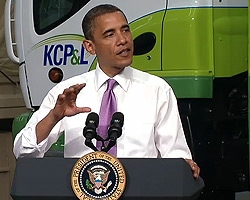 The President at Smith Electric Vehicles At that point, Barack Obama will be one or the other: the second Democrat in a generation who saved his presidency partly by discarding liberal priorities and emphasizing a hawkish profile on deficit reduction, or a discredited figure who squandered an electric personal mandate and failed to fight hard enough for his principles. Under either scenario, a trainload of agenda items, from immigration reform to stronger collective bargaining rights and stricter regulation of carbon emissions, will have been buried.
Read the rest of…
Artur Davis: What is Next for the Democrats?
By Michael Steele, on Tue Jul 12, 2011 at 8:30 AM ET
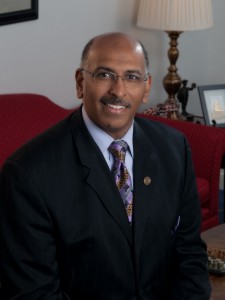
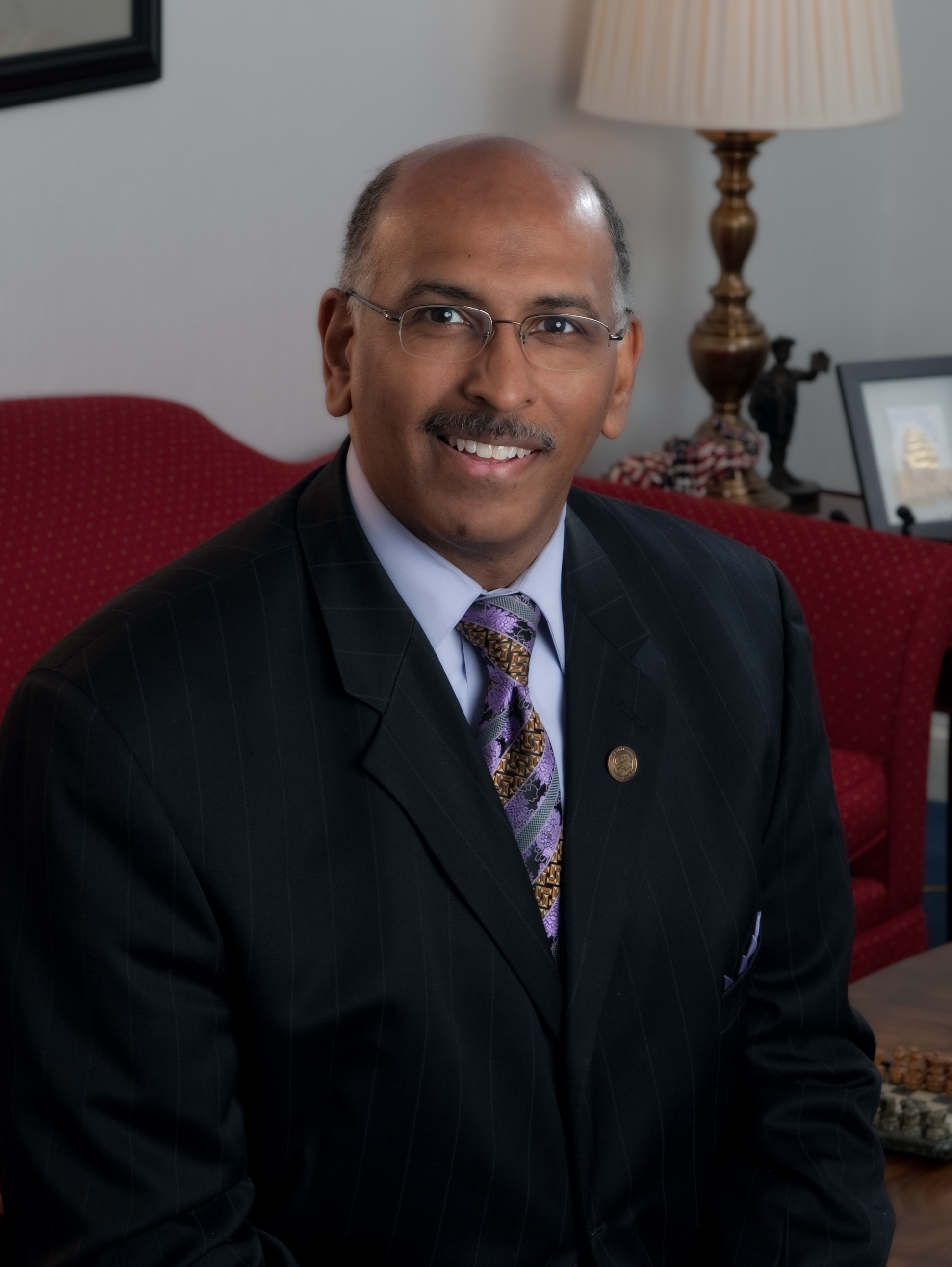
Although I grew up in Washington D.C., to me Capitol Hill was a very distant place. I felt that I was living in the real world; while Capitol Hill was in some parallel universe. I just didn’t understand how people up there thought. And I have to tell you the truth, as I watch our elected leadership deal with the very serious issues facing our nation’s fiscal health, I still don’t.
Take perhaps the most basic question of all when it comes to tax and budget policy—do deficits matter? That question has generated a lot of debate in Washington in recent weeks. I am mystified it has to be asked.
I am aware of the academic debate concerning the interplay between deficits and interest rates. I also acknowledge the points often made by The Wall Street Journal’s editorial pages about the empirical evidence casting doubt about the absolute linkage between the two, for example.
I first learned the value of a dollar not from The Wall Street Journal, but from a sharecropper’s daughter who had little choice but to drop out of school to work the tobacco and cotton fields of South Carolina. She later went out into the world fighting to provide for a family with only a 5th grade education. She worked for 45 years in a Laundromat, and the most she ever made in her life was about $3.80/hour.
Through the remarkable example of her life and her will, my mother taught me about fiscal discipline, the value of a dollar, budgeting; and most importantly, how thoughtful investment, when coupled with hard work, can provide empowerment and opportunity. So, as someone who has struggled to run a small business, and who had to balance budgets and manage that most precious of resource—taxpayer dollars—as a statewide elected official in a state where budgets must, by law, be balanced—deficits do matter.
 Deficits mean that our kids have to pay the bills we run up, and that, until those debts are paid off, we have to borrow the money to fund the shortfall from creditors around the world, to whom we are increasingly beholden. Can you say “China”? Deficits mean that our kids have to pay the bills we run up, and that, until those debts are paid off, we have to borrow the money to fund the shortfall from creditors around the world, to whom we are increasingly beholden. Can you say “China”?
So as our nation convulses from one more report of rising unemployment (now 9.2 percent), and more and more of our citizens doubt the sincerity, let alone the ability of elected officials to actually get something done, what must the White House, the GOP led Congress and Democrats in the Senate do to show they get it and are serious about restoring strength to our economy? (1) Respect where the money comes from in the first place—you and me; (2) Make the tough choices—now, not down the road; and (3) stop playing political games to block needed reforms.
Read the rest of…
Michael Steele: The Old Rules No Longer Apply
By Will Allison, on Mon Jul 11, 2011 at 12:00 PM ET  On August 2, the United States of America is set to default on its debt obligations. I am not an economist, and would not deign to pretend that I understand the economic repercussions of such a move. However, I do have another important credential, and that is called a “survival instinct.” This instinct is stronger than I remembered. On August 2, the United States of America is set to default on its debt obligations. I am not an economist, and would not deign to pretend that I understand the economic repercussions of such a move. However, I do have another important credential, and that is called a “survival instinct.” This instinct is stronger than I remembered.
I know this, because I am now up at 3am, scared right out my damn sleep from the horror movie that would be defaulting on our nation’s debt. I have read too many of these Freddy Krueger-themed articles not to believe it. Phrases like “global financial meltdown”, “financial apocalypse”, “the American economy dragging the global economy down the drain”, and “millions of unemployed joined by millions more” own me now, people. This is a cry for help.
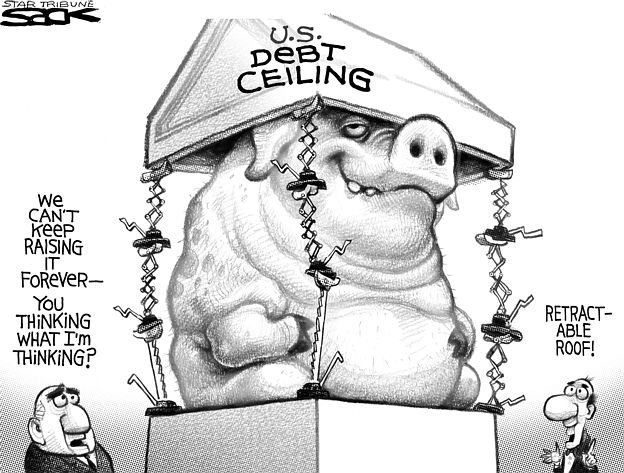
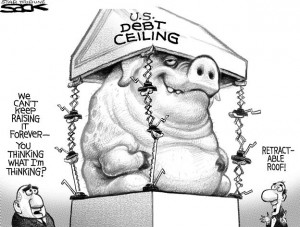 The raising of the debt ceiling, typically a pro forma vote Congress takes every year to meet our rising spending obligations, has met a wall this summer with a newly emboldened, GOP-controlled House. This House is heavily influenced if not directed by the Tea Party, willing to risk default to deal with what it feels is our top fiscal priority: spending cuts. In response, the Democrats, true to their nature, have already offered massive concessions on spending, in return for some kind—any kind—of tax increase on the very wealthy. The GOP has replied with “no”. Despite their deficit-obsessed rhetoric, they are not interested in increasing revenues to lower the deficit. They only want spending cuts, and apparently are willing to allow our economy to collapse if they don’t get exactly that, only that, and on a massive scale. The raising of the debt ceiling, typically a pro forma vote Congress takes every year to meet our rising spending obligations, has met a wall this summer with a newly emboldened, GOP-controlled House. This House is heavily influenced if not directed by the Tea Party, willing to risk default to deal with what it feels is our top fiscal priority: spending cuts. In response, the Democrats, true to their nature, have already offered massive concessions on spending, in return for some kind—any kind—of tax increase on the very wealthy. The GOP has replied with “no”. Despite their deficit-obsessed rhetoric, they are not interested in increasing revenues to lower the deficit. They only want spending cuts, and apparently are willing to allow our economy to collapse if they don’t get exactly that, only that, and on a massive scale.
And so it goes. The Republican Party’s “top negotiator” on the debt ceiling, House Majority Leader Eric Cantor, has already walked out of the talks. Democrats, in return, have begun to urge the President to invoke a little-known clause in the 14th Amendment to the Constitution that may legally require our nation not to default on its debt. The President could simply say he’s not legally allowed to permit our nation to default, and instruct the Treasury to continue to pay the bills. The GOP’s response is to threaten impeachment if the president goes that route, claiming he will have superseded Congress’ power of the purse. I am going insane trying to keep up with this stuff, people.
Read the rest of…
Will Allison: Watching the Ceiling Cave In
By Greg Harris, on Mon Jul 11, 2011 at 9:00 AM ET  Historic moments define presidencies. For President Obama, that moment came in the form of a nation teetering on the brink of depression. Historic moments define presidencies. For President Obama, that moment came in the form of a nation teetering on the brink of depression.
The President responded to the crisis by (while still Senator) supporting TARP and then, as President, spearheading a massive stimulus package.
This stimulus was very much unlike the federal “New Deal” spending that occurred under FDR during the depression, which included a primary focus on creating as many jobs as possible. Indeed, there are still many monuments to the WPA and related programs standing today (most notably, Hoover Dam, a primary energy source for the Southwest United States).
When you look at a breakdown on how American Recovery Act federal stimulus dollars were spent, you find that a big portion went to tax cuts, while the rest was spread scattershot over many programs. Much of these funds came in the form of aid to States, which supported essential programs (like Medicaid), but only long enough for States to put off most painful budget cuts until this year.
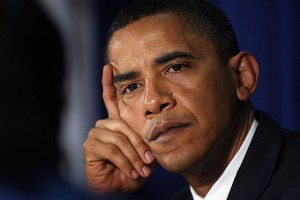 Today we struggle with a 9.2% unemployment rate, and a continuation of tax policies that redistribute wealth to the very top. Last December, President Obama arrived at a “compromise” with congressional Republicans to extend the Bush tax code designed to accelerate redistribution of wealth to those who are already very wealthy. Indeed, Reaganomics followed by W’-nomics have had their intended effect: over the past quarter century four-fifths of income gains have gone to the top 1% of individuals, while middle class wages haven’t kept up with inflation. Contrary to GOP rhetoric, trickle-down economics has defied gravity. Today we struggle with a 9.2% unemployment rate, and a continuation of tax policies that redistribute wealth to the very top. Last December, President Obama arrived at a “compromise” with congressional Republicans to extend the Bush tax code designed to accelerate redistribution of wealth to those who are already very wealthy. Indeed, Reaganomics followed by W’-nomics have had their intended effect: over the past quarter century four-fifths of income gains have gone to the top 1% of individuals, while middle class wages haven’t kept up with inflation. Contrary to GOP rhetoric, trickle-down economics has defied gravity.
Many progressives, me included, were hoping last December the President would take the fight to an opposition that would allow all tax cuts expire in the name of keeping income tax breaks for the wealthiest 2% of Americans. Had no compromise been reached, we would’ve returned to President Clinton’s more progressive tax code, which may well have proven a best case scenario with the added benefit of eradicating much of our deficit problem. But Obama didn’t take this approach. Rather, the debate was between keeping 98% of Bush’s tax code versus keeping 100% of Bush’s tax code. Hence, the GOP would’ve “lost” this showdown last December by only getting 98% of what they wanted versus 100%. Seems to me, they would’ve won either way. They got their 100% regardless.
Read the rest of…
Greg Harris: Obama’s Defining Moment
By Grant Smith, RP Staff, on Fri Jul 8, 2011 at 3:00 PM ET
Two United States Senators from ethanol-producing states propose legislation to immediately end corn-based ethanol subsidies. [CNBC]
Rupert Murdoch shutters “News of The World” amid continuing fallout from the phone-hacking scandal. [Forbes]
Fortune Magazine releases their latest Global 500 list of the 500 largest corporations in the world. [Fortune]
The editors of Cigar Aficionado Magazine report on their latest trip to Cuba. [Cigar Aficionado]
Final space shuttle launch will be the end of an era. [Washington Post]
|
The Recovering Politician Bookstore
|