By Patrick Derocher, on Tue Aug 2, 2011 at 9:30 AM ET
The surprise return of wounded Arizona Congresswoman Gabrielle Giffords was a high point of yesterday's successful debt ceiling vote in the House.
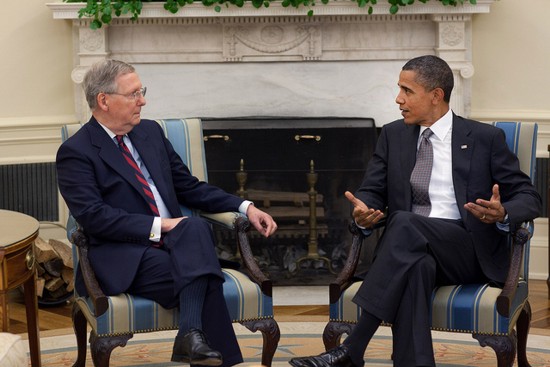
The Obama-McConnell compromise debt deal passed the House of Representatives, receiving 269 Ayes and 161 Noes. Prior to the Monday evening vote, there were concerns that the bill might not pass in that chamber, given resistance it was encountering from both sides of the aisle. However, a late endorsement by House Minority Leader Nancy Pelosi helped push it through, with about one-half of Democrats, including Pelosi, Minority Whip Steny Hoyer, and Assistant Minority Leader James Clyburn all voting yes. [CNN]
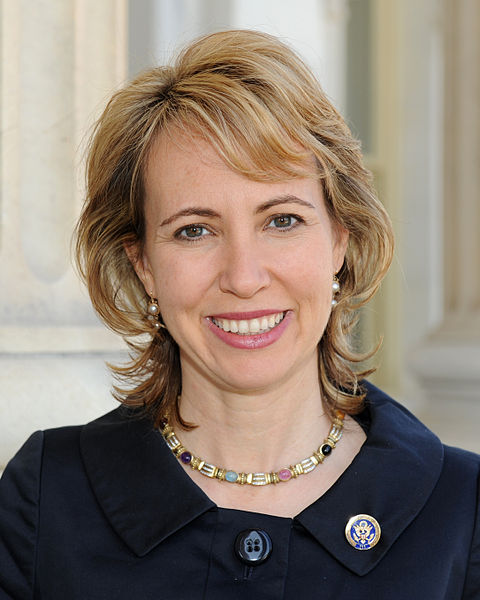
Additionally, Arizona Democrat Gabrielle Giffords made an unexpected return to the House floor to vote “Aye” on the compromise bill. Representative Giffords has not been to the Capitol since sustaining a gunshot wound to the head in a January shooting in Tucson that left 13 wounded and 6 dead. Ushered in by her husband, astronaut Mark Kelly, and applauded by her colleagues from both sides of the aisle, Giffords was reportedly alert and engaged with her fellow lawmakers, greeting many of them by name. [The Atlantic]
The House of Representatives website has a list of the “Ayes” and “Noes” recorded for the Obama-McConnell debt deal. Those in italics are Democrats, those not are Republicans [House.gov]
Perhaps proving that the deal was passed on the support of relatively moderate (and willing to compromise) member of the House, both far-right and far-left groups have taken issue with the compromise. Right-wing, usually Tea Party-affiliated, groups are complaining that cuts did not go far enough, while left-wing groups such as MoveOn.org have expressed concern that the deal has been made by placing burden on middle-class and elderly Americans. This is in spite of the fact that cuts are set to be completed in November while no cuts have been made in Social Security, Medicare, or Medicaid. [Roll Call]
Some are questioning the real power of Tea Party groups in debt negotiations after fully half of the members of the House Tea Party Caucus voted in favor of the Obama-McConnell deal in spite of vows that they would not vote for an increase in the debt ceiling under any circumstances. This comes on the heels of a poll that said that 53% of self-identified Tea Partiers supported a debt deal that included some combination of spending cuts and tax increases. [NY Times]
With the Obama-McConnell compromise bill passed in the House, it now moves on to the Senate, where it is expected to pass, but needs to do so in time to have the bill on President Obama’s desk by the end of Monday to avoid a default. The bill is set to be voted on at around noon, and though it is expected to pass by a wide margin, there needs to be unanimous consent. [NY Times]
Brookings Institution Fellow, former advisor to Bill Clinton, and No Labels Founding Leader Bill Galston has a piece in The New Republic detailing how President Obama could have better handled the budget crisis, including how it could have been avoided and better managed, especially during talks with Speaker Boehner. [The New Republic]
Let’s get the obligatory observations out of the way first: avoiding a default on the debt ceiling was a necessity for an economy that in many respects is already lifeless. That economic reality, and the refusal of House Republicans to budge on their priorities, tied the hands of both President Obama and congressional Democrats.
But politics grades results by who won and who lost, and on that core question, this is not close: The “compromise” reached Sunday night is a full-throated Democratic concession. It is a stunningly good deal for Republicans and the opposite for Barack Obama.
To take inventory, Republicans secured their most cherished priority by averting a rollback of corporate deductions or the expiration of the Bush tax cuts on the wealthy. Ten days ago, one or the other appeared to be within reach of Democratic negotiators. In addition, John Boehner and Mitch McConnell have installed a “trigger” for future cuts that will muddy the Democrats’ message on Medicare.
In fairness, it shouldn’t: There is a vast difference between handing over Medicare to the private insurance market, as all but four House Republicans voted to do earlier this year, and trimming the growth of provider subsidies. But Democrats failed miserably at making that case during the healthcare debate, when cuts to Medicare Advantage subsidies were ruthlessly, and effectively, turned against Democrats and there is no particular reason to think they will do better next year.
Republicans have also stripped Democrats of the additional discretionary spending they need to shore up their domestic priority list, including job training, education, and infrastructure. Nor did Republicans have to make a tradeoff by giving ground on extending unemployment benefits or the payroll tax cuts. It should gall Democrats even more that Republicans have had to pay no political price for their hostility to middle tax class tax relief and extra assistance to the unemployed–both deeply unpopular GOP stances that Democrats have utterly failed to exploit.
Read the rest of… Artur Davis: A Breathtaking Comeback for Conservatism
By Jonathan Miller, on Mon Aug 1, 2011 at 12:00 PM ET
Thanks to the magic of Skype, RPTV introduces a new feature today, “The RP’s Great Debates.”
Our very first installment features a debate between two former Missouri state legislators, from opposite sides of the political spectrum, who somehow found a way to become good friends: contributing RPs Jeff Smith and Rod Jetton. In this interview, Smith and Jetton discuss their relationship, debate the debt ceiling crisis, and — best of all — do pretty accurate and very funny impressions of each other.
If you are new to The Recovering Politician, you probably should read the following pieces by the two men:
Rod Jetton’s 3 part stunningly candid essay on his rise, scandal and renewal: Part 1, Part 2 and Part 3.
Thanks to his internationally (!) well-received piece last week in The Huffington Post, “Debt Ceiling for Dummies,” the RP has been on a virtual international tour of radio and TV talk shows.
By Patrick Derocher, on Mon Aug 1, 2011 at 9:30 AM ET
President Obama took to the White House briefing room at 8:40 p.m. Sunday to announce that an agreement had been reached on the debt ceiling.
President Obama and Congressional leaders have come to a compromise to avoid defaulting on the country’s loans and cut government spending. The two-step deal, which has been approved by Senators Harry Reid and Mitch McConnell Speaker John Boehner (but not yet Representative Nancy Pelosi), begins with the Boehener plan of $917 billion in cuts coupled with a $900 billion debt ceiling increase. This includes an immediate $400 billion increase through September and a later $500 billion increase, with Congress voting on resolutions of disapproval, which the President can subsequently veto. The second stage involves “Super Congress” cutting spending by $1.5 trillion by November, with a vote by the end of the year, at the peril of automatic across-the-board cuts. [CNN]
Even though a debt deal has been worked out, and many Republicans are pleased with the Speaker’s ability to reach a compromise, there are many in the House Republican Caucus, including many Tea Party-affiliated members, who have derided the bill as not going far enough. The challenge, now, is for John Boehner and House Minority Leader Nancy Pelosi to rally enough votes from their respective parties to pass the deal in spite of the flanks. [Politico]
On the other end of the spectrum, progressive members of Congress are taking issue with the deep cuts, including the possibility that Social Security, Medicare, and Medicaid may be on the chopping block if the 12-member board reviewing deficit cuts fails to reach a deal. In particular, Representatives Emanuel Cleaver of Missouri and Raul Grijalva of Arizona, who chair or co-chair the Congressional Black and Progressive Caucuses respectively, have already signaled that they do not plan to support the plan, and Nancy Pelosi was cautious with her support as of Sunday night. [Roll Call]
Even though the agreed-upon bill does not include any specific provisions to increase revenues, President Obama has said that the Bush tax cuts are included in the trigger, meaning that failure by the Super Congress to reach a deal by Thanksgiving will result in their repeal. [Huffington Post]
John Boehner used a PowerPoint presentation to sell the Obama-McConnell deal to his caucus on Sunday. Here it is. [National Journal]
The Washington Post provides a handy graphic illustrating which parties got and gave up what in reaching the deal being presented to Congress on Monday. [Washington Post]
With the House Republican caucus clearly split on whether or not to vote for the Obama-McConnell plan, all eyes are on House Minority Leader and former Speaker Nancy Pelosi of California. Pelosi, who has not specifically endorsed the deal as of Monday morning, also faces a caucus rife with division and distaste for the bill (though probably not as deeply divided as the Republicans), and the bill will not pass without some House Democrat support. In recent days, Pelosi and other senior Democrats have advocated for President Obama to invoke provisions of the 14th Amendment and raise the debt ceiling without asking (or waiting) for Congressional approval. [The Hill]
Following the announcement of a debt deal, markets in Tokyo, Seoul, and Hong Kong gained between 1 and 2 percent apiece while Dow Jones, NASDAQ, and S&P 500 futures all climbed by about 1 percent. Additionally, gold prices, which were expected to climb in the event of a default, dropped after rising steadily for years to an all-time high. [National Journal]
It’s still early, but there already whip counts for the Obama-McConnell bill. The Hill lists 13 in favor, 6 opposed, and several hundred unknown, and Republican Senator Mike Crapo of Idaho has said that he expects some 35 Republican senators to sign on to the Obama-McConnell deal announced last night. [The Hill]
By Jonathan Miller, on Mon Aug 1, 2011 at 9:30 AM ET
My latest column for The Huffington Post reflects one of my great frustrations about today’s politics: The absence too often of rational, civil dialogue. I try to explain why so many disaffected Americans — particularly those in the Tea Party — don’t accept many incontrovertible facts at the center of policy debates, and how the rest of us can become more engaged to dilute the influence of extremism and misguided politics.
Here’s an excerpt:
One of the critical lessons from the debt ceiling debacle is not to underestimate the Tea Party’s influence on Washington policymakers.
But perhaps even more alarming was the strikingly willful disdain many Tea Party activists demonstrated towards some of the rationally indisputable facts at the center of the policy debate.
I saw this phenomenon firsthand on the virtual pages of this very website. Last week, frustrated by my failure to find my teenage daughter a simple explanation of the budget crisis online, I decided to pen one myself. My column, Debt Ceiling for Dummies, was an attempt to provide a dispassionate, non-partisan guide to the sometimes archaic, and often complex, subject matter associated with the credit default debate. As a former state Treasurer and CFO, I hoped to share what I’ve learned from a myriad of experiences dealing with concepts like debt limits and credit ratings.
But as is far too typical in today’s blogosphere, my article provoked an avalanche of bitter invective in the comments section of this site, my own blog, and even my personal Facebook page. I was called a “liar,” a “fraud,” even an intimate of the international conspiracy to fool real Americans and rob them of their hard-earned savings.
My more than two decades of politics taught me not to take any of the criticism personally. But it’s hard not to be flustered when a not-so-insignificant segment of the body politic refuses to accept the incontrovertible fact that lifting the debt ceiling honors the debts we’ve already incurred through our prior spending, and does not require higher levels of future spending or borrowing. Or that the inevitable U.S. credit downgrade that would result from a failure to lift the ceiling would inarguably worsen our national debt problems by dramatically increasing the cost of borrowing.
As a former Member of Congress, I am no longer asked how I will vote; instead, the question I get almost every day is how did Congress become so dysfunctional? The second, less interesting question: Aren’t you glad you’re not there?
The generalized anger at “Washington” is misplaced. Not all parties are equally at fault. While political posturing is apparent, it’s not all about politics. Ideas matter more than most commentators will acknowledge, and ideas that morph into convictions impervious to evidence are the root of our distemper.
Tax cuts pay for themselves. We’ll be welcomed as liberators. Climate science is a hoax—or at least not “proven.” None of these claims was or is true; the evidence against them is overwhelming. But they remain for most congressional Republicans absolute convictions. Why? I believe they are rooted in a profound aversion to collective action by Americans through our governments.
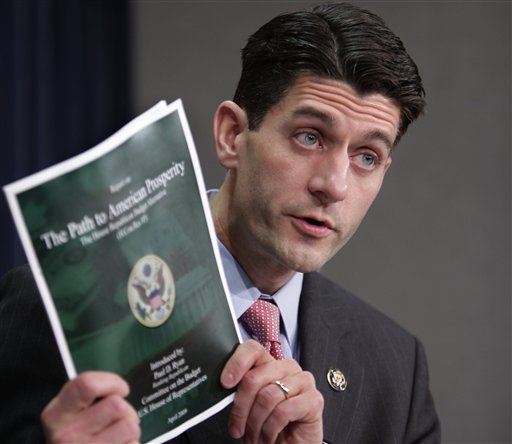
Rep. Paul Ryan
I served on the House Budget Committee for four years listening to Paul Ryan, Jeb Hensarling and my other Republican colleagues rail against “spending” (in the abstract) and promote the idea that tax cuts—in all times and circumstances—drive economic growth. The economists who testified at our hearings took a different view; they emphasized the importance in the long run of keeping revenues and expenditures in some sort of balance. Those were views not well received during the tax cutting frenzy of the Bush Administration.
The Tea Party Republicans are not promoting different ideas than their more senior Republican colleagues. They both disdain government, but the Tea Partiers reject political compromise as well.
How did we get here? George W. Bush’s signature line for his massive 2001 tax cut was just one step in the promotion of self-interest over common purpose that is weakening America economically and politically. “It’s not the Government’s money, it’s your money.” Right wing Republicans argue that federal taxes “diminish human freedom.” That world view, promoted with increasing intensity and success for over 30 years, leaves little room for a pragmatic debate about how governments can improve the well-being of the people.
Read the rest of… Tom Allen: Debt Dysfunction Has Deep Roots
By Patrick Derocher, on Sun Jul 31, 2011 at 4:01 PM ET
Following the failure of the Reid bill in the Senate on Sunday, the plan currently being worked on by President Obama and Sen. McConnell is the last major budget plan on the table.
The Atlantic provides a useful overview of the state of budget negotiations now that the Obama-McConnell plan, nebulous though it may be at this point, is the only budget plan (apart from the Gang of Six’s much maligned “Back in Black”) on the table in Congress. [The Atlantic]
More details are emerging about the Obama-McConnell debt reduction plan, including increased powers being granted to “Super Congress,” a bipartisan, bicameral council of 12 lawmakers who will have to make spending cut recommendations by Thanksgiving or face automatic, across-the-board spending cuts. This body has been demanded by Republican lawmakers, though Democratic leadership has only recently agreed to its existence. Neither the Tea Party nor the left wing of the Democratic Party is fond of the notion, as Tea Party factions believe it raises the possibility of increasing the debt whilst some Democratic groups balk at the notion that its actions may lead to deep, even automatic, cuts in Medicare, Medicaid, and Social Security. [Huffington Post]
The Reid plan for debt reduction failed in the Senate, leaving the fate of the Obama-McConnell plan somewhat in question, especially given Speaker Boehner’s difficulty in rallying his caucus behind previous plans. [Talking Points Memo]
According to Gene Sperling, Director of the National Economic Council, there are three provisions that must be in a final budget deal for President Obama to support it: That the bill include a “significant down payment” on the US’s debt, that revenues be part of a final plan, and that uncertainty be removed from the market. Although the plan as it is believed to exist includes only spending cuts, Obama Administration officials, most notably David Plouffe, insist that any recommendations by the “Super Congress” will be their nature have to include revenue raisers. [Roll Call]
Tea Party activists are exhibiting increasing displeasure at the House Republicans’ willingness to compromise on debt and budget concerns, with some taking issue with the fact that a debt ceiling increase has been approved at all. As in 2009, many of these groups have threatened incumbent lawmakers, even those who were elected with Tea Party support, with primary challenges. [Politico]
Although the Senate is technically in recess at the moment, Majority Leader Harry Reid has told Senators not to stray too far from the chambers, indicating the possibility that they will vote on the Obama-McConnell plan in the near future. In a tongue-in-cheek move, the Nevada Democrat said “I would not suggest a ball game” (Nationals Park is barely a mile from the Capitol). [The Hill]
Possibly in an effort to assuage liberal activists, President Obama and his administration have said that they will continue to push for revenue raisers, including repealing the Bush tax cuts, in spite of the fact that the Obama-McConnell plan does not explicitly include anything other than spending cuts. The administration’s plan includes using the cuts’ 2012 expiration as a sort of trigger to increase revenue increases, with the President possibly utilizing a veto after the election even if he loses. [Washington Post]
By Patrick Derocher, on Sun Jul 31, 2011 at 11:00 AM ET
A constant presence at the bargaining table, Chuck Schumer has been an important voice in budget negotiations.
Appearing on CNN Sunday morning, Mitch McConnell said that he and President Obama were “very close” to reaching an agreement on the debt ceiling. According to the Kentucky Senator, the deal would be a two-step process involving an immediate increase in the debt ceiling, a vote on the Balanced Budget Amendment, and a bipartisan committee to recommend spending cuts. [CNN] and [Washington Post]
According to former Moody’s Analytics economist Mark Zandi, the debt deal supposedly being worked out by the President and Republican members of Congress should be sufficient to avoid a credit downgrade for the United States. He did, however, admonish that if this deal breaks apart, it would plunge the country back into recession. [Politico]
Even as the House and Senate rejected or tabled each other’s bills Friday and Saturday, talks on Sunday rekindled hopes that a substantive bipartisan deal may still be possible. In particular, Chuck Schumer, Democrat of New York and Senate Majority Whip, said that while a final deal has not been worked out yet, there was a sense of “relief” in the Capitol Sunday morning. Recognizing that Democrats had compromised on some aspects of a budget bill, Schumer took pride from the fact that the Senate had kept at bay more drastic Republican measures, namely Paul Ryan’s budget. [Huffington Post]
Senior adviser to President Obama David Plouffe has said that, while there is no final deal in place between the President and Congressional leaders, a final deal could include provisions for $4 trillion in debt reduction by 2013. He has also said that, while there are no revenue increases in the first stage of the deal, the bipartisan committee charged with cutting further money from the deficit would have to include such measures in their recommendation. [Politico]
South Carolina Republican Senator Lindsey Graham, who himself has said he will not vote for the bill being worked on by President Obama and Congressional leaders, does not believe that more than about half of the House Republican Caucus will vote for that plan. Citing the possibility of increasing the country’s debt by $7 trillion, Graham expressed skepticism that Speaker Boehner would be able to sell the plan to House Republicans. [The Hill]
The Atlantic, as always, has some of the best quick analysis of what the rumored deal means, the pros and the cons: [Atlantic Wire]