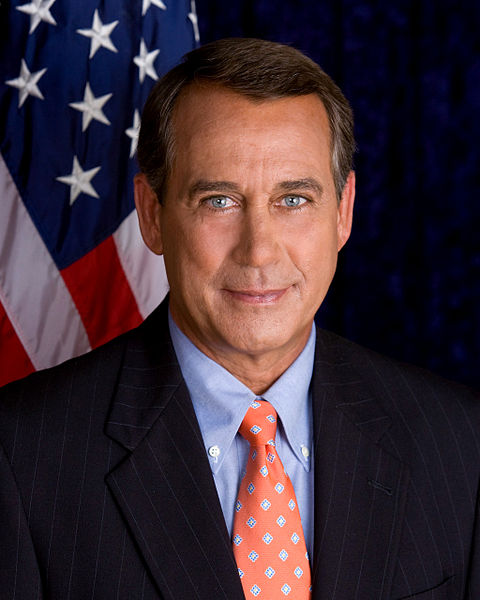
By Patrick Derocher, on Sat Jul 30, 2011 at 2:00 PM ET Harry Reid is hoping to pass his bill with bipartisan support by adding elements from proposals by Mitch McConnell. After a provision for the Balanced Budget Amendment was added at the last minute, the third iteration of Speaker Boehner’s debt bill passed the House 218-210, with all Democrats and 22 Republicans voting against it. Within only two hours, the Democratically-controlled Senate tabled the measure in a 59-41 vote that saw all 51 Democrats, 2 Democratically-aligned Independents, and 6 conservative Republicans vote against the measure. The Senate returned to session at 1 p.m. Today and a vote on Majority Leader Reid’s plan is expected around 1 a.m. Sunday morning. [Washington Post]
Among the 28 Republican “nays” between the two houses of Congress, seven came from the entirety of the South Carolina delegation. (Of the state’s six Representatives and two Senators, only House Assistant Minority Leader James Clyburn is a Democrat.) This move came as a result of the conservative lawmakers pushing for a Balanced Budget Amendment and deeper spending cuts than had been provided in the Boehner bill. [National Journal]
As of Friday morning July 29, Apple Computer has more cash on reserve than the Federal government- Apple’s $75.88 billion to the Treasury’s $73.77 billion. [MarketWatch]
Skipping Social Security payments has been floated as a possible response if Congress fails to come to a final deal on the debt ceiling. Outside analysis, however, has shown the possibility that doing so will unleash a “domino effect” of missed payments and pursuant interest rate hikes, especially among elderly women. [Huffington Post]
In a plan sent to Talking Points Memo, Senate Majority Leader Harry Reid put together what may be his final debt deal to Senate Republicans, designed to bring as many as possible on board to convince the House to pass the bill. Included are deeper spending cuts, to approximately $2.4 billion, and a provision, drawn from Minority Leader Mitch McConnell’s plan, to give President Obama the authority to raise the debt ceiling subject to Congressional disapproval. [Talking Points Memo]
Using evidence from budget impasses and government shutdowns from the 1980s and 1990s, some veteran lawmakers and experts on the Congressional process are skeptical about the possibility that any debt deal will be reached within that body by August 2. In particular, former Senate Majority Leader Tom Daschle has come out saying the thinks a deal may not arise in time. [NY Times]
By RP Staff, on Sat Jul 30, 2011 at 12:00 PM ET Thanks to his internationally (!) well-received piece in The Huffington Post, “Debt Ceiling for Dummies,” the RP has been on a virtual international tour of radio and TV talk shows.
Today, he appeared on CTV News, Canada’s version of CNN, making Mrs. RP (a native Canuck) very happy. Click here or on the logo below to watch the interview:

Last night, he appeared as the primary guest on the Wall Street Journal’s “The Daily Wrap” with Michael Castner. The subject — of course — was the ongoing debt ceiling crisis.
Click here or on the icon below to listen to the interview:

By Grant Smith, RP Staff, on Fri Jul 29, 2011 at 3:00 PM ET
The United States Supreme Court should invalidate patents for software. [Forbes]
Day-traders: how to trade a potential U.S. bond downgrade. [The Street]
Blackberry, once the status symbol of the business world is now fighting for its life. [CNBC]
The Forbes family’s dealings could spell disaster for their famous media brand. [Fortune]
Deficit cutting will widen the retirement gap for minorities. [Reuters]
By David Snyder, on Fri Jul 29, 2011 at 2:00 PM ET  While our government struggles to get its financial house in order, perhaps there is a lesson for all of us from what is happening in Washington. While our government struggles to get its financial house in order, perhaps there is a lesson for all of us from what is happening in Washington.
I do not think any of us really ever want to reach the point where we say, “How did it get this way? How did it get this bad?” So what to do – just a few simple steps to make sure your financial house is in order:
1. Risk Management
(A) Long Term Disability Coverage (Income Replacement insurance) – Whether you are single, married, divorced – it does not matter – just make sure you have adequate Long Term Disability coverage in place. In the event a disability stops you from working due to an illness or injury, you need to maximize your income. A disability could cause not only loss of income, but also loss of health insurance, loss of retirement benefits, increase health costs, etc. And the typical group plan only covers a portion of your income and that benefit is typically going to be taxable income to you. You need to have supplemental coverage from a highly rated company.
(B) Life Insurance – this discussion may depend on your family situation. But even if you are single, but plan to have a family, getting coverage while you are young and healthy may be an advantage. Too many times, a person waits and then later has a medical issue that either prevents them from getting coverage or makes it more expensive. With a family, life insurance is a must. A great rule of thumb here is that for every $1,000 of after tax monthly income you want to provide to a surviving spouse, you need $250,000 of death benefit in place. And when factoring in inflation, this sum will typically last the survivor about 20 years. So calculate the after tax monthly needs for your family and make sure you have adequate life insurance in place.
Lastly, don’t discount the value of a non-working spouse. Imagine the expenses if a stay at home Mom or Dad were not around. Non-working spouses need coverage too. A rule of thumb here – $250,000 of coverage on the non working spouse for each child.
(C) Cash – build up a reserve of about 3 months income and keep it in readily accessible cash. Use a money market or similar account that is safe and secure.
 2. Wealth Accumulation 2. Wealth Accumulation
Once Risk Management issues are resolve, the next step in planning for your financial house is wealth accumulation:
(A) Retirement Planning – Utilize your company 401(k) plans or pensions. If there is a matching contribution on behalf of your company, then at least contribute enough to maximize the company match. If there is a Roth option, use it. Conventional wisdom tells us that tax rates have nowhere to go but UP. If you believe this, then the old paradigm of straight tax deferral must be changed. You need to move as much as possible from Tax Deferred vehicles into Tax Free vehicles. Roth 401(k)’s provide this regardless of income level. Roth IRA’s do as well. For those that make too much to contribute on their own to Roth IRA’s (single – $122,000 of Adjusted Gross Income, and Married filing jointly – $179,000 of Adjusted Gross Income), the tax laws currently allow a non-deductible contribution to a traditional IRA and then the ability to convert it into a Roth IRA (regardless of your income level).
Read the rest of…
David Snyder: While the U.S. Can’t Get its Financial House in Order, You Can
By RP Staff, on Fri Jul 29, 2011 at 1:00 PM ET The RP wil be interviewed tonight at 7:00 PM EDT on Wall Street Radio about…what else…the debt ceiling crisis and his nationally-discussed piece, Debt Ceiling for Dummies.
To find out what radio affiliate carries the show in your area, click here.
To listen to the program live, click here.
By Artur Davis, on Fri Jul 29, 2011 at 12:30 PM ET  Until this week, Democrats were as split as Republicans over the debt ceiling endgame. But John Boehner has a far tougher task in keeping his party unified, and it is rooted in the very different political character of the rank and file membership within the House. Until this week, Democrats were as split as Republicans over the debt ceiling endgame. But John Boehner has a far tougher task in keeping his party unified, and it is rooted in the very different political character of the rank and file membership within the House.
A substantial part of the Democratic caucus consists of professional politicians who have climbed the ladder in a manner that makes them responsive to their party’s demands – they often won their first primaries by maneuvering to gain institutional support, and their ambitions invariably turn on the good graces of their party leadership. In turn, they are partisans first, ideologues second.
After the demise of the Blue Dogs in 2010, the remaining Democrats also represent disproportionately liberal districts where their pressure emanates from a base that scolds them for not doing enough to help President Obama.
In sharp contrast, a major part of the Republican caucus, particularly its massive freshman class, consists of relative newcomers who did not form ties by climbing the traditional ranks, and in many cases, won their primaries by overcoming their party establishment and their local versions of John Boehner. More of them owe their organizational strength to the Tea Party than to the local chamber of commerce.
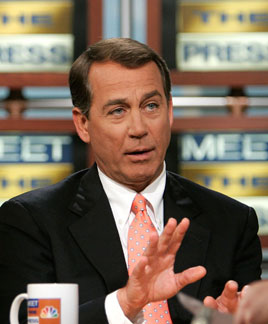 As a result, their ideological fervor shapes them much more than their party loyalty. Their hopes for advancement rest as much on carving out a profile with their party’s “movement conservatives” as it does currying favor on the Hill. Their external pressure arises from a base that loathes Barack Obama and grades them based on the intensity of their opposition to his agenda. As a result, their ideological fervor shapes them much more than their party loyalty. Their hopes for advancement rest as much on carving out a profile with their party’s “movement conservatives” as it does currying favor on the Hill. Their external pressure arises from a base that loathes Barack Obama and grades them based on the intensity of their opposition to his agenda.
Rallying the Democrats I describe to swallow a deal that is imperfect but “supports the President” is one thing; rallying the Republicans I describe to make an accommodation that cuts spending but salvages Obama is an infinitely harder mission. That is the reality that constrains John Boehner and it has the potential to wreck a deal even after one is reached.
(Cross-posted, with permission of the author, from Politico’s “Arena”)
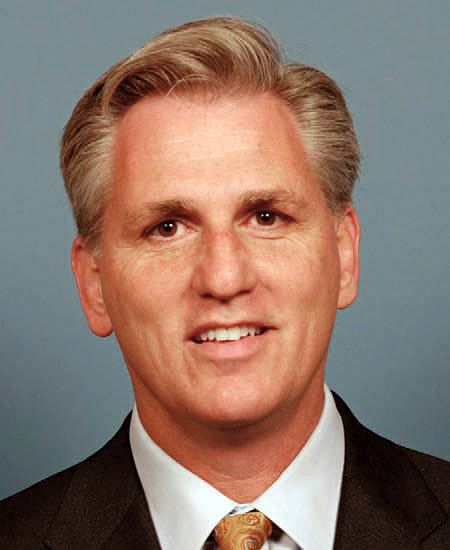
By Patrick Derocher, on Fri Jul 29, 2011 at 9:30 AM ET House Majority Whip Kevin McCarthy (R-Calif.) worked with Speaker Boehner to obtain votes for his ultimately delayed budget vote until late last night. There was one major development in the Budget Crisis yesterday: Nothing happened. After a vote originally scheduled for 6 p.m. was delayed several times, Republican leadership announced at around 10:30 that no vote would be taken on Speaker Boehner’s debt-reduction plan until Friday at the earliest. Republican leadership had been having difficulty, highly publicized, rounding up a sufficient number of “yes” votes from the Republican Caucus to pass the bill with no Democratic support. [The Hill]
On the up side, New York-based analyst Brian Gardner, who works for a boutique investment bank in that city, theorizes that threats to lower the United States’s credit rating under certain circumstances even if the debt ceiling is raised may be a bluff. According to his analysis, some level of “enforceable cuts” with an appropriate debt ceiling increase would avert the downgrade. [Huffington Post]
Democratic congressional leaders are floating the idea of a compromise bill that they hope will be amenable to House Republicans. According to the plan, the debt ceiling increase would still be in two steps, but the second raise would not be contingent upon the findings and recommendations of a panel dedicated to cutting the deficit. [Politico]
House Minority Whip Steny Hoyer of Maryland became the highest-ranking Democrat to call on President Obama to raise the debt ceiling unilaterally if a deal is not reached in time for the August 2 default deadline. The President’s authority to do this is said to derive from the 14th Amendment, which says that the validity of the US’s public debt shall never be called into question, though Congressional powers derived from Article 1 muddy the issue some. [Huffington Post]
Adding urgency to budget negotiations, at least over the long run, a study from Medicare economists has come to the conclusion that by 2020, healthcare costs will hit $4.6 trillion, or one-fifth of the American economy. At that point, per capita health spending is estimated to be at $13,710. [Huffington Post]
By Robert Kahne, RP Staff, on Thu Jul 28, 2011 at 2:00 PM ET
I’ve worked in the field of higher ed sustainability for several years now. Many of my colleagues, when asked to identify the main hurdle towards sustainability in existence today would respond with “America’s consumerist culture.” Not a bad answer, at first glance. Just looking around my room, I see dozens of items which I don’t use and indeed, many which I have NEVER used–and I’m supposed to be the sustainable one! It is not usual at all for American families to have 2 cars, 3 televisions, and a computer for every person in the house. Lots of people out there want to rethink this, especially in face of the facts such as “the useful life of a power drill is about 4 minutes.” and “there is a portion of the Pacific Ocean filled with plastic which is twice the size of Texas.” To fight this problem, people have set up system of “sharing” in which several people will buy 2 cars, or 1 vacuum cleaner, or one washer/dryer set, and share amongst themselves. People have even reformed their libraries so that if you need a power drill, you can check it out like you would the most recent George RR Martin book. A good idea, right?
The Great Pacific Garbage Patch Its true, it takes a lot of energy and carbon emissions to make a lot of the stuff that we don’t use, and it is further true that increased carbon emissions are heating the planet to the point that the world will likely become something none of our grandparents would recognize by the time we are dead. Ergo, reducing our consumption of stuff and sharing makes sense, right? As is true with everything, nothing is quite that simple. Our economic system is a complex system of purchases–purchases of big things like cranes and roads and tanks; purchases of important things like labor and art and food, and yes, even purchases of junk like McDonald’s toys and plastic spoons and cheez-its. When a piece of this consumption train breaks down, it causes all sorts of economic pain and suffering. In a piece published last Saturday in the New York Times Sunday Review, David Leonhart examined the effect which falling consumer purchases have prolonged the economy. His conclusion was that the old, consumerist economy, was dead; we need to build “an investment and production economy, with rising exports, expanding factories and more good-paying service jobs.”
 Image from NYT article Okay, that’s fine, but if we build one of these “investment and production economies” and shy away from the debt which helped us to build this huge consumption bubble, don’t we still need people to export to, and people to buy the things we make in these new factories? Don’t we need people who sell things to spend their money in places where these “good paying service jobs” still exist? I know that Leonhart is not making a case for sustainability in his article, but I think the solution he posits in his article still keeps relatively the same system in place which created the consumer problem in the first place: in order to create growth, stuff needs to be sold. Paradoxically, the more stuff that gets sold, the worse off the world is.
Read the rest of…
Sustainability and Consumerism
By Patrick Derocher, on Thu Jul 28, 2011 at 9:30 AM ET The passage of John Boehner's debt-reduction plan in today's House vote hinges upon his ability to organize the Republican Caucus. After another day of fruitless debt talks, stock markets reacted negatively, with the Dow Jones Industrial Average falling by 1.59 percent, NASDAQ by 2.65 percent, and the S&P 500 by 2.03 percent. [The Daily Beast]
Looking to put the plan up to a vote today, Speaker of the House John Boehner revised his debt-reduction plan following a Congressional Budget Office report that said it would in fact cut less than $1 trillion from the deficit. Under the new plan, cuts total $917 billion, more than the CBO’s original number of $850 billion, coupled with a debt ceiling increase of $900 billion. Additionally, the plan will cut $22 billion in 2012 rather than $1 billion under the first draft. [The Hill]
Following a disappointing scoring by the Congressional Budget Office, Senate Majority Leader Harry Reid has said he will tweak his debt-reduction plan. Though the original plan was supposed to save $2.7 trillion while raising the debt ceiling through the end of 2012, the CBO report said it would only reduce by $2.2. Reid’s stated goal was to bring both the debt ceiling increase and spending decrease to $2.4 trillion. [Roll Call]
In spite of previous reports to the contrary, John Boehner’s speakership is not in trouble, according to Republican Representative Paul Broun of Georgia. Yesterday, various Tea Party groups came out saying that they thought Boehner should (and possibly would) be replaced as Speaker of the House. [The Hill]
The president of credit rating agency Standard & Poor has said that he does not believe the United States will default on its loans while reiterating that the country’s debt problems need to be addressed to assure its fiscal security. This comes in light of recent assertions from both Moody’s Analytics and FitchRatings that a credit rating downgrade would not be catastrophic. [The Hill]
In spite of recent recalculations by groups such as Barclays Capital, the United States Department of the Treasury has said that it will indeed run out of money to pay its obligations on August 2 if the debt ceiling is not increased. Previously, it had been speculated that the Treasury might have enough money to last through August 10. [The Hill]
Debate rages on over the dueling House and Senate budget plans, though there appear to be many similarities between the Boehner and Reid plans. The National Journal lays them out. [National Journal]
Questions have been raised about the legitimacy of President Obama invoking the 14th Amendment to raise the debt ceiling unilaterally, but that has not stopped some Congressional Democrats. House Assistant Democratic Leader James Clyburn, Representative Jerry Nadler of New York, and other prominent House Democrats have publicly urged the President to raise the debt ceiling himself if Congress does not do so in a timely manner. [Washington Post]
Conservative opinion-maker Grover Norquist has called on House Republicans to support the Boehner debt-reduction plan, saying it is the only plan on the table that meets American for Tax Reform’s criterion of not raising taxes while decreasing spending at a level commensurate with debt ceiling increases. [Politico]
On Wednesday, all 51 Democrats in the Senate, in addition to both independents, signed a letter saying they would not vote for the Boehner plan, taking issue with its two-tiered approach to raising the debt ceiling, which they feel would put the country at risk of defaulting again in about six months. [Roll Call]
With strong opposition to any bill that is not contingent upon a balanced budget amendment, Speaker Boehner has been having difficulty getting the House Republican Caucus in line behind his budget plan. On Wednesday, he is reported to have told his fellow Republicans “get your ass in line” for the vote that is expected on Thursday. This is a change in tone for the Speaker, who has been criticized in the past for not being forceful enough with the Tea Party contingent of his party. [Washington Post 1] [Washington Post 2]
By Greg Harris, on Thu Jul 28, 2011 at 8:30 AM ET  August 2nd, 2011 Breaking News August 2nd, 2011 Breaking News
In a surprise and even stunning move, President Obama vetoed legislation that reached his desk today that would raise the debt ceiling in exchange for $2.4 trillion in spending cuts and the formation of a new commission to identify $1.6 trillion in additional cuts over the next 10 years.
House Speaker John Boehner earned the support of Tea Party members of his caucus and House passage of the legislation because it met their demands for $4 trillion in cuts without new revenue. The Democrats had originally hoped to close some corporate tax loopholes and end Bush-era income tax cuts on the wealthiest 2% of Americans. The compromise legislation was worked out between Boehner, Senate majority leader Harry Reid, and Senate minority leader Mitch McConnell.
The bill reaching the president’s desk was seen as the last possible compromise needed to prevent American default on its loans. But was it? Apparently heeding the advice of former President Bill Clinton, Obama invoked the 14th Amendment of the constitution in insisting the country would continue to pay its bills, and practically dared the GOP to challenge his authority to do so in federal courts. “If the Republicans want to sue me into forcing America to default on its loans, that is their prerogative. But I intend to carry out my constitutional authority to authorize the Treasury to pay our bills on time. What I won’t do is be cornered into supporting legislation that devastates America’s seniors and middle-class.” One House insider who was part of negotiations commented that by challenging the constitutionality of the debt ceiling deadline by ignoring it, “the President basically took away any and all GOP leverage.”

President Obama, with one stroke of his veto pen, declared that “I will not allow fringe elements of Congress to continue to subsidize corporate loopholes on the backs of our middle class and senior citizens. I will not see Medicare and Social Security and middle class tax breaks compromised so that a billionaire CEO can pay less in taxes than his secretary, or a profitable big corporation can pay less in taxes than a small business. This legislation revealed Republican true colors, and I had to kill it. We need to tip the scales back towards a government that serves everyday people.”
In a hastily assembled press conference, an obviously stunned House majority leader Eric Cantor (R-Virginia) declared “President Obama is willing to send America into default and possibly a constitutional crisis in the name of raising taxes on job creators.” The political airwaves are abuzz in debate over whether the President’s move was bold or careless. Emboldened Democratic congressional leadership has indicated they will stand behind the President.
In the coming week, Obama plans to take his case to the American people for a balanced approach to deficit reduction. According to USA Tomorrow’s latest polls, 56% of Americans support a balanced approach that uses cuts and new revenue to address the deficit; 64% oppose cuts in Medicare and Social Security; 78% oppose ending the home mortgage loan deduction.”
|
The Recovering Politician Bookstore
|