By John Y. Brown III, on Thu Aug 9, 2012 at 12:00 PM ET
Dear Olympics,
A modest proposal.
In the future, if you want to pull in a bigger and broader audience and gin up some fun and dazzling sports competition, please have fewer athletic events that seem selected by a prep school athletic director and more sporting events drawn from popular street ball pick up games.
By Jonathan Miller, on Wed Aug 8, 2012 at 4:00 PM ET
If you’ve been watching the Olympics…
OK if you have a pulse and electricity in your home…
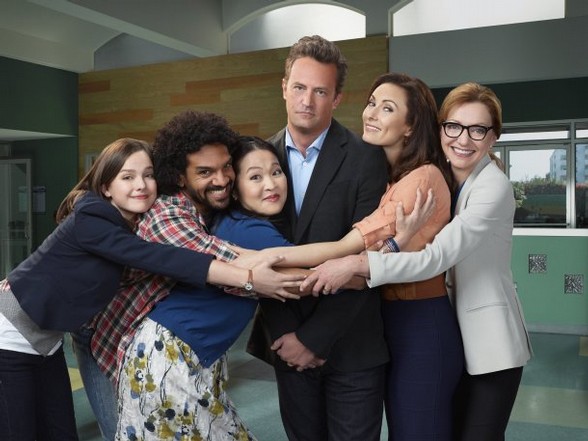
You’ve undoutbedly seen a promo of the much anticipated NBC series, “Go On,” starring Friends’ alum Matthew Perry as a sports radio talk show host who has recently been widowed.
If you are not already hooked, here’s another reason to watch: My cousin, Allison Miller, plays Perry’s assistant on the show. Allison, (at left, and at the far left in the picture to the right) has previously starred in Terra Nova and Kings, but this might be her breakout moment. So don’t you dare miss it.
So, stay up after the Olympics tonight (or if you are old like me, don’t forget to program your DVR). A star will be born! Or at least, I guarantee many laughs.
By Bradford Queen, Managing Editor, on Fri Aug 3, 2012 at 10:00 AM ET
The Politics of the Screen
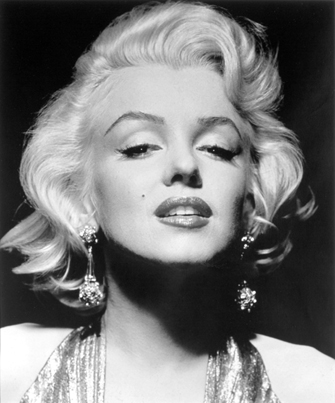
The celebrity brand of Marilyn Monroe remains as strong as ever as the 50th anniversary of her death approaches. [The Washington Post]
Jimmy Fallon is in the midst of talks with producers to host the 2013 Oscars, but ABC isn’t on board. [LA Times]
‘Vertigo’ has replaced ‘Citizen Kane’ as the best movie of all time in a new list by the British Film Institute. ‘Citizen Kane’ had topped the list for 50 years. [The Hollywood Reporter]
By John Y. Brown III, on Thu Aug 2, 2012 at 12:00 PM ET
It wasn’t long ago that this was the only option for TV entertainment after 1 am.
And now you can’t find the DVD series anywhere. I guess that shouldn’t come as a surprise.
The writing was weak. Nothing much happened. Yet it was nice knowing it was an option. And when I did stare at the Indian test pattern, it had a calming effect on me.
And it became a TV institution.
I suspect someone somewhere in Hollywood is thinking of a modern remake of this time honored piece of TV history.
Maybe starring the Indian guy from the Twilight series who turns into a werewolf. I actually liked him a lot. He inspired me to start working out and I thought he was a more compelling and interesting character than the guy who played Edward Cullen.
On the other hand, the Indian role in the test pattern is eerily similar in breadth and scope to the Edward Cullen character. Quiet, stoic, brave, eccentric, bit of an outcast, and up all night without much nuance. Yeah, maybe the guy who plays Cullen would be a better fit.
This remake idea could be big. I am already seeing a sequel in the works before the first one is finished.
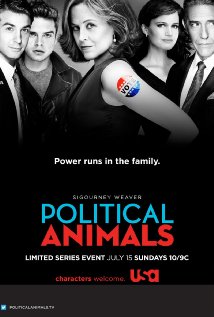
Showtime’s new mini-series “Political Animals” insists that it is not really a knock-off on the saga that is Bill and Hillary Clinton: the resemblance between Sigourney Weaver’s Elaine Barrish and Hillary is merely the surface match between two former First Ladies who endured a presidential sex scandal involving a junior staffer, subsequently launched their own political careers, and lost the Democratic presidential nomination to a smooth, if distant, senator who brings Elaine/Hillary into the Secretary of State’s position. Elaine’s ex, former president Donald “Bud” Hammond, (Ciaran Hinds) just happens to sound, charm, and manipulate like William Jefferson Clinton.
The parallels do break: Elaine Barrish, we learn by episode two, executed the forgiving spouse role only up to a point, divorcing her husband in the aftermath of her defeat in the primaries. And unlike Hillary, Elaine’s loyalties to her new boss are skin deep at best: she is already plotting to take him on in the next campaign. But the severance in the time line does not begin, or even attempt, to mask the obvious: the show is a guilty pleasure window into what the Clintons’ personal and public chaos might look like from the inside, and if the characterizations so far can seem more like an impersonation of the Clintons than an real exploration, it is richly entertaining in the same way the originals are. “Political Animals”, like the real thing it is based on, is a brew of tawdriness, deceit, inspiration, and fortitude, that works in spite of all the reasons it shouldn’t.
Among the reasons it shouldn’t work: the storylines to date–a mini hostage crisis in the Middle East, the Hammonds’ juggling of one son’s engagement party with the other son’s emotional spiral–are pedestrian stuff. The personal sketches reach for their share of clichéd foibles: the young reporter who exposed Bud Hammond’s escapades and has trained her sights on Elaine Barrish has her own penchant for personal turbulence and seems to have boundary issues of her own; the two Hammond children are sons (thankfully, Chelsea remains outside creative license, at least for now) and in predictable modern cinematic fashion, one is tormented, artistically gifted, and gay; the other ferociously protective and resentful of his father’s capriciousness, but if the teasers at the end of the last episode are right, possibly possessed of some of his father’s weaknesses. If cultural stereotypes are your peeve, some of the clichés touch on troubling ground: the Asian woman who is the fiancee of Douglas Hammond is a bulimic perfectionist whose first generation parents are inordinately status conscious; the foreign diplomats are all lecherous or spineless, and there is a weird dearth of African American or Latino characters. This is not the “Good Wife”, whose regular and recurring cast seamlessly integrates every strand of the social rainbow without really trying, and gives each the gift of individuality.
Read the rest of… Artur Davis: “Political Animals” is Telling Us Something
MSNBC’s newest show The Cycle is unlike any other political talk show on cable. That may sound like a PR cliché, but unlike your usual assortment of cable news veterans, old-school journalists, and suit-and-tie pundits, The Cycle resembles more a collection of Generation X-er political geeks talking about their passions. All four hosts represent a newer, younger generation of political pundits.
As the show’s executive producer Steve Friedman explains, that design was on purpose: “It’s basically a dinner party show, unlike any other ensemble on television.” A forty-year veteran of the business, Friedman has produced a slew of ensemble shows including ESPN2′sCold Pizza, The Early Show on CBS, and a little morning program called Today on NBC. “This is my computer,” he jokes, showing his college-ruled notebook and a pen. He may come from an older world of television, but he says that his goals with The Cycle don’t necessarily match that mentality.
The Cycle came about in the wake of Dylan Ratigan‘s abrupt departure from his MSNBC show. Friedman and executives decided to soft-launch an ensemble show with four distinct voices. “We wanted an ensemble show because we didn’t want the new person to be compared to Ratigan,” Friedman explains. “If we had just replaced him with a single host, reporters like you might’ve said ‘That’s who they replaced him with?’”
And so Friedman recruited a younger batch of frequent MSNBC guests to host the new show: controversial music journalist Touré, Salon‘s stat-obsessed political writer Steve Kornacki, former Democratic congressional candidate Krystal Ball, and outspoken conservative S.E. Cupp.
“It’s the personalities that set apart ensemble shows,” Friedman says, underscoring the network’s belief that these four are particularly unique host additions to a daytime landscape usually brimming with straight-reporting cable newsman types. Interestingly, their on-air dynamic is an accurate reflection of their off-air relationship.
Touré is the eldest of the group, probably the most talkative, and definitely no stranger to controversy. Within the show’s first week, he drew criticism for suggesting the death of U.S. soliderPat Tillman was an intentional silencing by the American government; another week, he drew the ire of small government advocates when he advocated for a variety of government mandates. “He just loves to argue,” Cupp says of her co-host, pointing out that even at group dinners a conversation can’t go on without Touré playing devil’s advocate.
Kornacki, by contrast, was enlisted by Friedman as the “anti-Touré” — not politically, but characteristically. Friedman sees his two male hosts as a perfect juxtaposition: Touré pushes buttons and invites controversy; Kornacki is measured and intellectual in demeanor. Off-air and on-air, the other three “Cyclists” openly tease Kornacki for his “nerdy” ability to rattle off obscure polling numbers at the drop of a hat. During one show, the cast created a compilation video of the most neurotic things Kornacki has said on the program, and all enjoyed a good laugh at the result.
Cupp was chosen because, as Friedman describes, “the show needed someone who is not a card-carrying liberal.” Among the network’s non-liberal personalities, Friedman says, Cupp is “the best one.” She jokes that she never dreamed of hosting a show on MSNBC beside all the network’s openly liberal personalities; but she has relished the opportunity: “This is a great opportunity for me to slay dragons in front of an unfriendly audience,” she says. Her conservative fans, however, have had mixed reviews for her new job: “I’ve gotten ‘you’re a traitor,’ to ‘you’re so courageous,’ to ‘I will never watch you on that network.’”
Much like the Touré-Kornacki pairing, Ball was selected as the “anti-Cupp,” in the political sense. Before her television career, she was a 29-year-old liberal congressional candidate in Virginia. Shortly thereafter, she made the rounds as a “Democratic strategist” on Fox News and MSNBC. She credits her on-air experiences with Touré during Ratigan’s “Mega Panel” as helping shape her comfortability with The Cycle‘s format. And even with the stresses of hosting a cable news program, Ball says “running for Congress was way harder,” especially in terms of having the time to spend with her young daughter.
By John Y. Brown III, on Mon Jul 23, 2012 at 12:00 PM ET
My version of George Washington’s cherry tree (I cannot tell a lie) story.
If you live long enough in a city you find pieces of yourself –your life–that catch you off guard and bring back a flood of memories.
That happened to me tonight when I went to an to a new ATM off Frankfort Ave. As I looked up I saw a door (see picture) that I recognized. I knew instantly it was a door from a defining moment in my life, when my honesty and character was put to the test.
I was 16 years old and was out one night with my closest high school friend, who I’ll leave nameless. We were discussing sneaking into a movie. A couple left through the door attached to the theater and my friend grabbed the handle and held it open for me.
“C’mon, Johnny! C’mon!! Quick!”
I almost impulsively rushed in. But didn’t. I hesitated just long enough for guilt to seep in and catch my self up….and muster the confidence to whisper bravely “Let’s just go inside and pay.”
I know…that wasn’t as brave a declaration as I’d hoped ….but it spoke volumes about the kind of person I was. My friend didn’t have the money and said we weren’t old enough to get in anyway. He held the door open a few more seconds urging me to sneak in. But I didn’t.
And we left.
And I hadn’t seen that door to the old Crescent Art (porn) theater since that night 33 years ago. The night my character–OK, a small piece of my character–was put to the test. And I passed. By refusing to sneak into a blue movie house without paying.
What a guy, huh? Made me wonder if George Washington felt this way when he’d tell people the cherry tree story. Yeah, of course he did!
Read the rest of… John Y’s Musings from the Middle: Being Good While Doing Bad
By John Y. Brown III, on Mon Jul 16, 2012 at 12:00 PM ET
Crashing or coasting?
Depends on if you are on the outside looking in or the inside looking out.
Unfortunately, you see it a lot in business. It’s almost a predictable arc–rising, leveling and, like a star, eventually imploding.
It starts with breaking through initial barriers and onto the scene. Followed by rapid and dynamic growth for a sustained period until it becomes an institution of sorts. Then there is a plateauing. An uneasy period where management becomes more concerned about maintaining market share than growing it…because, frankly, it already has about all the market share it can ever get.
And then there is a disconnect. Slow at first and only noticeable to those looking for it. But then noticeable to a growing number of others. But not to management. Until the decline has begun. Sometimes management notices and faces the problem then and tries to reverse course. Other times a new management team is brought on because the current team is unable to see the problem clearly or navigate out of the crisis they inadvertently created. And if neither of these take place, there is the crash. Sometimes its soft; sometimes hard. Sometimes swift; sometimes slow. But the crash is inevitable.
In the final stage the company is no longer nimble. No longer responsive to customers. It takes them for granted. Instead of trying to see ahead and anticipate market demands and adjust early to them the company instead rests on its laurels and tries to prevent the natural changes from happening within the industry—ironically, the same changes this once great company used to break into a leadership position by being more responsive than their former complacent competitors. The former agent of change has become the agent for the status quo.
They resist change during this phase not because change will hurt better delivery of their products or services to customers but because change has become an inconvenience for management. The company is no longer “client centered” but “self centered.” And they have long forgotten the day when they counted on their once larger competitors to believe that self-importance was a successful long-term growth strategy in business. It never is.
They will eventually remember this truth. That is inevitable too. But sadly that is almost always “after” the inevitable crash–not before.


 Dear Olympics,