By Bradford Queen, Managing Editor, on Fri Oct 19, 2012 at 11:00 AM ET
The Politics of the Screen
Superman will stay in the hands of Warner Bros. A federal judge denied the heirs of the comic’s creator an interest in the brand. [LA Times]
The Andrew Breitbart biopic lost its bid for a PG-13 rating. The MPAA found the language too harsh. The full release will now be delayed a week because of the squabble. [The Hollywood Reporter]
‘We Are Legion’, a brand-new film covering the group of “hacktivists” known as Anonymous, was well received at Austin’s SXSW festival. If you’ve been following the group that has reportedly launched cyberattacks on the Pentagon and has threatened to destroy Facebook, you’ll want to see this. [NYT Review]
ICYMI, yesterday afternoon, The RP was the special guest on MSNBC’s hot new afternoon talk show, The Cycle, co-hosted by The RP’s friend — and contributing recovering politician — Krystal Ball.
After Krystal kindly promoted a certain spectacular year-and-a-half-old Web site, The RP gave a spirited defense of No Labels, the grassroots movement he co-founded that now involves more than 500,000 Americans in efforts to promote bi-partisan problem-solving as a means to fix our broken political system.
If you haven’t had the chance, please be sure to check out the No Labels Web site, and if you support their mission, sign on to the important cause.
By John Y. Brown III, on Wed Oct 17, 2012 at 12:00 PM ET
“And just like that….”
That’s how Forrest Gump explains life’s sequences. How we begin something seemingly randomly and it leads to the next thing and that leads on to the next thing. Until a whole chunk of our life is played out and seems not only to make sense to others— but seems perfectly planned out all along.
Except it really isn’t.
Or is it?
I don’t know. But I think Forrest perfectly embodies the beautiful simplicity of living life by a pure and inspired intuition. And if done well—as Forrest does so effortlessly—trying to figure out what the ultimate plan may be seems beside the point. Like an absurd distraction.
“And just like that…” is how, I think, we should endeavor to live our own lives. And let the plan take care of itself.
I think that may be the most important message in this profoundly simple (or simply profound) movie.
Good morning from Las Vegas, and welcome to another edition of Prix Fixe Politics! I’m on my way out of town, but spent last night with 23 undecided voters, 18 of whom voted for Obama in 2008. After the debate, only five of the 23 committed to voting for the President again on November 6th. Still, I’m skeptical to believe there will be any significant movement in the polls after the town hall. For a quick look at why, here is today’s menu:
Appetizer: First, neither Obama nor Romney have that “Bubba Touch.” I’m not talking about some dish at the shrimp restaurant — I’m talking about Bill Clinton. Love him or hate him, you have to admit that the man could connect emotionally no matter the situation, and no matter the American. Obama’s a gifted rhetorician, but he isn’t the people person like the Democratic president that came before him. And Romney…well, there’s a litany of socioeconomic and demographic jokes that have been made about Romney’s potential interactions with the undecided “typical American” voters at the town hall. Regardless, neither candidate was going to score the bonus points that come not in the words of the answer, but in the empathy of the answering. And, sure enough, neither did. They spent more time trying to talk over each other than to listen to the concerns of the audience. Yes, Obama showed more life than he did in the Denver debate, but Romney matched him closely. I wish one of them had actually taken the time to ask one of the questioners a follow-up. After all, we’re the ones pulling the levers the first week of November.
Main Course: It’s a tried and true analogy now — sports and politics. Think about a sporting event you may have attended or watched between two teams to which you had no particular allegiance. Sure, we all love a good underdog; but, most of us in that situation (and in all other win/lose horse race scenarios) like to be connected to the winner. I think most of us, Democrat or Republican, can agree Romney won the first debate. The polls confirm as much, with the undecideds breaking toward the Governor in the last 10 days. But because this second debate was, and will be covered as, a draw (or a margin of error victory for Obama at the most), I expect the remaining undecideds to stay on the sideline and wait for the third and final debate next week. This one will be squeezed largely into irrelevance. As U2 and Linda Ronstadt sing, “everybody loves a winner”…and tonight’s debate left us lacking.
Read the rest of… Zac Byer: Prix Fixe Politics — The Second Presidential Debate
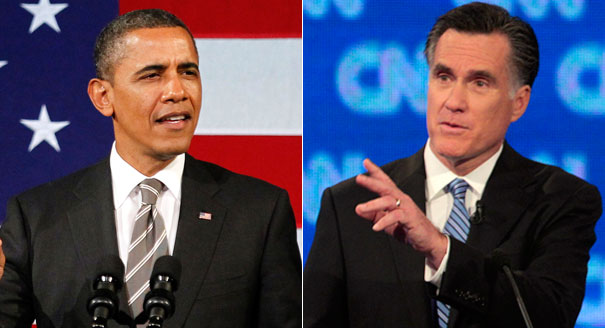
To most observers, Barack Obama’s poor night in Denver seems as inexplicable on reflection as it did in the moment. There is arguably nothing in presidential debate memory that matches it for improbability. Richard Nixon’s darting eyes and sweaty brow in 1960, Ronald Reagan’s distracted presence in 1984, Michael Dukakis’ mechanical dullness in 1988, Al Gore’s snide sighs in 2000 all resurrected conspicuous enough traits in their personas for even casual observers. The surprises, if any existed, were only that the mask slipped so revealingly, and with such ill timing.
But Obama’s plodding, sluggish, inert set of reflexes were a wholly unanticipated calamity. By any objective lens, Obama has been a famously intuitive performer who revels on the high wire—from the keynote in Boston in 2004 to the high risk Jeremiah Wright talk to the masterpiece victory speeches in Iowa and South Carolina in 2008 that played such an underrated role in crafting Obama’s charismatic image when large swaths of the country were just beginning to pay attention. There was none of that verve in the rambling opening answer on a thoroughly predictable question on jobs, none of that stage presence in the times Obama stood mute when Mitt Romney contradicted him on tax breaks, Medicare cuts, or the machinations around the Simpson Bowles Commission. Instead, it was the hard to disguise tentativeness of a job applicant who knows too well the gaps in his resume.
I’ll venture one theory that reconciles Obama’s past with his struggles the other night. For all of the president’s oratorical prowess, it is worth noting that Obama’s past high notes all revolved around one signature theme: a refrain against the costs of a divided culture, polarized elections, and all manner of American gridlock. It is a mantra that Obama the challenger and rising star wore very well, but it was also the cry of an outsider trying to crash the gates. The fact that Obama has not cultivated a presidential vision that is remotely as compelling as the rationale for his insurgency four years ago was on display in Denver, and a more conspicuous liability than the absence of a script or a teleprompter.
Read the rest of… Artur Davis: Obama’s Depressing Night
By John Y. Brown III, on Fri Oct 12, 2012 at 12:00 PM ET
The personal impact of movies on our lives.
I just went through the drive through at McDonalds and ordered coffee the same way I have ordered it for the past 18 years, “Lots of cream; lots of sugar.”
That’s always the way I take my coffee but not always the way I ordered it. Before seeing Pulp Fiction in 1994 I would ask for coffee “with extra cream and extra sugar.”
But this scene with Winston Wolfe changed all that. And for the past 18 years and probably the rest of my life, a small but noticeable change occurred in my life.
The coffee tastes the same, of course. But I get a little subconscious Wolfie rush every time I order coffee. And feel like I am a little more in control of the situation —because of my ordering style—than I used to me.
Join Team HTC for the Lexington, KY premiere screening of “Hitting the Cycle” on Thursday, October 11th @ 7:30pm! The film will be shown at The Kentucky Theater with an exclusive cast & crew after party immediately following the show at Portofino Restaurant (249 East Main Street, across the street from the theater).
“Hitting the Cycle” an independently produced feature film shot entirely on location in Lexington, Ky., was named Best Dramatic Feature Film at the 2012 Manhattan Film Festival in New York City.
The fictional story follows Jimmy “Rip” Ripley, a professional baseball player nearing the end of his career, who reluctantly revisits his long-forgotten hometown to face his estranged, dying father. While attempting to reconcile his fractured past with an uncertain future, Rip begins to gain insight into the choices, opportunities and sacrifices that people confront when they outlive the life of their dreams.
“Hitting the Cycle” screened at the 10-day Manhattan Film Festival in late June, and won the Best Dramatic Feature Film award at a ceremony on July 1st. Hitting the Cycle previously won an award in May at the Tupelo Film Festival in Mississippi.
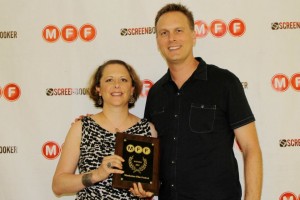
Lexington native J. Richey Nash portrays the lead character of Rip in Hitting the Cycle. Now based in Los Angeles, Nash also wrote, produced and co-directed the film (along with Darin Anthony). Oscar-nominated actor Bruce Dern plays Rip’s father. Co-producer (and RP Sister) Jennifer Miller is seen in the picture above with Nash accepting the Manhattan Film Festival award.
Though many of the film’s stars and primary crew members are Hollywood-based, Nash decided to bring the production to Lexington because of the diversity of available filming locations and the growing number of production and talent resources (Kentuckians comprise two-thirds of the cast and crew). The opening scenes from Hitting the Cycle take place at readily recognizable Lexington venues, most notably the ballpark of the Lexington Legends, the popular local Minor League Baseball team. The remainder of the story unfolds in “Sayreville,” Rip’s fictional hometown. Shooting locations included public parks, private homes, bars, restaurants, a high school, and several University of Kentucky hospital buildings.
“Lexington was the ideal place to shoot this film not only for its beautiful scenery and varied locations, but also for the tremendous support of the local community,” said Nash. “We had such a great experience. I wouldn’t hesitate to come back to Kentucky for another film project.”
Don’t miss this opportunity to be among the first in Lexington to see “Hitting the Cycle” on the big screen, then mingle with the filmmakers and cast at the after party! Reserve your tickets today before this event sells out!
In last week’s debate, Mitt Romney opened a can of worms, threatening to cut PBS funding even though “he loves Big Bird”. People started tweeting, chirping, and otherwise chiming in almost instantaneously – sure, there were plenty of comments about the basic math mistake (PBS funding is .012% of the national budget, so it hardly counts as responsible for our borrowing from China), misplaced priorities (how come adding a $5 trillion tax cut and boosting an already inflated defense budget don’t also concern Romney), and more, but the biggest outcry came on behalf of the big yellow bird himself. Now even without public funding, Sesame Street would go on, thanks to generous viewers, sponsorship, and highly successful merchandising (“Tickle Me Elmo”, anyone). But it was a fascinating illustration of the huge impact of public television for children, now that a couple of generations have grown up with Sesame Street and the other popular shows.
I’m going to date myself here by admitting that Sesame Street didn’t go on the air until I was already in elementary school, but I still remember it vividly (and loved to watch the other shows from my day, including the original Electric Company). My husband was 3 at that time, so he was the absolute perfect target audience and watched avidly. (Yes, I’m a cradle-robbing cougar, and I love it!) And I was re-introduced to PBS kids’ shows when I had my own kids – they particularly loved the music videos, like “Put Down The Ducky (If You Want To Play The Saxophone)”. I loved the puns that were clearly designed to keep us bleary parents entertained, like Ethel Mermaid singing “I Get a Kick Out Of U”. And PBS was great about generally making sure its kids programming appealed to parents – I can’t be the only mother who noticed that the adorable young men who hosted Blues Clues were pretty easy on the eyes.
Whether you agree or disagree with him, Romney clearly touched a nerve – so in tribute to PBS programming in general, Big Bird in particular, and the Sesame Street tradition of fun music, here’s a musical plea for our favorite large yellow non-flying bird . . .
If Showtime’s exemplary “Homeland” is the new pace-setter for politically themed drama, and CBS’s “Good Wife” is a successful, if less psychologically rich, portrait of a scandal surviving heroine, what to make of Starz’s largely obscure “Boss”, an ensemble drama about a fictional Chicago Mayor who is fighting off mental illness and all manner of intrigue? It is a well-acted, intricately conceived narrative that has utterly failed to break through the popular consciousness, much less the Emmy circle, and it is worth pondering why its ambitions have gone unrealized at a time when political morality plays are newly resurgent on network and cable.
The rap on “Boss” may well be that the conceit at the heart of the show—that gaining and holding power is one sordid, muddy blend of egos and ruthlessness—is so shopworn that it manages to bore. The protagonist, the 20 years plus mayor of the Windy City, Tom Kane (Kelsey Grammer) is a brute: by the middle of the second season, we know that his power is built on a web of corrupt bargains with city developers, a sham of a marriage to the glamorous daughter of his predecessor, and a staff of devotees who protect his lies out of some alchemy of ambition and loyalty. We know he ruins and takes lives. Nothing new here: it is more or less an amped up version of every recycled stereotype about the unseemly nature of power. Nor is there any justifiable thread for Kane’s abuses beyond the old stand-by—at least the city works for its elite, and the trains run on time, and the poor and the marginal are subsidized by a mixture of patronage and spoils. It is no accident that Chicago looks in this rendition less like a modern metropolis than a hulk of decaying deals and faded urban monuments.
Read the rest of… Artur Davis: The Unbearable Emptiness of “Boss”
By John Y. Brown III, on Wed Oct 3, 2012 at 12:00 PM ET
Trying to wake up but don’t have any coffee?
Here’s an eye-opener that just might do the trick for you…..
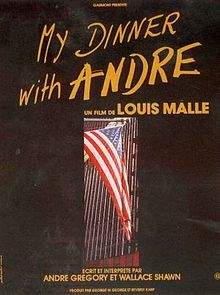
One of my favorite lines from the movie My Dinner with Andre.
ANDRÉ:
You see, Wally, the trouble with always being active and doing things is that it’s quite possible to do all sorts of things and at the same time be completely dead inside.
I mean, you’re doing all these things, but are you doing them because you really feel an impulse to do them, or are you doing them mechanically, as we were saying before?
Because I do believe that if you’re just living mechanically, then you have to change your life. I mean, you know, when you’re young, you go out on dates all the time, you go dance or something, you’re floating free, and then one day you find yourself in a relationship, and suddenly everything freezes. And this can be true in your work as well.
And I mean, as long as you’re really alive inside, then of course there’s no problem. I mean, you know, if you’re living with someone in one little room, and there’s a life going on between you and the person you’re living with, well then, you know, a whole adventure can be going on right in that room.
But there’s always that danger that things can go dead. And then I think you really do have to kind of become a hobo or something, you know, like Kerouac, and go out on the road. I really believe that. I mean, it’s not that wonderful to spend your life on the road. I mean, my own overwhelming preference is to stay in that room if you can!
Now, of course, if you live with somebody for a long time, people are constantly saying, “Well, of course it’s not as great as it used to be, but that’s only natural. The first blush of a romance goes, you know, and that’s the way it has to be.” Now, I totally disagree with that. But I do think you have to constantly ask yourself the question, with total frankness, is your marriage still a marriage? Is the sacramental element still there?
Just as you have to ask about the sacramental element of your work—is it still there?
And I mean, it’s a very frightening thing to have to realize suddenly that, my God, I thought I was living my life, but in fact I haven’t been a human being. I’ve been a performer. I haven’t been living. I’ve been acting. I’ve acted the role of the father. I’ve acted the role of the husband. I’ve acted the role of the friend. I’ve acted the role of the writer or director or whatever. I’ve lived in the same room with this person, but I haven’t really seen them. I haven’t really heard them. I haven’t really been with them.


 ICYMI, yesterday afternoon, The RP was the special guest on MSNBC’s hot new afternoon talk show, The Cycle, co-hosted by The RP’s friend — and contributing recovering politician — Krystal Ball.