By Jonathan Miller, on Tue Aug 9, 2011 at 8:30 AM ET
Maybe it’s the fact that Mrs. RP and I celebrated our 22nd wedding anniversary this past weekend. Or perhaps I’m just getting a little tired of the hot and muggy weather.
Whatever the cause, my bow to pop culture this week reveals the Top Five Romantic Screen Scenes in the Rain.
I’m not sure of the precise scientific link between romance and precipitation, but it’s real; it’s widespread, and it’s soaking wet. There’s just something in the water…that makes a love scene so powerful and/or tear inducing.
So here goes–the top five screen love scenes that are all wet:
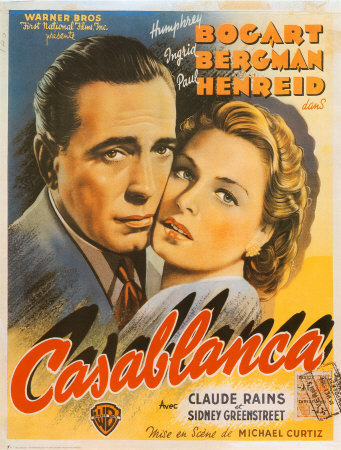
5. Casablanca
The granddaddy of all romantic rain scenes loses a few points because both Bogie and Bergman stay inexplicably dry amidst the gray, foggy drizzle. But aaaahhhhh, the romance…Humphrey Bogart’s cynical Rick risks his own life during WWII and makes the ultimate sacrifice: providing safe passage for the woman he loves and her Resistance hero husband. And as “As Times Go By” plays solemnly in the background, the Kentucky Derby of movie scenes (the most exciting two-minutes in film) packs in three of cinema’s greatest lines: “It doesn’t take much to see that the problems of three little people don’t amount to a hill of beans in this crazy world”; “We’ll always have Paris”; and “Here’s looking at you, Kid.” Watch it here, and then play it again, Sam:
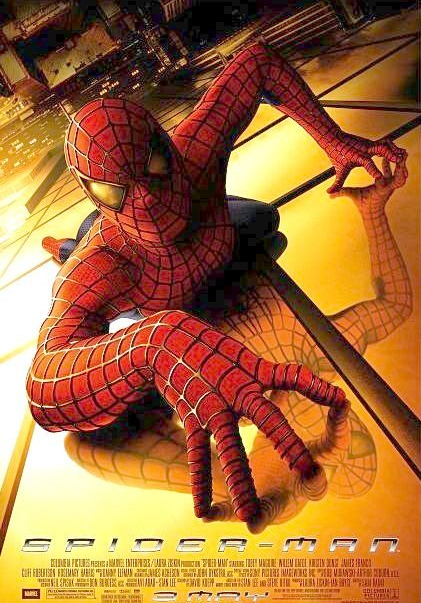
4. Spiderman
As we await the latest reboot of this epic Stan Lee franchise, it’s important to remember that the Tobey Maguire/Kirsten Dunst trilogy stood out less for its supernatural feats of strength and power — C’mon, it was Tobey Maguire, for goodness sake — but rather for the aching, unconsummated three-way romance among the forlorn Peter Parker, his alter ego Spiderman, and the beautiful ingenue, Mary Jane Watson. The climax of their romance comes in a kiss: As Spidey hangs upside down on a building’s edge in a dark, dreary alley in the middle of a rain storm, a dripping wet Mary Jane removes just enough of his mask to reveal his lips, and then plants a sloppy one on him. Watch it here, and just try not to gush.
3. The Notebook
OK, gotta admit: Didn’t care too much for this click-flick schlock. But I had to throw it in here for the RPettes, for this is the scene that will define their generation’s vision of young romance. After seven years of waiting for each other, the two lovers stand in a wholesome field…Rain Pouring…They exchange sorrowful shouts…He lifts her in his arms…Draws her closely to kiss…They lock lips…BLECHHHH!!!. At least it has inspired a fairly funny satire about cell phone use during the previews of pretty much every movie I’ve seen this summer. OK, you young’uns out there in RP Nation, here it is:
Read the rest of… The RP’s Five Most Romantic Screen Scenes in the Rain
By Kathleen Kennedy Townsend, on Wed Aug 3, 2011 at 8:30 AM ET
The headline in the passenger’s Washington Post Express newspaper two seats in front of me on the Metro caught my eye: “Home Births Up 20%.” Wow, I thought, that’s impressive.
Inevitably, the headline brought back memories of my children’s births. Three of our four daughters were born at home, and the fourth would have been, but I went into labor while visiting my mother in McLean, Virginia. Instead of rushing back to Baltimore, I hustled across the Potomac to the Bethesda Birthing Center, where Kerry Sophia was born.
Since the turn of the last twentieth century, the trend has been toward hospital births, and now less than 1 percent of all births are at home. Still, that 20 percent increase reported by the Centers for Disease Control is stunning.
Expense may have something to do with the uptick. One woman quoted in the Associated Press article that ran in the Express said that her home birth cost $3,300 as opposed to over $10,000 in a hospital.
But the trend toward home births is not just about cost. It’s about the kind of experience one wants. That’s why my husband, David, and I chose to have our children at home. The decision took a lot of thought and consideration.
When I was pregnant for the first time, I’d never considered a home birth. My mother had given birth 11 times, each time in a hospital. Without knowing the alternatives, I imagined that was where I would have my own children.
Read the rest of… Kathleen Kennedy Townsend: Giving Birth at Home-A Good Idea?
In my last post, I talked about some of my successes, and success can be a wonderful thing, but if you’re not careful, success can be your downfall.
It sure took a toll on me. I tried to hide my vanity and pride, but deep down in my mind, I started to believe all the things lobbyists, other members, donors and conservative activists were saying about me. When you are a public official with power over funding and other member’s bills — along with all the laws people live by — folks tend to tell you what you want to hear.
Everyone tells you what a good job you’re doing, how smart you are, how thankful they are that you are in charge, or that nobody else has ever done or could ever do as good as you.
Of course in politics not everyone is singing your praises. In Missouri the Kansas City Star and St. Louis Post Dispatch were not very friendly to a conservative Republican like myself. I received plenty of bad press. Liberals, labor unions, and trail attorneys opposed to my agenda sent me thousands of emails and letters, which were not always flattering.
Another item that made enemies and allowed the press to attack me was my campaign consulting company. By 2004, I was spending more and more time helping friends with their campaigns, so I decided to start my own campaign consulting business. I didn’t work for any House campaigns or HRCC, but I helped some of my friends who wanted to move up to the state Senate or Congress. I also was able to work on Mitt Romney’s presidential race in 2008.
Between my political activities, legislative duties and straightforward ‘tell it-like-it-is attitude’ I started picking up quite a few new enemies, and they never hesitated to start a nasty rumor or provide a negative quote about me when they could. Oddly enough, most of my attacks came from the Republicans.
You are probably asking why I didn’t listen to my critics or at least think about their charges. The simple answer is most politicians develop thick skins, because critics say such terrible things about them, and constantly mis-characterize their motives. For me it was easy to chalk up all the negative comments and criticism to enemy hacks that hated me, because I had either beat them in the legislative chess game or defeated them in a campaign. I told myself that no matter what I did they would complain.
My experience has shown me how easy it is for powerful leaders to listen to the flattery and discount their critics when they are under fire.
Another negative consequence to the flattery and criticism a leader hears is they start putting everyone into two camps. You’re either for them or you’re against them, and if you’re critiquing them or even questioning them, you fall in the latter category. They become a bit paranoid when friends or innocent bystanders try to be honest and tell them the truth. Unfortunately, I feel this sometimes happened to me and it damaged a few of my relationships.
But let’s get back to the flattery. It slowly started affecting me. Not in the beginning; I knew what they were doing and I told myself not to pay attention to them, but flattery has a way of slowly creeping up and changing your attitude. (Or at least it did me)
Have you ever heard the story about the frog that was placed in the pot of boiling water and immediately jumped out and survived?
If you have, then you know that same frog didn’t fare so well when he was placed in a pot of cold water while the heat was slowly turned up until he was boiled to death and never even knew it. It’s very embarrassing to admit that this happened to me. Looking back on my time in the legislature I feel a bit like the frog that was slowly cooked to death and just didn’t feel the heat rising. In fact the warm water feels kind of good after awhile.
But be careful, because the warm water will kill you.
What I needed was balance. Take a moment and think about the word: BALANCE.
It’s a simple word that makes the whole world go round. Balance is required for the sun, moon, and stars to work like they do. It takes balance for us to walk, drive and function as human beings. Most importantly it takes balance in your life to have healthy relationships with your wife, kids, family, friends, co-workers and fellow citizens.
The biggest mistake I made was not having balance in my life. I worked too hard at politics and forgot about my family, friends, community and sometimes, the whole reason I went to Jefferson City in the first place. I remember telling my ex-wife that when the first campaign was over I would be home more. Then session started and I said after session I will be home more. Then I was gone working on redistricting and when that was done the next session had started, and after that I was working night and day to win the majority, and I told her once we won I would be home.
Read the rest of… Rod Jetton: Success, Scandal & Change, Part 2-Flattery, Criticism and Bitterness
By David Snyder, on Fri Jul 15, 2011 at 8:30 AM ET
This story begins with a gift to my kids in December 2009: Rock Band – The Beatles.
At the time, my kids were 7 and 9, with very little “music of their own”. Music is different today, with IPods, ITunes and such. Back then, we bought albums and then cassette tapes. Today, you just go online and download. There was a glory, a joy, a feeling from looking at the album cover, from reading the lyrics, from playing the whole side over and over again, from hearing needle as it hit the vinyl.
Now, although my stereo equipment is set up in our house, the kids never use it. They would rather listen on the iPod with headphones, not, in my opinion, the way the music was meant to be heard.
One of my earliest memories is singing “Let It Be” with my Dad and older brother – we recorded it on an old hand held cassette recorder from the early 70’s. And thus my appreciation of The Beatles began. So when we knew we wanted Rock Band, the obvious choice was The Beatles version. With that, a new generation of Beatles lovers was born in our family. The kids had certainly heard some of the songs, but with Rock Band – a new world was opened up to them, to really hear the music of the greatest band ever. Yeah, I know – some will say Rolling Stones, The Who, U2, etc, but there really is no contest.
Just listening to the music that The Beatles recorded over a 10 year period is the transition from 50’s and 60’s rock and roll to modern rock. It is hard to believe the same band recorded “Love Me Do” and then later on, “Why Don’t We Do It In The Road” (or anything else from the “White Album” for that matter). To think that one band went through that much transition in such a short period of time is nothing short of incredible. And not just the music, but the recording of the music. Remember, Sgt. Pepper’s was recorded on a 4 track machine, and yet the way The Beatles layered music, and used the stereo settings, was truly groundbreaking and awesome. And to think that their music has endured for more than 40 years tells the real story. And I believe it is our job as music lovers to pass along our love for such great music. And this is what gets me back to my story.
Read the rest of… David Snyder: The Beatles & The Power of Music
By Will Allison, on Mon Jul 11, 2011 at 12:00 PM ET
On August 2, the United States of America is set to default on its debt obligations. I am not an economist, and would not deign to pretend that I understand the economic repercussions of such a move. However, I do have another important credential, and that is called a “survival instinct.” This instinct is stronger than I remembered.
I know this, because I am now up at 3am, scared right out my damn sleep from the horror movie that would be defaulting on our nation’s debt. I have read too many of these Freddy Krueger-themed articles not to believe it. Phrases like “global financial meltdown”, “financial apocalypse”, “the American economy dragging the global economy down the drain”, and “millions of unemployed joined by millions more” own me now, people. This is a cry for help.
The raising of the debt ceiling, typically a pro forma vote Congress takes every year to meet our rising spending obligations, has met a wall this summer with a newly emboldened, GOP-controlled House. This House is heavily influenced if not directed by the Tea Party, willing to risk default to deal with what it feels is our top fiscal priority: spending cuts. In response, the Democrats, true to their nature, have already offered massive concessions on spending, in return for some kind—any kind—of tax increase on the very wealthy. The GOP has replied with “no”. Despite their deficit-obsessed rhetoric, they are not interested in increasing revenues to lower the deficit. They only want spending cuts, and apparently are willing to allow our economy to collapse if they don’t get exactly that, only that, and on a massive scale.
And so it goes. The Republican Party’s “top negotiator” on the debt ceiling, House Majority Leader Eric Cantor, has already walked out of the talks. Democrats, in return, have begun to urge the President to invoke a little-known clause in the 14th Amendment to the Constitution that may legally require our nation not to default on its debt. The President could simply say he’s not legally allowed to permit our nation to default, and instruct the Treasury to continue to pay the bills. The GOP’s response is to threaten impeachment if the president goes that route, claiming he will have superseded Congress’ power of the purse. I am going insane trying to keep up with this stuff, people.
Read the rest of… Will Allison: Watching the Ceiling Cave In
By Kathleen Kennedy Townsend, on Tue Jun 28, 2011 at 8:30 AM ET
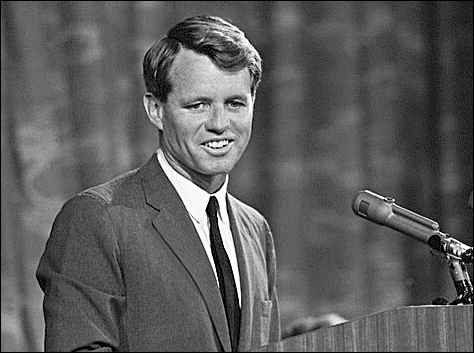
Last week, I wrote about my father, Robert Kennedy, and his critique of Gross Domestic Product (GDP) as the measure of national well-being. He said, “It measures everything except that which makes life worthwhile. And it can tell us everything about America except why we are proud that we are Americans.”
Had my father lived, we might have started work a lot sooner on truer ways to measure the state of the nation. Sadly, that did not happen. His critique of the GDP was forgotten. Instead, other values came to govern American life.
In 1968, David Frost asked both Ronald Reagan and my father to speak on the purpose of life. Ronald Reagan answered:
Well, of course, the biologist I suppose would say that like all breeds of animals, the basic instinct is to reproduce our kind, but I believe it’s inherent in the concept that created our country–and in the Judeo-Christian religion–that man is for individual fulfillment; for our religion is based on the idea not of any mass movement but of individual salvation. Each man must find his own salvation; I would think that our national purpose in this country–and we have lost sight of it too much in the last three decades–is to be free–to the limit possible with law and order, every man to be what God intended him to be.
My father said:
I think you have to break it down to people who have some advantages, and those who are just trying to survive and have their family survive. If you have enough to eat, for instance, I think basically it’s to make a contribution to those who are less well off. ‘I complained because I had no shoes until I met a man who had no feet.’ You can always find someone that has a more difficult time than you do, has suffered more, and has faced some more difficult time one way or the other. If you’ve made some contribution to someone else, to improve their life, and make their life a bit more livable, a little bit more happy, I think that’s what you should be doing.
Ronald Reagan’s views came to dominate the political landscape. Later, when he was asked what he meant by freedom, he described driving up the Pacific Coast Highway in a convertible with the wind blowing through his hair. Here was a man truly doing his own thing, alone.
George Washington and Thomas Jefferson had nice houses. They could have enjoyed contented private lives. But it was not just about their property.
What Ronald Reagan is remembered for does not reflect what he actually did. Of course, he believed in public engagement. He was a six-term president of the Screen Actors guild, calling union membership a “fundamental human right.” He was governor of California and president of the United States. He spoke eloquently about America as a “shining city on a hill.”
Read the rest of… Kathleen Kennedy Townsend: The Pursuit of Happiness: What the Founders Meant—And Didn’t
In an opinion piece in the New York Daily News yesterday, Seth Forman presented Five arguments against gay marriage: Society must brace for corrosive change. Your correspondent is still flummoxed by the fact that people put any credence into the types of arguments that were used to deny women the right to own property or vote, to deny “mixed race” marriages, to support segregation and Jim Crow laws, etc., etc. How can these arguments hold water in a country that supposedly cherishes “freedom”? What say you, dear readers?
And in the “odd couple” story of the week, Reps. Barney Frank and Ron Paul have gotten together to work on a little legislation. After 40 years of the “war on drugs” in this country, you’d think their bill would gain a little traction and find some love. Salon
Finally, in the heterosexual column this week, a new film from Mexico (directed, interestingly, by an Aussie) explores race, class, culture and a woman’s kinky sadomasochistic love affair in Mexico City. Yeah! Check out this titillating review of “Leap Year.”
I don’t know what he’ll do. I do know that it’s better to lead than to follow. I also know that future public opinion on this issue is easier to predict than that on any other major policy issue.
That’s because of the stark generational split: polls consistently show overwhelming majorities of people under 40 supporting gay marriage, and overwhelming majorities of those over 65 opposing it – just as polls during the mid-1960s showed on interracial marriage (before the Supreme Court banned state anti-miscegenation laws in Loving v. Virginia).
As generational replacement occurs, clear majorities of the electorate will support gay marriage, and it will require little courage to support it. Now is the time for the president to ensure that he is on the right side of history.




 In my last post