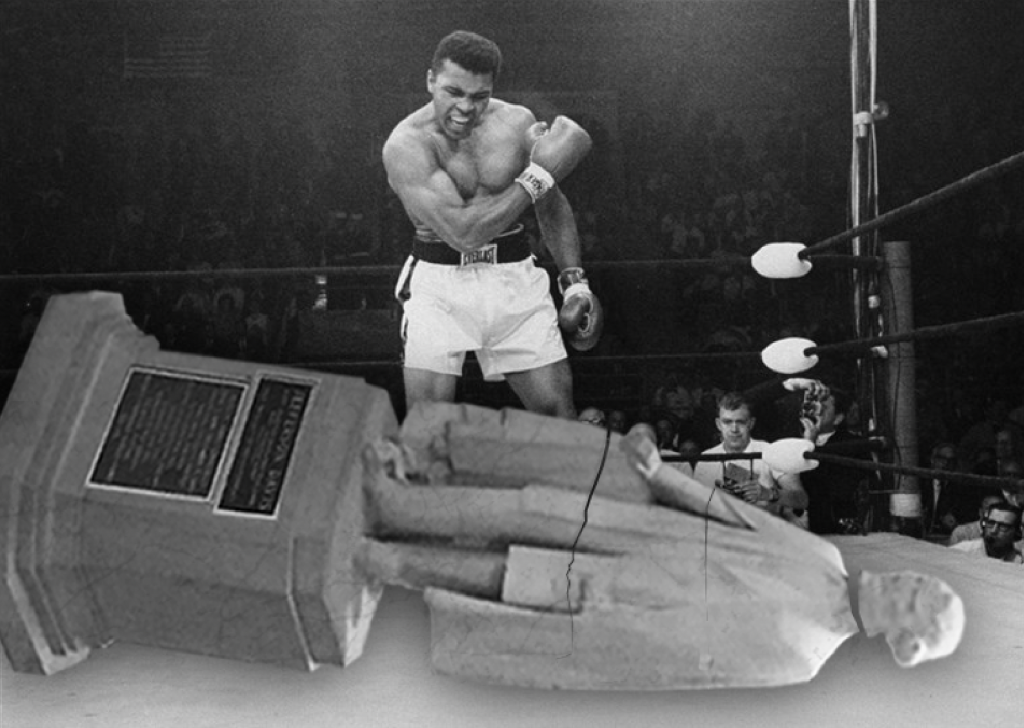
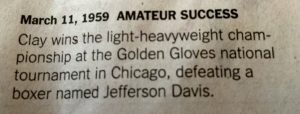
Please sign the petition below to remove the statue of Jefferson Davis currently in Kentucky’s Capitol Rotunda, and replace it with a tribute to Muhammad Ali, “the Louisville Lip” and “the Greatest of All Time.”
I just heard from the Ali family: It is the Champ’s belief that Islam prohibits three-dimensional representations of living Muslims. Accordingly, I have adjusted the petition to call for a two-dimensional representation of Ali (a portrait, picture or mural) in lieu of a statue.
UPDATE (Tuesday, December 2, 2014)
In this interview with WHAS-TV’s Joe Arnold, Governor Steve Beshear endorses the idea of honoring Muhammad Ali in the State Capitol (although he disagrees with removing Davis). Arnold explores the idea further on his weekly show, “The Powers that Be.”
Click here to check out WDRB-TV’s Lawrence Smith’s coverage of the story.
And here’s my op-ed in Ali’s hometown paper, the Louisville Courier-Journal.
UPDATE (Saturday, June 4, 2016)
In the wake of the 2015 Charlestown tragedy, in which a Confederate flag-waving murderer united the nation against racism, all of the most powerful Kentucky policymakers — U.S. Senator Mitch McConnell, Governor Matt Bevin, Senate President Robert Stivers and House Speaker Greg Stumbo — called for the removal of the Davis statue from the Rotunda. Today, as we commemorate last night’s passing of Muhammad Ali, there is no better moment to replace the symbol of Kentucky’s worst era with a tribute to The Greatest of All Time.
UPDATE (Wednesday, June 8, 2016):
Great piece by Lawrence Smith of WDRB-TV in Louisville on the petition drive to replace Jefferson Davis’ statue in the Capitol Rotunda with a tribute to Muhammad Ali.
UPDATE (Thursday, June 9, 2016):
Excellent piece on the petition drive by Jack Brammer that was featured on the front page of the Lexington Herald-Leader.
Highlight of the article:
Miller said he has received a few “angry comments” on his call to honor Ali.
“One of them encouraged me to kill myself,” he said. “You can quote me that I have decided not to take their advice.”
UPDATE (Friday, June 10, 2016)
The petition drives continues to show the Big Mo(hammed): check out these stories from WKYU-FM public radio in Bowling Green and WKYT-TV, Channel 27 in Lexington:
UPDATE (Saturday, June 11, 2016):
Still not convinced? Check out this excerpt from today’s New York Times:
I begin by offering a full-throated “amen” to Ron Granieri’s remarks regarding Jerry Ford’s presidency. While many Republicans seem to view Reagan as the progenitor of today’s Republican Party, Ford may be the reason why the Republican Party still existed in 1980.
Despite its brevity, Ford’s tenure offers more than its share of food for thought regarding the character of effective presidential leadership. As Ron points out, Ford indeed represented the quintessential “manager;” a moderate who was ultimately guided by what he perceived as the demands of the time. Far from the accommodationist caricature painted by his critics on the right, Ford did not hesitate to strike out on his own when necessary. While the Nixon pardon offers the ultimate measure of this characteristic (the fact that he received the 2001 John F. Kennedy Profile in Courage Award demonstrates long-overdue liberal respect for this decision), Ford’s economic record also demonstrated a unique mix of toughness and pragmatism.
Taking office in the midst of the Arab oil shocks of 1973-74, Ford identified inflation as the chief focus of his economic policy. Widely-derided at the time – and largely forgotten since – Ford’s “Whip Inflation Now” moniker reflected Ford’s deeply ingrained sense that inflation constituted the chief threat to long-term economic growth. Initially proposing a mixture of tax increases and budget cuts, Ford later embraced a program of modest tax cuts paired with spending restraint (the latter generating a series of vetoes which strained his relationship with the large Democrat majorities in Congress). These policies worked: inflation in 1976 was 5.75%, as compared to 11.03% in 1974. GDP grew at a rate of 5.4% in 1976 (after contracting -0.6% and 0.2% in 1974 and 1975, respectively), while unemployment fell from a high of 9% in May 1975 to 7.8% in December 1976. The subsequent unraveling of the economy began with Jimmy Carter’s early 1977 “stimulus package” that failed to recognize the brisk growth Ford had bequeathed to him. Matters grew worse, of course, with the second series of oil shocks in 1979.
By John Y. Brown III, on Mon Feb 20, 2012 at 12:00 PM ET
It may be time to consolidate national holidays–at least for February.
We Americans like our holidays–and like ’em big.
We talk a lot about humility and gratitude, but when it comes down to it…we really want to have a good time. In a big way.
We need holidays worthy of our time and effort.
February is national holiday rich but festivities poor.
Valentine’s Day is nice and sweet– but limited. There are no great Valentine’s Day books or movies or songs. No theme parks named Valentine’s Land. Not even a theme park ride. No special poem to say the night before Valentine’s Day. No event to dress up for….and no special meal around Valentine’s Day. And if more proof were needed, there’s no work day (and school day) off for Valentine’s Day.
As national holidays go, Valentine’s Day is an “under performer” In marketing terms, Valentine’s Day is neither a “cash cow” nor “rising star.” It’s not quite yet a “dog.” It’s just there. Every Feb 14th. With a card and box of candy. And disappointment for not offering more.
Of the two other February national holidays, President’s Day is the only one that offers a work day (and school day) off. That typically says “Something big is about to happen.”
But not with Presidents’ Day. It’s an honorable holiday and good patriotic pause….but talk about bait and switch. Sure, there’s the big day off but–think of it– Do you have a relative, friend who has a favorite story about something crazy that happened to them on Presidents’ Day?
I don’t.
I’ve experienced 47 Presidents’ Days and can’t say I’ve ever done anything interesting enough on Presidents’ Day to want to retell to others.
Whoever was in charge of marketing and planning for Presidents’ Day, let us down.
Presidents’ Day needs a new marketing gimmick or we may soon find ourselves at work and school that day.
Maybe we can come up with a Leprechaun, a Bunny, or fat old man in a red suit to help re-brand Presidents’ Day to make it relevant again.
And then there’s the third, and final, national holiday in February. Groundhog Day. No day off, no presents, no sweetheart candy. Just a morning spent waiting for Punxsutawney Phil to emerge from his burrowed hole to find out of he sees his shadow.
You read that right. I’m not even commenting on this one.
In business, where there are three lame business lines they can sometimes be consolidated into one strong business line. And that can apply to national holidays too.
I think.
There’s got to be a way to mix in a groundhog, cupid and romance, George Washington and Thomas Jefferson, and candy to create one off-the-hook holiday. It’s just a gut feeling I have.
But I see theme parks. Just need to work out the details.
As our RPs debate the greatness of our most recent presidents, we offer the results of a recent Gallup poll:
Americans believe history will judge Ronald Reagan and Bill Clinton as the best among recent U.S. presidents, with at least 6 in 10 saying each will go down in history as an above-average or outstanding president. Only about 1 in 10 say each will be remembered as below average or poor. Three years into Barack Obama’s presidency, Americans are divided in their views of how he will be regarded, with 38% guessing he will be remembered as above average or outstanding and 35% as below average or poor.
These days, when people speak abstractly about the kind of President the country needs, they usually say that it should be someone with legislative experience, who can reach across the aisle to compromise with the other party, who can make difficult decisions, and who enjoys the respect, even friendship of other world leaders, thus improving the international standing of the United States.
In my lifetime, we had just such a President, and no one appreciated him much. He still receives only occasional credit from history and policy geeks, and makes little impression on the public memory, never showing up on anyone’s list of the greatest Presidents. And yet, the closer you look at the actual record, the more of a gem he appears to have been.
I am talking of course about Gerald R. Ford.
I can hear the gasps now. Wait, you say, you mean the guy who fell down the stairs of Air Force One and helped launch the career of Chevy Chase and “Saturday Night Live?” The guy whose name graces the title of one of John Updike’s lamer late novels? The guy who pardoned Richard Nixon? That Gerald Ford?
Read the rest of… The RPs Debate Presidential Greatness: Ron Granieri Rebuts
I think it’s time to throw a bit of kerosene into this debate and see what catches on fire.
I’ve only been alive for a quarter century–a long enough time to see a mere five presidencies. All five of the men who have held the highest office in the United States since my birth have their detractors, but I believe there exists one President who will be held in the highest esteem by future generations; as well as the man I believe to have held the office with the most courage, created the most positive change, and wielded greatest political acumen. That man is the current President: Barack Obama.
It is extremely difficult to abstract from the present when it comes to judging Presidents. Consider the cases of men like James K. Polk and Harry S Truman: it took our country decades in order to give these men the accolades they deserved. However, as a student of policy and of political science, I believe President Obama will go down in history as one of our greatest Presidents regardless of the outcome of the election in November.
Read the rest of… The RPs Debate Presidential Greatness: Robert Kahne Rebuts
By Stephanie Doctrow, RP Staff, on Mon Feb 20, 2012 at 9:15 AM ET
ESPN fired one of its reporters this morning for using an ethnic slur about Knicks player Jeremy Lin in a headline posted on the website. They also suspended an anchor for using the same offensive phrase. [CNN]
Over the past month, we’ve launched a new tradition at The Recovering Politician: a great virtual debate on the issues of the day among our recovering politicians; with provocations, rebuttals, responses, and defenses. Our first discussion focused on presidential leadership; our second on legalizing marijuana; our third, Tim Tebow; our fourth, expanded gambling, and our fifth, the GOP primary mudfest.
On this Presidents’ Day, Artur Davis leads off a discussion on presidential greatness. What makes a president stand out among others? Who are the greatest chief executives of our lifetime? Join in the fun:
Let’s assume that there are two presidents whose greatness is not is dispute: Lincoln and FDR, both won defining wars that might have gone the other way absent superior leadership; both defined their political times by in Lincoln’s case, creating a new party, and in FDR’s case, re-conceiving a stagnant, fading party into a modern progressive one. I would venture there are three others who weren’t tested quite as severely but who dramatically strengthened the country and the office of president: Washington (who affirmed that the country was governable as a republic) Thomas Jefferson (who affirmed that the country’s future was westward, and expansionist) and Teddy Roosevelt (who enshrined the ideal of restraining corporate power and size, and who did so in an era when both parties were dominated by economic conservatives).
Then for good measure, throw in Andrew Jackson and Harry Truman at the bottom of the top tier, for all their petty prejudices and their small-mindedness toward their enemies, both had their transcendent moments: Jackson democratizing a country that was veering toward becoming an oligarchy, and Truman shoring up vulnerable democracies from Greece to Israel, and as a result, denying the Soviet Union ownership of the second half of the 20th Century.
Is there a modern president who makes a claim for membership on that list? I’m spending a lot of my time now at an institution that venerates John Kennedy. The argument for Kennedy is that he revitalized the ideal of civic commitment at a time when McCarthyism and fifties materialism had gutted it; that his decision-making skills in the Cuban Missile Crisis averted a nuclear war; and that he gave the cause of civil rights a moral boost at a time when it desperately needed it. The case against Kennedy is that his thousand or so days was too brief, too devoid of serious legislative accomplishments; that he laid the foundation for a disaster in Vietnam,; and that he was too late to the cause of civil rights to deserve much credit for it.
Read the rest of… The RPs Debate Presidential Greatness: Artur Davis Provokes
By John Y. Brown III, on Fri Feb 17, 2012 at 12:00 PM ET
Causation vs correlation.
Scientists and statisticians use this formulation to determine when the proximity between two events is sufficiently close to establish a causal relationship.
It’s an important concept.
Just because two events occur close to one another doesn’t necessarily mean they are related–i.e., the former “causing” the latter (“the cock crows and the sun rises”).
On the other hand, often they are linked and we need to make this important distinction (e.g., smoking leads to heart disease)–and adjust behavior accordingly.
Monday I was scanning my iPhone apps and noticed “Find my iPhone.”
I hadn’t thought about this app in nearly 3 months when I lost my iPhone and searched unsuccessfully for an hour before this app led me to my right pocket, where the iPhone was safely hidden.
Well, lo and behold, on Tuesday I lose my iPhone and have to use this app again to find it again. This time it only took about 8 minutes and it was located in my jacket pocket.
Which made me wonder, Did seeing the iPhone app the day before “cause” me to lose my phone the next day?
The human mind is a complicated mechanism. I think there was “causation.” And if some scientist tries to claim my analogy is more like the “cock crowing causing the sun to rise,” I’ll be the first to point out to the know-it-all that the sun rising is just an optical illusion.
By John Johnson, on Fri Feb 17, 2012 at 10:00 AM ET
1985 was the first baseball season when I truly became a fan of the sport.
My team was the New York Mets. I became a fan through the legacy fandom passed on
by my Uncle John, who used to take me to Shea stadium. That summer we constantly exchanged stories about the team, the pitching, and hated St Louis Cardinals, and one very special catcher–Gary Carter.
I remember that summer being the first when I really understood box scores and baseball standings. As Fall approached, I anxiously counted the number of wins the Mets needed to overtake the Cardinals. Realizing as the days of the regular season dwindled the Mets were going to run out of time..there only chance to clinch the NL East was a sweep the last weekend. Time ran out…a 98 win season just wasn’t enough. And disappointment filled me realizing that only one team can win the
championship…and even in a season as long as baseball, there was still such a
thing as having not enough time.
Time running out on the 1985 season was the first thing I thought about today
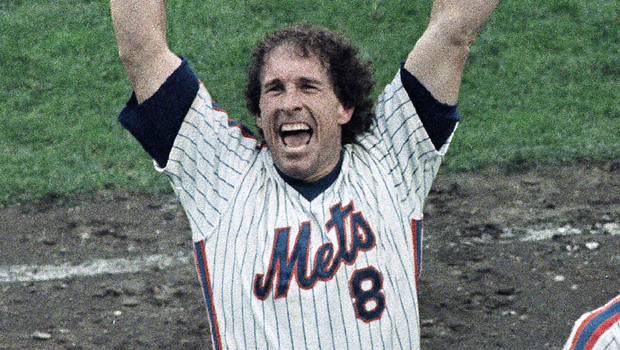
when I heard that one of the bedrocks of the Mets team in 1985 and 1986, Gary Carter, died tragically yesterday of brain cancer at the age of 57.
The next season–1986–the Mets exploded our of the gate to run away with the NL East. I followed every game that season. 1986 was, to steal a phrase from this website, a season of “recovery”….the unfinished business of a season where they got oh so close but time ran out. Gary Carter was right in the middle of so many of those 108 wins that year. He was the steady presence in the battery raising the game of Doc Gooden, Ron Darling, Sid Fernandez, Bobby Ojeda, and Rick Aguilera. He was a constant home run threat to drive in Lenny Dykstra, Wally Backman, Keith Hernandez, Darryl Strawberry. The stats speak for themselves…24 homeruns, 105 RBIs.
The endorsement by “The Donald” of Mitt Romney will amount to very little when all is said in done in the Republican primary.
To be honest, I firmly believed Trump would endorse Newt Gingrich. Why? First off, I think Trump and Newt are more aligned politically. More importantly, in the last year Trump has said Romney walked away with some money from a company he didn’t create, he closed companies and got rid of jobs, and he wasn’t in love with the job he did in Massachusetts. Trump also didn’t like the fact that Romney wasn’t a popular governor, served only one term, and didn’t like that he didn’t have high approval ratings. Trump wanted the individual running for president of the United States to be the most popular person you can have.
Read the rest of… Jason Grill: Will Trump Boost Romney?


 Blog this!