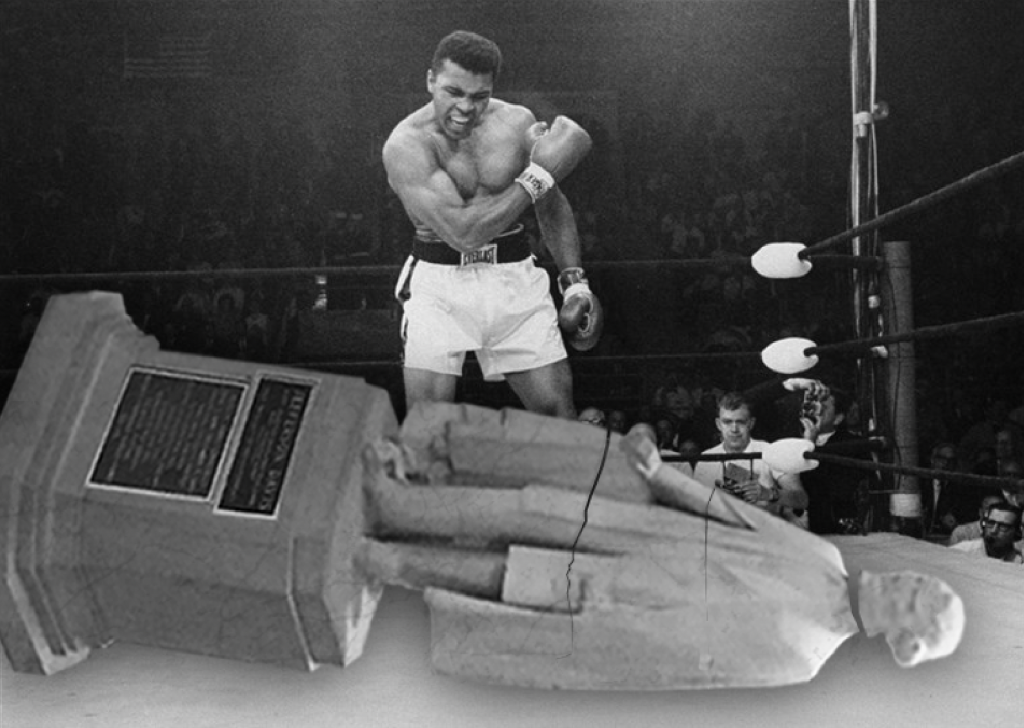
Please sign the petition below to remove the statue of Jefferson Davis currently in Kentucky’s Capitol Rotunda, and replace it with a tribute to Muhammad Ali, “the Louisville Lip” and “the Greatest of All Time.”
I just heard from the Ali family: It is the Champ’s belief that Islam prohibits three-dimensional representations of living Muslims. Accordingly, I have adjusted the petition to call for a two-dimensional representation of Ali (a portrait, picture or mural) in lieu of a statue.
UPDATE (Tuesday, December 2, 2014)
In this interview with WHAS-TV’s Joe Arnold, Governor Steve Beshear endorses the idea of honoring Muhammad Ali in the State Capitol (although he disagrees with removing Davis). Arnold explores the idea further on his weekly show, “The Powers that Be.”
Click here to check out WDRB-TV’s Lawrence Smith’s coverage of the story.
And here’s my op-ed in Ali’s hometown paper, the Louisville Courier-Journal.
UPDATE (Saturday, June 4, 2016)
In the wake of the 2015 Charlestown tragedy, in which a Confederate flag-waving murderer united the nation against racism, all of the most powerful Kentucky policymakers — U.S. Senator Mitch McConnell, Governor Matt Bevin, Senate President Robert Stivers and House Speaker Greg Stumbo — called for the removal of the Davis statue from the Rotunda. Today, as we commemorate last night’s passing of Muhammad Ali, there is no better moment to replace the symbol of Kentucky’s worst era with a tribute to The Greatest of All Time.
UPDATE (Wednesday, June 8, 2016):
Great piece by Lawrence Smith of WDRB-TV in Louisville on the petition drive to replace Jefferson Davis’ statue in the Capitol Rotunda with a tribute to Muhammad Ali.
UPDATE (Thursday, June 9, 2016):
Excellent piece on the petition drive by Jack Brammer that was featured on the front page of the Lexington Herald-Leader.
Highlight of the article:
Miller said he has received a few “angry comments” on his call to honor Ali.
“One of them encouraged me to kill myself,” he said. “You can quote me that I have decided not to take their advice.”
UPDATE (Friday, June 10, 2016)
The petition drives continues to show the Big Mo(hammed): check out these stories from WKYU-FM public radio in Bowling Green and WKYT-TV, Channel 27 in Lexington:
UPDATE (Saturday, June 11, 2016):
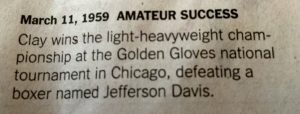
Still not convinced? Check out this excerpt from today’s New York Times:
By Lauren Mayer, on Wed Oct 15, 2014 at 8:30 AM ET
It has become a disturbing trend lately for politicians to defer expressing an opinion by explaining that they aren’t an expert in whatever area is under discussion. (I’m old enough to remember when the most common use of this phrase was commercial actors saying, “I’m not a doctor – but I play one on TV!”) I’m not a scientist either, but I know enough to figure that when 97% of climate change studies attribute it directly to human activity, that’s a pretty good argument.
In fact, I’ve heard that phrase used so often lately that it has become an ‘earworm’ (a disturbingly evocative description of those songs or soundbites that get stuck in one’s head). So here’s my musical response to this over-used excuse . . .
By Erica and Matt Chua, on Tue Oct 14, 2014 at 8:30 AM ET
Number one tour guide in Vietnam? Me. Being your own tour guide can save you money, but could present you with unexpected adventures such as needing a quick repair job. When we got to Mui Ne Beach I saw that the town was a straight line along the beach, a very long line. It was roughly 20km roundtrip to see Mui Ne and another 40km roundtrip to Phan Thiet. To tour both Mui Ne and Phan Thiet would be about $30 USD, but renting a motorcycle was $10. Quick math and motorcycle experience made it a clear choice, rent the bike.
I gave LOCAVORista the full Mui Ne tour and continued to Phan Thiet. I made it 3/4 of the way through the city tour and thought, “I hope this thing holds out, I am a long way from where we started.” Within 5 minutes I felt the rear end shimmy as the engine began to cut out. Immediately I made LOCAVORista get off the bike and asked, “Is it flat?” She laughed and responded, “Completely”.
I walked the bike over to the repair shop and they immediately started speaking to me in Vietnamese, because they, as everyone here, thinks that I am Vietnamese. Irregardless of what I may look like to them I had no clue what was going on. This clearly was a repair shop but they were saying no and pointing.
Read the rest of… Erica and Matt Chua: Motorcycle Maintenance in Vietnam
By John Y. Brown III, on Mon Oct 13, 2014 at 12:00 PM ET
Well world…here I come today!
One more sucker…running onto the field. And today I am going big! And starting early to get a head start on the rest of the world. Willing to totally humiliate myself in every way possible —and doing so loudly and proudly.
I will either achieve greatly or fail spectacularly. Or (most likely) do something in between.
But I am ready and willing to outfail anyone who gets in my way. And that is what matters most!
Irwin Kula is an eighth-generation rabbi known for his fearless attitude about change — a rare quality among religious leaders who tend to adhere closely to tradition.
Kula, president of the National Jewish Center for Learning and Leadership (CLAL) in New York and the author of Yearnings: Embracing the Sacred Messiness of Life, has dedicated himself to opening up the wisdom of his 3,500-year-old faith to be in conversation with the world.
Kula preaches the “highest possible institutional barriers between church and state,” with the “lowest possible communication barriers.” He welcomes intermarriage and interfaith dialogue. He recognizes God not as a “Seeing Eye,” but in “experiences of love, caring, and connection.”
Many consider Kula progressive; others, disruptive. But Kula maintains that institutionalized disruption is essential to adaptation and growth.
Rabbi Kula looks like the wise man of children’s books. He has a handsome widow’s peak, and speaks with homiletic pauses and animated hands. When asked about how his beliefs developed, he answers in stories.
At 14, Kula was thrown out of the private parochial school he attended for challenging the Torah. “I would ask a class of 25 students questions which were probably a touch ‘teenagerish’,” he recalls. “I’d ask, ‘You don’t really believe this — God splitting seas? Come on, this is not what this is actually saying’.”
This rebellious streak would come to define his practice.
The problem with most religious leadership, Kula claims, is that its mission is to convert the non-affiliated. “Religion is not about creed, dogma, or tribe,” he counters. “We need to stop judging our success by membership dues — this isn’t about how many hits. First and foremost, religion is a toolbox designed to help human beings flourish.”
Kula claims that he finds himself often at odds with the concept of “God” as commonly invoked in the American public arena. To him, this is the God of touchdowns and wars, an intervening God who “casts out” unless one “buys in.” “No religious or political system has a hold on being moral,” Kula says. “Systems are only as good as their people.”
For most of his rabbinic appointment, Kula kept these views to himself. Only after the September 11 attacks did he begin to more openly preach what he himself practiced.
“I was very unnerved, knowing the religious impulse compelled that,” Kula says. After the tragedy, he shut down his teaching for three months to reevaluate his role as a spiritual leader. When he returned to the synagogue, he had made the decision “never to teach Judaism again simply to affirm the group’s identity.”
In 2013, Irwin Kula recounted the narrative of his spiritual conversion to a packed theatre of global business leaders at the Collaborative Innovation Summit, an event hosted annually by the nonprofit Business Innovation Factory (BIF) in Providence, RI. On stage, the rabbi made an ambitious appeal to his audience, whom he knew to be composed of astute tinkerers and serial entrepreneurs: He asked them to join him in his mission to innovate religion.
Kula is a fervent believer in accessing insight beyond the religious tradition. “It’s really important to speak to non-incumbents,” he maintains. “The less you speak exclusively to your own ‘users,’ the better shot you have of keeping your own practices from becoming incredibly distorted.” His CLAL runs a program called Rabbis Without Borders, dedicated to fostering open dialogue across cultural and religious barriers.
Stories of innovation often feature “two kids in a garage.” Kula’s goal has been to tell an innovation story from the cathedral. “Religion’s just a technology,” his BIF talk began. “How the hardware of humanity gets used will depend on the software.”
His talk covered how the rapid advancements of the digital infrastructure age demand that we broaden our ethical horizons: What are the new crimes? In this new order, who is included and what are their rights? As we redefine morality, the need to innovate faith becomes especially pressing.
“The most interesting businesses ask ‘impact on society’ questions, which are more complex than ‘killer app success’ questions,” Kula reflects in hindsight. “At BIF, I asked, ‘What would happen if we applied innovation theory to religion, to compress the resources it takes to create good people?’”
Kula looks forward to returning for BIF10 in September.
“If a homily is 15 minutes in church, it’s 18 minutes at BIF,” he says. “As conferences go, BIF embodies total equality between the storytellers and their audience. In many ways, it’s the best of what a spiritual community is — we’ve got to bottle that.”
The BIF Collaborative Innovation Summit combines 30 brilliant storytellers with more than 400 innovation junkies in a two-day storytelling jam, featuring tales of personal discovery and transformation that spark real connection and “random collisions of unusual suspects.”
By Erica and Matt Chua, on Fri Oct 10, 2014 at 8:30 AM ET
One thing about Fall that gets me more excited than I probably should is BOOTS. Boots pretty much rock my world, and I’m thrilled that it’s time to start looking at what’s in stores this Fall.
Here’s why boots are so awesome:
1) Boots are a great way to distinguish your work clothes from your “going out” clothes. 2) [this one’s sneaky] Since boots often have thicker soles than regular shoes, they can give you a little help in the height department. 3) There are loads of different boot styles that allow you to create your own unique look (we’ll go over a few below), and designers are always coming up with hip new details. 4) Because boots are not as ubiquitous as, say, regular dress shoes, wearing stylish boots will set you apart as someone who is “in the know” about style.
And here are 3 great boot picks for this Fall in various price ranges:
Up to $250
Topman – $100 Don’t let the buckle scare you. It’s a subtle touch that will only be visible when you’re sitting down.
$250-$500 Rag & Bone – $450 – The roughed-up suede makes them gritty and masculine, but the half captoe maintains the polish.
Read the rest of… Julie Rath: If You Try One New Thing this Fall…


 Blog this!