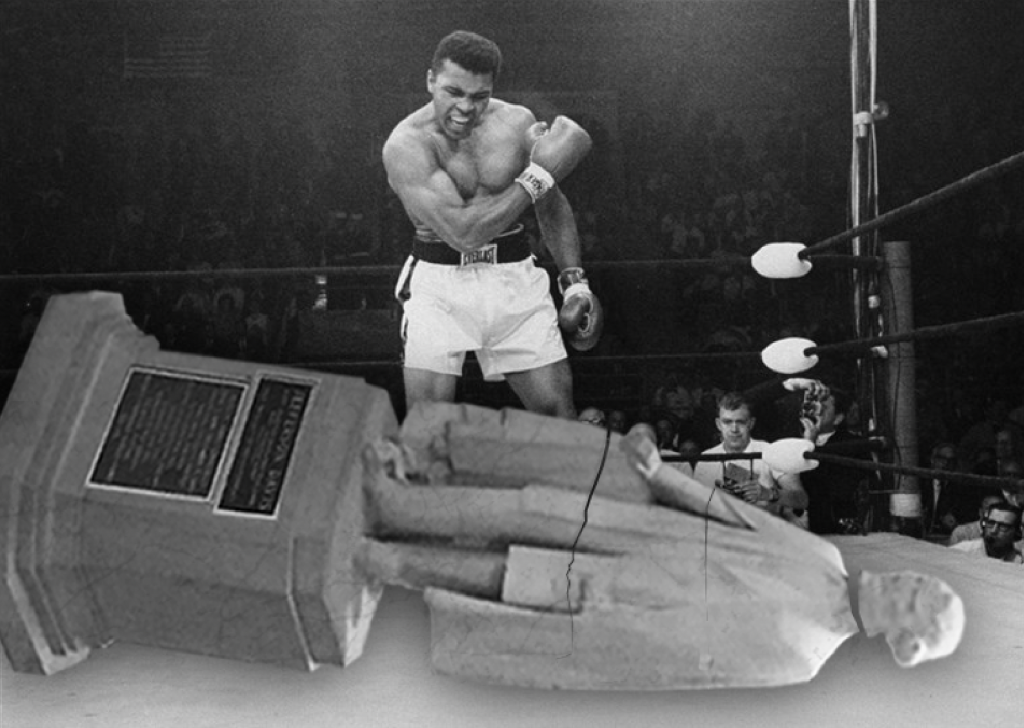
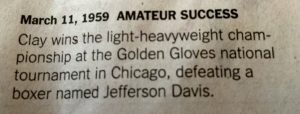
Please sign the petition below to remove the statue of Jefferson Davis currently in Kentucky’s Capitol Rotunda, and replace it with a tribute to Muhammad Ali, “the Louisville Lip” and “the Greatest of All Time.”
I just heard from the Ali family: It is the Champ’s belief that Islam prohibits three-dimensional representations of living Muslims. Accordingly, I have adjusted the petition to call for a two-dimensional representation of Ali (a portrait, picture or mural) in lieu of a statue.
UPDATE (Tuesday, December 2, 2014)
In this interview with WHAS-TV’s Joe Arnold, Governor Steve Beshear endorses the idea of honoring Muhammad Ali in the State Capitol (although he disagrees with removing Davis). Arnold explores the idea further on his weekly show, “The Powers that Be.”
Click here to check out WDRB-TV’s Lawrence Smith’s coverage of the story.
And here’s my op-ed in Ali’s hometown paper, the Louisville Courier-Journal.
UPDATE (Saturday, June 4, 2016)
In the wake of the 2015 Charlestown tragedy, in which a Confederate flag-waving murderer united the nation against racism, all of the most powerful Kentucky policymakers — U.S. Senator Mitch McConnell, Governor Matt Bevin, Senate President Robert Stivers and House Speaker Greg Stumbo — called for the removal of the Davis statue from the Rotunda. Today, as we commemorate last night’s passing of Muhammad Ali, there is no better moment to replace the symbol of Kentucky’s worst era with a tribute to The Greatest of All Time.
UPDATE (Wednesday, June 8, 2016):
Great piece by Lawrence Smith of WDRB-TV in Louisville on the petition drive to replace Jefferson Davis’ statue in the Capitol Rotunda with a tribute to Muhammad Ali.
UPDATE (Thursday, June 9, 2016):
Excellent piece on the petition drive by Jack Brammer that was featured on the front page of the Lexington Herald-Leader.
Highlight of the article:
Miller said he has received a few “angry comments” on his call to honor Ali.
“One of them encouraged me to kill myself,” he said. “You can quote me that I have decided not to take their advice.”
UPDATE (Friday, June 10, 2016)
The petition drives continues to show the Big Mo(hammed): check out these stories from WKYU-FM public radio in Bowling Green and WKYT-TV, Channel 27 in Lexington:
UPDATE (Saturday, June 11, 2016):
Still not convinced? Check out this excerpt from today’s New York Times:
By Lauren Mayer, on Wed Nov 12, 2014 at 8:30 AM ET
While I have the utmost respect for this site’s bipartisanship, readers know my views skew quite left. However, I like to think that humor and music have bipartisan appeal – I grew up in Orange County (the red state in the middle of California . . . . cue rim shot), and even my most rabidly rightwing classmates will tell me they enjoy my videos, even if they know I’m totally wrong about everything.
So in that spirit, this week’s song, while still partisan, is an effort to please everyone. Republicans can gloat over the political mistakes by Democrats I cite, Democrats can appreciate the strategic advice going forward, apolitical types can enjoy the bouncy catchy tune, and everyone can laugh at this middle-aged suburban Jewish mother imitating an adorabale pop star who is only 20.
I write in my capacity as a concerned UK alumnus. (B.A. 1995, J.D. 1998, M.L.S. 1999) I have recently come to the conclusion that college athletes have an equitable right to a fair distribution of the $6 billion revenue that their labor generates.[1] My goal is to persuade you to lead an initiative to recalibrate college athletics in a manner that achieves social justice for the players and restores higher education’s integrity. This letter will discuss how I became disillusioned with the status quo. I will then share my thoughts regarding a path forward that builds on reform ideas that Joe Nocera outlined in the New York Times Magazine.
I became sensitized to the issue by a thoroughly demoralizing article entitled “The Shame of College Athletics” by civil rights historian Prof. Taylor Branch.[2] I grappled with its implications throughout the 2011-2012 basketball season. Like many UK alumni, I have fervently followed UK basketball for the majority of my life. The inequity inherent in the fact that Rodrick Rhodes received no compensation as a result of my 1993 purchase of a 12 jersey never occurred to me. To the extent that the unpaid labor issue crossed my mind, I figured that the entertaining performers on court at Rupp Arena receive plenty of benefits: free tuition, lodging, coaching, food, travel, access to UK doctors etc.
My thinking evolved after reading Prof. Branch’s article. I learned that the value of the in-kind benefits that revenue sport athletes receive is a small percentage of the money that their labor produces: “[t]he average Football Bowl Subdivision player would be worth $121,000 per year, while the average basketball player at that level would be worth $265,000.”[3]
I finally decided that I could no longer consume college basketball in good conscience. The product is produced on the backs of a young, mostly unsophisticated (mostly black) group who are not permitted to have a voice to represent their interests. I am not content to merely avert my individual gaze. I hope to persuade you to take a public position in favor of UK’s withdrawal from the NCAA, market-driven compensation for the players and ending UK’s support of the myth of the “student-athlete.”
Alchemy and the Shibboleth of “Amateurism”
Prof. Branch eloquently argues that “‘amateurism’ and the ‘student-athlete’ are cynical hoaxes, legalistic confections propagated by the universities so they can exploit the skills and fame of young athletes.” He expanded this point in an NPR interview: “[t]he hoax is that it’s the only place in American society where we impose amateur status on someone without their consent. They’re not amateurs because they’ve chosen to be. They’re amateurs because we said that’s what you have to be.”[4] Prof. Branch’s article outlines the sad history that explains how the “student-athlete” concept was created to shield schools from workers’ compensation liability for incidents where players died or were paralyzed on the college football field.
Mark Emmert seems to perceive a threat in the expanding criticism of the NCAA cartel. In an apparent attempt to mute calls for reform, he instituted an annual cash stipend for college athletes in 2011. This was met with enough resistance by athletic directors that it was rescinded. The self-serving position that universities are unable to afford to pay $2000 a year to the performers in a $6 billion dollar entertainment industry brings the gross inequity of the status quo into stark relief.
On January 10, UK Athletics announced that it will fund the construction of new buildings on campus. It is hypocritical to suggest that paying the players would destroy the integrity of the competition but that it is okay for UK to spend the money without the players’ consent. I fail to understand the alchemy that leverages the shibboleth of “amateurism” to launder the otherwise corrupting loot into something virtuous when it funds UK facilities.
Recent incidents provide further evidence that the status quo is unjust. It was revealed on January 23 that the investigation of Miami football was compromised by NCAA investigator improprieties. The Miami controversy prompted Mark Story’s January 24 Lexington Herald-Leader column that asks this important question: “What if major college sports dropped all pretense of amateurism, adopted the Olympics model and allowed athletes to make whatever money the free market will yield?”. As Joe Nocera has written, the Olympics thrived after dispensing with silly amateurism absolutism.
Cleansing College Athletics: A Path Forward
Prof. Branch persuasively makes the case that college sports is shameful but he does not address the contours of what a fair system would look like. Joe Nocera added to the conversation by providing a viable path forward in his subsequent article entitled “Let’s Start Paying College Athletes.”[5] His ideas for reform strike an admirable balance between fairness and reality. I want to offer some additional thoughts of my own that build on his piece. There are a host of other issues that would need to be carefully considered in any reform initiative. My purpose is to argue for a general paradigmatic shift that hinges on both a literal and philosophical withdrawal from the NCAA. Defenders of the status quo tend to find refuge in the thicket of details that would need to be addressed. My comments are based on a firm belief that the academy has sufficient expertise to debate and resolve them.
I think that we should acknowledge the reality that participating in big time college sports crowds out any opportunity for the athletes to receive a meaningful college education. Tensions between academics and athletics are always resolved in favor of the latter. As one example in a tsunami of others, a 9 p.m. Tuesday UK tip-off in Oxford, Mississippi is obviously incongruous with a reasonable academic schedule.
It is best to dispense with the charade that requires both the institutions and players to engage in Student-Athlete Theater. It is a self-evident facade that these people are equally interested in both athletics and academics.[6] Forcing de facto professional athletes to go through the motions of pursuing a degree corrodes higher education’s integrity. The players refer to this as Majoring in Eligibility: lowered admission standards (“special admits”), no-show classes, less-than-rigorous grading, and even outright academic fraud in the preparation of athletes’ work etc.[7] Rejecting the hoary sentimentalism that requires fealty to the “student-athlete” fiction would remove the incentives that drive academic corruption.
The players should have the same freedom as coaches to earn market-driven salaries and endorsements. Players who wish to become legitimate students can return to campus when their athletic careers end.Conforming to the requirements of the Kabuki Theater of Amateurism degrades higher education’s integrity. It also does great violence to the notion of fair treatment for the players.
In addition to a market-driven compensation that Joe suggests, I propose that revenue sport athletes receive a 1.5 year tuition credit for each year that they perform for universities. I think that a reasonable cap would be 6 years of tuition that can be used at any point during the athlete’s lifetime. The business of college sports can sufficiently fund this benefit if current growth is assumed. A lifetime credit would provide a fair opportunity for the 99% of athletes who do not end up in the NBA or NFL to achieve success beyond athletics. They would then actually be able to “receive [the] quality education” that you said they deserve in the Herald-Leader on June 19, 2011.
Universities should withdraw from the NCAA and bring the management of the business of college athletics into the academy. Universities have sufficient expertise to administer this system. Tenured faculty are expected to contribute to the campus community. Administration of of the business of college sports would fit within a reasonable expectation of their academic duties. Let’s return the nearly $300 million that the NCAA kept in the 2011-12 academic year to the players and universities. Let Mark Emmert find a new job that has a $1.7 million annual salary that is not a product of rent-seeking from powerless young people. Unmooring college athletics from the myth of the “student-athlete” would obviate any ontological justification for the NCAA.
The core fundamentals of a post-NCAA architecture should mirror other American pro sports: 1) roughly 50/50 split of the revenue between players and owner/universities; 2) the creation of a union that negotiates the terms of employment in a collective bargaining agreement; and 3) establishing a trust that will help provide affordable care to athletes that suffer long-term adverse health outcomes from playing college sports.
The tipping point of reform in college athletics appears to be approaching. There has been a rising tide of national criticism that has been published since Prof. Branch’s article.[8] The sordid affair was the topic of Frank Deford’s recent NPR commentary. He said that he seeks one college president to publicly admit that “the NCAA is a sham and we should get out of it.”[9] I ask that you demonstrate national leadership in the areas of integrity, institutional accountability and social responsibility by accepting Deford’s invitation.
In summary, I encourage you to revisit your thinking regarding the morality of the University of Kentucky’s support of a $6 billion dollar entertainment business that exploits young people and corrupts higher education. I ask that you read “The Shame of College Athletics” by Taylor Branch, “Let’s Start Paying College Athletes” by Joe Nocera and watch Frontline’s “Money and March Madness.”[10] The University of Kentucky’s regal college basketball history makes it uniquely qualified to be the institution that leads the movement to achieve social justice for the “student-athletes” whose interests the academic community purports to serve. The prospect of your publicly repudiating the cynical hoax of amateurism may seem difficult for you to imagine. However, the University of Kentucky should never be criticized for “dreaming too little dreams.”
Sincerely,
Will Coy-Geeslin
Cc: Dr. Richard Angelo, The Atlantic, Prof. Lowell Bergman, Jay Bilas, Prof. Taylor Branch, Coach John Calipari, Chronicle of Higher Education, Frank Deford, The Drake Group, Mark Emmert, Patrick Hruby, Romogi Huma, Sarah Jaffe, Matt Jones, Ashley Judd, Prof. Michael LeRoy, Lexington Herald-Leader, Mike and Mike in the Morning, NAACP, Joe Nocera, President Barack Obama, Prof. Dan Rascher, Jalen Rose, Kevin Scarbinsky, Prof. Ellen J. Staurowsky, SVP & Russillo, Mark Story, Derek Thompson, University of Kentucky Board of Trustees, Up with Chris Hayes, Dick Vitale, Travis Waldron, Prof. Frank X. Walker, Dan Wetzel, Mary Willingham and Prof. Andrew Zimbalist.
[1] $6 billion is a conservative accounting. Prof. Dan Rascher, an economist at the University of San Francisco, explained to me that he erred on the side of exclusion in his analysis. A broader definition that includes other income (such as merchandise sales at university bookstores) as well as “non-revenue” sports income increases the figure to $10 billion. By contrast, the NBA earned $4 billion and the NFL took in $9 billion. The idea that college football and basketball are amateur nonprofit endeavors is at great variance with any reasonable definition of those terms.
[6]Naturally, Ohio State QB Cardale Jones was suspended for questioning the visibility of the Emperor’s wardrobe in an October 2012 Internet post: “Why should we go to class if we came here to play FOOTBALL, we ain’t come to play SCHOOL, classes are POINTLESS.”
By John Y. Brown III, on Tue Nov 11, 2014 at 12:00 PM ET
Something very thought provoking just occured to me.
What if life really is just a dress rehearsal? If so, how many “live” performances are we talking about and will we be expected to perform in all of them? And what kinds of snacks will be offered at intermission?
Could we maybe do just one full performance and just do some informal Q & A on the other nights?
I mean, we aren’t even finished with the dress rehearsal yet and it is hard sometimes to stay focused and remember my lines. I am not even sure we need an ending that ties up all the lose ends. Too many loose ends to keep track of anyway. Just go with a Sopranos type ending and wrap it.
By Erica and Matt Chua, on Tue Nov 11, 2014 at 8:30 AM ET
At Valley Forge George Washington participated in a cricket game with his troops. This may have marked the highpoint of cricket in what would become the USA, but why is this so? Can’t Americans enjoy cricket? How does it compare to watching baseball? We attended the T20 World Cup of Cricket in Sri Lanka to find out and offer the ultimate comparison…
As for excitement value, cricket matches baseball in dullness. Both sports excel in offering vies of people standing around. Better yet, just like baseball, you don’t have to worry about blinking…you won’t miss anything if you do…
EXCITEMENT WINNER: Draw, both of these sports are better in highlights than live.
What makes slow sports enjoyable? Beer. Cricket doesn’t fail the spectators, offering beers for $0.92 each. Referring to this handy 2012 MLB beer price guide I see that the average beer at a baseball game costs $6.17. To adjust for size, on a per ounce basis, cricket’s beer costs $0.12 per ounce versus the MLB average of $0.41.
Read the rest of… Erica and Matt Chua: Can Americans Enjoy Cricket?
By John Y. Brown III, on Mon Nov 10, 2014 at 12:00 PM ET
Parking next to this truck this morning while eating my breakfast made me think about some things.
First, staring at gigntic bugs while eating is a terrific way to suppress your appetite.
Second, although I am a Democrat, I am OK with outright killing these insects rather than just capturing and imprisoning them in hopes of eventually reforming them and returning them to society.
Especially the giant one on the left that I felt like was staring at me during breakfast.
This is your future Ebola Czarina checking in. You’ve been pretty busy lately, so if you missed my blog about Ebola, you can read it here: How Do You Solve a Problem Like Ebola? Seems like we have Ebola under control at the moment, so kudos to the current Czar, but if you would like to write in a succession clause, I’m your girl.
But I digress, Ebola is not why I am writing. Earlier this week, exactly 56.2% of the 46% of Kentuckians who even bothered to show up to vote sent Mitch McConnell to represent them in the United States Senate. (Note: let’s be fair, Lexingtonians and Louisvillians are excluded from this statistic, they actually voted to send Alison to the Senate in the same proportions)
I have to believe that a certain percentage sent him back, not because they liked him, but to bring home the “pork” to Kentucky, as Senate majority leader, because after all, it’s the American way. I’m not sure how I feel about those people as it is this logic that has completely bastardized the resource distribution of our democratic government but that’s a letter for a different day.
Those Kentuckians didn’t send him to represent me, as I promise you that the votes he will cast will never reflect anything that I stand for. And you know that saying, “You have to stand for something or you’ll fall for anything”. Yeah, well let’s just say that too many Kentuckians will fall for anything, and evidently that disease is pretty contagious among the voting electorate in the mid-terms of 2014.
On Wednesday, after those Kentuckians who cannot see that they are being lied to and their votes and souls are being bought by fear mongering billionaires, decided that Mitch McConnell, after 30 abysmal years of legislating, was yet again their man, you invited him over for some food, fun & fellowship at the White House. You said, I quote, “I would enjoy having some Kentucky bourbon with Mitch McConnell.” Now Mr. President, I will take you at your word that you meant what you said, but I have to assume it would be the bourbon that you would enjoy with Mitch McConnell, rather than the discourse.
In this state, bourbon flows like water. We drink it in any manner you can imagine, we’ve built a trail around it, we make candy out of it, we have even been known to light it on fire when served as part of a decadent dessert or two. In a few hours, I myself will be tailgating with it at the UK vs. Georgia game, but I think you get my point.
But Mr. President, this Kentucky girl is here to tell you…there isn’t enough bourbon. You could push Bourbon through the veins of Mitch McConnell intravenously and he still wouldn’t see what you and I see.
To see that people are people, and Corporations are NOT
To see that inconvenient truths not addressed for decades, could become species ending nightmares at the end of the millennium
To see that legislation passed in his name is often exactly what Jesus WOULDN’T DO! (not WWJD!)
To see that choosing “Pork” in Washington, in the long run, harms the men and women bringing home the bacon
To see that profit maximizers don’t self-regulate
To see that ending the “War on Coal” fuels a war on clean drinking water and irreversible environmental damage
To see that access to healthcare makes us all healthier
To see that Student Loans are as important, if not more important, as Business Loans
To see that Planned Parenthood serves low income women in ways they will never understand
To see that birth control pills are used for dozens of women’s health concerns, only one of which is preventing birth
To see that being Pro Life should mean feeding, clothing, and nurturing these children long after the birth is over
To see the importance of funding Sesame Street instead of Wall Street
To see that tomorrow’s criminal is today’s abused, neglected, and broken child
To see that neediest children come to school to be loved as much as to learn
To see that Head Start isn’t just an academic start, it is the ONLY start for many of these children
To see that choosing butter over guns is not only the right thing to do but the smart economic thing to do
To see that love is defined by the heart, not the type of genitalia
To see that government can and should reduce suffering, instead of inflicting it
To see that as Americans we are, and should be our brother and sister’s keeper
So now that the Bourbon Summit is over, keep fighting the good fight, please get back to doing what you have gotten really good at, rebuilding a country and economy you inherited 6 years ago that was decimated by 8 years of the policies of the same party that just dropped by for a bite of lunch.
And while these next two years are going to be a nightmare of preventing the passing of legislation that will undo the economic growing, deficit & governmental fraud reducing and consumer protecting accomplishments of your presidency, please know that history will be kind to you.
And Mr. President, if Mitch didn’t bring the Pappy Van Winkle, he brought the wrong stuff.
This is the sixth of a series of conversations originally published on the Time website, authored by myself and Nicha Ratana, with transformational leaders who will be storytellers at the BIF10 Collaborative Innovation Summit in Providence, RI, on Sept. 17-18
How many people end business meetings with an “I love you” and a hug? Venture capitalist and former AT&T Labs scientist Deb Mills-Scofield does.
To Mills-Scofield, to do business is to negotiate diverse personalities to get things done — and she has the gift for it. “The broader, deeper, and more diverse your network, the bigger the impact you can make on the world,” she says.
She explains her network this way: Her consultancy, Mills-Scofield LLC, is her livelihood and passion; venture capital firm, Glengary, where she is a partner, is her way of giving back. She helps entrepreneurs get their ideas off the ground by connecting them with clients and collaborators who are hungry for innovation. Furthermore, she mentors a small army of students at her alma mater, Brown University, introducing them to opportunities where they can help “kick things up a bit.”
Each connection Mills-Scofield makes is an iteration of her business philosophy, which is as old-school as it gets: she believes, simply, in “paying it forward.”
“Your network is not about you. A network is to be shared,” she maintains. “Networking is about people: seeing what makes them tick, and connecting them to someone to help them.”
She admits to being selective in networking, but her criterion is humble: “I only help people who are willing to help others.”
+++
Mills-Scofield grew up in Rumson, NJ. She and her sister attended public school, but every Tuesday, her mother took them into Manhattan to visit the museums. The girls were also encouraged to take another day off every week — to stay home and play.
“Right from the get-go,” Mills-Scofield says, “my model for education was that it is a personal responsibility.”
At Brown, she created one of the country’s first undergraduate majors in cognitive science. She went on to work for Bell Labs, where she was responsible for engineering the most lucrative messaging-system patent in the history of AT&T Lucent.
Long before corporate America started to sloganeer its rebellion, before “Work is Personal” and “All Business is Social,” Deb Mills-Scofield did business the only way that made sense to her — with curiosity and compassion. She called herself a “troublemaker.”
“Part of what I bring when I’m consulting is the fact that I care about you as a person, and not as your function,” she says.
In conversation, Mills-Scofield asserts a motherly kind of authority. She is frank but affectionate; she genuinely asks after your family. She doesn’t miss anything.
Her consultancy helps companies humanize their practice. “Any business that wants a return on investment needs to focus on how it impacts its community,” she says.
Mills-Scofield urges CEOs to put themselves in their customer’s shoes. “Have you ever tried to buy from yourself? Have you ever called your own customer service line?” she asks them. She teaches leaders to trust their employees’ desire to learn and create. “Treat them like adults!” she insists. “Give them the autonomy to innovate.”
Fundamentally, she believes that management’s job is to exercise “stewardship” over the organization, not control. “Business strategy is a living, breathing thing,” Mills-Scofield claims, “It’s not a plaque on a shelf, which is where most companies have gone wrong.”
+++
When Mills-Scofield visits the Brown campus in the fall, she will hold her “office hours” in the cozy kitchen of the student community service center. Over the years, the guidance she has offered her “kids,” as she calls them, has made her a household name within the institution.
This September, she looks forward to introducing her mentees to one of the greatest resources within her network: the Collaborative Innovation Summit hosted annually by the nonprofit Business Innovation Factory (BIF) in Providence, RI.
In 2009, Mills-Scofield connected with Saul Kaplan, BIF’s founder, to encourage a student’s interest in local business innovation. She and Kaplan struck up a friendship, founded on their belief in the better nature of business, and he invited her to speak at the BIF Summit.
“We desperately need to see real examples of world-changing innovation and the “ordinary” people who come together to create it,” Mills-Scofield says.
“I call the BIF Summit a ‘wedding.’ It is better than any other conference at creating connections among strangers at a profoundly human level, because it provides the space — physical, emotional, and intellectual — for you to challenge yourself to think differently, surrounded by other people who are willing to take the risk with you.”
“I came to the BIF-6 Summit, and my network has never been the same since,” she says. “It’s a gift. I’ve been to every one and I can’t wait to go to BIF10.”
The BIF Collaborative Innovation Summit combines 30 brilliant storytellers with more than 400 innovation junkies in a two-day storytelling jam, featuring tales of personal discovery and transformation that spark real connection and “random collisions of unusual suspects.”
By John Y. Brown III, on Fri Nov 7, 2014 at 12:00 PM ET
Reconsidering my high school highlights reel
As I drove to Rebecca’s 30th high school reunion last night I passed the low bridge on River Road and was reminded that one of my most thrilling accomplishments that made me feel my high school class was clearly more awesome than Rebecca’s involved that bridge — and I hadn’t thought about that night for a very long time.
It was the night that me and two other guys from my high school class stripped down to our underwear and jumped off the low bridge into the icy cold water below. As I smugly recollected that awesome night 33 years ago from the perspective of a non-17 year old, it occurred to me I may have over-estimated the raw awesomeness I had attached to that evening for all these years. Somehow, from the perspective of a modestly mature 51 year old adult, that high school highlight seemed to drop form a “10” to about a “6” on a scale of 1-10. I heard that voice in my head that says things to me like, “That was a bad choice..” In fact, I even began to worry that reassessing my high school highlight reel, so to speak, may lead me to conclude that my high school graduating class wasn’t superior to my wife’s. Especially after I spotted three guys at Rebecca’s reunion who looked like they may have jumped off that same bridge in their underwear on multiple occasions.
Reconsidering my youthful delusions is never an easy thing. So I did the only prudent thing to do in this situation and decided to just table the whole issue of whether my or my wife’s high school class was more awesome –until my wife’s 35th high school reunion.
===
Attending your spouse’s 30th high school reunion makes you realize that almost all high school graduating classes have the same stock characters and only a few minor diferemces in the supporting cast and cameo roles.
And for the first time in over 30 years you are forced to entertain the possibility that your high school graduating class may not have been the baddest, coolest, most epic high school graduating class in the history of the universe (excluding the senior class i…n Fast Times at Ridgemont High but they weren’t real).
And that your 1981 Central High School graduating class may only have been a slightly above average graduating class compared to other high schools in your school distict in 1981.
And then you begin to wonder if you have made any other warped presumptions about yourself and the world in other areas of your life. But calm yourself by being certain there was never a greater, hipper kindergarten class in the history of the universe than yours. But are especially grateful your spouse doesn’t have any kindergarten reunions to challenge your belief.
Have you ever wondered how you rate on a scale of 1-10? Fall is practically here, and the holidays right after that. Those are key times to be exuding confidence and looking your best.
If you want to get serious about your style, and be taken seriously as a result, I invite you to watch the video I made for you explaining how it all works. I’ve worked with hundreds of men worldwide, and it’s been my incredible privilege to observe how much their lives improve and what opportunities come their way when they upgrade their style.
On the same page as the video, you can also take my style quiz. It will show you how you measure up, and what you can do to get to a 10.
By John Y. Brown III, on Thu Nov 6, 2014 at 12:00 PM ET
This morning had an awesome start. The 4 1/2 minute drive from my house to the coffee shop rocked — literally. I really nailed Eddie Vedder’s voice and the air guitar solo in a Pearl Jam song playing in my car.
But while in line for coffee and waiting to meet a business associate, I couldn’t stop looking at two very distinguished looking businessmen about to meet with each other. While I was stirring half-and-half into my coffee …at the condiment bar an even more impressive third member joined their party and they decided to take the “large table in the back.”
The guy I was waiting to meet wasn’t as impressive as these three and I was secretly hoping they would notice me at the condiment bar and invite me to join their table and their meeting. I even asked one to pass me a stir stick and gave a very confident and “important” look as if to say “We have a lot in common. More than the guy I am waiting to meet.” But nothing.
I sat down at a tiny table that hadn’t even been wiped off and tried to look like I was thinking about about a large financial deal. Finally, my guy shows up. But walks past me to say hello to the three guys at the back table.
What if they invite him to join their table and I am left all alone at my small and dirty table? That would really suck. As great a start as my day got off to it was now cratering.
I tried to think of a way to make my table, as I sat by myself, look cooler than the other tables — but feared it wasn’t working. And the worst part of all is I don’t think anyone in the coffee shop even knew about the Eddie Vedder song I lip-synced so flawlessly just a few minutes earlier.


 Blog this!