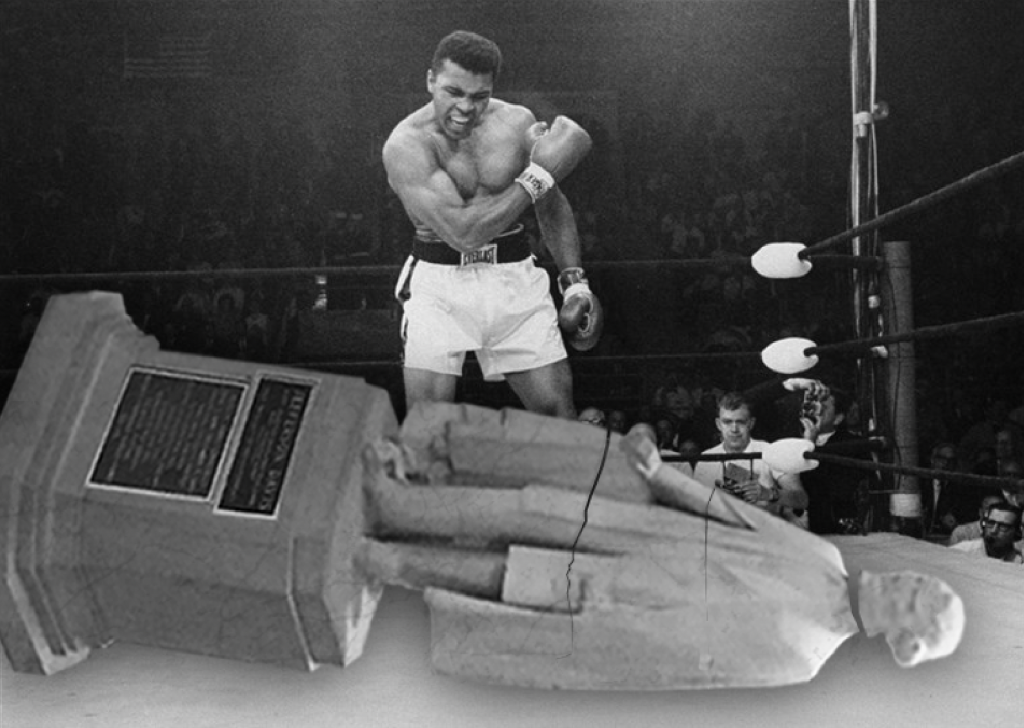
Please sign the petition below to remove the statue of Jefferson Davis currently in Kentucky’s Capitol Rotunda, and replace it with a tribute to Muhammad Ali, “the Louisville Lip” and “the Greatest of All Time.”
I just heard from the Ali family: It is the Champ’s belief that Islam prohibits three-dimensional representations of living Muslims. Accordingly, I have adjusted the petition to call for a two-dimensional representation of Ali (a portrait, picture or mural) in lieu of a statue.
UPDATE (Tuesday, December 2, 2014)
In this interview with WHAS-TV’s Joe Arnold, Governor Steve Beshear endorses the idea of honoring Muhammad Ali in the State Capitol (although he disagrees with removing Davis). Arnold explores the idea further on his weekly show, “The Powers that Be.”
Click here to check out WDRB-TV’s Lawrence Smith’s coverage of the story.
And here’s my op-ed in Ali’s hometown paper, the Louisville Courier-Journal.
UPDATE (Saturday, June 4, 2016)
In the wake of the 2015 Charlestown tragedy, in which a Confederate flag-waving murderer united the nation against racism, all of the most powerful Kentucky policymakers — U.S. Senator Mitch McConnell, Governor Matt Bevin, Senate President Robert Stivers and House Speaker Greg Stumbo — called for the removal of the Davis statue from the Rotunda. Today, as we commemorate last night’s passing of Muhammad Ali, there is no better moment to replace the symbol of Kentucky’s worst era with a tribute to The Greatest of All Time.
UPDATE (Wednesday, June 8, 2016):
Great piece by Lawrence Smith of WDRB-TV in Louisville on the petition drive to replace Jefferson Davis’ statue in the Capitol Rotunda with a tribute to Muhammad Ali.
UPDATE (Thursday, June 9, 2016):
Excellent piece on the petition drive by Jack Brammer that was featured on the front page of the Lexington Herald-Leader.
Highlight of the article:
Miller said he has received a few “angry comments” on his call to honor Ali.
“One of them encouraged me to kill myself,” he said. “You can quote me that I have decided not to take their advice.”
UPDATE (Friday, June 10, 2016)
The petition drives continues to show the Big Mo(hammed): check out these stories from WKYU-FM public radio in Bowling Green and WKYT-TV, Channel 27 in Lexington:
UPDATE (Saturday, June 11, 2016):
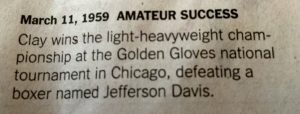
Still not convinced? Check out this excerpt from today’s New York Times:
By John Y. Brown III, on Tue Nov 18, 2014 at 12:00 PM ET
They say go with your first thought on things.
I was never sure what that meant until this morning.
On my way to meet someone for an early morning business meeting, I got an email from someone else that he couldn’t make our meeting — a meeting I had set for the exact same time and completely forgotten about –because he had “something unexpected come up at work.”
1) My first thought was, “Oh wow! Thank you, God! That would have been humiliating. I wrote an email response telling him “No problem,” and that we could reschedule.
2) My second thought was I should put a little hint of disappointment in my response email to make him feel guilty for cancelling at the last minute.
3) My third thought was “Wonder who the heck he is meeting with who is so important that he had to cancel a meeting with me” –that I had admittedly forgotten and couldn’t make myself because I was meeting with someone else too.
4) My fourth thought was, “Maybe you should just email the response from your first thought and keep the rest to yourself.”
So, always go with your first thought. And if you can’t do that hold off until the fourth thought. And don’t dwell on the second and third.
A good rule of thumb is that genuine gratitude is always better than false indignation.
By Erica and Matt Chua, on Tue Nov 18, 2014 at 8:30 AM ET
Traveling around the world is not one trip; rather it is a collection of many small trips. Each country we visit brings unique challenges, especially arranging visas and transportation. Given our travel experience, we can usually nail the logistics down in 10-20 minutes. Here are the most important aspects we’ve learned in planning a trip to another country and pointers that you can put to use for your next adventure.
These steps are in order; they should be followed in this order, because the steps are dependent on each other.
WHERE TO GO
Obviously, you need to know the country or region you want to visit. When we were doing some advance trip planning we ran into a challenge, which I will use as an example; getting to Patagonia in the right time of the year, from Europe, without paying visa fees.
VISAS
First and foremost, do you need a visa? Is there a fee to enter the country? We are budget travelers, we avoid these fees whenever possible. To figure this out, I google “US citizen visiting [insert country name]” and look for the US State Department website, specifically the “Entry/Exit Requirements for US Citizens” section. Also useful is Project Visa. I avoid visa service websites, they try to steer you towards paying them. If you are a citizen of another country, you should check your State Department equivalent.
OUR EXAMPLE: We will be visiting Brazil, but won’t have time to get a visa prior to our arrival in South America. I checked to make sure we could get the visa while traveling (read: not only in our home country). Chile and Argentina charge $120 for American citizens to enter their country…or so it seems. This fee is only charged at airports, probably only Santiago and Buenos Aires, therefore to gain entry to these countries for free, you have to enter via land. I have traveled overland between the two countries more than a dozen times, never having to pay.
OK, so we want to get to Chilean or Argentine Patagonia as quickly as we can from Europe. What are our choices? Looking at Google maps, the land borders are: Brazil (already ruled out), Bolivia, Peru, Uruguay or Paraguay. Knowing we are flying from Europe, we need a major airport, major airports are generally in wealthy, commercial countries, making Peru and Uruguay the targets (no visa fees, good transport to Chile and Argentina).
Returning to Chile from my first date with LOCAVORista, I took a bus from Lima, Peru to Santiago, Chile. It was a grueling 56 hour ride…and Santiago is only halfway to Patagonia. Even being a lovesick adolescent, I promised myself to never take that bus again, therefore, Peru is out. That leaves Uruguay. Checking out the US State Department page, I see there are no visa fees or needs for me to enter Uruguay. Even better, it’s major airport, Montevideo, is a short ferry ride from Buenos Aires.
The more entry points that you have, the better deal you can get on flights. In this case, due to visas and fees, our options were pretty limited. Obviously planning around visiting one country is much simpler.
WEATHER
After knowing the visa situation, the most important thing to know is when to go. Figure out what exactly you want to do, and what months are best. January is summer in Chile, the best time to go to Patagonia, but the worst time to go skiing there.
I get this information from Wikitravel or, if I have it, Lonely Planet.
GETTING THERE CHEAPLY
This takes a little practice to get the hang of, but try it a couple times, it could save you hundreds, if not thousands of dollars over several flights.
Figure out all cities that you could possibly leave from and arrive in. Is there a reasonably short bus or train ride you could take? For example, if you wanted to go to Paris, the cheapest could be to fly into London, Amsterdam or Brussels, then take the train to Paris. The transport from another city is irrelevant for a moment. Write down all the possible locations you could fly to/from. Write departure and arrival country vertically on a piece of paper.
OUR EXAMPLE: even though I know my target is Montevideo, I am going to check prices for Rio de Janeiro, Buenos Aires, Santiago, Sao Paulo, and Montevideo. If the ticket price to Montevideo, Buenos Aires and Santiago are the same, it is cheaper to go to Montevideo, but it is possible there will be a fare sale and if flying to Buenos Aires or Santiago is $120 or more cheaper, per person, it is worth paying the high visa fee.
Go to www.kayak.com and type in each possible departure city, one at a time, and write the three-letter airport code for each city down. If there is a code for the city, versus a specific airport, use that. For example, “LON” is “London, England-All Airport” so you can search Heathrow, Stansted, Gatwick and London City with one code.
SOME POINTERS:
If you want to visit Australia, you will probably go to Melbourne and Sydney. If you are flexible in timing, switching the order you visit each may save you big money.
If you want to visit the East Coast of the USA, there are inexpensive buses connecting many of the major cities including the “Chinatown” buses between New York, Boston, and Philadelphia.
If you want to visit Disney World you could always fly to Jacksonville or Miami and drive. (And who doesn’t want to go to Disney World? Random aside: My senior year of high school I went to LA to visit colleges. My mother had a meeting the day I was supposed to visit USC…I never actually made it to USC, I went to Disneyland instead.)
If you want to visit South East Asia, you should look to fly to SIN (Singapore), BKK (Bangkok), or KUL (Kuala Lumpur). From any of these you can get discount airline tickets or buses around the region.
Here’s the greatest thing about KAYAK.com: the ability to search for up to four departure and arrival cities at once! Put in each three-letter airport code, followed by a comma. Chose your travel dates and click “My dates are flexible” to see the range of prices you could pay. Click search.
If you get a pop-up to set a “price alert” do it! This allows you to watch the price for your itinerary, you can even set an alert based on price such as “flights from Minneapolis to Mexico for under $300” Anytime a fare falls below this, you’ll get an email! Seemingly at random, a link will appear in the left sidebar that says “Get a price alert”, allowing you to set it up.
Read the rest of… Erica and Matt Chua: 10 Minute Trip Planning
By John Y. Brown III, on Mon Nov 17, 2014 at 12:00 PM ET
I was just notified I have been–again–a victim of credit card fraud.
Someone in NY manually charged some product from Nevada that costs 99 cents.
I thought it was kinda pitiful. If I had met the man on the street and he’d told me about the 99 cents and that he was about to commit a major crime for it, I might have given him the money myself. Especially if it would have meant he would have left my credit card alone and I wouldn’t have to go through getting a new one. Heck, that would be worth maybe $1.50 to me. Just to avoid the hassle.
If you are out there and thinking of stealing my credit card information to buy something less than $1.50 (like this last guy), talk to me first. Let’s see if we can’t work something out. If you are interested in more than that, we are going to be negotiating for a while and I am not willing to be shaken down for more than, ohhh, $2. Tops!!
This is the seventh of a series of conversations originally published on the Time website, authored by myself and Nicha Ratana, with transformational leaders who will be storytellers at the BIF10 Collaborative Innovation Summit in Providence, RI, on Sept. 17-18.
Keith Yamashita vividly remembers one smoggy school day from when he was eight years old. He and fellow classmates at the local elementary school in Santa Ana, California, spent their recess corralled in the indoor gymnasium to watch a movie.“That film stuck with me for the rest of my life” Yamashita later recalled while sharing a tale of personal transformation onstage at the Collaborative Innovation Summit, a storytelling event hosted annually by the nonprofit Business Innovation Factory (BIF) in Providence, RI.
The 9-minute film, “Powers of Ten” by Charles and Ray Eames, begins with an overhead view of a couple lounging on top of a checkered picnic blanket in a park. The camera zooms out and appears to rise into the atmosphere, marking off the distance from the picnic blanket in powers of ten, until it is far outside our galaxy. Then it zooms back in, ending at the atoms in the husband’s hand.
“Up to that point,” he said, “I had no idea that anything existed beyond my house and school, existed outside of what I knew.”
Yamashita is the chairman of SYPartners, a fast-paced consultancy whose work has realigned the visions of numerous corporate titans.
SYPartners encouraged Nike to make a greater commitment to corporate responsibility. General Electric, a company with a 20-year track record of acquisitions, was helped to welcome internal growth. That SYPartners took Starbucks CEO Howard Schultz on a field trip, visiting artisanal businesses and food shops to rethink the meaning of connoisseurship, remains an industry legend. Shortly after, Starbucks closed all of its U.S. locations for a day to retrain its staff.
“Companies that get the most stuck are often ones that have been very successful at doing something,” Yamashita observes. “It’s always easier to perpetuate what is, rather than to invent the new.”
In his talk at the BIF Summit, Yamashita used the Eames film to demonstrate the importance of collaborative perspective. From different viewpoints, the sun may be a mere pinpoint, while a proton may be a critical force.
It is no longer enough to aim for personal success, Yamashita tells his clients. Companies must adapt to see themselves as units within a bigger system; they must collaborate while being able to articulate what unique part they play.
Yamashita started his career at Apple, as Steve Jobs’ writer. “My job was to get on paper the things that were floating around in Steve’s mind,” says Yamashita. He credits Jobs to teaching him his first lesson on business innovation: “the power of galvanizing vision. Steve had this wonderful capability of permitting himself to see what the rest of the world did not yet see, and holding steadfast to that as a compass.”
Keith Yamashita founded SYPartners with Apple’s former creative director Robert Stone. The firm, headquartered in a sunny loft in San Francisco’s warehouse district, boasts an eclectic team of strategists — “designers and technologists, poets and MBAs.” They navigate their practice through a compass of innovation, devised from their collective experience. The compass has the following points: “See, Believe, Think, Act.”
“What we permit ourselves to see affects and challenges what we believe, which changes what we’re willing to think about,” Yamashita explains. Consequently, “what we’re willing to think about builds confidence and courage to take action.”
To Yamashita, “the process of innovation is going around that circle dozens of times to come up with something that disrupts and that’s valuable.” He adds, “They’re super simple words, but the practice of it goes deep.”
Though Yamashita spoke to a rapt audience at BIF’s Collaborative Innovation Summit, he claims his most meaningful experience there did not come from sharing his vision, but from sharing the visions of others.
“I remember eating lunch with three remarkable individuals — BIF storytellers” he says. Their table started a “round-robin conversation,” letting each person forecast the future of their industry.
Yamashita recalls that Carmen Medina, a former director within the CIA, predicted, that “in several years, open systems will be closed systems.”
Another luncher, Ben Berkowitz, founder of SeeClickFix, an app that enables citizens to report community problems to the local government, anticipated “an increase of people mobilizing not through structure or hierarchy, but by the will to contribute on their own terms.”
To the right of him sat Fast Company founder Alan Webber, (“my life-long mentor,” says Yamashita), who stressed the idea that our most pressing problems cannot be solved without better integration of government, business resources and public initiative.
“Over the past four years, all of those predictions have turned out to be true,” says Yamashita. “To me, that’s such an emblem of what the BIF Summit is about — convening with others to be able to see things that none of us could see on our own. I’m thrilled be to able to go BIF10 this year.”
The BIF Collaborative Innovation Summit combines 30 brilliant storytellers with more than 400 innovation junkies in a two-day storytelling jam, featuring tales of personal discovery and transformation that spark real connection and “random collisions of unusual suspects.”
November 15th, 2014 marks the opening of enrollment for KYnect, the Kentucky created health insurance exchange. KYnect has made so many strides over the year since they first went into place. They have been a presence at local fairs and events throughout the state. They have shared information about the options, educating the public, and passing out reusable grocery bags so the citizens are aware. Here in Louisville, I’ve seen them at WorldFest and St. James Art Festival. They even opened a store in the Fayette Mall in Lexington, KY this week. Finally, there’s even a mobile app this year! These ways of improving their name recognition are not in vain.
As Governor Steve Beshear stated in his NY Times op-ed last year, Kentucky ranks highly in all the wrong things when it comes to health- smoking, obesity, heart disease, lung cancer, and diabetes. Through the efforts of our state with KYnect supported by Governor Beshear and outgoing Lieutenant Governor Abramson, our state has made amazing strides to improve the health care of its citizens.
Prior to the ACA going into effect last year, 20.4% of Kentuckians were uninsured. Gallup conducted a poll in August, and our uninsured rate dropped to 11.9%. We along with Arkansas had the largest drop in the country in terms of the uninsured.
Beyond the numbers, as I reflect on our patient population, I have seen a drastic difference. To give you an idea, last year, we were so accustomed to having uninsured patients at our downtown Louisville clinic, that we were experts at the Wal-Mart $4 formulary. We knew what inhalers were the cheapest to get our chronic lung disease patients. We knew how to titrate the complicated twice a day 70/30 insulin because that’s what our patients with diabetes could afford. We knew the resources and financial assistance available to hook our patients into the system to be able to just get that imaging or that colonoscopy that would help us provide a diagnosis.
This year, I can count on my hand the number of times I’ve referenced the Wal-Mart $4 formulary. Instead, we are focusing on referencing formularies to find the medications that will be covered on our patient’s insurance plan. The inhalers our patients struggled to afford are now covered by their formularies. The easy to take daily basal insulins which better regulate blood glucose and improve diabetes are readily available for our patients. The only hitch we encounter with imaging and other tests is a matter of finding a time that works for the patient to schedule it.
The Affordable Care Act has had a very positive impact on our state. Not everything is perfect, but this is the best start we have had in as long as I can remember. Rather than repealing the entire legislation, it would be better to fix portions that have been difficult to implement. But please, do not take away this opportunity for affordable healthcare that Kentuckians have access to. Our health depends on it. I hope our Senator recognizes and appreciates this positive impact for Kentuckians as we begin the enrollment process for 2015 this weekend.
By John Y. Brown III, on Fri Nov 14, 2014 at 12:00 PM ET
Memory supplements may or may not help improve mmemory. But I have discovered a way to make you feel again like your mind is a steel trap.
Going off a prescription medication that has listed as a side effect “Memory.” It wasn’t clear from the side effect list if “memory” was affected negatively or positively as a possible side effect. Turns out it is negative. Fortunately, however, “Not caring about having memory loss” was NOT another side effect. So, my doctor took me off it.
It’s nice having the memory again of a 51 year old rather than a 91 year old. Like taking off ankle weights after wearing them all day, I feel like I can mentally run and jump again like never before. I feel ready to re-memorize all the books of the Bible, memorize the alphabet backwards (just for the heck of it), and learn a new language on Rosetta Stone in one day (but probably not today).
I probably won’t do any of these things. In fact, I am sure I won’t. But it is nice to have the thought that I might and could. Even better than the results I had with Gingko which I bought several years ago but admittedly never gave a full chance. (Full disclosure: I couldn’t remember where I put the bottle.)
One of my favorite activities at this time of year is selecting transitional jackets for my clients. Moderate in weight, the Fall jacket falls squarely between an overcoat or parka, and one made of light material like cotton or nylon. The reason I like this type of jacket so much is that the stylistic options are practically endless. Below are my top picks for Fall outerwear in 7 different categories.
Leather
The nice thing about this leather jacket from John Varvatos ($1898) is that its waxed texture won’t show scratches or spills the way a softer, smoother leather does. But at the same time it still has a refined quality. The most important tip I can give you on buying a leather jacket is to make sure it fits perfectly. If you haven’t read my leather jacket guide, check it out here.
Field Jacket
Downtown meets classic country in this great Moncler field jacket ($1695). I love the combination of the quilting and knit fabrics for creating visual interest.
Biking Jacket
I probably should’ve called this jacket from Fay, “Field Jacket 2,” as I’m not quite sure what a Biking Jacket is (the company’s term, not mine). Nonetheless, I am very much into this refined yet approachable tweed wool coat which also comes in blue and gray.
Peacoat
A peacoat is one of the most versatile jackets around: you can wear it for everything from a night out to a trip to the gym. I like this one ($1795) from cult brand Camoshita for its elegant tailoring and supersoft wool-cashmere blend. Bonus that this mid-gray color is universally flattering.
Trench
You can’t go wrong in this minimalist pick from Jack Spade ($595). It’s a clean and modern take on the classic trench. Wear it for dressy or casual, rain or shine.
Vest
As I’ve said before, a thin down vest is a terrific layering piece. You can throw it over or under a sportcoat/suit jacket for extra warmth once the sun goes down. This navy one from J. Crew ($128) is perfect because it’s thin and not as sporty as many other vests.
Denim
This jacket from Vince ($245) is a bit of a cheat, as denim is pretty lightweight. But when layered correctly, you can absolutely incorporate a jean jacket into your Fall repertoire. Rock it layered with a cardigan, hoody or wool vest. Bonus tip: for a bold-playful look, try it with a pocket square. If that’s not your jam, but you still want to add a stylistic touch, then put your sunglasses in the chest pocket for an alternative take on the pocket square.
You’ll notice that my picks on a whole are simple and unfussy, which are good things to aim for with outerwear, especially when you’re building a wardrobe. My suggestion: keep the jacket classic, especially if it’s an investment piece. Then you can pull in trends, colors/patterns you love or personal touches via your accessories, like with the pocket square suggestion above, a scarf or even a lapel pin. That way, if you get tired of those things, you can easily change them up (which is much less painful than getting a new jacket every season!).
What’s your Fall jacket of choice? Leave me a comment or question below. I always love hearing from you!
By John Y. Brown III, on Thu Nov 13, 2014 at 12:00 PM ET
I was just reminded of an interview my grandfather Brown did with the wonderful Sue Wylie when he was 84 years old.
After explaining all of the political races he had lost, Sue tried to offer a softball question to distract from the awkwardness and wrap up everything on a pleasant and hopeful note.
Sue queried, “But Mr Brown if you could live your life over would you have done anything differently?”
After a confused pause my grandfather responded, “Well, Honey, of course I would. I would have done a whole lot of things differently. Look, it’s a little silly to get to the end of your life and say you wouldn’t have done anything differently …if you could do everything over again.”
And he stopped. I loved it. And I never forgot the leason that when you are asked a question and aren’t sure how to answer it, you can’t go wrong going with raw candor. And then stopping.
This weekend I have been away at Disney World, learning from the best in the fitness industry. Most of what was covered was very simple and based on habits. So it got me to think about the fitness journey and the impact our habits have on our success or failure.
What are the habits that successful people have? In my humble opinion, here they are:
Eat Whole Foods What is the ultimate secret to fitness success? Eat like you want to be successful. Eating non-processed, non-packaged, non-shit (sorry for the language) is the secret. Cleaning up just one aspect of your diet will make a huge difference. Focus the next 30 days on something, whether it is to eat more vegetables, cut out alcohol or eat more protein. We will call this the Aspire30. A 30 day whole food challenge. Are you ready?
Stay Consistent No matter what you do, consistency will always be key in success. No one needs to workout every day. Decide upon a frequency (preferably 3-4 days per week) and commit to it. Again, let’s institute the Aspire30. 30 days straight of at least 3 workouts. That’s 12 workouts per month. Commit and execute. Also, stay consistent with your nutrition. Pick a focus and go for it for 30 days. This turns into a habit.
Get Plenty of Rest Work + Rest= Success. You only gain muscle and lose fat during rest. Sleep is vitally important to that body fat loss. 7-8 hours per night. Focus for 30 days and see what happens.
Lift Weights This is a no brainier. People who want to be in the best shape of their lives lift weights. The road to success is not on the treadmill or elliptical. It’s in picking up heavy things multiple times for a long stretch of time.
Stay Hydrated Being properly hydrated effects your results…period! Those who don’t get results are not hydrated enough. Drink at least 100 ounces of water each day to maximize your goals and feel better.
Have Laser Focus Focus on each task at hand with laser precision. For every problem there is a solution, your solution is to focus on the weak areas without being distracted. Do not cancel on yourself!
Never Give Up Sometimes it doesn’t come to us as easy as it did. Sometimes we need to evaluate our habits to see if that is the problem of why we don’t results. Regardless, you should never give up. Never stop fighting and sure as he’ll never stop believing in your dreams.
Bonus: Have Non Negotiables Set times periods you devote to workout. If you schedule a session, don’t cancel it. Make every effort to commit to the time you set aside. To take yourself where you want to go or have never been, you must focus on the habits you form. Your thoughts become your reality, rid yourself of clutter and unnecessary static. Use the habits above to build a healthier you and look the best you can.
By John Y. Brown III, on Wed Nov 12, 2014 at 12:00 PM ET
Getting advice from my wife on the differences in how men and women communicate.
Rebecca suggests if you are mad at someone to just to ignore them. But I worry that the other person (the person you are mad at and ignoring) isn’t aware that my silence means I am mad at them.
I asked if it was possible to follow up with an email explaining my anger strategy.
Rebecca said only if it is a guy you are mad at.
I prefer communicating like a male. It keeps me from having to track down old email addresses, if nothing else.
===
t’s your loss, Honey.
My wife is working on something in our bedroom and asked me if I had time to help by doing her a favor….. I explained that I had a pile of busywork to finish and couldn’t help right now. Rebecca understood and I went back to my office in our home.
But before getting down to work, I saw I had left a basketball in the office from earlier. Feeling fidgety, I picked up the ball and tried to spin it on my finger, like I used to as a boy. I was a little rusty at first… but by the third try it was the ball spinning equivalent of riding a bicycle. You don’t forget how to do it.
This was exciting to me.
So I took the ball and walked into our bedroom where Rebecca was working away and I started tossing the ball up and down while pacing casually and trying to think of how to bring up the topic most naturally, “Would you like to see me spin a basketball on my finger?”
But before I could ask anything, Rebecca looked up at me and said, “What are you doing in here? I am busy now and I thought you told me you had work to do.”
“I do.” I said. “Have work to do.” I paused and acted like I had been working and was confused how I ended up back in our bedroom holding a basketball. I looked at her and thought one last time about asking her if she wanted to see me spin the basketball on my finger.
“What do you want?” Rebecca asked. “Seriously? Are you just going to stand there? I really have a lot to do now.”
I just shrugged and said, “I have a lot to do too.” And mumbled under my breath “Probably even more than you” as I slinked out of the room with my basketball.
And back in my office I made a decision. I am never showing Rebecca how I can spin a basketball on my finger. Never. Ever. Even if she begs me to.
Unless she begs a whole lot. Over and over and over again. Then maybe.


 Blog this!