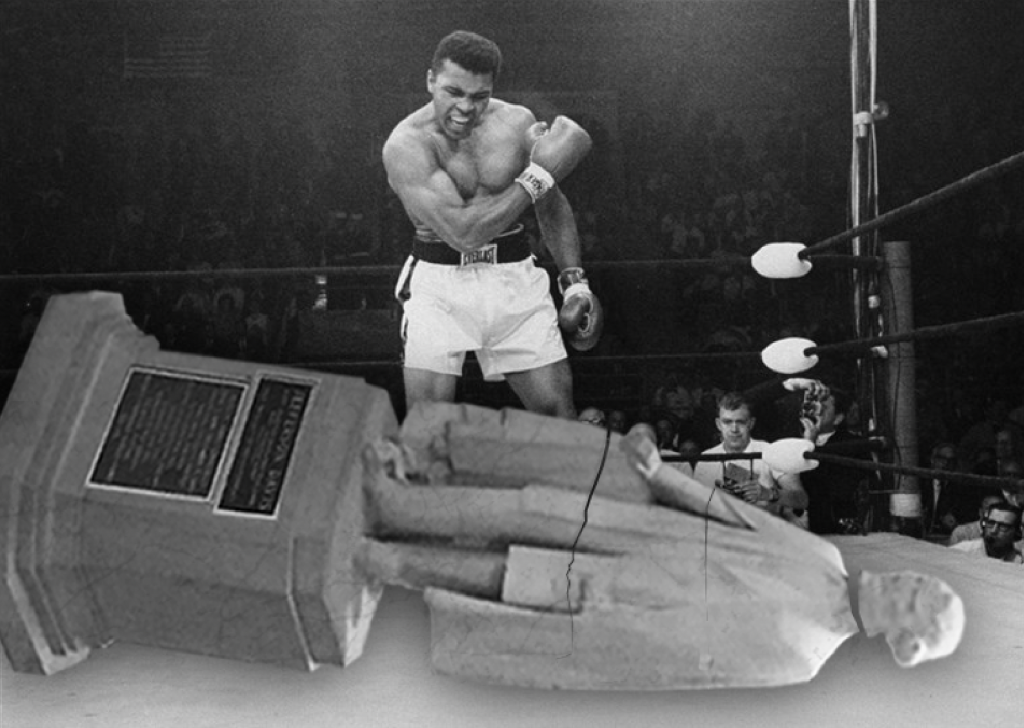
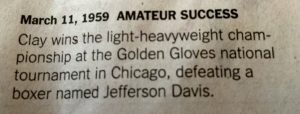
Please sign the petition below to remove the statue of Jefferson Davis currently in Kentucky’s Capitol Rotunda, and replace it with a tribute to Muhammad Ali, “the Louisville Lip” and “the Greatest of All Time.”
I just heard from the Ali family: It is the Champ’s belief that Islam prohibits three-dimensional representations of living Muslims. Accordingly, I have adjusted the petition to call for a two-dimensional representation of Ali (a portrait, picture or mural) in lieu of a statue.
UPDATE (Tuesday, December 2, 2014)
In this interview with WHAS-TV’s Joe Arnold, Governor Steve Beshear endorses the idea of honoring Muhammad Ali in the State Capitol (although he disagrees with removing Davis). Arnold explores the idea further on his weekly show, “The Powers that Be.”
Click here to check out WDRB-TV’s Lawrence Smith’s coverage of the story.
And here’s my op-ed in Ali’s hometown paper, the Louisville Courier-Journal.
UPDATE (Saturday, June 4, 2016)
In the wake of the 2015 Charlestown tragedy, in which a Confederate flag-waving murderer united the nation against racism, all of the most powerful Kentucky policymakers — U.S. Senator Mitch McConnell, Governor Matt Bevin, Senate President Robert Stivers and House Speaker Greg Stumbo — called for the removal of the Davis statue from the Rotunda. Today, as we commemorate last night’s passing of Muhammad Ali, there is no better moment to replace the symbol of Kentucky’s worst era with a tribute to The Greatest of All Time.
UPDATE (Wednesday, June 8, 2016):
Great piece by Lawrence Smith of WDRB-TV in Louisville on the petition drive to replace Jefferson Davis’ statue in the Capitol Rotunda with a tribute to Muhammad Ali.
UPDATE (Thursday, June 9, 2016):
Excellent piece on the petition drive by Jack Brammer that was featured on the front page of the Lexington Herald-Leader.
Highlight of the article:
Miller said he has received a few “angry comments” on his call to honor Ali.
“One of them encouraged me to kill myself,” he said. “You can quote me that I have decided not to take their advice.”
UPDATE (Friday, June 10, 2016)
The petition drives continues to show the Big Mo(hammed): check out these stories from WKYU-FM public radio in Bowling Green and WKYT-TV, Channel 27 in Lexington:
UPDATE (Saturday, June 11, 2016):
Still not convinced? Check out this excerpt from today’s New York Times:
By Nick Paleologos, on Fri Nov 9, 2012 at 3:00 PM ET
In their quest for the presidency, Barack Obama and Mitt Romney each spent a billion dollars. They debated each other three times in front of an average audience of 60 million Americans. In the process, they aired sharp differences on several major issues facing the country.
The people listened carefully.
On Tuesday November 6, 2012, Americans delivered their verdict.
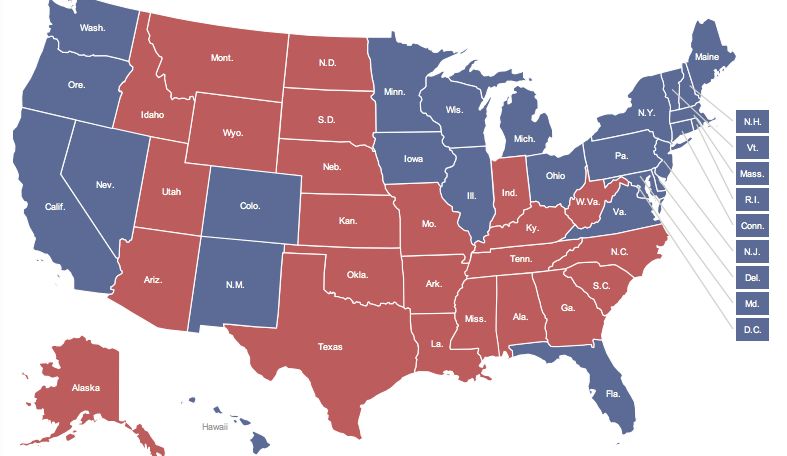
They gave President Obama three million more popular votes–and 126 more electoral votes–than Governor Romney. By their votes, the American people settled the following questions:
1) National health care? YES. (Obamacare is here to stay.) 2) Tax cuts for the rich? NO. (Ryan Budget rejected.) 3) Roe v. Wade? YES. (Rape is never “legitimate.”) 4) Citizens United? NO. (Most expensive election ever.) 5)Balanced approach to deficit reduction? YES. (Grover Norquist sent packing.) 6) Privatize social security & medicare? NO. (Fix, don’t nix.) 7) More women in US Senate? YES. (Number climbs to 20–the highest ever.) 8) More Republicans in congress? NO. (GOP loses 2 seats in Senate, 5 in House.) 9) Bi-partisanship? YES.(Voters applaud Obama-Christie cooperation.) 10) Deregulation? NO. (Voters to top 1%: Greed is NOT good.) 11) Equal pay for equal work? YES. (Voters punish GOP for “war on women.”) 12) Self-deportation? NO. (Voters support sensible immigration reform instead.) Significantly, the proportion of young people voting in 2012 was up from 2008—as was the proportion of African-Americans and Latinos.
President Barack Obama–by virtue of 2 consecutive majority victories in the popular vote–is now the most successful Democratic presidential candidate since Franklin Roosevelt.
For a rare look into the man’s soul, I offer you this:
When all was said and done, this election did turn out to be 2004 again. A polarizing president with tepid approval ratings fended off a Massachusetts based challenger who proved surprisingly resilient, but whose tactical errors and vulnerabilities put an unbreakable ceiling on his appeal. The victory itself was a weirdly shaped bubble made partly of scaring up a base vote with ad hominem attacks on the persona and character of the opponent, and partly of one time, single issue alliances that lifted the beleaguered incumbent without gaining much for his ballot mates in his own party: In George W. Bush’s case, a same sex marriage ban that doubled the normal black Republican vote in Ohio, in Barack Obama’s, an adept use of Mitt Romney’s opposition to the automobile industry bailout to bolster Democratic white working class support in Ohio.
But winning in uninspiring form counts just as much as the grand sweeps like 1980 and 2008. The Republican Party’s defeat unmasks deep liabilities beyond the expected demographic shortcomings with Latinos and voters under 29 (who against all expectations, maintained their slice of the electorate at 2008 levels in the midst of an appalling job market for new college graduates). The electorate rejected Romney even in the face of exit polls showing that voters trusted Romney to handle the economy better than Obama; that they overwhelmingly viewed the economy as poor or mediocre; that they favored repeal of Obama’s signature healthcare initiative; and that they rejected Obama’s strategy of deficit reduction through tax increases.
The conservative base is smaller than it has been in three decades, with its share falling to 35% while liberals edged up to 24%, a narrowing advantage further diminished by the fact that about a fifth of that conservative base consists of blacks and Latinos who still overwhelmingly voted for Obama. The Republican conservative base seems perilously close to shrinking to white southern evangelicals, senior white males, and upper income Protestants.
That Obama more or less maintained the 2008 foundation of his victory, with the exception of North Carolina and Indiana, is especially striking given the weak-kneed nature of the Obama recovery and the fact that close to half the country now views the president, a figure once ascribed near mythical powers, in an unfavorable vein. One unavoidable conclusion is that the country’s skepticism toward the last four years was outweighed by a marginally wider distrust of what Republican rule would look like. Another is that the electorate’s affinity for individual elements of the Republican agenda never coalesced into their approval of a broader GOP governing vision.
Hence the seemingly conflicted choice to pair Obama with a Republican House that surrendered few members of its majority beyond districts with a history of Democratic strength. Keeping the House red preserves the check on the unpopular aspects of Obama’s rule, while electing Romney would have meant sanctioning a policy course that remained nebulous or disconcerting to many swing voters and moderates.
To be sure, a better crafted campaign would have filled in Romney’s policy goals more convincingly than the ritualistic invocation of five point plans and generic references to cutting regulation and producing more domestic energy. But that failure is not just a marketing flaw on the part of Romney’s ad men: it is a symptom of a modern conservatism that seems spent and resistant to innovation on some days, purely oppositional and reactive on other days. And the weightiest part of the recent conservative agenda, Paul Ryan’s budget plan, was barely mentioned and its details only intermittently defended. (The details of Ryan’s budget had their share of political pitfalls, but the scant attention to it by the Romney campaign surely contributed to the impression that the Republican wish list was being kept deliberately shadowy.)
The other risk for Republicans, as Fox News’ Britt Hume noted last night, is that the axis of gravity is shifting leftward, and that a center right electorate is more predisposed than ever to a view that equates conventional conservatism with a middle aged backwardness. The hardening of the Democratic edge in affluent Northern Virginia, the white professional female gender gap, and the historically poor Republican showing with Hispanics can all be linked to a value judgment about the insularity of the Republican coalition. It is not hard to imagine that Democrats will exploit their growing cultural edge by pushing harder on issues that seemed marginal a cycle ago, like a fifty state right of same sex marriage, or more aggressive regulation of faith based institutions.
Read the rest of… Artur Davis: The Republican Dilemma
By John Y. Brown III, on Fri Nov 9, 2012 at 12:00 PM ET
Ultimate Friday questions …..of life, the universe and everything.
Most are never solved.
A few–from time to time–can be approximated. We get a handle on them. But no more. That’s about the best we can hope for.
As we get older and wisdom replaces impatience and impertinence, we can even celebrate those moments when we merely approximate the ultimate truth of some timeless conundrum.
Recently, I had a momentary insight, a breakthrough, if you will on one such timeless question that had forever remained and enigmatic and unsolvable riddle to me.
You’ll recognize it instantly. As well as be reminded of the mind-numbing circles the question has put your mind through over the years.
“How much wood does a woodchuck chuck, if a woodchuck could chuck wood?”
My answer?
First, in the short run, it no longer matters because with the internet flattening our global economy there are now wood chucks on the other side of the world—hungry, talented and tireless wood chucks—who will do three times the work at a fraction of the pay. Making the American woodchuck more of a drain on our economy who will have to develop more diverse, creative and less routinized talents–just to survive.
The real question is what “value adds” and “intangible values” the American woodchuck can bring to his work in the future to even remain relevant. And as much as I don’t like even going there, we have to face the fact that most wood based products will soon be replaced by superior digital substitutes.
But now I’m over-thinking it.
I’m not saying this is “the answer.” I’m only saying it’s a approximate of “an answer.” But it’s something and will free our mind up to ponder other–even deeper–questions
Bradford Cummings — a former chairman of Louisville’s Republican Party, a leader in the Kentucky equine industry, and (I understand) the owner of a quite beautiful singing voice — published a very brave and poignant op-ed in today’s Louisville Courier-Journal that endorses marriage equality, as well as a general return to a more compassionate Grand Old Party. With his permission, we cross-post it here in whole:
It was about seven years ago that I witnessed an expression of love and devotion that has forever moved me. A dear friend had experienced complete kidney failure and needed an immediate organ donor. Without hesitation, his partner risked his own life to donate one of his two working kidneys. While I don’t see them much anymore, I know both have been given a clean bill of health. I still get choked up thinking about this story.
And yet, despite unequivocally expressing their love, these two cannot be celebrated equally with the many married couples in our society simply because they are of the same sex. The GOP must understand how important that inequality is to so many in our electorate.
Before this most recent Election Day, I believed that while gay marriage is an important issue, most people vote with their pocketbooks first. Logically, the Romney/Ryan ticket would have broad appeal, especially in this time of economic malaise. Mitt Romney, the turnaround artist, was a man uniquely created and placed here for this time in history.
And the exit polls show that most people agreed. Romney won on economic issues across the board and the American desire for smaller government was clearly communicated. But despite these advantages, the Republican nominee lost. Our country is shifting center/left on social issues. I miscalculated, and so did many others, by believing that when the ship is sinking social issues become less important.
But after some reflection, I see the error in that thinking. If the Southern Democrats of the 1860s or 1950s and 1960s, who were supportive of racist stances from segregation to slavery, were also the party of smaller government, I too would have had to vote against my economic ideals. Americans prefer limited government but not at the expense of limited social freedoms.
I also wonder exactly what we are fighting so hard to preserve. I’ve been pro-gay marriage for years but also respect that the original basis for marriage came from religious orthodoxy. Every day, I feel blessed to be married to my wife and our marriage grows stronger each year. But exactly how would that change if two men or two women held the same societal status?
The legalization of gay marriage wouldn’t force churches that disagree with homosexuality to perform marriage ceremonies or infringe on the rights of heterosexual couples. Marriage in our society has become a social contract first and should not be legally restrained through religious eyes. As a wise man once said to his followers, “Render unto Caesar what is Caesar’s.” I’m a follower of that man, but with the tax advantages and other benefits given to married couples in the United States, not allowing gay couples to participate immediately makes them a second-class citizenry.
But it’s not just the anti-gay marriage stance likely hurting Republicans in the future. While most people say they are pro-life personally, it is a simple reality the majority of Americans also want the option preserved and women especially find this to be a top priority. Personally, I find abortion as a form of birth control to be a sad and immoral act, while supporting the common exceptions of rape, incest and life of the mother. I tried to embrace a pro-choice stance in my youth, but could never get around the idea it’s ending a life. Despite this, sometimes you have to realize you are in the minority and work from within the existing realities.
Is my time better spent fighting a losing battle trying to end abortion in the United States and therefore risk losing every foreseeable national election? Or would I be better served to encourage other choices for unwanted pregnancies and not let this single issue derail the rest of my political ideology? It’s a tough one to swallow, but Republicans need to begin to ask themselves these difficult questions.
Read the rest of… Bradford Cummings: A GOP Leader Endorses Marriage Equality
The Jewish vote for Romney was 32% – up 10% from 2008..but clearly the Obama coalition doesn’t depend on it like the Democrat Party of old. It’s the new youth-single women-black-latino votes that lost this thing. I think I was somewhat prophetic in what I said to you in my email before the election.
What this means is we need to clean house and start to put other faces in charge; the future coalition of the GOP will be a synergy between social Libertarians, Jack Kemp (supply side) Republicans, and something I call Republican NeoRealists (“Neo Realism”).
This will include people like Condoleeza Rice, Allen West, Ted Cruz, Marco Rubio, Alberto Gonzalez, and Log Cabin (gay) Republicans.
NeoRealists will work for, push, support, and make law state-based solutions for replacing the social compact of the New Deal and War on Poverty, while being inclusive of the reality of our population – it is openly accepting of gay issues, and I think the Republican Party should just accept it, support it, and make it known that we’re not going to fight that issue since gays, too, are concerned about economic freedom and prosperity. I think we should just say we support gay marriage as a general rule as a state-by-state decision, and that any marriage recognized in one state will be automatically recognized in another.
To bring forward the understand of the grievances of the black population, we can there tap into the connection of the religious aspect – as churches are a core element in many around the country.
I think we’re hanging onto some ideals that are a little rediculous and there is nothing wrong with waking up to this fact.
The focus of the moral majority of the 1980s is over and we need to accept it and make appropriate changes. The Reagan coalition came together because one person had the vision to realize what unites people.
The youth today are clearly – clearly – unimpressed with the GOP. The only way to capture them is to tap into their desires. They just don’t care about anything, frankly. Look at all the smut on the internet. We can support their smut and just tax it – tax it overwhelmingly.
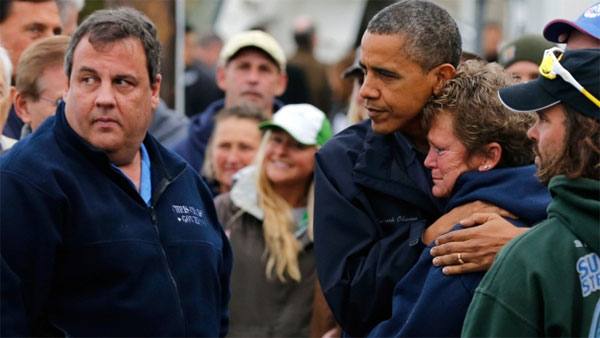
Whew! After all that worrying, there were no fights over vote counts, no major machine meltdowns, no hanging chads, and nothing to do for the legions of lawyers on deck for both parties. It’s a little like the aftermath of Y2K, when the world didn’t end and nothing bad happened other than a few hangovers. Of course there were plenty of positive newsworthy stories, from the increase in women in the senate, to patient voters who cheerfully waited out long lines, to the bipartisan bromance of Governor Christie and President Obama. But perhaps the biggest winner of all was Nate Silver, the NY Times “538” blogger, sabermetrician (look it up, I had to) and expert on psephology (ditto) whose mathematical polling analysis proved 100% accurate, making all his critics look foolish and illogical. Plus his calm analysis throughout the campaign made him a refreshing Dr. Spock in a sea of emotional hotheads.
I referred to him as the heretofore unsung star, because after this video he’ll no longer be unsung. This may be the first fan song he’s received, but I doubt it will be the last.
By John Y. Brown III, on Thu Nov 8, 2012 at 12:00 PM ET
Politics and summer camp.
I guess my father was right. Funny, it took 36 years for me to understand clearly the point he was making.
When I was 13 years old I went to summer camp in North Carolina for seven weeks. I didn’t want to go but once I got there loved it. I had the time of my life, made new friends, and didn’t want to leave when it was time to come home.
The night before camp ended there was an awards ceremony. Sort of like senior superlatives in high school. I’m sure most every camper got an award but I was covetous toward the award I was expecting. I had overheard the counselors say I wasn’t going to get “Best basketball player” (which is what I wanted). But I would get “Best all-round athlete.” At first, it sounded like a made-up consolation prize. But the more I thought about it, the more I liked the way it sounded. And maybe I did deserve it. I thought of my highlights that summer in kick-ball, softball, soccer, hide-and-seek with a flashlight, treading water for 30 minutes, Zip line, and dodge ball and decided it was an even better award than what I had originally hoped for—and now I wanted it even more than the initial award I desired. And couldn’t wait to hang it in my bedroom back home for all my friends to see.
And now the moment had arrived. I could tell the master of ceremonies was talking about me. I was so excited when he called my name I didn’t even listen for the title of the award. I just went up front, took the hand-carved and hand-painted award (about the size of a miniature license plate, and sat down jubilant.
Until I looked down and read what what I had won. “Best Sportsmanship Award” was written in what looked like green and yellow nail polish. What?!!? What happened? How did I go from potential “best basketball player” to “best all-round athlete” to this? Who wants to be a good sport? I mean, that’s just saying I am a pleasant loser, right? And seems to imply I am bad at every sport since I have to be so nice about losing all the time—and I must lose a lot to stand out enough for an award for how well I do it!
I felt about the same way I did as when I was at Bruce Zimlich’s second grade birthday party at Lyndon Lanes bowling alley and his mother gave my a prize even though I had the lowest bowling score of any of the kids at the party.
She explained, “I had won!”
“But how?” I asked, remembering my abysmal score and frequent gutter balls.
“Well, John, it’s called a ‘Booby Prize.’ It’s the prize for finishing in last place” she said smiling, trying to put a happy face on my “award.”
“How awesome,” I probably thought to myself sarcastically. And looking at my sportsmanship award that night, I was having similar thoughts.
But when my father saw the award tossed to the corner of my bedroom desk, he picked it up and praised me for it. He effused about how important it was in life to always be a good sport, to be “man enough” (person enough) to shake hands and congratulate the winner and never to sulk or whine or start making excuses for when you lost. Or gloat when you won. And recited from memory a poem he and my grandfather liked –one of those inspirational sports poems that drove the point home.
I believed some of it, I guess. But not all. Until tonight.
I was reflecting on the 2000 and the 2012 presidential elections. Hard fought battles with so much seemingly on the line for the two major political parties and their supporters.
I was a good sport in 2000 when the candidate I voted for lost in a heartbreakingly tight election. And I didn’t gloat when the candidate I supported won in a similarly close election last Tuesday. And it made me think about my “Best Sportsmanship” award at summer camp in 1976. Finally, all these years later, I realized it was a good award to receive and something to be proud of. And that being a good sport in life really is important. Just like my dad said. No matter how old you are.


 Blog this!