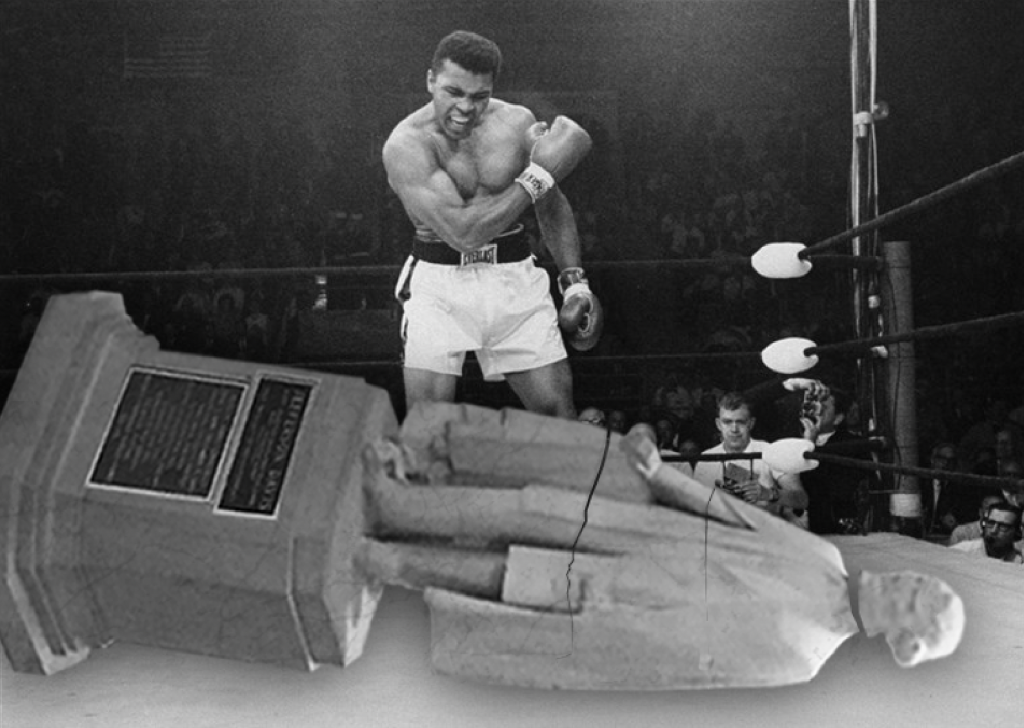
Please sign the petition below to remove the statue of Jefferson Davis currently in Kentucky’s Capitol Rotunda, and replace it with a tribute to Muhammad Ali, “the Louisville Lip” and “the Greatest of All Time.”
I just heard from the Ali family: It is the Champ’s belief that Islam prohibits three-dimensional representations of living Muslims. Accordingly, I have adjusted the petition to call for a two-dimensional representation of Ali (a portrait, picture or mural) in lieu of a statue.
UPDATE (Tuesday, December 2, 2014)
In this interview with WHAS-TV’s Joe Arnold, Governor Steve Beshear endorses the idea of honoring Muhammad Ali in the State Capitol (although he disagrees with removing Davis). Arnold explores the idea further on his weekly show, “The Powers that Be.”
Click here to check out WDRB-TV’s Lawrence Smith’s coverage of the story.
And here’s my op-ed in Ali’s hometown paper, the Louisville Courier-Journal.
UPDATE (Saturday, June 4, 2016)
In the wake of the 2015 Charlestown tragedy, in which a Confederate flag-waving murderer united the nation against racism, all of the most powerful Kentucky policymakers — U.S. Senator Mitch McConnell, Governor Matt Bevin, Senate President Robert Stivers and House Speaker Greg Stumbo — called for the removal of the Davis statue from the Rotunda. Today, as we commemorate last night’s passing of Muhammad Ali, there is no better moment to replace the symbol of Kentucky’s worst era with a tribute to The Greatest of All Time.
UPDATE (Wednesday, June 8, 2016):
Great piece by Lawrence Smith of WDRB-TV in Louisville on the petition drive to replace Jefferson Davis’ statue in the Capitol Rotunda with a tribute to Muhammad Ali.
UPDATE (Thursday, June 9, 2016):
Excellent piece on the petition drive by Jack Brammer that was featured on the front page of the Lexington Herald-Leader.
Highlight of the article:
Miller said he has received a few “angry comments” on his call to honor Ali.
“One of them encouraged me to kill myself,” he said. “You can quote me that I have decided not to take their advice.”
UPDATE (Friday, June 10, 2016)
The petition drives continues to show the Big Mo(hammed): check out these stories from WKYU-FM public radio in Bowling Green and WKYT-TV, Channel 27 in Lexington:
UPDATE (Saturday, June 11, 2016):
Still not convinced? Check out this excerpt from today’s New York Times:
By John Y. Brown III, on Tue Nov 27, 2012 at 12:00 PM ET
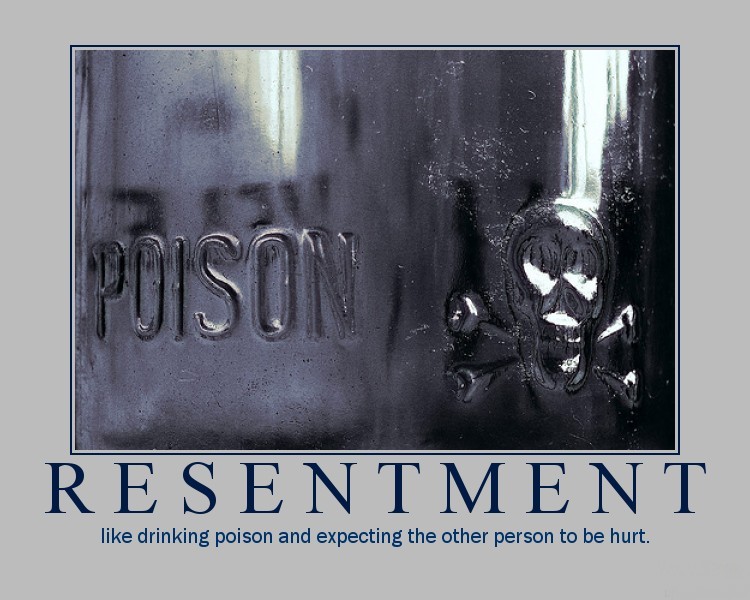
This absurdity of holding on to petty resentments.
True story.
Last night–and I don’t remember the details—but I had a dream in which a tall gentlemen I seemed to respect but didn’t know well and who was wearing a yellow-ish jacket passed me by on the street and intentionally brushed up against me in that way that seemed to say he was upset with me or sending me a message of disrespect.
That’s all I remember from the dream. The rest of whatever happened has been forgotten–which I think was mostly pleasant.
But twice today I’ve thought about the brush off passerby.
And I’ve decided the next time I have this dream and he shows up–assuming I can remember to do it—I am going to go out of my way to walk past him and brush up lightly against him (not in an offensive way that is trying to start a fight but rather just to let him know that what happened last night in my dream gets acknowledged, was not OK with me, and send the message that I hope it doesn’t happen again.)
On the other hand, I could just forgive him or assume it was an accident. In my dream. And let it go.
I want to let it go but this slight seems different and worth holding on to a little longer. Because, you know, it’s the principle of the thing. Right?
By Zack Adams, RP Staff, on Tue Nov 27, 2012 at 10:00 AM ET
Parity has been the name of the game in the 2012 Recovering Politician Bowl. Bandits are making their long-awaited push towards relevancy with 3 wins in a row. On the other hand former league powers Quaker Country and your hero, The Fighting Mongooses, are reeling from 3 losses in a row.
With one game left in the fantasy season and with the top 6 teams at the end of the regular season entering the winner’s playoff bracket it is anyone’s game. Remember that the bottom 6 teams will compete in a loser’s bracket so there will still be a consolation prize to win.
Last night, The RP took on his semi-regular gig as a national political commentator on Wall Street Journal Radio’s The Daily Wrap with Michael Castner.
The RP and Castner celebrated all of the “No Labels” talk this week: Republicans breaking the Grover Norquist “no tax” pledge, both sides talking compromise on the fiscal cliff, references to the Reagan/O’Neill iconic partnership. And they discussed how all Americans should sign on to No Labels’ efforts to continue pressure on Washington policymakers to continue the problem-solving momentum.
By Nancy Slotnick, on Tue Nov 27, 2012 at 8:30 AM ET
“You never don’t know” is what my mother-in-law says when she means “You never know.” It must be said in a Polish accent with the conviction that only a Holocaust survivor could pull off while using a double negative. So by the theory of transitivity, “You never don’t know” equals “You always know.” I’m going with that theory. You always know.
If you can tap into your instincts, and distinguish them from anxiety, you always know. “Is he the One?” You know. “Should I have that opening line?” You know. “Should I write that email to reach out?” You know, but you don’t always listen to your gut. You talk yourself out of it.
Do you expect greatness to come your way or mediocrity? Or disaster? Murphy’s Law is more about Murphy than about a law of nature. I think Murphy attracted bad luck because he’s always expecting bad luck and it feeds on itself. Of course if you want to attract good luck you have to do the work. There’s plenty of good luck out there and it will come your way sooner or later. You just have to be prepared to seize your luck.
Here’s how: Let’s say you’re on a train traveling for the holidays, like I am right now. Let’s say you’re single and you secretly wish that the man of your dreams would sit next to you. You do hold out the hope for good luck. But you also dread the fat lady who talks your ear off or the crying baby that blocks the audio of Gossip Girl Season 2. Even though you’ve already seen it. You are tempted to just put your backpack up on the seat next to you, put on your headphones and go into “Do Not Disturb” mode. If you’re lucky, then the train is not sold out and you will get two seats to yourself. But is that what you really want?
Read the rest of… Nancy Slotnick: You Never Don’t Know
By Zack Adams, RP Staff, on Mon Nov 26, 2012 at 3:00 PM ET
The Politics of Pigskin
The Pittsburgh Steelers are really struggling without Ben Roethlisberger at the helm. [ESPN]
The Kansas City Chiefs are the first team to be mathematically eliminated from the playoffs. [NFL.com]
49er DE Aldon Smith is the fastest player in NFL history to reach 30 sacks. He did so in 27 games beating Reggie White’s previous record of 28 games. [Twitter]
Peyton Manning is playing like he didn’t miss a single game instead of sitting out a whole season due to multiple neck surgeries. [LA Times]
Watch out! The Snake might be on his way back. Jake Plummer reportedly wants to get back into the NFL. [NY Times]
Martellus Bennett is a pretty funny guy (on catching a kid falling from the stands): “I’m usually a ninja, but my Spidey-senses told me he was going to take a fall, so I saved his life.” [USA Today]
The Arizona Cardinals are the first team in NFL history to lose 7 games in a row after starting 4-0. [NFL.com]
Newt says that he is not ruling out another presidential run.
Smart move. By dangling the prospect of a 2016 candidacy, Newt can charge higher fees as an…historian. [Naples News] (This link is not an Onion article.)
By John Y. Brown III, on Mon Nov 26, 2012 at 12:00 PM ET
“You can’t manage whay you can’t measure.”
Wrapping up our 6th annual father – daughter weekend with my 14 year old daughter, Maggie.
All 6 have been excellent but some feel a little better than the others —but we have never had a concrete, objective way to measure the success of our annual weekends.
Until now.
Late this afternoon I got a call from my credit card company for an “Alert for potential fraudulent activity with my credit card.”
They needed me to confirm three unusual purchases this weekend that deviated from my usual habits—-all involving female clothing purchases.
I finally explained “I am with my 14 year old daughter this weekend.”
Even that gentleman on the other end of the phone from what seemed like a call center in India understood. “Thank you, Mr Brown” he laughed. “I understand now!”
By Artur Davis, on Mon Nov 26, 2012 at 10:00 AM ET
I read Karen Cox’s provocative essay about what it takes to revive southern Democrats, (“A New Southern Strategy”), with a view that was doubtful from the start. There was the skepticism from having heard the logic before: it is a perennial preoccupation of southern progressives to envision an latent regional majority based on suburbanized whites, minorities, and educated professionals, although to date, Virginia and North Carolina are the sole places where the coalition seems to materialize and even then, only intermittently. Cox also does not acknowledge, much less grapple with, the fact that the South’s most rapid economic modernization has happened at the same pace and time as its decisive tilt toward Republicans, in direct contradiction of the progressive expectation.
Then are the persistent factual blunders, from her conclusion that the Republican edge in the South is driven by outsized rural populations, when it is in actuality the suburbs outside the metropolitan cities that account for the consistent GOP advantage, to her glossing over the fact that southern big cities have tilted Democratic not so much out of their cosmopolitanism, or their burgeoning market in downtown lofts, but because their minority populations have steadily expanded (a misinterpretation Alec MacGillis takes her to task for in The New Republic).
More problematic than Cox’s treatment of data, though, is her threshold assumption that a more liberal South is an automatically enlightened place and that a more conservative South is a primitive dead zone that disdains modernity and ratifies the Old Confederacy’s historic pathologies. It’s the left’s stereotypical dichotomy of political polarization—but it is also a worldview that papers over the peculiar and more ideologically ambiguous disputes that dominate southern state capitals.
To be sure, there are conventional partisan battles in the South that mimic fights in Washington: whether to accept federal dollars to expand Medicaid, whether to set up the state exchanges created in the new healthcare law, and the aggressiveness of local immigration laws. But there is a much larger raft of region-specific policy dilemmas that thankfully don’t have a strong national analogue: they range from pervasive public corruption, to the explosion of a low wage casino culture in minority counties, to notoriously underfunded state universities, to tax structures that reverse federal policy by soaking low wage workers and families.
The fact is that those perennial challenges have been managed less by conservative Republicans, and more by Southern Democrats, who until the last few election cycles, still dominated state legislatures and held their share of governorships—trends with which many national observers are unfamiliar, as they erroneously assume that the deep red presidential voting patterns in the South have been as strong at the state level. Cox, a University of North Carolina historian, obviously knows better and must be aware of (1) the inconvenient truth that Democrats have had considerable governing responsibility during the South’s recent history and (2) the decidedly un-progressive ways Southern Democrats have used their powers.
At least one assumes she is. Does Cox actually understand that in Alabama, Democrats have only sporadically embraced reforming a state constitution that perpetuates one of the most sharply regressive tax structures in the nation, or that the state’s Democratic Party is funded primarily by a gambling lobby that enriches itself on the backs of the low wage poor? Would it be bothersome to Cox that the same gambling interests lavished huge campaign sums on an initiative to monopolize the state’s casinos in the hands of a couple of magnates, inside a few counties that are almost entirely black and impoverished? What about the effort the state Democratic Party spent trying to block an ethics package aimed at reducing lobbyist influence in state politics, the kind of good government crusade progressives salivate about at the national level?
To a depressing degree, the same elements that have warped Alabama’s Democratic Party into a weirdly retrograde force, at least on local issues, are equally present with their regional co-partisans—they include a faux populist aversion to elite supported reforms, an obsession with racial patronage politics, and a persistent trouble with raising money that leads to a few convenient if corrupting alliances.
Read the rest of… Artur Davis: Toward a More Liberal South?
The nuclear industry measures how long a radioactive material will retain its potency by its half-life — the time it takes for the material to lose half of its radioactivity. The half-life of Uranium-235 is 700 million years, for example. During the industrial era the half-life of a business model was typically measured in generations. Once the basic rules for how a company creates, delivers, and captures value were established, they became etched in stone, fortified by functional silos and sustained by reinforcing company cultures.Those days are over. The industrial era is not coming back. The half-life of a business model is declining. Today’s leaders are either going to learn how to change their business models while pedaling the bicycle of the current one or they are going to be “netflixed.”
If netflix isn’t a verb it should be.
net-flix
1. to cause disruption or turmoil to an existing business model
2. to destroy a previously successful business model
3. to displace the way value is currently created, delivered, and captured
Blockbuster started out with a compelling business model. Its value proposition was clear, enabling consumers to watch hit movies in the comfort of their homes. Blockbuster established an extensive value delivery network with stores conveniently located on every corner. Its first store opened in 1985 and it quickly grew to have over 5,000 retail outlets and 60,000 employees. It also had a smart financing model to capture value. It rented hit movies at a price consumers found attractive relative to the price of going out to the movies. Instead of paying a large upfront fee to buy videos from the studio (up to $65 per video) Blockbusters entered into a revenue sharing model with the movie studios including little to no upfront costs per video which gave them a huge advantage fueling explosive growth. Blockbuster started out on a roll. At its peak in 2002 Blockbuster’s market cap rose to $5 billion. In 2010 in filed for bankruptcy. So what happened? Blockbuster was netflixed.
Read the rest of… Saul Kaplan: How Not To Get “Netflixed”


 Blog this!