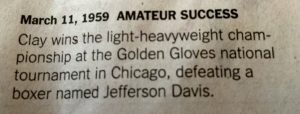
Please sign the petition below to remove the statue of Jefferson Davis currently in Kentucky’s Capitol Rotunda, and replace it with a tribute to Muhammad Ali, “the Louisville Lip” and “the Greatest of All Time.”
I just heard from the Ali family: It is the Champ’s belief that Islam prohibits three-dimensional representations of living Muslims. Accordingly, I have adjusted the petition to call for a two-dimensional representation of Ali (a portrait, picture or mural) in lieu of a statue.
UPDATE (Tuesday, December 2, 2014)
In this interview with WHAS-TV’s Joe Arnold, Governor Steve Beshear endorses the idea of honoring Muhammad Ali in the State Capitol (although he disagrees with removing Davis). Arnold explores the idea further on his weekly show, “The Powers that Be.”
Click here to check out WDRB-TV’s Lawrence Smith’s coverage of the story.
And here’s my op-ed in Ali’s hometown paper, the Louisville Courier-Journal.
UPDATE (Saturday, June 4, 2016)
In the wake of the 2015 Charlestown tragedy, in which a Confederate flag-waving murderer united the nation against racism, all of the most powerful Kentucky policymakers — U.S. Senator Mitch McConnell, Governor Matt Bevin, Senate President Robert Stivers and House Speaker Greg Stumbo — called for the removal of the Davis statue from the Rotunda. Today, as we commemorate last night’s passing of Muhammad Ali, there is no better moment to replace the symbol of Kentucky’s worst era with a tribute to The Greatest of All Time.
UPDATE (Wednesday, June 8, 2016):
Great piece by Lawrence Smith of WDRB-TV in Louisville on the petition drive to replace Jefferson Davis’ statue in the Capitol Rotunda with a tribute to Muhammad Ali.
UPDATE (Thursday, June 9, 2016):
Excellent piece on the petition drive by Jack Brammer that was featured on the front page of the Lexington Herald-Leader.
Highlight of the article:
Miller said he has received a few “angry comments” on his call to honor Ali.
“One of them encouraged me to kill myself,” he said. “You can quote me that I have decided not to take their advice.”
UPDATE (Friday, June 10, 2016)
The petition drives continues to show the Big Mo(hammed): check out these stories from WKYU-FM public radio in Bowling Green and WKYT-TV, Channel 27 in Lexington:
UPDATE (Saturday, June 11, 2016):
Still not convinced? Check out this excerpt from today’s New York Times:
By Zack Adams, RP Staff, on Mon Dec 3, 2012 at 3:03 PM ET
The Politics of Pigskin
On Saturday there was a tragedy in the NFL family when Kansas City LB Jovan Belcher shot and killed his girlfriend with whom he had a 3-month-old child before committing suicide by way of self-inflicted gunshot. It is reported that he spoke shortly with KC head coach Romeo Crennel and GM Scott Pioli in the the Chiefs parking lot before taking his life. [Kansas City Star]
Somberly moving on to game action from Sunday – 37-year-old Charlie Batch picked up a win over the rival Baltimore Ravens in what will probably be his last start as an NFL quarterback. [Pittsburgh Post-Gazette]
You may not have noticed, but Adrian Peterson, who is coming off knee surgery, is dominating the competition. [screenshot]
On Sunday Tom Brady helped the Patriots lock up their 10th division title while he has been the starting QB. He has now passed Joe Montana for more division titles as a starting QB all time. [Boston Globe]
Russell Wilson and Andrew Luck continued this amazing year for rookie QBs as they both led their teams on game-winning drives in their respective 4th quarters. [NFL.com][NFL.com]
Things finally came to a head in New York and Mark Sanchez was benched. However, his replacement was not named Tebow. In fact, it was Greg McElroy. [ESPN]
By John Y. Brown III, on Mon Dec 3, 2012 at 12:00 PM ET
Idiot proofing and the decline of Microsoft?
In my old job when we were about to introduce a new online service to the public, it had to pass one final test (after all the technical specifications were met). It had to be what I called, “Idiot Proof.”
And we had one simple test for whether or not something passed the critical “Idiot Proof” test.
I had to be able to figure it out how to use it quickly and easily (intuitively) without reading the directions.
My rationale was that I’m a pretty ordinary consumer and, like many (maybe most) consumers, I have a short attention span and short frustration-tolerance level (before giving up and moving to the next product). And– this is key–I don’t ever read directions first.
So….if I could figure out quickly how to use a new service successfully —it was ready to “Go live.” (And I remember literally sitting with my tech team trying out something new. For them it was probably like watching a child tinker with a new toy. But it was a good threshold test then…and I still think it still is today.)
Which brings me to Microsoft Windows 8. I am now into week 4 (or maybe its week 7 or 8), and I still don’t know what it is that has improved from the previous Windows version. It is not “Idiot Proof” It is not —to me anyway–intuitive. It is confusing and cute and clever and hip-looking but for all the wrong reasons. Namely, because Microsoft wanted it to look cute and clever and hip-looking to cover up any real substantive improvements. And that is —after 4 weeks (or maybe 7 or 8 weeks) confusing. Not to mention disappointing and frustrating.
At least that’s one Idiot’s opinion. But an Idiot who has been a loyal Microsoft user for many years.
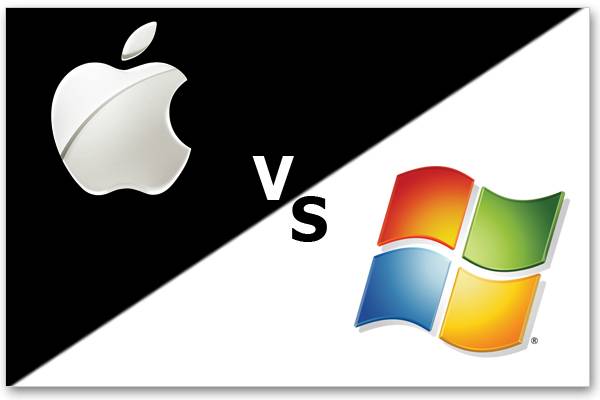
Maybe Microsoft is trying too hard to be like Apple (but without seeming like it’s trying to be like Apple). And that doesn’t work. Remember when Al Gore kept trying to reinvent himself in the 2000 presidential campaign? He wasn’t an Apple. He was a PC. Bill Clinton was an Apple using open source code on a wireless and virtual mini tablet. Al would have been much better off just being good ole trusty un-cool and un-hip but smart and reliable dorky Al.
Al was a first rate Al Gore but a 3rd rate Bill Clinton wanna-be.
Some people just can’t dress up in the latest cool fashions and pull it off.
Some companies can’t ever be dressed up like the cool kid either.
But remember, for the cool kid to be the cool kid, there has to be a lot of ordinary (PC students) who begrudgingly admire and aspire to be him/her. The PC kids, so to speak.
But from a market share standpoint, cool kids only make up about 3-5% of the market share. Which means the PC kids make up 95% of the student market. And that’s a much bigger (albeit different) market to sell to. Unless you forget who you are —and who they are (your customer base).
What point am I trying to make with all the gobbledygook rigamarole? I think it is this.
Microsoft can either be a first rate Microsoft or it can keep trying to be a third rate Apple poser.
Microsoft needs to embrace its ordinariness. The world actually needs more ordinariness to function successfully that it does coolness. A lot more. And embrace it before they embarrass themselves. Windows 8 reminds me of the prolonged kiss with Tipper Gore at the convention to demonstrate Al was a passionate, hip and cool guy. (Note: Al and Tipper are split today).
If Microsoft doesn’t learn that lesson soon the entire company may start looking like the Zune. On eBay. Because who wants the Zune when you can have an iPod.
And what the heck is Microsoft doing pretending to be like Apple anyway? They are Microsoft for goodness sakes!
That was a good question a few years ago during the Zune debacle. And it’s an even more pertinent question today.
And it doesn’t take an idiot to see the source code writing on the wall, so to speak.
But I thought I’d offer one idiot’s opinion anyway.
By Jonathan Miller, on Mon Dec 3, 2012 at 10:00 AM ET
We’re proud to announce The RP’s latest gig — a semi-regular columnist for The Times of Israel. As the Jewish State finds itself in the headlines following the Gaza conflict and Palestinian maneuvers before the United Nations, The RP dispels the myth of Israel’s illegitimacy being pounded by the mostly-liberal Blame Israel First crowd.
Here’s an excerpt:
My column last week in The Huffington Post, “Why My Fellow Liberals Should Support Israel in Her Conflict with Hamas,” provoked the predictable hackles from the Blame Israel First crowd.
Within their excuses and rationalizations for the Hamas regime’s abhorrent actions — such as the targeting of Israeli civilians and the employment of Palestinian human shields — ran a familiar argument: That all means are justified, since the Jewish State is legally and morally illegitimate.
You may have heard their historical narrative: The Great Western powers, triumphantly basking in the aftermath of World War II, were paralyzed with guilt for their failure to prevent history’s most horrifying genocide. The Allies decided to resolve the “Jewish problem” by carving up the Arab-dominated Palestine to create a Jewish State because of the Chosen People’s mythical, Biblical ties to the land. Just as with the imperialist colonization of Africa and Asia; here, white-skinned, European, self-important and self-righteous conquerors patronizingly tried to “civilize” — and, if that failed, they’d violently displace — dark-skinned, indigenous peoples… all along ironically justifying their actions as a pursuit of justice and freedom and democracy.
It’s a powerful story that tugs at the heartstrings and plays to the deepest biases of many American liberals. For most progressives, our foreign policy worldview was defined by Vietnam, during which the old liberal guard launched a misguided quest to further the cause of global freedom, resulting instead in the inexcusable loss of hundreds of thousands of lives — mostly innocent, native Southeast Asians. The mindset was reinforced more recently in Iraq, where a neo-con Bush/Cheney Administration played upon popular insecurities to wage an unnecessary and brutal war under the false pretenses of promoting democracy.
And hey, what liberal doesn’t love a good underdog story; whether it’s a minority group championing civil rights, or a tiny nation battling an imperial power?
It’s no wonder that this Bizarro-Bible myth of Israel as Goliath and Palestine as David plays smack dab into the liberal wheelhouse. And it confirms to some progressives that it’s the Israeli imperialists — greedily grasping onto their colonial territories — who are the key obstacle to peace in the Middle East.
The trouble with this narrative is that it’s entirely untrue.
Whether or not you believe that the Hebrew Bible (Old Testament) and/or the Christian Scriptures (New Testament) should be accepted as literally true — I don’t — it’s important to understand that for millennia, Jews and Christians have proclaimed Israel as their ancestral homeland. The city of Jerusalem and the land of Zion are mentioned more than 800 times in the Hebrew Bible, and in over 100 instances in the Christian Scriptures. Contrast that with the Koran; even though Jerusalem is spiritually significant for Muslims, the city is never mentioned in Islam’s holiest text.
But even those who reject any discussion of the holy books in this context must concede that the objective, independent historical and archaeological evidence is overwhelming: There has been a sustained and vibrant Jewish presence in the land of Israel for thousands of years.
Over the past few centuries, archaeologists have made a series of extraordinary discoveries that establish that a distinctive Jewish religion and culture was developed around 4,000 years ago in Israel, and that Biblical figures such as David, Solomon and Jesus were the focus of considerable attention by the Jews of antiquity within Jerusalem and throughout the holy land. Further, Martin Gilbert, a widely-respected historian, has demonstrated, through a dispassionate examination of the historical record, that for more than 1600 years, Jews formed the “main settled population” of what now is considered the modern state of Israel.
I am proud of my bona fides on supporting the advancement of women. It angers me to think how slow executive suites and boardrooms are to welcome more qualified females. Stubborn gender wage gaps for comparable work are unacceptable and must be closed.
However, with all of the attention and focus on supporting equal opportunities for women, we have taken our eyes off an alarming trend. Young men in the US are in trouble by any measure of educational attainment. It’s a big deal and, for reasons of political correctness, we aren’t talking enough about this growing national problem.
I refuse to believe the support of young American’s progress is a zero-sum game – that somehow if we call attention to the problem and take a different approach to improve the experience and outcomes of boys it would come at the expense of celebrating and enabling continued advancement of girls. We can and must recognize the unique challenges of young men and we had better start doing something about it now.
Read the rest of… Saul Kaplan: Plight of Young Males
By Krystal Ball, on Fri Nov 30, 2012 at 1:30 PM ET
Krystal Ball’s rant this week from MSNBC’s “The Cycle”:
Krystal’s daughter Ella
Just listen to that good old-fashioned common sense. You know, really breaks our government problems down for the common man in that classically patronizing yet wholly inaccurate way that politicians seem to excel at. There are a lot of lame talking points out there, but this one probably drives me the most nuts. And while I mostly hear it from Republicans, far too many of my own have fallen for its folksy kitchen table appeal. Here’s the problem.
First off, how much like the federal government is your household really? Granted, things may be a bit different in your home than mine but we haven’t had a whole lot a luck getting anyone to accept our family currency. And the international markets? They’ve turned their nose up at buying our bonds. When we have borrowed money, it sure wasn’t at 1.5% like US Treasuries. I will say, sometimes our neighbors do get a bit out of hand but I think a drone strike might be a bit over the top. In fairness, my daughter did attempt a Mitch McConnell style filibuster but it didn’t really work out for her.
And actually, even if you did pretend that your household worked exactly like the largest most complex government in the world, the analogy still doesn’t make any sense! You may not have noticed but our families buy things on credit all the time. Especially at this time of year. Plenty of families take on long term debt for things like, I don’t know, a house? Or an education? In other words, investments for the future. Hey! That does actually sound like something the federal government should do. Businesses borrow too! So don’t give me this nonsense about how for families and business owners the revenues and expenses have to add up every year. They don’t. My family and many others have yet to pass a balanced budget amendment.
Finally, come on y’all. Have a little bit of creativity!!! I know you’re trying to break things down in a way that regular folk can relate to, I get it. But every time I hear a politician or pundit use this tired hokey worn-out analogy it’s like they think they’re the one who birthed this brilliant thing. Certainly everyone will be won over by their winning wit and creativity. Guys. The gig’s up. We’ve heard this patronizing, illogical, trope about 1 million times. I’m begging you. Please stop. Time to come up with some new material. Or better yet, actually have enough respect and faith in the American people that we can wrap our little minds around the big problems facing the country. Trust me. If y’all can understand it, we can too.
By John Y. Brown III, on Fri Nov 30, 2012 at 12:00 PM ET
The truth about attorneys.
Lawyers aren’t always as smart as they want you to think they are.
(Email exchange today with my law firm doing a conflict check for a potential new client.)
Me: No conflict….
Partner: John, Why the ellipsis?
Me: Smart people use ellipses and I never knew why. I thought it would make me look smart if I used one during the conflict check after “No.” So, that’s why I used the ellipsis.
As the new Steven Spielberg movie has reignited our national passion for our 16th President, we continue our series of posts from one of the nation’s leading experts on the topic: Dr. Matthew Pinsker, a Lincoln scholar, Civil War historian and college professor based at Dickinson College in Carlisle, PA (and of course, longtime Friend of RP). For the last five years, Pinsker has personally trained more than 2,500 K-12 educators on Civil War and American history topics, and he has also been directing the House Divided Project, a digital effort designed to help classroom teachers use the latest technologies to promote deeper study of the American Civil War during its 150th anniversary.
Here is is second, cross-posted with Quora.com, with permission of the author:
Why do most people think of Lincoln as an anti-slavery President? Wasn’t he really more a pro-reunification president?
The best way to answer this question is to begin by defining terms. When Lincoln wrote on August 22, 1862 in his famous open letter to Horace Greeley, “My paramount object in this struggle is to save the union and is not either to save or to destroy slavery,” he was employing a word –“union”– that meant different things to different people (and still does, by the way). For Lincoln and the Republicans, the union was never merely a collection of states. Nor was it a centralized federal government or some abstract attachment to a paper Constitution.
This is the key point and what always leads to confusion. For Lincoln especially, the “union” was “the people” –as in “We the people” and what should properly be considered the fundamental and most revolutionary American doctrine of popular sovereignty.
Professor Matthew Pinsker
Look carefully at all of Lincoln’s wartime speeches and statements and you will see that behind the phrase “save the union,” Lincoln always meant to protect the results of the 1860 election which he believed had defined the popular will through a legitimate electoral process. That’s how he justified calling himself a unionist even though he led a sectional party. That’s why he refused practically all compromises during the secession crisis because he believed that they failed to acknowledge how much the election mattered. And that’s why he pursued increasingly “hard war” policies against the Confederacy, including emancipation, that ultimately turned the war into what he had once warned against, “a remorseless, revolutionary struggle.”
In other words, Lincoln was both anti-slavery and pro-union. In fact, he considered those positions one and the same, because he defined “union” as the popular will which by the 1860 election results had determined that the future of the country was to be free, or, as Lincoln put it at Gettysburg, to be “a nation conceived in liberty and dedicated to the proposition that all men are created equal.” He was always willing to reunify the country on those terms, and never willing to consider anything less. This is, by the way, exactly the question that Steven Spielberg’s new movie, “Lincoln,” intends to examine by focusing on the last few months of the war and what the movie-makers present as the fundamental choice that Lincoln navigated during that period between pushing for a Thirteenth Amendment to abolish slavery or pursuing potential peace talks with Confederates.
By Jonathan Miller, on Fri Nov 30, 2012 at 9:15 AM ET
The RP sent the following op-ed to hundreds of college newspapers on behalf of No Labels.
You may have more in common with your member of Congress than you think, especially around this time of year.
Students and lawmakers alike want to finish up the year and head home for the holidays.
But there’s a final exam standing between Congress and Christmas — and America’s citizens are ready to give the body an “F” if it doesn’t pass. That exam is coming in the form of the “fiscal cliff” — the combination of arbitrary, automatic, across-the-board spending cuts and tax increases coming at the end of the year that could cripple the economy.
It all started last year when Congress picked 12 of its members to try to find a deal to secure America’s long-term financial future. Consumer confidence had dropped dramatically and a credit ratings agency dropped our country’s rating. It seemed the only thing that could make members of both parties work across the aisle was an alternative so terrible that it would be untenable to both parties.
That alternative is coming closer and closer to reality — and unfortunately, it is your generation that will have to pay the highest price. The Congressional Budget Office has predicted that if we do not avoid the fiscal cliff, the $7 trillion combination of spending cuts and tax increases could send the economy hurtling back into recession for years to come. Unemployment, especially among young people, will rise even further. Education will suffer among the harshest spending cuts, losing about $4.8 billion in funding.
Our leaders have had more than three years to address these issues — imagine if you had that long to prepare for a test. Yet rather than hunkering down in the library, or in their case the Capitol Building, to solve this crisis, leaders of each side aren’t even meeting right now to talk about what’s going on. How is this going to solve anything? We need real solutions. These solutions begin with both parties understanding that they need to work together to stave off this crisis.
No Labels — a growing grassroots movement of more than 600,000 Republicans, Democrats and independents — is working to facilitate just this kind of cooperation. Since last year, we’ve been advocating for leaders in all negotiations to put everything on the table and ensure all interested parties are at the table. You can be a part of this movement and sign on at NoLabels.org These solutions can also help fix the underlying problem: the way Washington does business. We need to find real and permanent ways for our leaders to come together to govern for the future. Because our nation’s financial situation is not the only problem America faces. We need our leaders to come together and find solutions in immigration, energy and infrastructure policy.
As Washington’s current stalemate has shown, we can’t afford to wait for Congress to find bold, pragmatic across-the-aisle solutions. Changing Washington won’t happen quickly. But even you would have a hard time cramming three years worth of work into one night. What we can do now is commit ourselves, and hold our elected officials accountable, to the idea that progress is only made when our common national interest is the priority. And that is what No Labels is all about.
Socks, swords, and a sled built for speedfreaks… What more could you ask for this holiday season? Read on for 15 Rath-approved holiday gifts.
STOCKING
1) Make a quick getaway from your style rut with this wool suiting pocket square ($10). Wear it with a navy blazer or suit, a light pastel shirt and a dark wool tie.
2) For the drink that’s always with you, a stately flask with the Russian coat of arms ($25).
3) Socks are a holiday gift list mainstay, and these Etro Herringbone socks won’t disappoint ($39).
SNAG
4) This cozy wool hat ($88) comes in charcoal, navy and cream, so there’s something flattering for everyone.
5) I always like to look for belts that are a bit “different” to help my clients define their style, and this two-tone leather belt ($180) is an excellent find with its unexpected blue buckle.
6) Silk scarves are dressier in feel than their wool or cashmere cousins, but they do work casually. Try one like this Jack Spade dress scarf ($185) draped simply around your neck when a tie is too much and an open collar just isn’t cutting it.
7) The frequent traveler’s defense against wrinkly neckwear: a tie case ($185), this one from Pierrepont Hicks.
8) Nothing says holiday cheer like swordplay. Make like Napoleon, and open your next bottle of champagne with a Champagne Saber ($189). (Yes, you really can open a champagne bottle with a sword; click for a video play-by-play.)
9) Manly yet romantic, this Etro paisley scarf ($245) can take an outfit from zero to sixty with one swift loop around the neck.
11) Form and function come together elegantly with this collapsible beach table and chair set ($495) which folds down to the size of a tote bag.
12) Sophisticated and sumptuous, this Loro Piana suede belt ($500) works with everything from jeans to a suit. And you don’t need suede shoes to rock this — it works just fine with brown leather in a similar shade.
13) Nothing beats a smooth black briefcase for making a smart and stylish impression. This one from Thom Browne ($1850) is a handsome option.
14) For the watch connoisseur, this solid leather rotary watch case ($3720) from Smythson has two Swiss-made rotators to keep his timepieces in top-notch condition.
15) The Snolo High Performance Alpine Sled (price upon request) can hit speeds of over 40 mph on average gradient slopes, and, on top of that, it can be folded into a backpack by collapsing one locking nut. Perfect for the speed demon with space issues.
By Zack Adams, RP Staff, on Thu Nov 29, 2012 at 3:00 PM ET
The Politics of Tech
Rep. Darrell Issa (R-CA) has proposed a piece of legislation he calls the Internet American Moratorium Act of 2012. The aim would be to “create a two-year moratorium on any new laws, rules or regulations governing the Internet.” [CNN]
A BGR writer posts a plea to Google: to please bring Google Fiber to his city to save him from Comcast. [BGR]
We all know that no one person, organization, or country runs the Internet. However, in the near future the United Nations could seek control of the Internet, unless the U.S. takes action, warns the Wall Street Journal. [WSJ]
Google has combined Drive with Gmail enabling file transfers up to 10GB. [CNET]
Women in Saudi Arabia are now being tracked electronically [Raw Story]
Should coding be taught in elementary schools? [Venture Beat]



 Blog this!