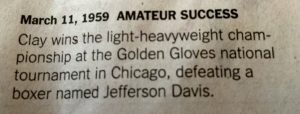
Please sign the petition below to remove the statue of Jefferson Davis currently in Kentucky’s Capitol Rotunda, and replace it with a tribute to Muhammad Ali, “the Louisville Lip” and “the Greatest of All Time.”
I just heard from the Ali family: It is the Champ’s belief that Islam prohibits three-dimensional representations of living Muslims. Accordingly, I have adjusted the petition to call for a two-dimensional representation of Ali (a portrait, picture or mural) in lieu of a statue.
UPDATE (Tuesday, December 2, 2014)
In this interview with WHAS-TV’s Joe Arnold, Governor Steve Beshear endorses the idea of honoring Muhammad Ali in the State Capitol (although he disagrees with removing Davis). Arnold explores the idea further on his weekly show, “The Powers that Be.”
Click here to check out WDRB-TV’s Lawrence Smith’s coverage of the story.
And here’s my op-ed in Ali’s hometown paper, the Louisville Courier-Journal.
UPDATE (Saturday, June 4, 2016)
In the wake of the 2015 Charlestown tragedy, in which a Confederate flag-waving murderer united the nation against racism, all of the most powerful Kentucky policymakers — U.S. Senator Mitch McConnell, Governor Matt Bevin, Senate President Robert Stivers and House Speaker Greg Stumbo — called for the removal of the Davis statue from the Rotunda. Today, as we commemorate last night’s passing of Muhammad Ali, there is no better moment to replace the symbol of Kentucky’s worst era with a tribute to The Greatest of All Time.
UPDATE (Wednesday, June 8, 2016):
Great piece by Lawrence Smith of WDRB-TV in Louisville on the petition drive to replace Jefferson Davis’ statue in the Capitol Rotunda with a tribute to Muhammad Ali.
UPDATE (Thursday, June 9, 2016):
Excellent piece on the petition drive by Jack Brammer that was featured on the front page of the Lexington Herald-Leader.
Highlight of the article:
Miller said he has received a few “angry comments” on his call to honor Ali.
“One of them encouraged me to kill myself,” he said. “You can quote me that I have decided not to take their advice.”
UPDATE (Friday, June 10, 2016)
The petition drives continues to show the Big Mo(hammed): check out these stories from WKYU-FM public radio in Bowling Green and WKYT-TV, Channel 27 in Lexington:
UPDATE (Saturday, June 11, 2016):
Still not convinced? Check out this excerpt from today’s New York Times:
By John Y. Brown III, on Wed Dec 5, 2012 at 12:00 PM ET
“Oh my gosh. That is such a heterosexual thing to say.”
No one has said that to me yet. But I think one day it will be commonplace phrase in our culture if we heteros don’t get it together. And quickly.
I just walked out of a coffee shop where four well groomed, physically fit , articulate and nice looking men were sitting having a serious and substantive discussion. And I was envious. I thought to myself, “Part of me is jealous and wishes I was one of them.” Not a practicing gay, of course…but just gay in the other ways that my sexual orientation seem to be falling so far behind.
Oh, you are probably thinking to yourself “John is stereotyping gays by ‘assuming’ this group of men are gay because of the way they look and talk.” No. Not really. Think about it for a minute. When was the last time you saw four well-groomed, physically fit, articulate, nice looking heterosexual men having a substantive conversation about anything?
Oh sure, we heteros were represented at the coffee shop, too, alright. Don’t worry about that. Two of us were spread out at a table bitching about politics and why they couldn’t catch a break, in work or in romance. I couldn’t hear specifics because I was only in line for a few minutes. But it appeared they had a lot of misfortunes to cover today because it looked like they had been there most of the morning. And had enjoyed breakfast and a follow up snack. Put it this way, if the average male waistline is 34- 36, my two hetero colleagues were doing their job of balancing out the 4 other men’s trim waistline in the coffee shop (with a little help from me, size 38).
I was so embarrassed I almost wanted to say, “Hey guys. At least fix your hair and speak in complete sentences. You’re giving us heterosexuals a bad name.” But, of course, I didn’t. My hair was unkempt too. And I was eating a cake pop with my coffee.
As I walked out I remembered kids when I was younger saying things like, “That’s such a ‘gay’ thing to say” and meaning it as a put down. Heck, I am sure I said it myself. But today, if someone said to me, “That is so gay of you, John.” Well, I think it would be about the nicest thing anybody said to me all day.
And I wouldn’t even correct the person offering the compliment by telling them I was really heterosexual. I would just let them think I would not be out of place in a group like the one I saw today at the coffee shop –and most everywhere else for that matter.
And that’s when I worried about the next step after that. When someone accuses me of sounding hetero for the first time, and meaning it as a put down making the point that I am overweight, lazy and unimaginative or have no taste in clothes or don’t understand movies. As in, “That is such a heterosexual thing to say.” It could happen. And these days, when we heteros can’t seem to stay fit, keep married, stop complaining or come up with anything interesting to say outside of rattling off some sports scores, asking if there will be a Porkies III, and deciding when the next game of fantasy baseball will be, well, them are darn near fighting words, if you ask me.
And the worst part is, we heteros aren’t even very tough any more. I’m afraid we’d lack the energy to even fight back or have the cleverness to come up with an adequate “retort.”
The more I thought about it the more I thought of this video clip, imagining what our retort to the hetero put down might look like.
Then again, uhhhh, well, that’s just my opinion, man.
As we near our fiscal cliff deadline, No Labels co-founders Mark Mckinnon and William Gallston are issuing a new list of principles the House speaker and the President should consider when discussing our nation’s most pressing problem. As they note, in a Daily Beast column entitled, “With the Fiscal Cliff Looming, It’s Time to Take Politics Off the Table,” Americans are ready for “a rebirth of leadership” in Washington, one that puts an end to the partisan bickering and includes a steadfast commitment to problem-solving.
Write McKinnon and Gallston: “Only once in the past four years have Democrats and Republicans made significant progress toward an agreement—when President Obama and House Speaker Boehner met behind closed doors, with everything on the table.” That’s a lot of talk for very little progress.
That’s why on January 14, 2013, at the Marriott Marquis in New York, NY, No Labels will host a meeting titled, “Meeting to Make America Work,” to discuss how we can move forward on problem solving in Washington. At the meeting, No Labels will unveil two national leaders – one Republican, one Democrat – who will help guide the movement in 2013 and the organization will introduce a group of congressional Members who have signed on as members of the “Problem Solvers Bloc” in Congress. To RSVP to the January meeting, please send an email to January14@NEWPARTNERS.COM. For more information about the meeting visithttp://meetforamerica.com/.
No Labels supports a range of common-sense proposals designed to reinvigorate problem-solving in Washington. Among them include the set of principles highlighted in today’s Daily Beast column:
“Tell the people the full truth. It’s time to stop playing around with budget baselines and phantom budget cuts. Stop pretending that small changes can meet big challenges. Tell us how big the problem is (including unfunded liabilities for Social Security, Medicare, and federal employee future retirement benefits not shown “on the books”) and how much different approaches can contribute to solving it. Use charts, graphs, and language that citizens can understand. And once and for all, agree on the facts, so that we can spend our time on the real issues.
“Govern for the future. What’s at stake in the budget debate is nothing less than growth, opportunity, and fairness for all citizens. If we want to preserve our tradition of innovation and upward mobility, we must remove the uncertainty that hovers over our economy. And if we want to retain our global leadership, which has done so much to build peace and prosperity, we must convince other nations that we have regained the capacity to overcome our differences and govern ourselves once more.
“Put the country first. The election of 2012 is over. It’s time to stop wrestling for partisan advantage. Yes, there are sincere differences about what we must do to promote the national interest. But deep down, most of our leaders know that no one has a monopoly on wisdom or virtue. It’s time for them all to negotiate with a measure of humility.
“Take responsibility. We can argue forever about who is responsible for our current plight, but that won’t help us end it. Our elected officials have been charged with a grave responsibility—to make the decisions that will shape our future. No one can do it for them—not pollsters, not blue-ribbon commissions, not even elections. Our officials cannot escape their responsibility, and they should not evade it. The point is not to blame the other side for failure; the point is to succeed.
“Finally: work together. While each party can thwart the other’s plans, neither can impose its will on the other. Relearning the art of working across party lines is the only way of doing the people’s business. During the past generation, the parties cooperated and compromised to save Social Security, reform the tax code, and balance the budget. Yes, it’s harder than it once was: partisan divisions are deeper, and trust has all but disappeared. But that doesn’t change the basic fact that there are only two options: bipartisan compromise and success, or partisan gridlock and failure. There is no third choice, and it’s time for our leaders—all of them—to stop pretending that there is.
“Officials in both parties must level with their most fervent supporters: no matter how deeply we believe that we are right, we can’t get everything we want. And the longer we try to, the worse it will be for the country.
“It’s time for real leadership. And that means it’s time for truth.”
“I’m not eating this weekend because the girls at school want to be skinny.” Emily, 9.
In 2004, after years of processing my own body image issues, and with a determination to have things be different for my daughters, I didn’t expect my own child to begin that steep slide into dieting misery so soon, if at all.
I took a few hours to recover from my little girl’s statement of deprivation, and then I came to the conclusion that if I really wanted things to be different, I would need to take action myself, and fast.
The conversation and research that followed opened my eyes to several truths:
Kids talk. And they are all affected by media messages (billboards, commercials, print ads, Hollywood glamour) about protruding stomachs, fat thighs, and jiggly arms.
Women talk. We do, and it’s a lot of self-criticism about protruding stomachs, fat thighs, and jiggly arms. And, we talk about other women in relationship to all those things, and about how she looked in that outfit. Constantly, constantly, constantly. Conversations overheard about appearance become messages about what is acceptable, desirable, worthy of love, and they are more potent than any billboard costing 1,000’s of dollars to print, because they are personal—about real people we know—about ourselves. And, our girls are listening closely, all the time.
The seeds of self-esteem and self-image are planted long before girls approach puberty. Though criticism may be directed at others, and even if we only ever compliment our little girls, they grow on the reality that criticism is just around corner if they grow into women of stomachs, thighs, and arms, of any type.
So what’s a mother to do? I wasn’t certain, but I was sure that I wouldn’t allow one more generation of women in my family to struggle with the self-hatred that comes from a legacy of criticism, peer pressure, never ending dieting, and debilitating low self-esteem.
I did have a hunch that in order to help make changes for my daughter and her friends, I needed to help make cognitive and emotional changes for moms, too. Because after all, we were all once girls who grew on those very messages. No one ever told us to stop listening.
And so, with mother-bear determination, I called health and wellness professionals in my Lexington community who seemed to carry some authority: pediatrician; nutritionist; psychotherapist; police-officer. And I asked them to become a part of the community that Hillary Clinton talked about in, It Takes a Village, where everyone helps raise healthy children.
Click on image to purchase book
With professionals on board, Girls Rock!: Workshops for Girls and Moms, was born. We would all come together, pre-teen girls, mothers, and professionals, for a big empowering day of programming that would make all of us responsible for healthier language, relationship to self and friends, and habits at home.
But still, the kids in attendance would need real, up-close and personal role models to emulate—people they could think of as big sisters—the ultimate role models of omniscient authority to a girl.
So I recruited a diverse team of teenagers with leadership potential who seemed to defy what Mary Pipher identifies as one of our culture’s greatest tragedies when she says, “Adolescence is when girls experience social pressure to put aside their authentic selves and to display only a small portion of their gifts.”
Read the rest of… Lisa Miller: Empowering Your Daughters…And You
When you think of incongruities, Jews plus country music is right up there with pickles & ice cream or Paris Hilton & Wallace Shawn – a pair that just don’t seem right together. (Although there is one colorful exception, Kinky Friedman, who fronts a band known as The Texas Jewboys and who came in 4th in the 2006 Texas gubernatorial race, and who inspires me with his mix of politics and comedic music.) (Not that I’m considering running for governor in the near future!)
The lack of Jews in country music is actually surprising – Jewish songwriters are responsible for many of our classic Christmas songs, and given country music’s tradition of chronicling pain and suffering, it would seem to be a perfect fit. I like to say I’m from in the south – southern California, to be precise, but growing up in Orange County (where there were even fewer Jews than Democrats) did make me feel as much of an outsider as many country singers lament. But I hadn’t really made the connection until I heard Peter Sagal, the host of “Wait, Wait Don’t Tell Me” on NPR, crack a joke about an upcoming appearance in Nashville. Suddenly it seemed like a match made in heaven (and now I feel like Melanie Griffith’s character in “Working Girl,” in that climactic elevator scene where she explains to Mr. Trask how she connected his company to radio, or something along those lines).
Chanukah/Hanukkah/etc (choose your favorite spelling) is really the ultimate country holiday – muscular heros, old fashioned candles, and fried food, so this week’s video is what may be the first country Chanukah song – enjoy!
(And remember, there are only 4 shopping days left til the first night of Chanukah, but copies of my Chanukah comedy CD, “Latkes, Shmatkes,” are available on iTunes, at amazon.com, and at www.laurenmayer.com!)
The notion that a reelected Barack Obama would revert to the centrist, bipartisan sounding Obama of the 2008 campaign trail was a fantasy from its conception, and the White House officially punctured it with its release of a deficit plan that resembles a Democratic wish list: the death of the Bush era tax rates for upper income earners; a bump in the estate tax; for top brackets, a return to pre 2003 treatment of dividends as ordinary income rather than capital gains; a few carve-outs from 2011’s mini stimulus bill; and amorphous, undefined cuts to farm price supports, a rare spending reduction that enthuses the Democratic base. Entitlements are virtually left alone, save for a mystery round of “savings” in Medicare, with details to be named later.
It has the aesthetics of a maneuver rather than a genuine negotiating stance. And as maneuvers go, it is a skilled one. Offer a package thick enough with proposals to keep the high ground, but make it one-sided enough that Republicans will dismiss it, while counting on the GOP congressional base to keep unraveling to the point that sometime around Christmas Eve, Republicans yield on the two points that Democrats genuinely want from this exercise: a continuation of the Bush cuts for earners below $250,000, and another short-gap extension in jobless benefits. Of course, there aren’t a lunchtable’s worth of congressmen who seriously believe that once the White House has spared Democrats the vulnerability of defending seats in 2014 in the aftermath of a middle income tax hike, that Obama will return to the table to re-open the viability of the Bush top bracket cuts.
There are all manner of reasons to wonder why congressional Republicans saddled themselves with a dead-end that was so thoroughly predictable: from overconfidence about winning in 2012, to a momentary infatuation with the notion that the all but forgotten deficit super-committee would develop a deal-making prowess Washington has not seen in several generations, to an under appreciation of how much raising upper income taxes has become a politically cost-free goal for Democrats.
The last blunder is worth dwelling on. To a degree Republicans were much too slow to realize, the political consequences around advocating for higher taxes have steadily declined over the last decade, to the point that three successive Democratic presidential campaigns have overtly favored a hike in upper income taxes. While Republicans have gamely protested that tax increases threaten job growth, Democrats have proved far more successful in fending off those claims with their own arguments that the tax code is too tilted toward the interests of top bracket earners. While the polling on the subject is partly a creature of a sample’s wording (exit polls showed a broad public preference for raising the tax burden on the “wealthy” coinciding with even stronger support for reducing the deficit primarily through spending cuts), there is virtually no evidence that a viewpoint exceedingly popular with the Democratic base has taken any electoral toll with swing voters.
Republicans are partly to blame for their own much less confident position. The closest Republicans have come to a comprehensive deficit strategy, Paul Ryan’s budget, has been only occasionally defended and its particulars remain obscure to most Americans who don’t frequent policy salons or Heritage Foundation online seminars. In fact, in an eerie echo of the Democratic play on health care reform in 2010, Republicans have invariably touted the Ryan Plan as a bold-hearted act of political courage while spending little energy on articulating its fine points. Nor have Republicans shown the strategic wherewithal to prioritize a single policy objective as dramatically and neatly defined as the Democratic aim of “making the rich pay their fair share.” Lastly, with their own rhetorical embrace of deficit reduction without the benefit of specificity, and by showing their own penchant for symbolic, but insubstantial gestures, Republicans paved the way for Democrats to wage their own disingenuous maneuver by overstating the impact of tax hikes that would only put a minor dent in the deficit.
So, what is a party to do, when it has been so constrained by its own miscalculations that it has almost no bargaining power? Assuming the administration does not have an outbreak of authentic compromise, congressional Republicans would do well to remember that their non-existent leverage will be enhanced the day sequestration takes effect and the mandatory cuts and revenue increases become a market and economic reality. With a newly strengthened hand, the onus would shift to Republicans to craft a detailed round of spending cuts, to become serious about downsizing corporate deductions, and to proffer a serious set of entitlement reforms, from partial means testing to restraining Medicare growth through a premium support based alternative. It would become an imperative for Republicans to conquer their own squeamishness about entitlements with the same nerve that has liberated Democrats from their fears about taxes.
Read the rest of… Artur Davis: The Case for Republicans Walking Away from the Budget Talks
By John Y. Brown III, on Tue Dec 4, 2012 at 12:00 PM ET
Polygamy vs Monogamy.
An ordinary married couple discusses the pros and cons. And realities.
I love laughing with my wife about about bizarre speculative situations….Like just now. My wife and I are talking about Muslim culture, women’s roles, and polygamy. Rebecca asked if I would practice polygamy if I had been born into Muslim culture. And smiled anticipating my answer….Kind of put me on the spot… a little bit.
I said, “Look honey, you know me. I’m not…..I’m not really the martyr type. I wouldn’t want to marry other women, of course. But would do it to, you know, so people wouldn’t talk bad about you. Because, like, if I was the only monogamist in a polygamist culture people start talking and assuming things about me and, you know, maybe think you were the cause. I could never allow that perception of you to happen and so would marry other women just to preserve your reputation in the community. Again, not that I’d want to. You know, When in Rome….”
We were both laughing hysterically at this riff….and then it was Rebecca’s turn.
“You’d be an awful polygamist. You know how I get upset when you are late or or don’t give me your full attention when talking sometimes? Or if you text me instead of call me? Well, multiply that 5 times! Those 5 wives would be so angry and fed up with you.
“Where is he?” “Are you kidding?” “He’s a mess.” “We know he’ll never take the garbage out.”
“They would be talking about you all the time and you’d be miserable. And begging for a monogamous relationships. ”
Laughing even harder….as I have to completely agree. I’d be a dismal polygamist.
It’s good to laugh with your spouse. And I’m grateful to live in a monogamous culture. And to have a mate who keeps me always on my toes…and laughs with me (as often as at me).
By Zack Adams, RP Staff, on Tue Dec 4, 2012 at 10:00 AM ET
The regular season is over and I would like to congratulate Team Unibrow, managed by the offspring of the RP himself, on finishing at the top of the league.
The playoffs have now started and all teams will play in either the championship bracket or the consolation bracket. In the Championship bracket Team Unibrow and Targaryen 2012 have byes and Fighting Mongooses and Powerful Lobbyists control the byes in the Consolation bracket. Stay tuned as the playoffs will continue for 3 weeks until a Champion is decided.
While The Recovering Politician is dedicated to making the most of our second acts, we’ve usually focused on the second (or third, or fourth) acts of adult professionals. We’ve ignored literally the second act of most everyone of us — the act of leaving home for college or adulthood. Until now.
Our newest Friend of RP, Emily Miller, started Miami University this fall; and she will be sharing her thoughts about this awesome, scary, exciting, bewildering transition. She’s a very insightful, thoughtful, and eloquent writer. And she also happens to be The RP’s oldest daughter.
Enjoy:
Dear Grandpa,
You were here for such a short part of my life, and I missed you during so many of important events. You could have watched my failed attempt at trying to play basketball, and you could have listened to Daddy and me play guitar together on the holidays. I would have loved having you read an Aliyah at my Bat Mitzvah while watching me grow into an adult in the Jewish community and in the world. I missed you at my high school graduation, and I should have been able to call you with the news that I was going to attend Miami University.
While I begin this new chapter in my life, I have been reflecting on my past. What did I learn during the past 18 years that prepared me for college? While specifically reflecting on the past year, I realized something that I learned from the death of a good friend; let the ones you love know how much you appreciate and cherish them.
When you died, I was much too young to understand the importance of this idea, and I never got the chance to tell you about the big effect you had on my life. It might be too late to tell you now; and whether or not these words reach you, I am hoping I can at least honor you by showing people the great influence you had on my life.
There are so many things that you did for me for which I am eternally grateful, but when I think about how you inspired me, two big things come to mind. The first is your love of books and literature. Thank you for always reading to me and insisting that I learn to read myself. I could always count on a stack of books being there when I came to visit. Thank you for assuring me that I would some day be able to read fluently and not letting me give up when I struggled. I didn’t believe you when you told me that some day I would enjoy reading, and I could not believe that anyone could do such a thing for fun. Not every child gets the enriching opportunity of constantly being read to, and I am so thankful that you provided me with this. I know people to this day who do not enjoy reading, and I feel sorry for them because they are truly missing out on a wonderful gift. Thank you for this gift; my love of literature is all thanks to you.
By Nancy Slotnick, on Tue Dec 4, 2012 at 8:30 AM ET
Paper towels are my guilty pleasure. Is that pathetic or what? But I’m totally serious. Especially the Viva ones, that are so soft and absorb everything. I never have to touch a sponge. My husband wipes up turkey grease with a Crate and Barrel hand towel and it kills me. Why? I wish it didn’t. I’m trying to train myself not to care. Shalom Bayit is the term for letting sh*t go for the sake of peace in the family. It’s more than that. It’s letting go of thinking that the way I do everything is the right way. Realizing that there are many ways to skin a cat. And that some of us would never dare skin a cat. But my husband would if we were hungry enough. I respect that. He does love cats too.
So I have to pull it together when he puts the Tupperware on the bottom shelf of the dishwasher. I stole that line from Liz Lemon on 30 Rock, btw. I was encouraged to know that I’m not the only one who worries about crap like that! But a little scared to think that I’m about as sexy as Liz Lemon sometimes. I used to be sexy though. And I think I still can be on a good day. In further tribute to Tina Fey, I don’t own Mom Jeans. But I’m not quite Nancy [MILF] on Weeds. That’s probably good news for my son, as well as for the paper towel industry, but it might not be so good for me.
I must channel my inner MILF. Okay, excuse me, there’s something I need to go do.



 Blog this!