Please sign the petition below to remove the statue of Jefferson Davis currently in Kentucky’s Capitol Rotunda, and replace it with a tribute to Muhammad Ali, “the Louisville Lip” and “the Greatest of All Time.”
I just heard from the Ali family: It is the Champ’s belief that Islam prohibits three-dimensional representations of living Muslims. Accordingly, I have adjusted the petition to call for a two-dimensional representation of Ali (a portrait, picture or mural) in lieu of a statue.
UPDATE (Tuesday, December 2, 2014)
In this interview with WHAS-TV’s Joe Arnold, Governor Steve Beshear endorses the idea of honoring Muhammad Ali in the State Capitol (although he disagrees with removing Davis). Arnold explores the idea further on his weekly show, “The Powers that Be.”
Click here to check out WDRB-TV’s Lawrence Smith’s coverage of the story.
And here’s my op-ed in Ali’s hometown paper, the Louisville Courier-Journal.
UPDATE (Saturday, June 4, 2016)
In the wake of the 2015 Charlestown tragedy, in which a Confederate flag-waving murderer united the nation against racism, all of the most powerful Kentucky policymakers — U.S. Senator Mitch McConnell, Governor Matt Bevin, Senate President Robert Stivers and House Speaker Greg Stumbo — called for the removal of the Davis statue from the Rotunda. Today, as we commemorate last night’s passing of Muhammad Ali, there is no better moment to replace the symbol of Kentucky’s worst era with a tribute to The Greatest of All Time.
UPDATE (Wednesday, June 8, 2016):
Great piece by Lawrence Smith of WDRB-TV in Louisville on the petition drive to replace Jefferson Davis’ statue in the Capitol Rotunda with a tribute to Muhammad Ali.
UPDATE (Thursday, June 9, 2016):
Excellent piece on the petition drive by Jack Brammer that was featured on the front page of the Lexington Herald-Leader.
Highlight of the article:
Miller said he has received a few “angry comments” on his call to honor Ali.
“One of them encouraged me to kill myself,” he said. “You can quote me that I have decided not to take their advice.”
UPDATE (Friday, June 10, 2016)
The petition drives continues to show the Big Mo(hammed): check out these stories from WKYU-FM public radio in Bowling Green and WKYT-TV, Channel 27 in Lexington:
UPDATE (Saturday, June 11, 2016):
Still not convinced? Check out this excerpt from today’s New York Times:
By John Y. Brown III, on Tue Dec 18, 2012 at 9:15 AM ET
I’m not complaining. Being on a cruise ship is great.
Really.
OK. Not entirely.
It can be a little confining. But it’s mostly very pleasant.
However, it can play games with your mind.
For example, it just occurred to me that the real reason in Dr Suess’s Green Eggs and Ham that Sam-I-Am gave in and agreed to try –and then admitted he liked —green eggs and ham in a boat WAS NOT because he finally became open minded about the and discovered he liked the taste.
But rather he was feeling claustrophobic after being on that boat several days and was willing to say or do anything to wrap the story up so he could get back to dry land.
And now I really am going to bed. Before someone offers me green food and a fork. ; )
====
Cruise ships and Reincarnation.
I don’t really believe in reincarnation….but I’m no expert on the topic either. I just know what it means as a general matter and couldn’t help thinking of it yesterday when boarding our cruise ship.
There were several hundred of us. Maybe closer to 1000. Tall, short, skinny, heavy, loud, quiet, young and old— different ethnicities and skin colors, and temperaments and personalities from across those spectrums.
These were the assemblage of people fate had handed me to experience this voyage with. They would be the people populating my new world.
I didn’t know any of them but had to be careful not to pre-judge who I would get along with and who I wouldn’t. I’m always surprised in that way.But there we were. Like the first episode of Lost –only a lot more of them and none of us were cast for a TV show. And, fortunately, we weren’t really lost.
But we we will be discovering and experiencing things together and create a miniature microcosm of a world of our own for a week. And least that’s what i imagined.If we had longer–a few months or year or two together, maybe we’d develop a tribe or community or perhaps even a city and decide what our common characteristics are — they’d be arbitrary, of course (a desire for adventure and interest traveling my water and ability to live in close quarters with others, etc)—and try to define ourselves accordingly.
Picture #2: What a Mediterranean Cruise actually looks like.
And then, I suppose, after distinguishing ourselves from other “cruise ship cities or communities” we’d elect leaders to protect us from them.
That just seems so odd and funny. And yet it isn’t so far fetched compared to the way we humans do form tribes, communities, cities, states and countries.
Then again, I had a lot of time to think about it all because registration for the cruise was slow…and when I have free time on my hands, my mind wanders and my imagination takes on a life of its own. Especially if I’ve just taken a Dramamine tablet.
Actually, my first thought was “This feels like the first day at a new school.” That worked for awhile and I was good with that analogy and just trying to figure out where I’d fit in and wasn’t having much luck. But as registration dragged on….my thoughts moved from first days at a new school to how communities develop to what caused nations to go to war to what reincarnation must feel like to experience. And then we were all checked in, so I stopped there.
Probably a good place to stop. Besides, the Dramamine was wearing off anyway and it started to feel like I had simply boarded a cruise ship with my family and checked into my cabin. Geez. That sounds so overly-simplified and pedestrian. But could be that’s all there was to it.
By Zack Adams, RP Staff, on Mon Dec 17, 2012 at 5:00 PM ET
The Politics of Pigskin
The 49ers managed to win away in New England last night in a really entertaining game with playoff implications. [ESPN]
Adrian Peterson got even closer to Eric Dickerson’s season rushing record after a great performance on Sunday. It’s really hard not to root for him. [NFL.com]
The Packers ran a weird trick play on Sunday and the rest of the week’s winners and losers. [Yahoo!]
The Seattle Seahawks are the first team since 1950 to score 50 points or more in two consecutive games. [Pro Football Reference]
Here is a really nice breakdown of how Julio Jones got past the NY Giants’ defense to catch a 40-yard TD pass. Really interesting stuff. [National Football Post]
“C.J. Spiller now at 1,000 rush yds on season on just 154 carries, 2nd fewest to get to 1,000 in NFL history (Beattie Feathers, 1934)” [Twitter]
Here is your preview for what appears to be a bad job of scheduling for MNF: Jets v. Titans. [ESPN]
By Jonathan Miller, on Mon Dec 17, 2012 at 3:00 PM ET
#TEAM JYB3:
Day 5 of diet goal of losing 15 pounds (or at least 10)
The importance of small wins in human motivation
When a person sets a goal (like losing 15 pounds or at least 10), they will face obstacles that discourage them. Like actually gaining weight during the prescribed diet time period instead of losing weight.
When that happens, it’s important not to give up but to instead find “small wins” that are positive indications that the person should continue pursuing their goals.
Today’s small wins list:
1) I found out that in Italy they sell Nutella in industrial size containers (see pic). I did not purchase one…and didn’t even purchase one of these giant donuts with Nutalla smeared on it. I did look inside one of the giant Nutella containers. But for less than 2 minutes.
2) The rate at which I am gaining weight on my diet is actually slower than the rate at which I normally gain weight.
3) Although the shirt I’m wearing today does feel too tight for me to wear at my current weight, my pants feel OK. (Note: I had the pants taken out recently, so not as hopeful a sign as I might first want to believe).
4) No one has refused to serve me in any of the Italian restaurants because they feared, like an intoxicated alcoholic, “ I had eaten enough already and needed a cab to drive me home.”
5) I considered trying to slyly pretend my “start weight” was higher than it really was so I could at least pretend I had lost weight and not be humiliated by Jonathan Miller beating me. But chose not to try to slyly adjust my weight. (Note: my actual start weight was 193).
6) Since my start weight was 208, I’ve already dropped 14 pounds to 194! (Note: I changed my mind about #5 after dinner tonight).
7) Felt guilty about adjusting weight and, after walking up to Fitness Area got motivated to come clean about #6 being false.
8) I’m not giving up yet! I’m still in this competition.
9) Decided to adjust my goal from losing 15 pounds (or at least 10) to 15 pounds (or at least 7) but only changed one of the two weight goals and initially was tempted to change both and drop second goal to 5. But didn’t.
10) This is Day 5 and can’t last forever. However long it does last, at least 5 of the days are over with.
====
Diet update.
Two days of solid progress can be undermined by giving into an instant of temptation.
Remember the hotel relapse scene in the movie Flight, when Denzel Washington, a rabid alcoholic on the wagon for a few days, discovers the miniature vodka bottle in his hotel mini bar?
He pulls it out and looks at it longingly for a moment. And sternly sits it back on the fridge. And leaves.
And returns seconds later to go on a bender of a lifetime that destroys Denzel’s character and two hotel rooms.
Well, after two days of disciplined dieting and constructive preparation for working out, I had my own “moment” this morning.
At breakfast, before I even realized what I was doing, I caught a glimpse of my dear old friend. Stashed it in my breast pocket furtively….and swore it would be between me and my Facebook post but I’d never breath a word about it to anyone else. I’m staring now….and I’m walking away. Like Denzel Washington in that movie.
====
#TEAMRP
Ouch.
But a good ouch.
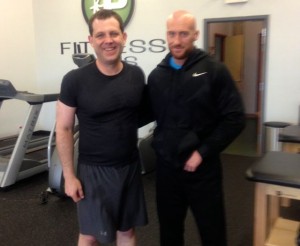
I woke up Saturday morning after my first workout session with Josh the day before, and I could feel it in my legs.
A good hurt.
It’s been a while since I felt that way.
Over the past few years, I have felt many times a bad hurt — my bulging disk clamping down on the nerve that runs through my left leg, causing me serious pain, the kind of pain that kept me up nights.
Since I fixed that problem though medical treatment and yoga stretching, I’ve been pain-free, cautiously exercising to ensure that I don’t trigger my disk problems again. But that kind of cautious exercise does little to keep me in optimal shape.
Enter Josh. During our first session, we did no cardio, no weightlifting — just a bunch of stretching and exercises where I used my body weight to train and tone. And boy it worked — I hurt. But in a good way.
I will keep you updated as the training continues. And hopefully be able to provide a “AFTER” picture that looks better than the “BEFORE” picture above, and doesn’t involve a body cast.
I am a conservative who believes that any philosophy is strengthened by reexamination. I do regard theory as a valuable measure of whether a policy has integrity, and the lawyer in me accepts that hard facts make bad law, and worse, can unfurl dangerously unintended consequences: but an ideology that can’t grasp the real-world consequences of its aims is deeply flawed. I am, it so happens, a defender of the Second Amendment who thinks that the right to own guns is privileged by some of the most explicit words contained in the Constitution. I also remember Lincoln’s admonition that a constitution is not a suicide pact that is oblivious to the ways history has reshaped us.
So, in that spirit, I acknowledge that in the last two years the gun debate has turned a corner. The slaughter of children, on top of the massacre of Sikhs in a temple, and moviegoers in a theater, and constituents at a congressional fair, demands that level of humility on the political right; arguably, it’s a corner that should have been turned earlier when bodies of inner city teenagers started piling up in morgues and assault weapons started outnumbering drug paraphernalia in crack houses.
The operative legal and moral question is how to frame a gun policy that reconciles our Constitution and the freedom of law abiding gun owners with the appalling ease of marginal, pathological drifters building a personal arsenal.
Liberals will need to concede that banning firearms altogether is undesirable as well as unconstitutional, and that prohibitionist rhetoric only aids and abets the NRA’s own absolutist stance. They will need to demonstrate a much sharper sensitivity to the fact that handguns do serve the ends of self-defense in both middle class suburbs and urban neighborhoods, and that hunting is part of the national cultural fabric: much too much of the leftwing punditry on this subject overflows with a barely disguised regional and class based contempt. In addition, advocates of stricter gun laws should drop the misleading implication that there are no meaningful barriers to gun ownership: to the contrary, they should be stressing that the Brady Bill’s waiting period and the longstanding prohibitions on gun ownership by felons or the institutionalized demonstrate pathways to strengthening public safety without shredding the liberties of law abiding gun owners.
At the same time, conservatives would do well to recognize that the fact that gun ownership is a right does not immunize it from regulation—no more than speech is shielded from defamation suits, or restrictions against inciting violence or using words to conspire to achieve a crime; no more than the free exercise of religion precludes scrutiny of whether churches are complying with the obligations of their tax exempt status, or of whether government grants to faith based institutions are being validly spent. Similarly, the roots that gun possession hold in our culture surely don’t carry more sociological sway than driving or marriage, both of which require some method of formal registration. Lastly, just as liberals ought to abandon their fictions around existing gun laws, conservatives should also admit that the existing regulations around guns have hardly marginalized gun ownership or created some unreasonable barrier to gun possession.
My own preferred approach would be to avoid outlawing classes of weapons, even the most lethal, semi-automatic versions: whether or not a hunting weapon can be distinguished from a killing machine is debatable, but even skeptics of that proposition must allow that the task of separating firearms based on their mechanical characteristics is too slippery to rely on, and too imprecise to offer gun manufacturers any predictable notice of whether they are crossing the line. But a strategy that focuses on discerning more about the humans who would own the guns (especially high impact firearms) makes sense. To be sure, constructing a licensing regime is a challenging enterprise: a firearms knowledge test would probably have had no impact on the self-taught nutjobs at work in Aurora and Newtown, much less the ex soldier in the Sikh shooting; a background check couldn’t be allowed to devolve into a profile that punishes the unemployed or the dropouts or the socially disconnected.
Read the rest of… Artur Davis: The Emerging Moral Reality on Guns
By John Y. Brown III, on Mon Dec 17, 2012 at 12:00 PM ET
What is the posthumous shelf-life of a human life?
(Or the length of time before it is no longer of use, or suitable for sale?)
We all would like to be immortal. Or at least avoid coming to grips with the fact that we are mortal and our time on this planet is finite.
As my first step-father shrewdly put it to me many years ago when I was in college. “Look around this restaurant (there were about 100 patrons). Everyone of here has fully accepted that everyone in this restaurant is going to die one day. Except them.”
I thought that was very wise. I also never returned to that particular restaurant after that story.
So, now what? We aren’t immortal…but can we leave a legacy? Will people’s memory of us linger on many, many years after we pass?
I got a curt glimpse at that answer a few days ago while getting coffee and eavesdropping on two female customers at the condiment bar. It went something like this.
Lady 1: “Did you not hear? Yes, he had a heart attack and died.”
Lady 2: “Oh, no. I hadn’t heard. That is so sad. How old was he?”
Lady 1: “I think he was 58. Too young. I can’t believe it. He was in the Hawaii and just died suddenly of a heart attack, I heard.”
Lady 2: “That is just so sad. Way too young……Oh, did I tell you I was in Hawaii about 6 months ago…..”
My conservative estimate —at least for these two casual acquaintances— this unfortunate gentleman’s posthumous shelf life was about 11.2 seconds.
Sure we can leave legacies and loved ones will talk about us for longer than 11.2 seconds. But the harsh reality, it seems, is that any credit we hope to make up for in goodwill memories after we die, aren’t going to be worth much at all. And if we want to be well thought of….and have a full life, we’re better off asking what can we do today instead of banking on some pleasant lingering sentiment posthumously.
Unless, of course, we were one of the 100 people in the restaurant that night that believes this is true for everyone else alive. Except them.
By Jonathan Miller, on Mon Dec 17, 2012 at 11:00 AM ET
Since the horrible tragedy in Connecticut on Friday, I’ve been seeing the picture above shared by hundreds of my Facebook and Twitter friends.
While I share the sentiment, I’m curious about something: If indeed 42 people were killed “last year” in “West Germany,” what are the figures “last year” for the Soviet Union?
Or Transjordan?
Or New Amsterdam?
Or Gaul?
Seriously, this country, I hope, approaches a desperately needed and vigorous debate on gun control in the country, let’s make sure that we have our facts straight. I’m confident that the real data is still powerful.
By John Y. Brown III, on Mon Dec 17, 2012 at 10:00 AM ET
God showing off this morning in Pireus, Greece.
What’s the point of being in Greece if you can’t come up with a little philosophy along the way?
Like eating in Italy; philosophizing in Greece is unavoidable. So here goes.
A cautionary tale:
Why is it the lessons we are taught in life—the bigger lessons; the morality tales, the ultimate life questions—are so difficult to master?
We are taught these simple lessons over and over and still over again throughout life.
First through school primers, then fairy tales, then film, music and art, then through literature, then philosophy, then theology ,and then through the life of those around us and near to us, and finally and most painfully, through our own lives.
And then the final stage of this educational process arrives and we become the teachers ourselves to those younger and less wise, when we die, having never learned these life lessons fully enough along the way.
We are born to learn and yet the less we learn the more we teach when we die.
A cautionary tale.
====
“Be not afraid of being a tourist: some are born tourists, some achieve tourist status and some have have being a tourist thrust upon them–usually by their spouse.”–
Paraphrase of Shakespeare
====
Are you smarter than an 8th grade slacker?
Probably.
Today we visited–with my wife and two teen kids–the Acropolis and the Parthenon in Greece.
As we walked by where some of our civilization’s earliest and greatest minds philosophized about the nature of democracy, ethics and the the meaning of life, my mind raced to try to recall a childhood school lesson about this place’s historic significance.
I almost started my impromptu lecture before a full thought had fallen into place….but then caught myself when I realized what the full thought was. And it was this.
“Johnny and Maggie, I’m going to tell you my story about learning about the Acropolis and Parthenon. It’s funny, so you’ll like it. When I was in Mrs Hughes eighth grade world civilization class we studied these great Greece structures and their significance –and had a pop quiz one morning to name the Parthenon, Acropolis and one other structure I can’t remember.
Look, I wasn’t a really, really, really good student back then. In fact, I wasn’t even a good student. So, I hadn’t read the assignment and, although I hate to admit doing this, I was sitting next to a smart student and craned my neck straining to see the answer and copy it down myself. I rationalized it was only a pop quiz and the first two weeks of classes and I wouldn’t do it again.
What I saw written on the good student’s page looked like a foreign language. “What kinds of names are these? I wondered.
I did the best I could copying down my friend’s answers one letter at a time and hoping for the best. The next day was relieved to see I had gotten a passing grade on the quiz —but noted a written comment, “John, your spelling is terrible!!”
====
“If I’d only known then what I know now about what’s important in life, I would have done things very different.”
No, you wouldn’t have. Or at least, No, I wouldn’t have. And I just realized this harsh truth fully today for the first time
When I was 20 years old I had the opportunity of a lifetime to spend a semester abroad traveling to less developed countries and seeing these countries, their people and their cultures first hand. But it was also a low point in my life where shallowness (masquerading as existential angst) and excessive alcohol combined to cause me to miss out on taking full advantage of my brief time in these foreign countries. So I told myself for several decades.
Back then I had a Walkman I carried with me everywhere and always had my headphones on. My roommate once yelled (laughing and frustrated), “If I hear the song Rainmaker or Low Spark of High Heeled Boys again by Traffic one more time —I’m going to scream and then unravel your cassette tape!”
And so today, back in a poor foreign country for the first time in nearly 30 years, my tourism habits should have been much more structured and refined. But there I was, walking through the Acropolis in Greece and taking pictures of the Parthenon, with my ear buds in from my iPod and listening to, unbelievably, Steve Winwood singing Can’t Find My Way Home –and singing under my breath just low enough so no one will hear me. And even dancing ever-so-slightly too.
And I “got it.” No. I would never have been any different “Had I known then what I know now.” Or at least not that different. At best, I would have handled life about the same way as I did the first time around. Just maybe picked a slightly better song from a slightly different band but with the same lead singer to listen to while being irresponsible.
And not riding elephants and wearing tie-dye shirts.
(Please note today I wasn’t wearing Tie-Dye but rather a cream colored pull-over sweater from Jos. A. Banks. And long pants.)
====
“With all its sham, drudgery, and broken dreams,it is still a beautiful world.”
Desiserata -Max Ehrmann
====
Vacation mindsets.
When I am on a vacation, I think of how to do as little as possible, if I think at all.
My wife, on the other hand, the consummate planner, prefers to treat vacations as an opportunity to earn extra college credit.I think she may secretly be working on her masters this trip.
I, on the other hand, am opting for the GED approach.
Which one is smarter?
I’m afraid I’m not smart enough to know the answer to that.
Oh, and who planned out this entire vacation?
That would be my wife.
Thank you, honey.
I’ll be there in a minute. Studying for my GED right now. ; )
====
When trying to keep your wits about you in a remote part of the world, I’m happy to report Eric Clapton works as well as ever. Maybe better.
By Jason Atkinson, on Mon Dec 17, 2012 at 9:15 AM ET
My party, the Republican Party, is stunned and wandering in the desert right now. Many just don’t understand how polls could have been wrong and how primary victories were turned into general election losses. Now that the dust has settled, most Republicans I hear from are blaming it on America’s slide toward socialism.
Let’s slow down here. We can agree America is changing, but we should look at us first. Our primaries are about who can out-conservative the other, then who can swing to the middle for the general election. It’s as if we’re telling voters we don’t even believe ourselves.
Many, many Republicans I know feel the party has left them. They believe the party is out of step, focused on fear and being the party of “no.” Whether other Republicans believe that or not isn’t the issue. Americans believe it, and they’re not voting Republican.
Parties and federal government aside, people today are just trying to hold it all together. We’ve all got bills, health care issues, aging parents and kids with cavities. Research shows that most Americans are center right, believe in limited government and personal responsibility, and don’t think government is a good steward of tax money, but they are choosing to be unaffiliated, independent voters.
It appears to many that Republicans have forgotten that politics is about serving people. Who cares if we’re ideologically perfect to each other but not elected to office?
If my party is going to win in the future, it must do 10 things immediately:
Read the rest of… Jason Atkinson: Advice for the GOP — Don’t be about perfection, be about service
During my six years as an accidental bureaucrat, after spending twenty-five years in the private sector, my friends often wondered how I could do it. They routinely asked versions of the question: doesn’t government move too slowly for you? My standard reply was that, yes, the public sector moves slowly – but then, big companies don’t move so quickly either. And come to think of it, I teased my friends in higher education, colleges and universities move more slowly than either business or government! The point is, all institutions move slowly.
What surprised me wasn’t how slowly the different institutions moved, but the different language, behavior, secret handshakes, and views of each other I found across sectors. Xenophobia runs rampant within public, private, non-profit, and for-profit silos. Each silo has created its own world completely foreign to inhabitants from other sectors. Visiting emissaries are always viewed with skepticism. (”I’m from the government and I’m here to help …”)
One epiphany from my immersion into the non-private sector is how strenuously social sector organizations resist the notion they have a “business model”. Non-profits, government agencies, social enterprises, schools, and NGOs consistently proclaim that they aren’t businesses, and therefore business rules don’t apply.
Well, I’m sorry to break the news, but if an organization has a viable way to create, deliver, and capture value, it has a business model. It doesn’t matter whether an organization is in the public or private sector. It doesn’t matter if it’s a non-profit or a for-profit enterprise. Allorganizations have a business model. Non-profit corporations may not be providing a financial return to investors or owners, but they still capture value to finance activities with contributions, grants, and service revenue. Social enterprises may be mission-driven, focused on delivering social impact versus a financial return on investment, but they still need a sustainable model to scale. Government agencies are financed by taxes, fees, and service revenue, but are still accountable to deliver citizen value at scale.
The idea that business models are just for business is just wrong. Any organization that wants to be relevant, to deliver value at scale, and to sustain itself must clearly articulate and evolve its business model. And if an organization doesn’t have a sustainable business model, its days are numbered.
Read the rest of… Saul Kaplan: Business Models Aren’t Just For Business



 Blog this!


 2) The rate at which I am gaining weight on my diet is actually slower than the rate at which I normally gain weight.
 He pulls it out and looks at it longingly for a moment. And sternly sits it back on the fridge. And leaves.
 Ouch.
Ouch. Liberals will need to concede that banning firearms altogether is undesirable as well as unconstitutional, and that prohibitionist rhetoric only aids and abets the NRA’s own absolutist stance. They will need to demonstrate a much sharper sensitivity to the fact that handguns do serve the ends of self-defense in both middle class suburbs and urban neighborhoods, and that hunting is part of the national cultural fabric: much too much of the leftwing punditry on this subject overflows with a barely disguised regional and class based contempt. In addition, advocates of stricter gun laws should drop the misleading implication that there are no meaningful barriers to gun ownership: to the contrary, they should be stressing that the Brady Bill’s waiting period and the longstanding prohibitions on gun ownership by felons or the institutionalized demonstrate pathways to strengthening public safety without shredding the liberties of law abiding gun owners.
 Today we visited–with my wife and two teen kids–the Acropolis and the Parthenon in Greece.
 When I was 20 years old I had the opportunity of a lifetime to spend a semester abroad traveling to less developed countries and seeing these countries, their people and their cultures first hand. But it was also a low point in my life where shallowness (masquerading as existential angst) and excessive alcohol combined to cause me to miss out on taking full advantage of my brief time in these foreign countries. So I told myself for several decades.
 Parties and federal government aside, people today are just trying to hold it all together. We’ve all got bills, health care issues, aging parents and kids with cavities. Research shows that most Americans are center right, believe in limited government and personal responsibility, and don’t think government is a good steward of tax money, but they are choosing to be unaffiliated, independent voters.