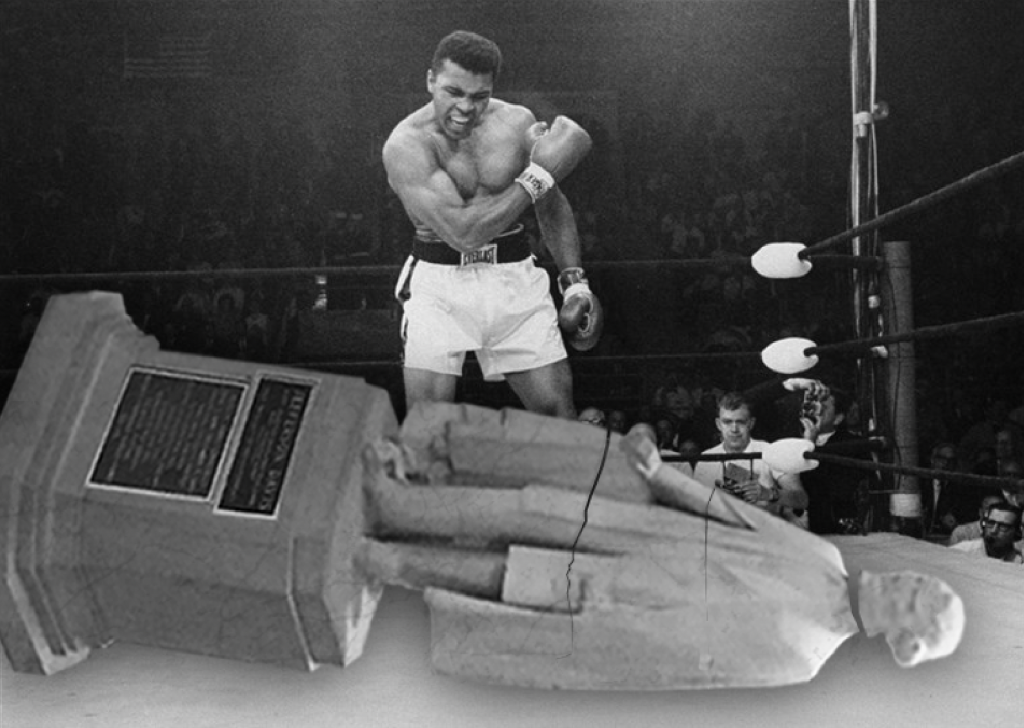
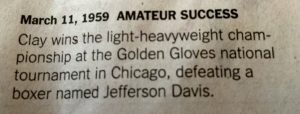
Please sign the petition below to remove the statue of Jefferson Davis currently in Kentucky’s Capitol Rotunda, and replace it with a tribute to Muhammad Ali, “the Louisville Lip” and “the Greatest of All Time.”
I just heard from the Ali family: It is the Champ’s belief that Islam prohibits three-dimensional representations of living Muslims. Accordingly, I have adjusted the petition to call for a two-dimensional representation of Ali (a portrait, picture or mural) in lieu of a statue.
UPDATE (Tuesday, December 2, 2014)
In this interview with WHAS-TV’s Joe Arnold, Governor Steve Beshear endorses the idea of honoring Muhammad Ali in the State Capitol (although he disagrees with removing Davis). Arnold explores the idea further on his weekly show, “The Powers that Be.”
Click here to check out WDRB-TV’s Lawrence Smith’s coverage of the story.
And here’s my op-ed in Ali’s hometown paper, the Louisville Courier-Journal.
UPDATE (Saturday, June 4, 2016)
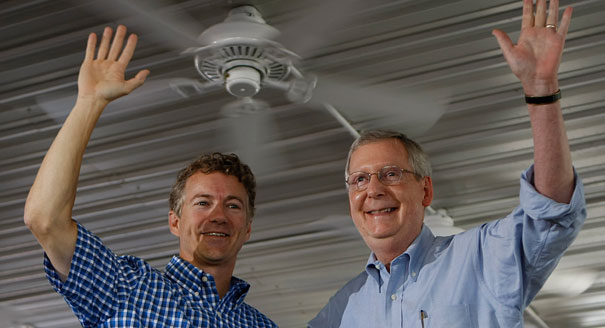
In the wake of the 2015 Charlestown tragedy, in which a Confederate flag-waving murderer united the nation against racism, all of the most powerful Kentucky policymakers — U.S. Senator Mitch McConnell, Governor Matt Bevin, Senate President Robert Stivers and House Speaker Greg Stumbo — called for the removal of the Davis statue from the Rotunda. Today, as we commemorate last night’s passing of Muhammad Ali, there is no better moment to replace the symbol of Kentucky’s worst era with a tribute to The Greatest of All Time.
UPDATE (Wednesday, June 8, 2016):
Great piece by Lawrence Smith of WDRB-TV in Louisville on the petition drive to replace Jefferson Davis’ statue in the Capitol Rotunda with a tribute to Muhammad Ali.
UPDATE (Thursday, June 9, 2016):
Excellent piece on the petition drive by Jack Brammer that was featured on the front page of the Lexington Herald-Leader.
Highlight of the article:
Miller said he has received a few “angry comments” on his call to honor Ali.
“One of them encouraged me to kill myself,” he said. “You can quote me that I have decided not to take their advice.”
UPDATE (Friday, June 10, 2016)
The petition drives continues to show the Big Mo(hammed): check out these stories from WKYU-FM public radio in Bowling Green and WKYT-TV, Channel 27 in Lexington:
UPDATE (Saturday, June 11, 2016):
Still not convinced? Check out this excerpt from today’s New York Times:
By Lauren Mayer, on Tue May 21, 2013 at 3:00 PM ET
Americans have always had a love-hate relationship with France. On the one hand, we use “french” as a positive adjective, applied to everything from kissing to toast, and we admire French cuisine and fashion. (I’ve always had this image of impeccably chic French women with a spartan wardrobe of 3 perfectly fitted sweaters, a pair of slacks, a pencil skirt, and 2 Hermes scarves, out of which they create 300 different, equally stunning outfits. As well as never getting fat despite enjoying daily champagne and truffles.) But we also use being French as a symbol of snobbery and effete-ness (remember how John Kerry was attacked during the 2004 election for speaking fluent French?, which was supposed to reflect everything that was wrong with his privileged background). And there was that unfortunate episode in 2003 when France’s refusal to participate in the Iraq war resulted in Congress renaming a familiar side dish – anyone remember “freedom fries”?
So France’s latest news will probably cause some mixed reactions, but I for one am thrilled that the country we associate with ooh la la and romance has now opened up official recognition of romance (i.e. marriage) to same sex couples. Sure, France is a largely Catholic country, but it’s also a place we associate with l’amour, toujours l’amour. (Madame Popejoy, my high school french teacher, would be proud of me, I didn’t even have to look up the spelling!)
Quick disclosure – I was actually born in France. (I have no french roots, but my dad was in the airforce about to be stationed in Labrador; he & mom had a whirlwind courtship and he swore the last thing he would do before he shipped out was to get her pregnant. And it was. So she went to France, where her parents were on sabbatical and which was at least a little closer to Labrador. So while I have no recollection of my 3 formative months in France, I have a soft spot for the country.) (And my parents checked, as a US citizen born in an Air Force Hospital, I could run for President. Of course, at the time they checked, Donald Trump wasn’t around. . . . )
Anyway, here’s this week’s song in celebration of France joining the increasingly large list of countries that have legalized same sex marriage:
We’ve all heard the saying, “It’s better to win the war, not the battle”. But what defines a battle, and what defines a war? When are you seen as wise, and when are you seen as a chicken? Better yet, as a female – which of your actions revere you respected, and regretfully, what of your behavior leaves the all too familiarized impression of being “hormonal”?
When I am mad, REALLY mad, I cry. I cry because I spend 50 percent of my day internalizing the raw emotion felt by others. That “responsibility” as I’d like to call it, leads me to subsequently ration it into specific places as to find a way to improve the entirety of the situation. I do not spend enough time thinking of myself…not even a small piece from the left over pie. Instead, I work diligently, compartmentalizing and structuring a plan that will result in enjoyable, elated coworkers leading to extremely profound results. So, when 50 percent of my time – time dedicated to a quiet, diligent effort to sustain a respectable, productive existence for those around me crumbles, well, I cry.
Crying is most always seen, regardless of sex, as weak (unless you are Jennifer Lawrence who literally burbs rainbows, Mathew McConaughey or in recent years, Justin Bieber). Crying is never depicted as a strong attribute. You can be winning battles and wars, slaying dragons, closing deals, negotiating people right out of their skin…but the only carnage you create that truly gets noticed is if you cry.
Yet, and I have no source to site or reference to footnote, I truly believe it is the strongest form of passion and compassion for one’s job that can truly be witnessed. Hand me a reason to care about my job, my co-workers, my bosses, the betterment of all and the betterment of those we serve – and guess what? From time to time, you will see me cry.
Give me a situation where I don’t care? Well, chances are, if I haven’t cried at least once – and publicly – I won’t be there long. If I find my tear ducts dry for too long, that is my signal: CODE BLUE! We have a problem. ABORT MISSION. This isn’t worth crying over.
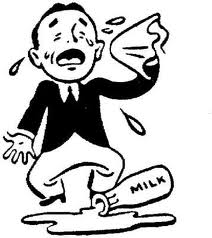
Why? Because there really is no use crying over spilled milk. And as a woman, I think I should know what’s worth a tear or two. If this makes me weak in the eyes of the many? Eh, so be it. I’m going to remain steadfast on this principal and work hard to command attention and gain respect one battle dissolved, one war won, one tear shed at a time.
By John Y. Brown III, on Tue May 21, 2013 at 12:00 PM ET
Me and all the things I can do with my second phone
I have a second phone. I use it as my back-up phone. For situations like when I lose my primary phone. I have my back-up, or secondary phone, to call my first phone and help me find it by hearing the ring.
Sometimes my main phone has fallen under my car seat. Sometimes I’ve slipped it into my laptop bag and forgotten where I put it. Other tim…es, I’ve placed it in my pocket or in the holster for my back-up phone. But the great thing about my back-up phone is that I don’t lose my main phone for long.
It helps me save time that way.
This past Sunday I lost my phone that morning. And found it quickly, of course. Just how I always do.
But later in the day, after a few phone calls, I noticed an unusual number that I had tried to call me earlier in the day. Not once, but twice!
Technology is great. I didn’t have to wonder “Who called me?” I could simply Google the number. After Google turned up no results, I went to a service called Spokeo. Spokeo helps you identify people based on a strange phone number. They don’t always get it right but they do have a pretty impressive record of past owners of that phone number.
I plugged in the strange number than had called me and up came a name I wasn’t familiar with —but it was a name. I had what appeared to be the current (or previous but recent) owner of the number.
After Googling the name and coming up empty handed, I went to Facebook and typed in the name. Bingo! There he was. Looking right at me. And we had 4 mutual friends. I looked at his business but didn’t recognize it. Then on the mutual friends to try to solve the purpose of this mystery caller. I sort of knew them but not well. I knew a little about one of their businesses but couldn’t figure out why they would be calling me.
I then looked at some of the mutual friends of the mutual friends for more clues, but nothing was jumping out at me. I looked through some pictures of their Facebook pages and finally realized I was going to have to cave in to my curiosity—and just call back the unrecognized number. I decided I would call and whoever answered, I would explain that I saw they had tried to call me earlier in the day and I am sorry I missed their call –and was calling now to see how I could help them. And ask, “And whom do I have the pleasure of talking to?”
I dialed the number, fearlessly, and waited for the ring.
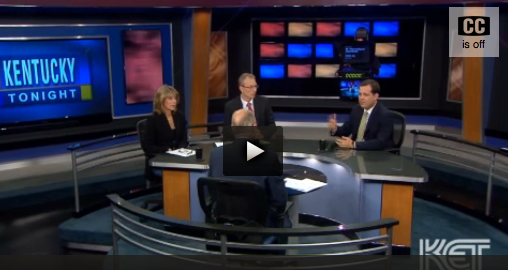
Last night, on Kentucky Educational Television’s “Kentucky Tonight,” Hall of Fame journalist Bill Goodman and his guests discuss the 2014 election. His guests included: Steve Robertson, chair of the Republican Party of Kentucky; Jonathan Miller, former chair of the Kentucky Democratic Party; Ellen Williams, former chair of the Republican Party of Kentucky; and Louisville Metro Councilman David Tandy, former treasurer for the Kentucky Democratic Party.
By Artur Davis, on Tue May 21, 2013 at 10:00 AM ET
No, the Obama Administration’s disaster of a week is not Watergate. Not unless Barack Obama is found scheming with his aides about how to pay “hush money” to witnesses. Not unless the foraging of journalists’ phone logs included eavesdropping with wiretaps. No unless revelations surface that Obama ordered a federal agency to shut down a criminal investigation, or that he skimmed campaign funds to build his own private network of thieves and vandals.
But this appalling seven days need not be Watergate to be something lethal and destructive of the public trust, a cascade of events that has hardened and validated the worst characterizations of this White House. The axiom on the political right that Obama’s presidency threatens constitutional freedom could seem overwrought when it was confined to insurance mandates and gun background checks. But from now on, the brief has just gotten appallingly straightforward: it sweeps in elements that are at the core of the First Amendment, in the form of the IRS digging into filers with the wrong politics, and into groups with an unapproved ideological agenda. The case that liberties are being violated—pirating the links between certain reporters and their sources for over two months, and in such an indiscriminate manner that close to a 100 working reporters might have been compromised—no longer seems to the media the stuff of right-wing paranoia.
The supposedly partisan charge that the Obama Administration was covering up details in the deaths of four Americans in Benghazi takes on more plausible colors when a diplomat describes the way he was beaten down by political appointees for asking hard questions. And the vague but toxic insinuation that high level negligence contributed to their deaths now has chilling specific details: one official’s account of a special operations rescue team being bluntly shut down when it was poised to strike, another’s description of an inter-office climate that minimized safety concerns about the American consulate as unseemly griping.
Obama has maddened his adversaries by only repeating his routine for handling public storms: indignation that his White House’s motives are questioned, and an implication that parts of the executive branch, in this case the IRS, are an island beyond his ability to influence. For his political acolytes, the effect is good righteous theater. Never mind the inconvenience that the IRS’ presidentially appointed leadership knew of political targeting, failed to stop it, and may have implicitly blessed it. Forget that the ugliness of his subordinates’ response to Benghazi is a picture supplied by members of his own government, not by his opponents but by professionals, people who until these events were trusted comrades of the appointees who ended up sacking or maligning them.
Read the rest of… Artur Davis: Obama’s Scandalous Seven Days in May
By Nancy Slotnick, on Tue May 21, 2013 at 8:30 AM ET
How POPS changed my life.
I am referring to Privately Owned Public Spaces, not those cupcakes on a stick that they sell at Starbucks. Those are just weird. Though they are only 170 calories and they’re darn cute. But I digress.
Public space changed my life the first time in ’99, when I met my husband on a street corner. Now it’s changing my business life—who knew that all one has to do is go out in public? I guess on some level I did.
As with most things in my crazy-sexy-cool life, I came upon the POPS serendipitously. [Disclaimer: Please note that my characterization of my life may be highly exaggerated given that I have an eight-year-old son, a pile of bills to pay, and an anxiety disorder. But at least on Tuesdays, I have a crazy-sexy-cool life.]
I was trying to find retail space in New York City for a potential Matchmaker Café site that would fit into my budget. My budget was a maximum of $0. A girl can dream. I came across the empty space in Lincoln Center, next to the Apple store, that used to be Ollie’s, and I noticed that it was empty and locked. I was walking down that block on a frigid winter Tuesday because it is the same block where my husband and I met on the street, incidentally. For those of you who believe in fate, this fact is significant.
I did a quick survey of the premises, knowing that the space had been a public space and having a gut feeling that it wasn’t supposed to be closed. I had no understanding of POPS or their legalities, but something seemed fishy. Thanks to the handy “Open to Public” POPS sign and to the magic of Google, I had the email address of Professor Jerold Kayden, within minutes. He literally wrote the book on the POPS. And within a few more minutes, he emailed me back!
So, short story long, we had a phone meeting and I was told that yes, it’s true, that POPS is not allowed to be closed. But no, in fact, I could not make a Matchmaker Café in that space for free, even if it is benefitting the public, because that would be commercialization of the space. I was crushed. But he invited me to his conference at Harvard to learn more about public space and its uses. It was a free conference. And my old stomping grounds. So I went. It was a crazy snow storm but I put on my Dickie’s coveralls that have a Matchmaker Café patch on them and I got on the train.
Read the rest of… Nancy Slotnick: How POPS Changed my Life
By Jonathan Miller, on Mon May 20, 2013 at 12:15 PM ET
With a vote for a hemp amendment to the Farm Bill possible THIS week, I urge you to contact your U.S. Senator NOW. Here’s a link with an easy way to contact them.
Great piece by The Huffington Post’s Ryan Grim which demonstrates the strange bedfellows who are pushing for hemp legalization, and reveals how close we really are.
Kentucky’s two senators, Republicans Rand Paul and Mitch McConnell, have been working to include a provision that would legalize industrial hemp into the farm bill, according to Senate and Kentucky sources, an effort that is likely to result in a floor vote on the issue this week.
Paul and McConnell had hoped to insert the measure into the farm bill as it was being considered by the Agriculture Committee, but a jurisdictional spat broke out, as often does in the Senate. McConnell, a member of the committee, approached Chairwoman Debbie Stabenow (D-Mich.) last Monday night about inserting the provision, according to Senate aides, and was told that the Judiciary Committee had jurisdiction and he would need a waiver from its chairman, Sen. Pat Leahy (D-Vt.). Hemp laws are the purview of the Drug Enforcement Administration, even though hemp is not a drug and has no psychoactive potential, no matter how much a person smokes.
McConnell faces reelection in 2014, and has been working so closely with Paul that some aides have begun to refer to the libertarian newcomer and tea party favorite as the “shadow minority leader” — a term that presumably expires if McConnell wins his race. McConnell brought Jesse Benton, a longtime aide of Rand Paul and Ron Paul, onto his campaign. With Rand Paul in his corner, there is little chance for a tea party candidate to successfully challenge McConnell, and Paul’s energized base may boost turnout in the general election. If McConnell’s effort on hemp is any guide, he’s taking nothing for granted.
McConnell approached Leahy to ask for the waiver, but was rejected, sources said. McConnell returned to Stabenow and again asked that she insert the provision, and Stabenow said no. She offered, instead, to allow a vote on an amendment, and said that she would introduce it on his behalf. (Minority leaders rarely appear at committee hearings in person.) McConnell declined the offer and by proxy voted against the farm bill in committee. Holly Harris, chief of staff to Kentucky Agriculture Commissioner James Comer, a strong hemp advocate, said that her office had been told by Senate Republican leadership that Leahy had refused the waiver request, citing Judiciary Committee turf, confirming what several Senate sources told HuffPost.
By John Y. Brown III, on Mon May 20, 2013 at 12:00 PM ET
I just failed to prove I am not a bot trying and failing repeatedly to sign in to LinkedIn after forgetting my password yet again.
I typed about 15 random combination of made up words and failed each time to read these sign-in word forms correctly. 15! This was not something I took lightly.
Which means….I suppose, that I am a bot!
Which does explain a few things about me I’ve never understood like being drawn to HAL’s voice in 2001 A Space Odyssey when I was just a child.
But doesn’t explain why I would be so eager to sign in to LinkedIn at this hour.
Maybe I’m a bot with a heart.
Or at least a bot with a networking gene that lives on despite my automaton ways.
It’s my own way of railing against the machine. I suppose. ; )
By Erica and Matt Chua, on Mon May 20, 2013 at 10:00 AM ET
Many people travel in search of a place. There is an idea among travelers, whether spoken or not, that one day they will come across a place so perfect they’ll lay down roots. Even among non-travelers there is an idea that there is somewhere that will feel the way home should. The people will like you, the scenery will inspire you, work won’t be work…in short, in the perfect place life will be perfect. The core of this idea is that a place can make us happy, not that we make a place happy. Couchsurfing in the Middle East showed me that it is up to us to make a place, a home, spending our energy making a life rather than trying to find one.
Having met and stayed with expats the world over, the people we met in Oman and UAE were different, they had made their lives there. Most of the young people we’ve met working abroad were abroad because they didn’t know what they wanted to do with their lives. We even met one person who moved to Asia because they clicked on a facebook ad promoting teaching opportunities. There is no discounting the amount of work that everyone teaching abroad must do, from visas to physically moving across the planet, but, in general, most of the young expats I met were abroad not because they knew what they wanted to do, rather they were there because they didn’t know what they wanted to do. At their worst they were killing time, at their best they were hoping to find themselves. In the UAE and Oman though, the people we met were dynamic, seizing the opportunity to live in a rapidly changing place, who were making a life abroad.
Read the rest of… Matt & Erica Chua: How to Make a Life Abroad
Time spent in the public sector as an accidental bureaucrat has made me a keen observer of how states and countries use tax incentives to attract and retain corporate investment and jobs. I have watched companies extract mind-boggling incentives from the taxpayer simply by either moving or threatening to move jobs across state and country borders. While tax incentives may be great for corporations they make little or no sense when viewed through a community lens. Corporate tax incentive deals are a terrible use of taxpayer dollars.
Communities everywhere have lost leverage to companies who now have all the buying power. Corporations have disaggregated their business models moving capabilities around the world like chess pieces. Companies are no longer dependent on a single location and force communities to bid against each other competing on who will offer the biggest tax breaks. Communities are treated like commodities. The pricing food fight is intense and all at the taxpayer’s expense. There is no net new value created when companies move activities and jobs from one community to another. Consider Captain Morgan & The Hobbit.
My favorite example of bad tax incentive deals gone crazy is the movie industry. Community leaders and politicians fall all over themselves to bring movie productions to their localities. It must be about having pictures taken with movie stars because it isn’t about the economics of the deals the movie studios cut playing communities against each other. The going discount to attract movie production in the U.S. ranges from 30 to 40% of the total production costs in the form of tax credits that can be sold to local taxpayers. I have reviewed several of these deals and can’t begin to make economic sense out of them for anyone other than the movie studio.
Read the rest of… Saul Kaplan: Captain Morgan & The Hobbit


 Blog this!