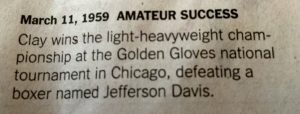
Please sign the petition below to remove the statue of Jefferson Davis currently in Kentucky’s Capitol Rotunda, and replace it with a tribute to Muhammad Ali, “the Louisville Lip” and “the Greatest of All Time.”
I just heard from the Ali family: It is the Champ’s belief that Islam prohibits three-dimensional representations of living Muslims. Accordingly, I have adjusted the petition to call for a two-dimensional representation of Ali (a portrait, picture or mural) in lieu of a statue.
UPDATE (Tuesday, December 2, 2014)
In this interview with WHAS-TV’s Joe Arnold, Governor Steve Beshear endorses the idea of honoring Muhammad Ali in the State Capitol (although he disagrees with removing Davis). Arnold explores the idea further on his weekly show, “The Powers that Be.”
Click here to check out WDRB-TV’s Lawrence Smith’s coverage of the story.
And here’s my op-ed in Ali’s hometown paper, the Louisville Courier-Journal.
UPDATE (Saturday, June 4, 2016)
In the wake of the 2015 Charlestown tragedy, in which a Confederate flag-waving murderer united the nation against racism, all of the most powerful Kentucky policymakers — U.S. Senator Mitch McConnell, Governor Matt Bevin, Senate President Robert Stivers and House Speaker Greg Stumbo — called for the removal of the Davis statue from the Rotunda. Today, as we commemorate last night’s passing of Muhammad Ali, there is no better moment to replace the symbol of Kentucky’s worst era with a tribute to The Greatest of All Time.
UPDATE (Wednesday, June 8, 2016):
Great piece by Lawrence Smith of WDRB-TV in Louisville on the petition drive to replace Jefferson Davis’ statue in the Capitol Rotunda with a tribute to Muhammad Ali.
UPDATE (Thursday, June 9, 2016):
Excellent piece on the petition drive by Jack Brammer that was featured on the front page of the Lexington Herald-Leader.
Highlight of the article:
Miller said he has received a few “angry comments” on his call to honor Ali.
“One of them encouraged me to kill myself,” he said. “You can quote me that I have decided not to take their advice.”
UPDATE (Friday, June 10, 2016)
The petition drives continues to show the Big Mo(hammed): check out these stories from WKYU-FM public radio in Bowling Green and WKYT-TV, Channel 27 in Lexington:
UPDATE (Saturday, June 11, 2016):
Still not convinced? Check out this excerpt from today’s New York Times:
I’m not going to lie, the term POWER SUIT makes me cringe a bit. Yes, the right suit can help you look powerful, at least if it fits you perfectly, but just donning a suit does not by itself do the job. There are other pieces to the puzzle. So if you’re going into a situation where you want people to sit up and take notice when you walk in, read on for 4 easy tips on how to manage your appearance.
1) Straight lines and angles in patterns and clothing silhouettes signal authority. An easy way to apply the former is with ties: the tie above left is much stronger because of its angularity than the tie to the right with its curved lines. For silhouettes, you can see this everywhere from glasses, to suits, to sport jackets (if you wear glasses, my article on how to choose glasses frames is a must-read). For example, a squared-off jacket shoulder is more commanding than a soft shoulder.
Read the rest of… Julie Rath: What’s Your Power Suit?
By John Y. Brown III, on Thu Oct 24, 2013 at 12:00 PM ET
An important PSA (public service announcent)
It has been nearly three years since my unfortunate incident at Speedway where I was so absent-minded I left the gas pump in the gas tank and tried to pull away before the pump pulled out loudly and flapped around. No gas sprayed but it created a hard to explain spectacle before the manager kindly waived me away in a manner that said “Just please go to Thorton’s next time you need to fill up.”
And yet three long years later –without incident–every time I get gas I relive this fear as I start to pull away.
Call it PTSDFLGPIGTADO (Post traumatic stress disorder from leaving gas pump in gas tank and driving off).
It is real. And, frankly, the acronym sounds even worse than I expected.
So, please, when you get gas, replace the gas pump before driving off. For the station owner. And for your own mental health.
Through our 12 Steps we have come to find out how confusing fitness can be. Just the act of working out and changing our nutrition can be enough to scare people away. Compound that with going to find a gym and it can overwhelming. For the majority of my fitness career I have spent time training and working in commercial gyms. I know a thing of 12 about picking the right place. Here are 12 Steps to help you decide on the right place for you to work out.
1. Know what you are looking for Have your goal (s) and your why in mind when shopping for a gym. Do not join a CrossFit gym if your goal isn’t high intensity, advanced workouts. Your goal and why will help you make a decision.
2. Ask friends and family Ask the people closest to you about their experiences with gyms. This can give you a good gage on where to look at and where not too.
3. Look at the Internet and Social Media We live in an era where nothing is a secret and everyone markets like they are going out of business. Check websites of the gyms you are thinking about joining. The bigger gyms will let you join online which can be a plus not having to deal with sales people. Also, look for gyms that promote successes of their members. This shows they care about the people inside their walls.
4. Search reviews I have vast experience with negative reviews in the fitness industry in places I have worked. In fact you will be hard pressed to find any company that does not have more negative reviews than positive. However, look for the positive reviews from current and former members and take some of the negative with a grain of salt.
5. Location, location, location In most cases, not all, we would like a place that is convenient to get too. If its easy to get too we are more likely to go.
6. Find a gym you feel the most comfortable At first, any gym can seem intimidating. However, it’s important you feel welcomed and comfortable in your surroundings. If you are having a hard time deciding possibly get a guest pass and go workout a few times or try a class. This may help in aiding your decision.
7. Know your budget Know what you are willing to spend before you go. The sales team’s job is to sell memberships and some clubs will try to take advantage of someone who has never purchased a membership before. Stick to your budget.
8. Know your commitment The gym industry has changed, allowing month-to-month contracts for easy access to people. However, if you chose to sign a contract know your commitment level. 80% of all gym memberships go unused after three months. Do not let this be you.
9. Ask the membership guys for success stories Ask them for proof behind their product. If they can’t show you one, run away.
10. Look at the trainers and front desk I know this better than most, the trainers and front desk staff are the gyms face. If they do not look happy, chances are you won’t be happy as a member.
11. Cleanliness If the gym isn’t clean and the weights are not racked, chances are it always looks this way.
12. Do not buy a membership because of the pool Unless you plan on being in the pool a lot, do not make a buying decision based upon the pool. It is the most unused thing in any gym.
There are more options now than ever before in regards to gym memberships. Choose wisely, read what you sign, and pick somewhere you’ll be comfortable and enjoy.
By John Y. Brown III, on Wed Oct 23, 2013 at 12:00 PM ET
The American Basketball Association was in some ways more about what it means to be an American than it was about basketball. It had nothing to do with Associations. That was just an unfortunate name borrowed by copying the NBA’s final initial. But it had everything to do with thinking the unthinkable. And then trying the impossible. Just because we can. And not caring what others said or did.
Thanks to David Vance and my mother for forwarding this video clip to me just now.
Put it this way. This is an HBO special for “dreamers.” Make that “Dreamers” with a capital “D.”
Not for the keepers of the status quo ante….or defenders of the way things have always been done. And certainly not for those threatened by those who dare to ask, “Is there a better way?” –and greet such impudence with sneers and nervous laughter.
It’s not for any of them. (Watch Red Auerbach late in the show try to dismiss the ABA as a curious asterisk in basketball history and failed misadventure propped up briefly due only to the presence of Dr J….As another well-quoted dreamer would say, “The lady doth protest too much.”)
And yet….and yet….
No professional sports experiment I can think of is a greater reflection of the entrepreneurial mind and (more important) entrepreneurial spirit than the creation of the American Basketball Association. It is –was–a uniquely American experiment. If there had been a movie about the ABA it would have been a mirror image of Tucker: The Man and His Dream. But there wasn’t. But there is this archived HBO special.
And because history is written by the victors, in the lofty chambers of those who retell basketball history from on high, the ABA was merely something of a curious asterisk to the NBA.
But for those of us who lived closer to it and had no vested interest in rewriting basketball history and, yes, were ourselves cast under the spell of the ABA dreamers, well….we know better. We not only dreamed but saw and believed and eventually knew. We learned as a matter of course as an ABA fan that the impossible was possible. And even for a few moments could be sublime. And that has never left us.
And although we still have no vested interest in rewriting basketball history, we know that no other basketball innovation changed the game more (and for the better) than did a little dream that germinated in a few small cities like Louisville, KY nearly 50 years ago.
We won’t ever get the respect we deserve. History doesn’t work like that. But we have something even better. The memories of some of the greatest basketball ever played on our planet–and played with creative abandon because, as Bob Costas said, “We had nothing to lose.” And today we can take quiet pride in seeing the stodgy long shadow of tradition of the NBA has been replaced by the sunlight of what we know was someone else’s impossible dream. And we saw it first. And proudly cheered it along.
By Artur Davis, on Wed Oct 23, 2013 at 10:00 AM ET
In one rosy scenario, the self destructive streak of Ted Cruz and House Republicans burns out without a default, with Barack Obama incurring his share of the national disgust, and with the public’s frustration over the Affordable Care Act eventually cancelling out memories of the shutdown itself. And in that same optimal place, Republicans absorb their lessons with something like the synthesis that Ross Douthat writes about in his Sunday column:
“..Republicans need to seek a kind of integration, which embraces the positive aspects of the new populism—its hostility to K Street and Wall Street, its relative openness to policy innovation, its desire to speak on behalf of Middle America and the middle class—while tempering its [nihilistic] streak with prudence, realism, and savoir-fare.”
As good as Douthat has been in outlining during the last few weeks why the shutdown strategy is painfully flawed, from even a right-leaning perspective, he is engaging in his own bit of wishful thinking about the lines of a Republican comeback and its worth taking some space to say why. First, as I suggested in my last column, the shutdown is best understood not as some bridge too far from the populism he describes but a pretty natural outgrowth of it. The reality is that the right’s populism has had a consistent unifying principle since the spring of 2009: it is that the federal government is posing an unprecedented threat to liberty, and that it presents an existential danger to a particular ideal of American society. That apocalyptic claim has played out in any number of contexts, from suspicions about Barack Obama’s citizenship, to cries of socialized medicine, to the painting of liberalism as a subversive scheme. It’s not the sort of rhetorical tendency that distinguishes between programs based on their relative effectiveness or which weeds out obtainable goals from unrealistic ones. It’s absolutely a worldview that has made any approach to Obamacare other than all out obstruction or resistance seem like unprincipled softness.
Is there a middle class friendly legislative vision waiting to burst of all that anti government zeal? Not so far at the grassroots level, and not inside the rarified air of various conservative conferences. And as Bobby Jindal’s swift fade from prominence since last winter, and Marco Rubio’s slippage from “can’t miss” status to the mid tier of 2016 contenders indicate, the more potent currency in conservative settings has not been an appeal to more policy creativity or substantive rebranding on issues like immigration, but the fundamentalism offered by Rand Paul and Ted Cruz: and as Douthat himself has pointed out, their message is either decidedly vague on details (Cruz) or a rehash of conventional top heavy tax cut plans that shortchange the middle class (Paul).
The “integration” between populism and reform that Douthat pines for is not a fantasy: the conservative populism of the Obama era has opened a window to the alienation downscale whites felt through the last decade of American politics, when Bush Republicans seemed indifferent to wage stagnation and Obama Democrats seemed incapable of reversing the erosion of working class security. But the right’s most conspicuous rising stars have expended virtually no capital on building or selling any type of actual policy framework to activists: even a conservative with an authentic record of engaging topics like inner city poverty and educational inequality, Ben Carson, has seen fit to downplay that history in favor of diatribes equating slavery with Obamacare.
I’ve written that the populist right’s tilt toward radicalism isn’t likely to be self-correcting and requires a much more forceful counter-argument from the center right. And unlike Douthat, I have become skeptical that it is a simple matter of a candidate with “movement credibility” combining the right’s passions with a more tenable market oriented reform vision. The more plausible fact may well be that a reform vision is temperamentally and substantively at odds with right wing populism’s intense distrust of public institutions. Breaking through that tension might not be a pipe dream, but it is hard to imagine without a sustained case about what public (and conservative) purposes can legitimately be accomplished through government.
And without question, the kind of accommodation and outreach that builds coalitions is discredited when conflict has been over-dramatized into a clash between freedom and darker impulses. Is the antidote what Douthat describes as declaring war on the GOP base? Not at all, but given the base’s demonstrated inability to strengthen the party’s electability, there is a distinct need to challenge that base’s grip on the meaning of conservatism and its monopoly on defining legitimacy within the party. I’ve come to the mindset that the challenge will require more toughness than politeness.
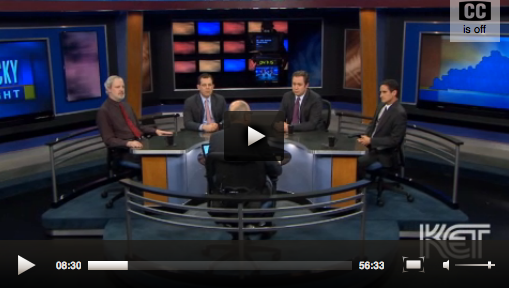
Last night, Kentucky hall of fame journalist Bill Goodman and his guests on “Kentucky Tonight” discussed the federal budget and debt ceiling. Scheduled guests: Jonathan Miller, former Kentucky state treasurer and former chair of the Kentucky Democratic Party; Brad Cummings, former chair of the Jefferson County Republican Party; John Heyrman, political science professor at Berea College; and Stephen Voss, political science professor at the University of Kentucky.
By John Y. Brown III, on Tue Oct 22, 2013 at 3:00 PM ET
Click here to BUY MY BOOK!
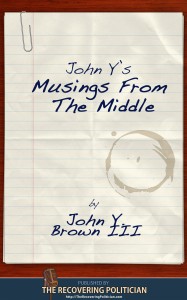
Two of my favorite books are The Bible and Musings from the Middle.
You are probably saying to yourself, “John, I know you wrote one of those books, right?”
Well, yes. I sure did. And thanks for remembering. (It was the latter book, of course.)
Now, I am not saying that the two books have anything even remotely in common. They don’t.
Is Musings from the Middle a great book? No. An important book? No. Not at all. A well written book? Not really. A good book? Not if you are sober while reading it. Is it even an insignificant book (as opposed to a book completely devoid of any substance)? Arguably but it is a very weak argument and, frankly, more of a frivolous musing.
But here’s the thing. The Bible has, I believe, 66 Books. And at times can get a little heavy trodding reading it. Wouldn’t it have helped to have had an extra book –just one–called “Musings?” If for no other reason just to break things up a little?
Maybe “Musings from Mathusula.” He lived a long time and would have had lots to muse about.
Imagine kids learning the books of the Bible. “Genesis, Exodus, Leviticus, Musings, Numbers, Joshua, Judges, Ruth.” It just flows, doesn’t it? OK, maybe not the first time you read it but conceivably it could grow on you over time.
Granted it is impossible to compete with Genesis and Exodus but most Biblical scholars would surely agree we could all use a mental break and a few laughs after Leviticus and before plowing into Numbers.
The Book of Musings wouldn’t teach anything. Just serve as a kind of a palette cleanser.
Well, an extra book of the Bible titled Musings is not going to happen. But you can still get the book Musings from the Middle, albeit completely separate from the Bible. And that is unfortunately probably the only way it will ever be sold.
And even though it wasn’t written by Mathusela people tell me I have Mathusula’s sense of humor.
Not really. I just made that up. But it is already a shameless sales pitch, so why not throw that in. Mostly I am just trying to get my sales rank on Amazon.com higher than 2000 times Mathusela’s age and figured since the Bible is selling so well…..
By John Y. Brown III, on Tue Oct 22, 2013 at 12:00 PM ET
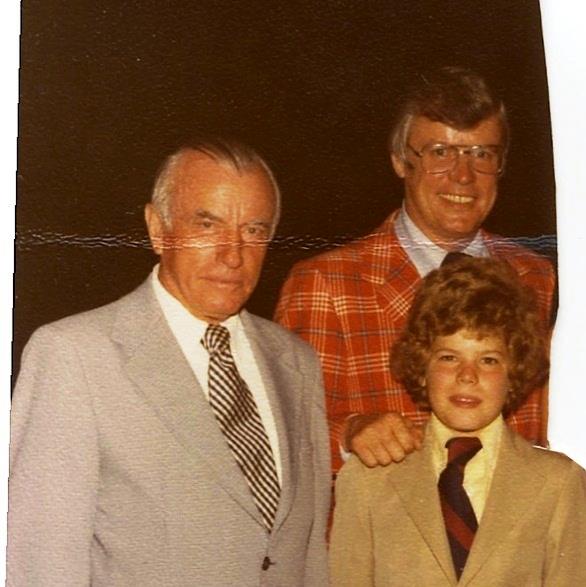
JYB Sr., JYB Jr. and JYB III circa 1972
My grandfather Brown was (and still is –posthumously 28 years later) the family patriarch. And for pretty good reason. He was very disciplined, accomplished, learned, pulled himself from poverty as the son of a tenant farmer to achieve renown as a trial lawyer and being in debt like most well-to-do people, and –most of all–was a character with a seeming limitless number of memorable stories about him. Many of them true.
A story my mother liked to tell about him was when she had just married my father she sat in on one of his biggest trials that year. It was a packed courtroom and when a crucial piece of evidence was admitted against his client, my grandfather said, “Judge, that is inadmissible according to KRE 802 (11).” This impressed everyone attending with his encyclopaedic memory of the rules of evidence.
Afterwards, my mom asked him, “Mr Brown, do you really know what KRE 802 (11) says?” And my grandfather responded, “No, honey. But neither does the judge.”
Love that story. Even if it isn’t true or entirely true. As Mark Twain said,
“Never let the truth get in the way of a good story.”
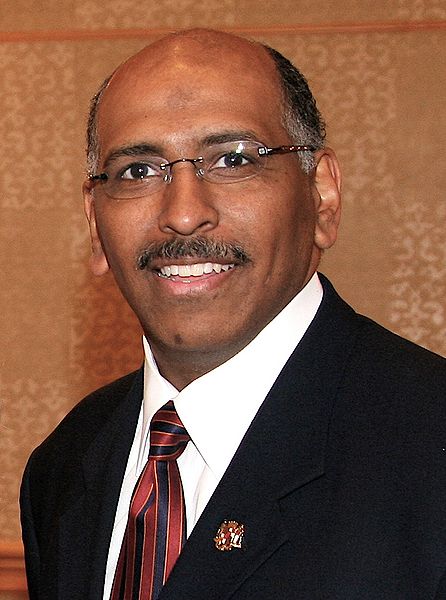
By Michael Steele, on Tue Oct 22, 2013 at 10:00 AM ET
Look ma, no federal government!
At some point the entire BS that is the government shutdown sinks in and we have to deal with reality: We have elected a bunch of children to run our government.
One reality that must not change about America and the free enterprise economy is that the root of America’s success has always sprung out of the hard labor of its entrepreneurs: the men and women who risk it all on a dream. Government doesn’t do that; government can’t do that. When a job is created by a small business owner they make an investment in people in a way that government can’t match. So when those same business owners have legitimate concerns about government policies that affect them, elected officials must listen in order to preserve the conditions that allow small businesses to thrive.
The fact that politicians in Washington have lost sight of that tells me we can longer trust them to do this by themselves. Each one of us must be prepared to help set the nation’s priorities for the immediate future. We must decide what price we’re prepared to pay for a strong national defense and better schools; how much are we truly ready to spend for our children’s healthcare and to secure our nation’s borders? Which programs are we prepared to cut in order to get our financial house in order, and by how much? While these are difficult questions, they are not either/or choices, but rather complementary opportunities.
The White House and the Congress need to take a time out from the silliness of politics and the drama of blaming one or the other for shutting down the government—both political parties, the White House and Congress are to blame. Stupid lives at both ends of Pennsylvania Avenue in this mess.
Read the rest of… Michael Steele: We Have Elected a Bunch of Children to Run Our Government



 Blog this!